Mechanical vs Chemical Hair Damage: Mechanisms, Signs, and Management
9 min read ·
Explore Mechanical vs Chemical Hair Damage: discover how physical friction and chemical processing degrade the hair shaft and how to treat breakage.
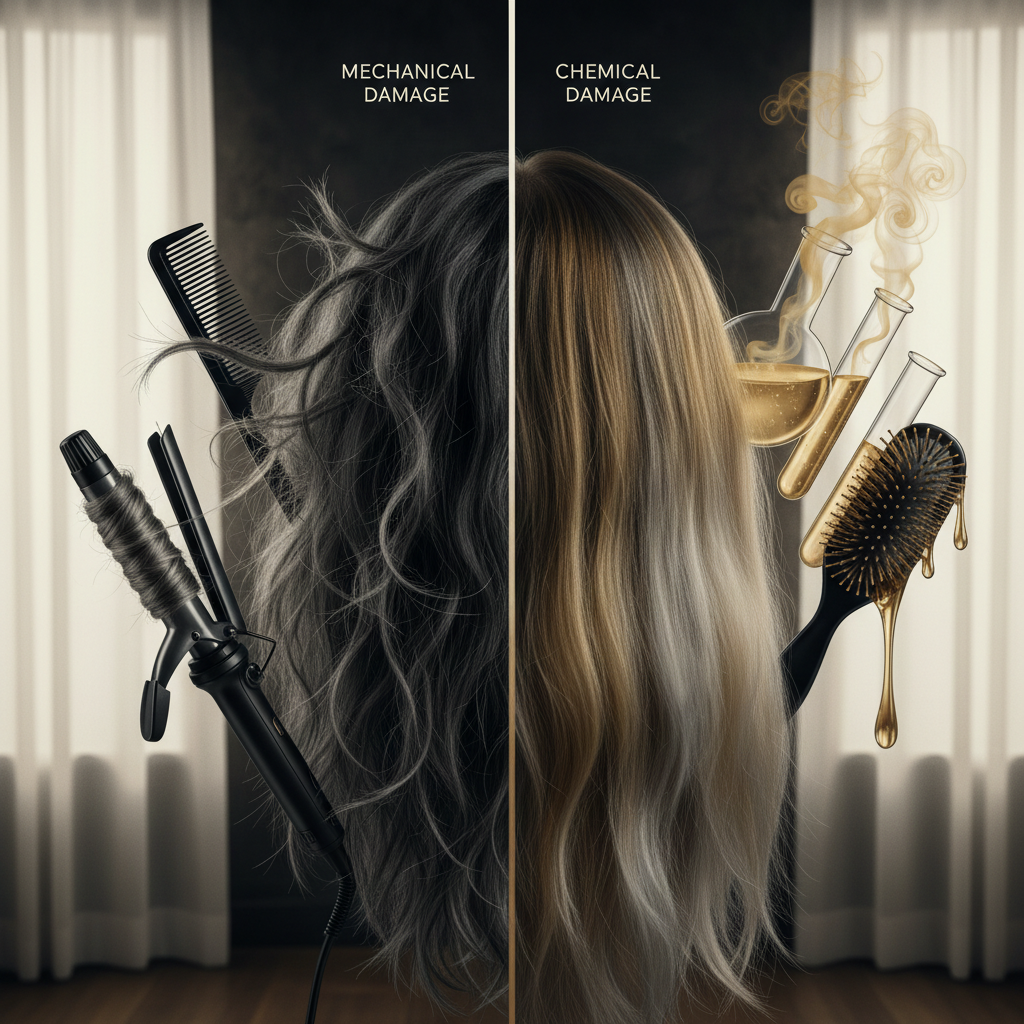
Quick answer: Understanding Mechanical vs Chemical Hair Damage comes down to friction versus molecular alteration. Mechanical damage occurs when physical forces such as aggressive brushing, friction from fabrics, or tight elastic bands strip the outer cuticle scales and fracture the fibre. Chemical damage happens when alkaline agents, bleaches, or permanent dyes break internal disulphide bonds within the cortex and strip protective surface lipids. While neither directly causes follicular hair loss, both cause significant shaft breakage that requires distinct preventive and restorative approaches.
Key takeaways
- Mechanical damage is driven by physical friction, tension, and abrasion, primarily chipping away the protective cuticle layer from the outside in.
- Chemical damage alters the internal molecular architecture of the cortex by breaking disulphide bonds and stripping 18-methyleicosanoic acid (18-MEA), the hair fibre's natural hydrophobic lipid barrier.
- Breakage from physical friction often produces jagged, splintered ends (trichorrhexis nodosa), whereas chemical over-processing results in gummy, hyper-elastic fibres that snap when wet.
- Neither form of damage represents true hair loss or follicular shedding; both refer strictly to structural breakage along the non-living hair shaft.
- While you cannot permanently repair severed keratin bonds or regenerate lost cuticle scales, targeted cosmetic conditioning, bond-building formulations, and tension-reduction habits can prevent further fibre failure.
Mechanical vs Chemical Hair Damage: what the evidence shows
The distinction between Mechanical vs Chemical Hair Damage rests entirely on where and how the hair shaft is compromised. Human hair is a composite material: an outer protective sheath called the cuticle surrounds an inner structural core known as the cortex, which provides tensile strength and elasticity.
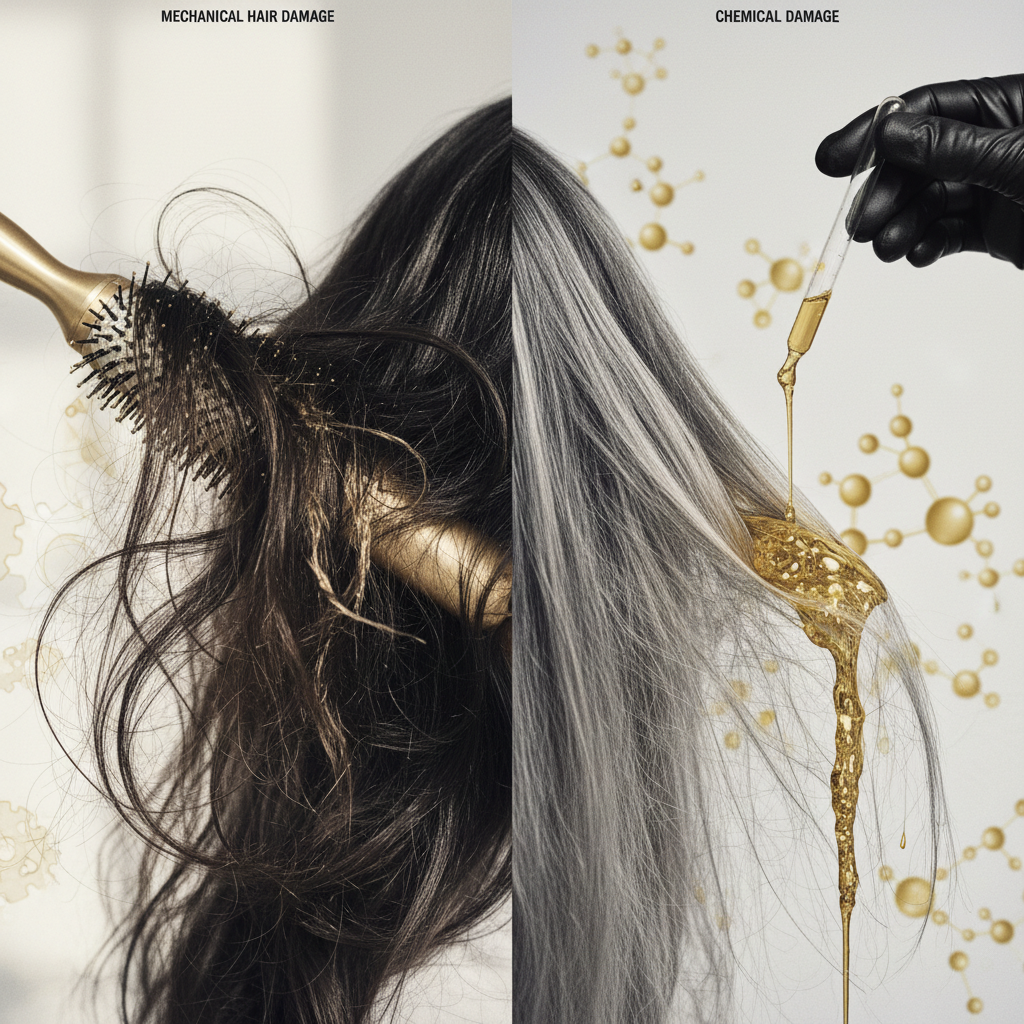
Mechanical damage is an external, surface-first phenomenon. When you brush wet hair, sleep on rough cotton pillowcases, or secure ponytails with uncovered rubber bands, physical shear stress acts on the cuticle scales. Repeated friction lifts these shingle-like cells, leading to chipped edges, longitudinal fissuring, and eventual cuticle loss. Research published in the Journal of Cosmetic Science shows that wet hair exhibits higher friction coefficients and lower tensile strength than dry hair, making vigorous detangling especially destructive. Once the cuticle is worn away, the exposed cortex frays, producing classic split ends (trichoptilosis).
Chemical damage, by contrast, targets the inner fibre from within. Bleaches, permanent hair colours, perms, and chemical relaxers operate at high pH levels (often between pH 9.0 and 11.0) to swell the shaft and force open the cuticle. Once inside, oxidising agents degrade cystine, the sulphur-rich amino acid that forms covalent disulphide bonds. The International Journal of Trichology notes that chemical bleaching can destroy a substantial proportion of disulphide linkages, converting them into cysteic acid. Concurrently, chemical processing strips away the f-layer, a microscopic layer of 18-methyleicosanoic acid (18-MEA) that makes virgin hair naturally water-repellent. Without 18-MEA, hair becomes porous, hydrophilic, and chronically vulnerable to environmental moisture swings.
| Feature | Mechanical Damage | Chemical Damage |
|---|---|---|
| Primary Site of Injury | Outer cuticle scales and epicuticle | Internal cortex disulphide bonds and 18-MEA lipid layer |
| Common Causes | Brushing wet hair, backcombing, rough towels, tight elastics | Bleaching, permanent hair colouring, chemical relaxers, perm solutions |
| Fibre Behaviour When Wet | Weakened, but maintains normal stretch-and-rebound limits | Gummy, mushy, hyper-elastic; stretches abnormally before snapping |
| Microscopic Appearance | Chipped, cracked, or peeled cuticles; splintered ends | Swollen, hollowed, porous cortex with widespread cuticle dissolution |
| Surface Feel | Rough, snaggy, prone to friction knots | Straw-like when dry, porous, matte, excessively tangly |
| Corrective Focus | Lubrication, slip agents, protective styling, gentle detangling tools | Protein replenishment, bond builders, pH-balancing acid rinses, lipid mimics |
What the evidence does not show
Controlled cosmetic research does not show that hair products can permanently fuse severed split ends or regenerate dead keratin tissue. Hair is biologically dead once it emerges from the scalp. Products marketed as "bond builders" or "cuticle sealers" provide temporary chemical reinforcement or hydrophobic coatings; they do not bring dead cells back to life.
Furthermore, the evidence does not show that chemical or mechanical damage causes medical hair loss conditions like androgenetic alopecia or telogen effluvium. When people notice their ponytail feeling thinner after extensive bleaching or aggressive detangling, they are usually observing shaft breakage near the roots, not an inhibition of the hair follicle itself. The only notable exception is mechanical traction alopecia, where constant, prolonged mechanical pulling physically damages the follicle over time.
How the mechanisms degrade the hair fibre
To understand fibre degradation, look at the physical physics of the hair shaft under stress.
Mechanical degradation accelerates exponentially when hair is wet. Water molecules penetrate the cortex, breaking temporary hydrogen bonds and allowing the keratin chains to stretch by up to 30 percent beyond their dry length without breaking. However, this elasticity comes at a cost: the cuticle cells soften, and the force required to peel them off via abrasive brushing drops dramatically. Each stroke of a stiff bristle exerts shear force against the edges of these swollen scales. Over months, complete patches of cuticle are abraded away, leaving bare patches of cortical fibres that split under normal movement.
Chemical degradation alters the electrostatic charge of the fibre. Virgin hair has an isoelectric point around pH 3.67; at neutral or basic pH levels, the hair surface carries a negative charge. Alkaline chemical treatments dramatically amplify this negative charge while breaking covalent disulphide cross-links. The loss of disulphide bonds reduces the wet tensile modulus, meaning the hair requires far less physical pull to deform permanently. Simultaneously, the destruction of the 18-MEA lipid layer leaves the hair hydrophilic. The fibre absorbs ambient water rapidly, leading to constant swelling and deswelling (hygral fatigue) that destabilises the inner protein matrix.
Recognising the signs in your hair
Identifying whether your symptoms stem from mechanical or chemical distress helps you choose the correct intervention.
Signs of mechanical damage include:
- White dots along the hair shaft (trichorrhexis nodosa), marking points where the internal cortex has collapsed due to physical trauma.
- Split ends that appear clean, forked, or branched like a tree, while the mid-lengths feel relatively intact.
- Short, broken hairs concentrated around the crown, hairline, or nape where hair ties, friction from collars, or tight clips rest.
- Excessive snapping during brushing or towel-drying.
Signs of chemical damage include:
- Hair that feels noticeably gummy, limp, or sponge-like when saturated with water in the shower.
- Hair that stretches out like chewing gum when wet and fails to snap back to its original length.
- Extreme surface roughness accompanied by rapid moisture loss; the hair dries unusually fast yet feels brittle and parched.
- Sudden, widespread breakage occurring evenly across treated sections rather than isolated friction points.
Practical steps to prevent and manage damage
Because hair cannot self-heal, prevention and mitigation are your most effective strategies.
For mechanical protection:
- Never detangle soaking wet hair with fine-toothed combs or stiff-bristled brushes. Use a wide-toothed comb or a flexible wet brush, starting from the ends and moving upward.
- Swap cotton bath towels for microfibre wraps or soft cotton T-shirts. Blot gently; never rub hair vigorously.
- Switch to silk or satin pillowcases to lower the friction coefficient between your hair and bed linen during sleep.
- Use seamless hair ties, silk scrunchies, or spiral bands rather than uncovered elastic bands that saw into the cuticle.
For chemical mitigation:
- Respect processing limits. Never apply high-volume bleach over previously bleached fibres.
- Integrate acidic leave-in formulations (pH 4.5 to 5.5) after chemical services to help contract the hair shaft and lower cuticle flare.
- Use amino-acid or hydrolysed-protein conditioning agents to temporarily fill voids in the porous cortex.
- Space out permanent colour or chemical services by at least 8 to 10 weeks to minimise cumulative structural fatigue.
When breakage indicates a different underlying issue
Sometimes excessive fibre snapping is not purely a result of Mechanical vs Chemical Hair Damage. Systemic health factors can alter the quality of the keratin produced by the hair follicle before the fibre even emerges:
- Nutritional deficiencies: Inadequate intake of dietary protein, iron (ferritin), or zinc can impair keratin synthesis, producing a structurally fragile fibre that breaks under minimal mechanical force.
- Thyroid disorders: Hypothyroidism often leads to dry, brittle hair shafts that mimic severe chemical over-processing even in untreated hair.
- Genetic structural disorders: Conditions such as monilethrix (beaded hair) or trichorrhexis invaginata (bamboo hair) cause genetic weaknesses along the shaft, causing profound breakage from gentle handling.
If you notice unexplained breakage alongside scalp redness, scaling, patchiness, or diffuse thinning that originates directly from the scalp, consult a qualified trichologist or dermatologist for a clinical assessment.
Supporting fibre resilience with Watermans
When managing damaged hair, cosmetic care must focus on supporting a healthy scalp environment while delivering moisture and surface slip to fragile fibres. Watermans offers formulations developed to nurture hair condition from base to tip. The Watermans GrowMe Shampoo and ConditionMe Conditioner system combines ingredients such as biotin, rosemary extract, caffeine, and hydrolysed lupin protein. While shampoo cannot undo severed disulphide bonds, the slip provided by a well-balanced conditioner reduces the mechanical friction generated during daily detangling, helping keep stressed, fragile lengths intact.
Frequently asked questions about Mechanical vs Chemical Hair Damage
Which is worse: mechanical or chemical damage?
Chemical damage is generally more severe because it permanently destroys internal disulphide bonds and strips 18-MEA lipids, altering the fibre's core architecture. Mechanical damage is primarily a surface issue, though severe friction can eventually lead to complete structural breakage if left unchecked.
Can damaged hair bonds be repaired naturally?
No, broken disulphide bonds do not regenerate on their own. The hair shaft contains no living cells to produce new proteins. Cosmetic bond builders can create temporary synthetic bridges between damaged amino acid chains, but the only permanent solution for heavily compromised ends is trimming them away.
How does wet hair influence Mechanical vs Chemical Hair Damage?
Wet hair is uniquely vulnerable to both forms of trauma. Water disrupts hydrogen bonds, lowering tensile strength and making the cuticle soft. When chemically damaged hair becomes wet, its compromised internal network loses elasticity, making it exceptionally prone to severe mechanical snapping during ordinary brushing or towel drying.
Does mechanical damage lead to permanent hair loss?
Standard mechanical damage causes shaft breakage, which does not affect the follicle or stop hair growth. However, chronic, high-tension hairstyles (such as tight braids, weaves, or tight ponytails) can cause traction alopecia. Over time, that chronic pulling can inflame follicles and lead to permanent loss.
Can deep conditioning reverse chemical processing?
Deep conditioning treatments cannot reverse the structural changes caused by chemical processing. They work by depositing silicones, fatty alcohols, and hydrolysed proteins onto and slightly within the porous shaft. This temporarily smooths the cuticle, reduces porosity, and restores moisture retention until washed out.
Summary
Distinguishing Mechanical vs Chemical Hair Damage gives you the knowledge needed to adjust your daily styling routines and product selections. Mechanical damage chips away the cuticle through physical abrasion and tension, while chemical processing breaks internal disulphide bonds and removes essential surface lipids. By combining friction-reducing habits with targeted protein and conditioning care, you can shield vulnerable fibres from structural failure and maintain healthier-looking hair.
Sources and references
- Journal of Cosmetic Science: "The effect of chemical and physical damage on hair properties," 2009.
- International Journal of Trichology: "Hair cosmetics: An overview," 2015.
- British Journal of Dermatology: "Structural changes in human hair induced by chemical treatments," 2012.
- Robbins, C. R.: Chemical and Physical Behavior of Human Hair, 5th Edition, Springer, 2012.
- National Health Service (NHS): "Hair loss causes and treatments," 2023.
Find these ingredients in Watermans products
- Zinc: you will find this ingredient in our Hair Vitamins.