Male Pattern Baldness Stages: The Norwood Scale Explained
9 min read ·
Explore the Male Pattern Baldness Stages using the Hamilton-Norwood scale. Learn how DHT drives progression, how to spot early signs, and what treatments work.

Quick answer: The Male Pattern Baldness Stages refer to the progressive phases of androgenetic alopecia classified under the Hamilton-Norwood scale, running from Stage 1 (minimal recession) to Stage 7 (severe loss leaving only a peripheral rim). Male Pattern Baldness Stages track follicular miniaturisation driven by genetics and dihydrotestosterone (DHT). The main limitation is that the scale describes pattern and surface area rather than rate of progression, and it cannot predict how quickly an individual will move between stages.
Key takeaways
- The standard clinical classification uses the Hamilton-Norwood scale, dividing progression into seven distinct phases.
- Early stages involve slight temporal recession, while intermediate stages see vertex (crown) thinning that eventually merges with frontal loss.
- Androgenetic alopecia is progressive, driven by the conversion of testosterone into dihydrotestosterone (DHT) in genetically sensitive follicles.
- Shedding differs from miniaturisation: pattern hair loss produces finer, shorter hair shafts over successive cycles rather than sudden mass shedding.
- Interventions are far more effective at arresting progression in early stages than at restoring follicles in advanced, fibrotic areas.
Male Pattern Baldness Stages: what the evidence shows
The clinical evaluation of androgenetic alopecia relies heavily on classification systems developed to measure hair thinning patterns. Dr James Hamilton first established a categorical framework in 1951, which Dr O'Tar Norwood subsequently revised and expanded in 1975. This system, known as the Hamilton-Norwood scale, defines the recognized Male Pattern Baldness Stages through seven numbered categories and several variants.
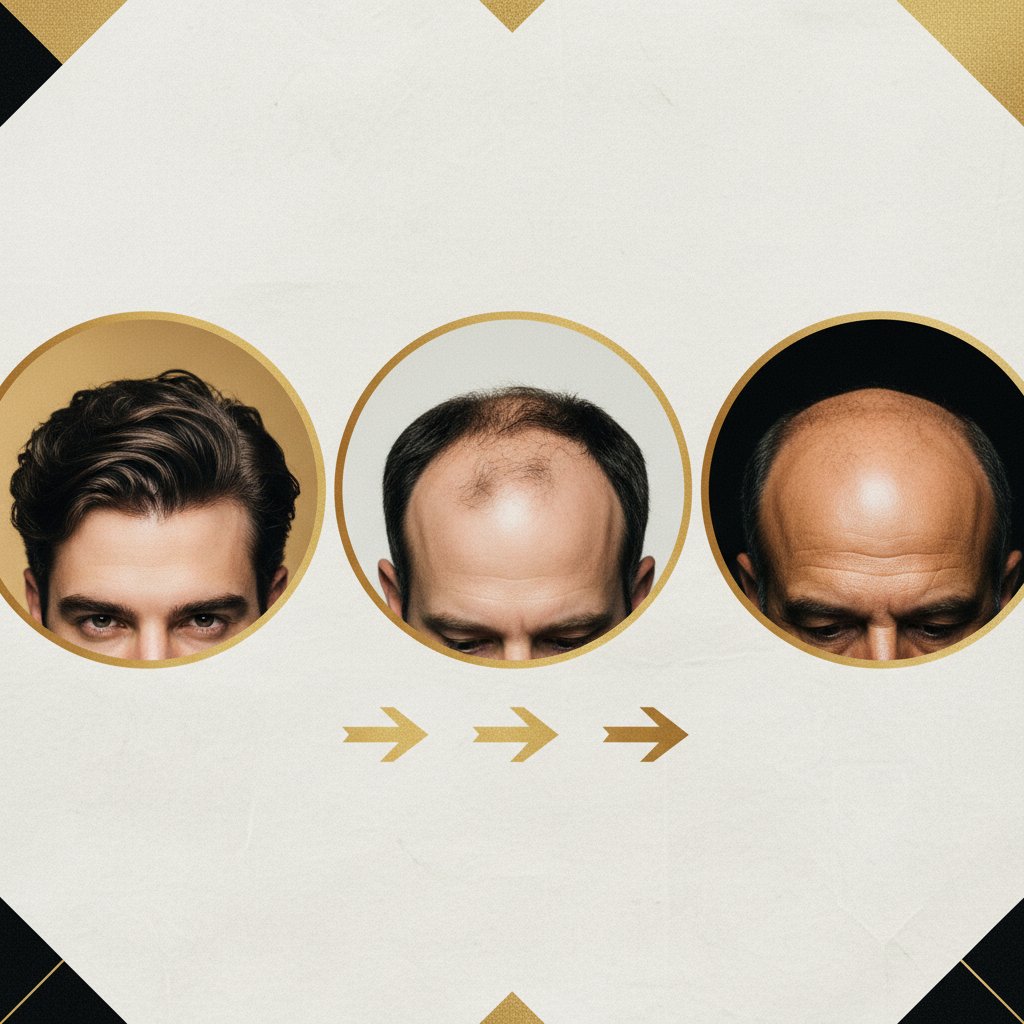
Stage 1 -> Stage 2 -> Stage 3 (Frontal/Vertex) -> Stage 4 -> Stage 5 -> Stage 6 -> Stage 7
Stage 1: Minimal or no recession
Stage 1 represents an adolescent or non-balding adult hairline. The anterior border sits low on the forehead, with no significant recession at the temples or crown. While no clinical hair loss is present, this baseline serves as a reference point for monitoring future changes.
Stage 2: Triangular temporal recession
Often described as a mature hairline, Stage 2 features mild, symmetrical recession at the temples. The frontal border remains intact across the centre of the forehead. The hair loss here rarely extends posterior to a coronal line drawn several centimetres anterior to the external auditory meatus (ear canal). Many men retain this mature pattern throughout adulthood without progressing further.
Stage 3: The diagnostic threshold
Stage 3 represents the earliest stage considered clinically balding under the Norwood system. Deep, symmetrical recessions develop at the temples, which are either completely bare or only sparsely covered with miniaturised hair.
In the subtype known as Stage 3 Vertex, recession at the front remains mild (often resembling Stage 2), but a clear, circular area of thinning emerges at the crown (vertex).
Stage 4: Deeper recession with crown thinning
At Stage 4, temporal recession deepens significantly compared to Stage 3. Concurrently, hair loss on the vertex expands. Crucially, a distinct, moderately dense band of hair spans across the top of the scalp, separating the receding frontal zone from the thinning crown.
Stage 5: Narrowing of the dividing band
The frontal and vertex zones expand further in Stage 5. The bridge of hair separating the two regions becomes noticeably sparser and narrower. Viewed from above, the hair loss occupies a large expanse of the upper scalp, though the frontal and crown areas have not fully converged.
Stage 6: Convergence of frontal and vertex loss
By Stage 6, the bridge of hair crossing the mid-scalp disappears entirely. The frontal recession and vertex balding join into a single, confluent area of loss. The hair on the sides and back of the head remains present but begins to descend slightly lower on the parieto-occipital scalp.
Stage 7: Severe, extensive loss
Stage 7 is the most advanced presentation. Only a narrow, horseshoe-shaped band of hair remains around the sides and back of the scalp. This remaining fringe is frequently less dense than in earlier stages, and individual hairs may show signs of slow miniaturisation. The scalp skin across the top becomes smooth and shiny as follicular ostia (pores) gradually close.
| Norwood Stage | Frontal Hairline Status | Crown / Vertex Status | Defining Characteristic |
|---|---|---|---|
| Stage 1 | Full, straight or juvenile | Dense, fully covered | Baseline, non-balding hairline |
| Stage 2 | Mild triangular recession | Dense, fully covered | Typical adult "mature" hairline |
| Stage 3 | Deep, symmetrical recession | Dense (unless Vertex subtype) | Clinical threshold for male pattern loss |
| Stage 3 Vertex | Mild to moderate recession | Visible patch of thinning | Crown loss starts before extensive frontal loss |
| Stage 4 | Advanced temporal recession | Distinct patch of thinning | Crown and frontal zones separated by hair band |
| Stage 5 | Severe recession | Enlarged thinning zone | Separating band becomes thin and sparse |
| Stage 6 | Joined with crown | Joined with front | Frontal and crown zones merge completely |
| Stage 7 | Entire upper scalp bare | Bare; low peripheral rim | Only thin horseshoe band remains on sides/back |
The biological mechanism behind the stages
Male pattern baldness is not caused by poor scalp circulation, clogged pores, or wearing hats. It is a genetically determined endocrine sensitivity.
The primary trigger is dihydrotestosterone (DHT), a potent androgen synthesised from circulating testosterone via the enzyme 5-alpha reductase (specifically type II 5-alpha reductase in the dermal papilla). Follicles situated at the temples, frontal hairline, and crown possess a high concentration of androgen receptors.
When DHT binds to these receptors in susceptible follicles, it alters gene expression, leading to:
- Shortened anagen phase: The active growth phase shrinks from 3 to 7 years down to mere months or weeks.
- Prolonged telogen phase: Follicles spend longer in the resting phase between cycles.
- Follicular miniaturisation: With each successive cycle, the hair bulb becomes physically smaller, producing a thinner, shorter hair shaft (transforming terminal hairs into vellus-like hairs).
- Perifollicular fibrosis: In late stages, the connective tissue sheath thickens, and the follicular unit undergoes irreversible fibrosis, eliminating the capacity to generate terminal fibres.
The follicles at the lower back and sides of the head (the occipital zone) lack this genetic sensitivity to DHT. This biological discrepancy explains why the horseshoe pattern persists even in Stage 7, and why donor hair harvested from the occipital area retains its resistance when transplanted to the front.
Signs to look for: pattern loss versus shedding
Recognising the progression through Male Pattern Baldness Stages requires distinguishing between hair shedding and hair miniaturisation.
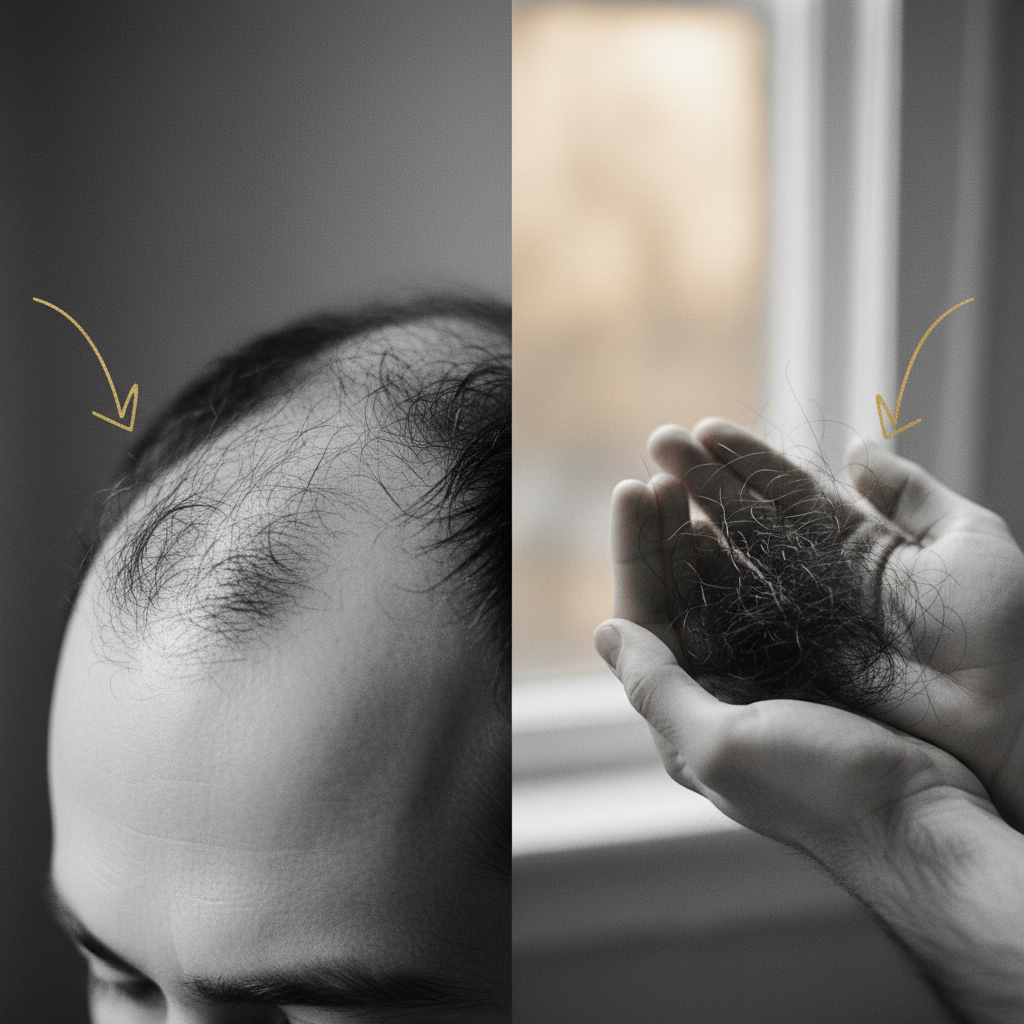
- Follicular miniaturisation: Hairs grow back finer, lighter, and shorter with every growth cycle. You might notice the hairline creeping back incrementally, or the scalp showing through more easily under bright overhead light. This is the hallmark of pattern loss.
- Telogen effluvium (shedding): This involves sudden, diffuse loss of full-thickness hairs across the entire scalp, often triggered by severe physical stress, nutritional deficits, or illness. It does not follow the Norwood pattern and rarely causes permanent follicular damage.
- Hair breakage: The hair fibre snaps along the shaft due to mechanical or chemical trauma (bleaching, heat styling). Breakage leaves the root intact in the follicle and does not cause hairline recession.
What the evidence does not show
Popular culture surrounds hair loss with persistent myths that contradict clinical dermatological evidence:
- Maternal grandfather myth: While the primary androgen receptor gene resides on the X chromosome (inherited from your mother), susceptibility to male pattern loss is polygenic. Dozens of autosomal genes inherited from both parents influence age of onset, pattern, and severity.
- Frequent washing causes loss: Shampooing dislodges hairs that have already detached from the dermal papilla and entered the late telogen/exogen phase. It does not accelerate follicular miniaturisation.
- Circulation limits: The scalp has an exceptionally rich vascular network. Decreased blood flow seen in bald scalps is a consequence of follicular atrophy, not its primary cause.
Clinical management and supporting hair quality
Managing androgenetic alopecia depends heavily on your current stage. Interventions aim to lower DHT exposure, prolong the anagen growth phase, and maintain fibre integrity.
Medical interventions
Licensed pharmacological options exist to address the hormonal and cellular drivers of androgenetic alopecia. Oral 5-alpha reductase inhibitors reduce systemic and scalp DHT levels, slowing or arresting progression in the majority of men. Topical vasodilators act directly on potassium channels in follicular cells to prolong anagen duration and encourage fibre thickness. These treatments are most effective in Stages 2 through 4, where viable follicles remain. In advanced stages (6 and 7), surgical hair restoration may be considered, using DHT-resistant occipital donor hair to reconstruct earlier patterns.
Cosmetic care and hair density support
Cosmetic products cannot alter your genetics or cure androgenetic alopecia, but they play a practical role in maintaining a clean scalp environment and reducing mechanical breakage on miniaturising fibres. A well-formulated routine helps maximise the visual density of remaining hair.
Watermans produces targeted scalp and hair solutions, including the Grow Me Shampoo and Condition Me Conditioner. Formulated with biotin, rosemary, caffeine, and niacinamide, these blends are designed to revitalise the scalp surface, improve moisture retention, and fortify hair fibres against day-to-day breakage. For men navigating early pattern thinning, supporting fibre resilience ensures that thinning areas retain as much natural body and visual fullness as possible.
When the cause may be something else
Not all thinning conforms to the standard Male Pattern Baldness Stages. A professional evaluation is essential if you notice:
- Patchy, circular bald spots: Smooth, coin-shaped patches often indicate alopecia areata, an autoimmune condition.
- Scarring, redness, or burning: Conditions such as lichen planopilaris or frontal fibrosing alopecia cause inflammation, pain, and permanent follicular destruction.
- Rapid, diffuse thinning: Thinning that occurs evenly across the entire head over a matter of weeks usually points to systemic issues, such as thyroid dysfunction, severe iron deficiency, or telogen effluvium.
Frequently asked questions about Male Pattern Baldness Stages
At what age do the Male Pattern Baldness Stages typically begin?
Male pattern loss can begin any time after puberty, when circulating androgen levels rise. Around 20 percent of men experience noticeable signs by age 20, 30 percent by age 30, and approximately 50 percent by age 50. Earlier onset often correlates with faster progression through the stages if left unmanaged.
Can you reverse Stage 6 or 7 hair loss?
Reversing Stages 6 or 7 back to a full head of hair using medical treatments alone is biologically impossible. In these advanced stages, the vast majority of follicles have undergone complete miniaturisation and perifollicular fibrosis. At this point, the hair-producing machinery is no longer viable, making surgical hair transplantation the only potential option for physical restoration.
How quickly do men progress between Norwood stages?
Progression rates vary widely and are notoriously unpredictable. Some men move from Stage 2 to Stage 4 within two to three years, while others remain at Stage 2 or 3 for decades. Progression often occurs in stuttering phases, with periods of gradual thinning punctuated by intervals of relative stability.
Does a receding hairline in Stage 2 always mean I will reach Stage 7?
No. A Stage 2 hairline is extremely common and often represents a natural transition from an adolescent hairline to an adult mature hairline. Many men reach Stage 2 in their twenties and never experience further recession or crown thinning throughout their lives.
Summary of pattern baldness progression
Understanding the Male Pattern Baldness Stages provides clarity when assessing personal hair density and evaluating management options. The Hamilton-Norwood scale categorises hair loss from mild temporal recession through to severe vertex and mid-scalp thinning. Because androgenetic alopecia is progressive and driven by follicular miniaturisation, monitoring your pattern early offers the best opportunity to preserve existing hair density and maintain long-term scalp health.
Sources and references
- Norwood, O. T. (1975). Male pattern baldness: classification and incidence. Southern Medical Journal, 68(11), 1359-1365.
- Hamilton, J. B. (1951). Patterned loss of hair in man: types and incidence. Annals of the New York Academy of Sciences, 53(3), 708-728.
- British Association of Dermatologists. (2020). Androgenetic Alopecia: Patient Information Leaflet.
- National Institute for Health and Care Excellence (NICE). (2021). Alopecia, androgenetic - male: Clinical Knowledge Summaries.
- Kaufman, K. D. (2002). Androgens and alopecia. Molecular and Cellular Endocrinology, 198(1-2), 89-95.
Find these ingredients in Watermans products
- Niacinamide: you will find this ingredient in our Hair Mask.