Mature Hairline vs Receding Hairline: How to Tell the Difference
9 min read ·
Confused between a mature hairline vs receding hairline? Discover the biological differences, the wrinkle test, Norwood stages, and how to identify early signs.
Quick answer: The debate around a Mature Hairline vs Receding Hairline centres on whether hairline movement is a natural developmental shift or progressive male pattern baldness. A mature hairline moves back evenly by roughly 1 to 2 centimetres above the adolescent crease between ages 17 and 30, then stabilises. A receding hairline continues retreating unevenly past this boundary, forming deep temporal peaks, a sharp V-shape, or thinning at the crown. Monitoring change over 6 to 12 months is essential to tell them apart.
Key takeaways
- A mature hairline is a normal anatomical transition experienced by up to 95 percent of men as they exit adolescence.
- Maturation moves the hairline uniformly backwards by roughly 1 to 2 centimetres (about one finger-width) and then halts.
- A receding hairline is driven by androgenetic alopecia, causing follicular miniaturisation that continues without intervention.
- The highest point of the forehead wrinkling muscle (the frontalis) marks the original juvenile baseline.
- Hair miniaturisation, marked by short, wispy, unpigmented hairs along the edge, signals active recession rather than simple maturation.
- Cosmetic haircare helps maintain a clean, resilient scalp environment, but clinical hair loss treatments require medical advice.
Mature Hairline vs Receding Hairline: what the evidence shows
The distinction between a Mature Hairline vs Receding Hairline comes down to progression and follicle biology. During puberty, boys possess a flat, low, juvenile hairline that sits directly against the uppermost crease of the forehead when raising the eyebrows. Between the ages of 17 and 29, almost all men experience a natural shift.
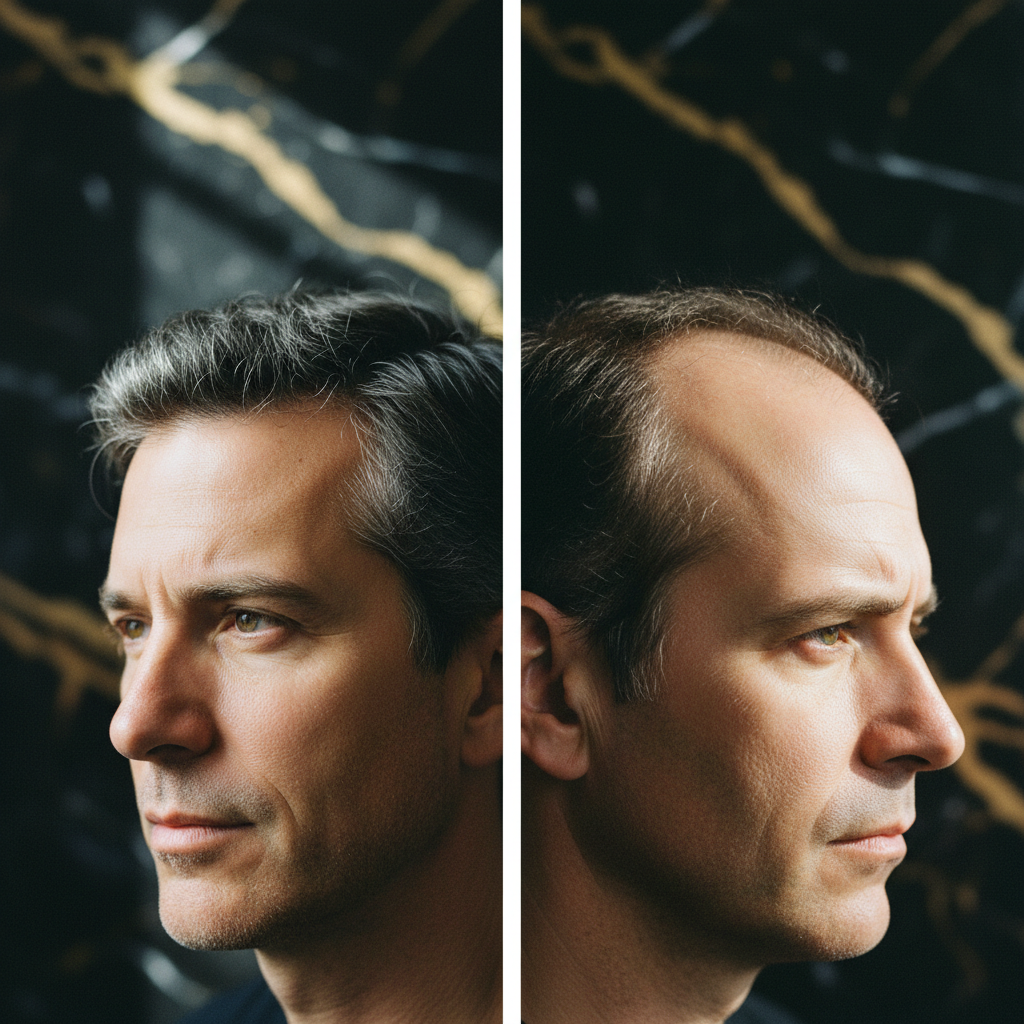
Dermatological literature, beginning with Dr James Hamilton in 1951 and later refined by Dr O'Tar Norwood in 1975, classifies this transition. Hamilton identified that a straight adolescent hairline is temporary. As circulating androgens rise during late adolescence, the hairline typically rises 1 to 2 centimetres above the highest horizontal forehead wrinkle. The frontal corners round out slightly, turning a straight horizontal line into a gentle, soft curve. This is a mature hairline, classified as Norwood Stage 2. Once this shape establishes itself, it can remain unchanged for decades.
In contrast, a receding hairline marks the early stages of androgenetic alopecia (Norwood Stage 2A, 3, or beyond). Here, hair follicles at the temples and frontal zone are genetically sensitive to dihydrotestosterone (DHT). Instead of settling into a higher, stable position, the follicles continue to shrink. The hairline creeps further back, creating pronounced, asymmetric triangles at the temples, often leaving an isolated forelock in the centre.
| Feature | Mature Hairline | Receding Hairline |
|---|---|---|
| Typical age of onset | 17 to 25 years | Any age after puberty (often begins 18 to 35) |
| Distance from upper wrinkle | 1 to 2 cm (roughly one finger-width) | Greater than 2 cm, continuously moving back |
| Shape | Gentle curve or soft, shallow M-shape | Deep, sharp M-shape, V-shape, or asymmetric hollows |
| Hair shaft thickness at margin | Uniform, terminal hairs up to the edge | High variation in thickness (miniaturisation present) |
| Progression | Halts naturally after initial transition | Continues over time without medical intervention |
| Crown involvement | None (vertex remains fully dense) | Frequently accompanied by thinning at the crown |
| Norwood Scale stage | Norwood 1 to 2 | Norwood 2A, 3, and higher |
The underlying biological mechanisms
Understanding the mechanism explains why a mature hairline stops while a receding hairline marches backward.
Both processes involve androgens, but the degree of receptor sensitivity dictates the outcome. Testosterone converts to dihydrotestosterone via the 5-alpha reductase enzyme located inside the hair follicle tissue.
In a maturing hairline, follicles along the lowest margin of the forehead respond to standard post-pubescent hormonal profiles by completing their genetically programmed adult placement. The underlying skin and facial structure expand during late teen development, and the hairline shifts upward to match adult skull proportions. Once that shift concludes, the remaining follicles maintain standard growth phases (anagen lasting 3 to 7 years) and normal hair shaft diameters (typically 60 to 80 microns).
In androgenetic alopecia, follicles carry an inherited susceptibility to DHT. When DHT binds to the androgen receptors in these vulnerable frontal follicles, it shortens the anagen (growth) cycle and lengthens the telogen (resting) cycle. Over successive cycles, the dermal papilla shrinks. This process, called miniaturisation, forces terminal hairs to become thin, short vellus-like strands before the follicle eventually ceases producing visible hair fibres entirely.
Signs to look for: how to assess your hairline
Telling the difference between these two conditions requires methodical observation rather than daily panic in front of a mirror. Look for these distinct diagnostic signs:
1. The eyebrow wrinkle test
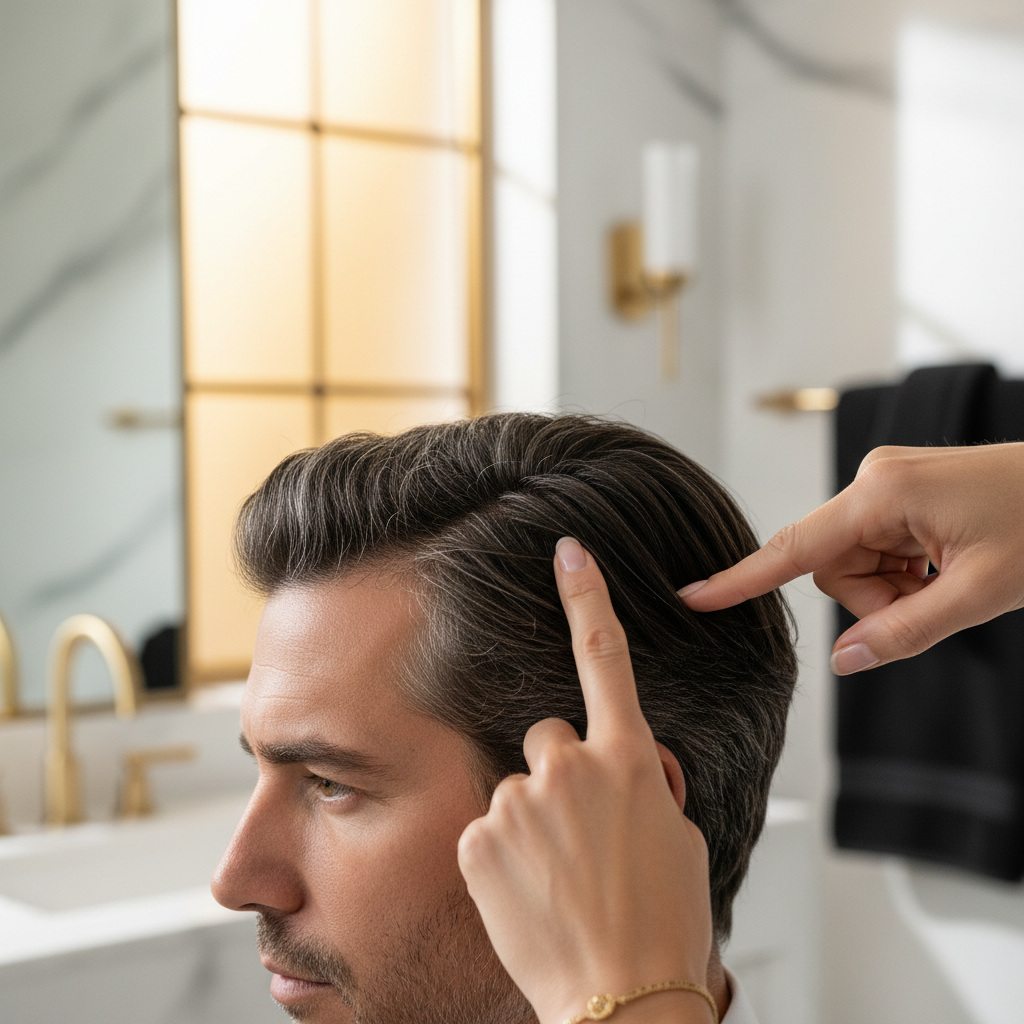
Raise your eyebrows firmly to create horizontal furrows across your forehead. Locate the highest wrinkle, which marks the upper edge of your frontalis muscle. A juvenile hairline sits right on that wrinkle. A mature hairline sits roughly 1 to 2 centimetres above it. If your temporal margins have retreated significantly higher than 2 centimetres above that line, progressive recession is far more likely.
2. Hair fibre calibre variation
Part the hair directly at the corners of your temples and examine the individual strands under bright, direct light. In a mature hairline, the hairs directly along the edge are thick, fully pigmented, and uniform in width. In a receding hairline, you will observe marked calibre variation (anisotrichosis), where thick terminal hairs are mixed with wispy, pale, brittle hairs that struggle to grow past a few centimetres.
3. Rate of change over six months
Take standardised photographs once every two months under identical lighting and from the same angles (front, left profile, right profile, and overhead). A mature hairline takes shape slowly and stays stable. If your photographs show noticeable hollows forming at your temples over a 6 to 12-month period, you are dealing with active recession.
4. Vertex and mid-scalp density
A mature hairline never affects the top or back of the head. Part your hair down the centre and check the crown. If the parting looks wider at the crown or if the scalp shows through on the vertex, the process is widespread androgenetic alopecia rather than localized hairline maturation.
What you can do: maintenance, styling, and scalp support
If your hairline is maturing, you do not need aggressive pharmacological interventions. You simply have an adult hairline. However, supporting the scalp and keeping existing hair strong prevents avoidable shedding and breakage.
Optimise your daily routine
- Cleanse without stripping: Use a sulphate-free, pH-balanced shampoo (ideally pH 5.0 to 5.5) to keep the scalp barrier intact and free from excessive sebum accumulation.
- Minimise mechanical tension: Avoid tight hairstyles, aggressive towel drying, or harsh brushing when hair is wet, which causes traction and breakage.
- Support microcirculation: Gentle manual scalp massage during washing can promote localized blood flow around hair roots.
Cosmetic care with Watermans
For those wanting to keep their hair feeling thick, robust, and full of body, topical cosmetic formulas provide practical support. Watermans Grow Me Shampoo combines natural ingredients such as biotin, rosemary extract, caffeine, and lupin protein designed to revitalise the scalp environment and strengthen hair fibres from the root. While cosmetic shampoos cannot alter genetic sensitivity to DHT or reverse clinical androgenetic alopecia, maintaining an optimal scalp environment helps minimise hair breakage and keeps maturing or thinning hair looking visibly denser and healthier.
When the cause may be something else
Hairline changes do not always come down to the simple binary of maturation versus genetic pattern baldness. Several other conditions can mimic a receding hairline:
- Traction alopecia: Caused by prolonged pulling forces from tight ponytails, braids, cornrows, or heavy hair extensions. It typically affects the frontal and temporal borders, leaving small broken hairs along the margin (the "fringe sign").
- Telogen effluvium: A reactive shedding condition triggered by acute stress, severe illness, rapid weight loss, or nutritional deficits (such as low ferritin or zinc). Telogen effluvium causes diffuse shedding across the entire scalp rather than targeted temporal retreat, though it often makes a mature hairline look suddenly sparse.
- Frontal fibrosing alopecia (FFA): A form of scarring (cicatricial) alopecia seen most commonly in post-menopausal women, though it can occur in men. FFA causes the hairline to recede progressively while leaving behind pale, smooth, shiny skin devoid of follicular openings, often accompanied by loss of eyebrows.
When to get professional advice
If your hairline is moving back rapidly, if you notice itching, burning, or redness around the follicles, or if you spot round patches of sudden loss, arrange an appointment with a registered trichologist or a consultant dermatologist.
A clinician will perform trichoscopy (dermoscopy of the hair and scalp). Using a specialised polarized lens, they can measure the exact percentage of miniaturised hairs along your frontal zone. A miniaturisation rate above 20 percent at the hairline confirms androgenetic alopecia, allowing you to discuss evidence-based medical treatments such as topical minoxidil or prescription 5-alpha reductase inhibitors if you wish to retain your hair.
Frequently asked questions about Mature Hairline vs Receding Hairline
How long does a mature hairline take to settle?
A mature hairline typically develops over a span of several years, usually between the ages of 17 and 25. The transition happens gradually, moving back by 1 to 2 centimetres before stabilising. Once the mature position is reached, it generally remains constant for decades unless male pattern hair loss develops later in life.
Can a mature hairline turn into a receding hairline?
Yes, having a mature hairline does not provide immunity against male pattern baldness. Many men successfully transition from a juvenile to a mature hairline in their early twenties, only to experience androgenetic alopecia in their thirties or forties. Regular photo monitoring helps you detect any secondary phase of movement.
Does a receding hairline always start at the temples?
While temple recession is the most common presentation of androgenetic alopecia, it does not always start there. Some men experience diffuse thinning across the frontal band without deep temple recession, while others develop a bald spot on the crown (vertex) before their hairline shifts backward significantly.
What is the most definitive test for Mature Hairline vs Receding Hairline?
The most definitive method is trichoscopy performed by a dermatologist. By magnifying the follicles by 20 to 70 times, the clinician measures hair diameter diversity. An abundance of miniaturised hairs (varying thicknesses) confirms a receding hairline, whereas uniform hair shaft diameters confirm a stable mature hairline.
Managing your hairline with clarity
Navigating the difference between a Mature Hairline vs Receding Hairline comes down to tracking objective measurements over time rather than reacting to daily shedding in the basin. A mature hairline is a natural developmental shift that gives an adult face balanced proportions, requiring neither panic nor aggressive medication. If your hairline shows signs of continuing recession, identifying it early through photographic monitoring and professional assessment gives you the best opportunity to protect your scalp health and hair density.
Sources and references
- Hamilton, J. B. (1951). Patterned loss of hair in man: types and incidence. Annals of the New York Academy of Sciences, 53(3), 708-728.
- Norwood, O. T. (1975). Male pattern baldness: classification and incidence. Southern Medical Journal, 68(11), 1359-1365.
- British Association of Dermatologists. (2020). Androgenetic Alopecia (Male and Female Pattern Hair Loss). Patient Information Leaflet.
- National Institute for Health and Care Excellence (NICE). (2021). Alopecia androgenetica: Scenario: Management in men. Clinical Knowledge Summaries.
- Rossi, A., et al. (2012). Trichoscopy in male and female androgenetic alopecia: A systematic review. Journal of the American Academy of Dermatology, 67(4), e151-e152.
Find these ingredients in Watermans products
- Zinc: you will find this ingredient in our Hair Vitamins.