Evidence-Based Ingredients for Dandruff Control: A Complete Guide
8 min read ·
Explore the most effective ingredients for dandruff control, comparing the mechanisms of antifungals, exfoliants, and cytostatics to restore a healthy scalp.

Quick answer: Effective Ingredients for Dandruff Control work by reducing the population of Malassezia yeast, exfoliating adherent skin flakes, or calming inflammatory redness on the scalp. Clinically validated agents include ketoconazole, piroctone olamine, zinc pyrithione, selenium sulfide, and salicylic acid. While these compounds reliably suppress visible flaking and itching, their main limitation is that they manage symptoms rather than provide a permanent biological cure, requiring consistent maintenance to prevent flaking from returning.
Key takeaways
- Dandruff is primarily driven by an overgrowth of lipophilic Malassezia yeasts interacting with natural sebum, producing irritating free fatty acids.
- Topical active compounds fall into three distinct functional classes: antimycotics, keratolytic exfoliants, and anti-inflammatory or cytostatic agents.
- Piroctone olamine and ketoconazole target fungal cell membranes directly, whereas salicylic acid breaks down the protein bonds holding dead corneocytes together.
- Rotating active agents can help prevent tolerance and address multiple pathways, such as pairing an antifungal with an exfoliant.
- Persistent scaling accompanied by thick plaques, intense erythema, or bleeding suggests conditions beyond common dandruff, such as scalp psoriasis or contact dermatitis.
Ingredients for Dandruff Control: what the evidence shows
Peer-reviewed clinical dermatology demonstrates that specific topical active compounds significantly lower scalp scaling, sebum oxidation, and pruritus. Successful management relies on identifying active agents designed to target Malassezia globosa and Malassezia restricta, the two fungal species most strongly correlated with dandruff and seborrhoeic dermatitis.
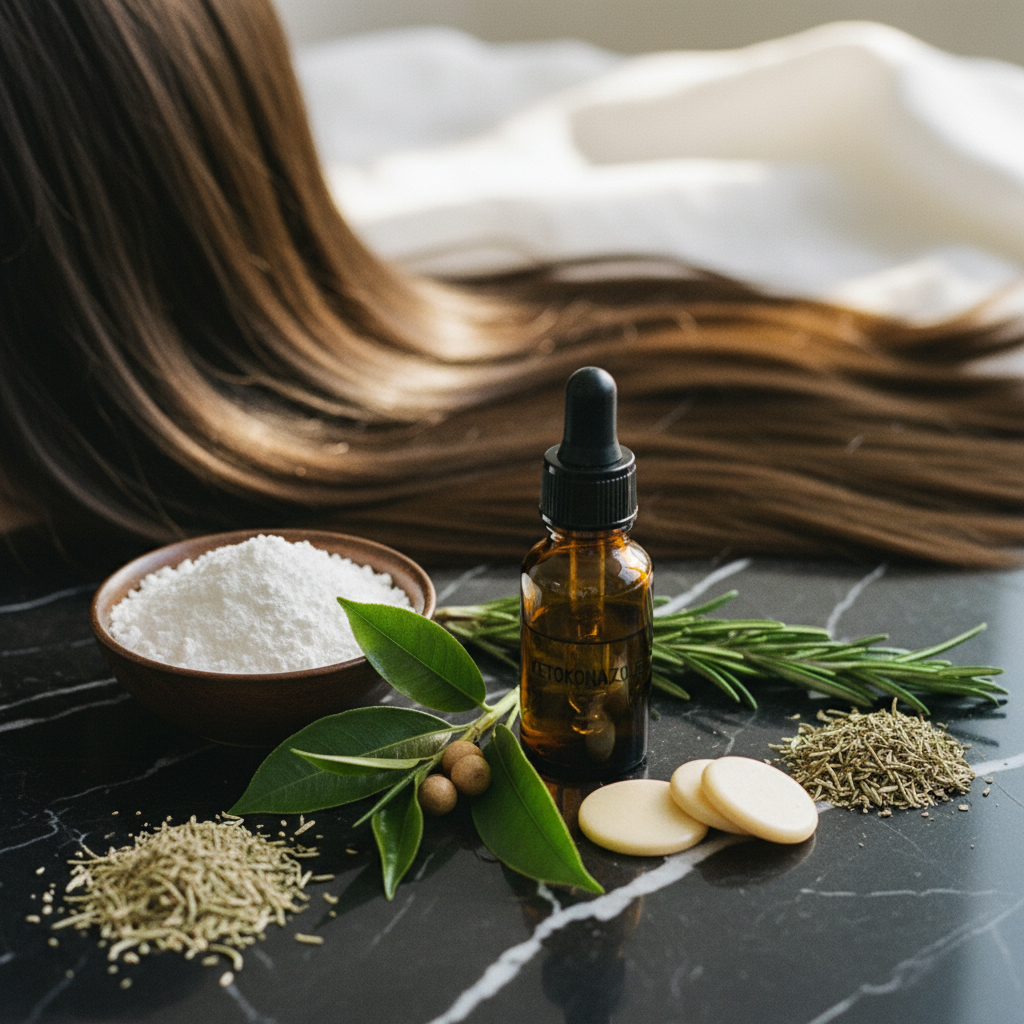
Here is how the primary categories of Ingredients for Dandruff Control perform in clinical trials:
Antifungal agents
Antifungal agents reduce the viable fungal load on the stratum corneum, preventing the hydrolysis of sebum triglycerides into oleic acid, the primary chemical irritant behind flaking.
- Ketoconazole (1% to 2%): An imidazole antifungal that inhibits fungal ergosterol synthesis. Clinical trials consistently show that 2% ketoconazole applied twice weekly achieves clearance or marked improvement in over 80% of individuals with moderate-to-severe dandruff within two to four weeks.
- Piroctone Olamine (0.5% to 1%): A hydroxypyridone compound that penetrates fungal cell walls to bind iron and disrupt mitochondrial energy metabolism. Comparative studies indicate 0.75% to 1% piroctone olamine rivals zinc pyrithione in reducing flaking while demonstrating superior conditioning outcomes on hair shafts.
- Climbazole (0.5% to 2%): A topical imidazole that destabilises fungal cell membranes. It is frequently formulated alongside gentle surfactants to lower fungal density without causing significant cuticle swelling.
Keratolytic agents
Keratolytic agents break down the desmosomes, the intercellular protein bridges binding shedding stratum corneum cells, promoting the shed of fine, imperceptible flakes rather than large visible clumps.
- Salicylic Acid (1.5% to 3%): A lipid-soluble beta-hydroxy acid that dissolves intercellular cement between corneocytes. It excels at breaking down thick, adherent scaling, though on its own it does not directly lower fungal populations. It is most effective when combined with an antifungal.
- Sulfur (2% to 5%): Often paired with salicylic acid, elemental sulfur provides mild keratolytic and antimicrobial activity, although formulation aesthetics and scent require careful cosmetic balancing.
Cytostatic and soothing agents
Cytostatic agents reduce epidermal hyperproliferation, slowing down the accelerated transit time of epidermal cells from the basal layer to the surface (which drops from 28 days down to 7 to 14 days in active dandruff).
- Selenium Sulfide (1% to 2.5%): A cytostatic agent that lowers cellular turnover and possesses moderate antifungal activity against Malassezia. It effectively reduces flake production, though regular use can sometimes leave an oily residue on fine hair textures.
- Tea Tree Oil (Melaleuca alternifolia, 5%): Clinical testing shows that 5% formulations possess meaningful terpinen-4-ol levels, providing broad antimicrobial and anti-inflammatory properties that reduce itching and mild flaking.
| Active Ingredient | Typical Concentration | Primary Mechanism of Action | Best Suited For | Hair Fibre Impact |
|---|---|---|---|---|
| Piroctone Olamine | 0.5% to 1.0% | Disrupts fungal iron metabolism | Daily or alternate-day control | Gentle, leaves fibre soft |
| Ketoconazole | 1.0% to 2.0% | Inhibits fungal ergosterol synthesis | Moderate to severe flaking | Can feel slightly drying |
| Salicylic Acid | 1.5% to 3.0% | Keratolytic (dissolves desmosomes) | Thick, adherent flakes | Stripping if used daily |
| Selenium Sulfide | 1.0% to 2.5% | Cytostatic, slows cell turnover | Stubborn flaking and scaling | May leave hair limp or oily |
| Tea Tree Oil | 2.0% to 5.0% | Broad antimicrobial, anti-inflammatory | Mild flaking, sensitive scalps | Neutral to drying |
What the evidence does not show
Popular hair forums often promote natural remedies that lack rigorous scientific backing for managing dandruff:
- Lemon juice and neat vinegar: Applying unbuffered acidic rinses (pH 2.0 to 3.0) can cause irritant contact dermatitis, stripping the scalp barrier and worsening inflammation without eliminating fungal reservoirs.
- Coconut oil as a leave-in scalp treatment: While coconut oil conditions the hair shaft, Malassezia is a lipophilic yeast that feeds directly on specific lipid fractions. Applying heavy plant oils to an actively flaking scalp can accelerate fungal proliferation.
- Permanent cures: Dandruff is a recurring condition driven by normal skin flora interacting with your individual sebum chemistry and genetic susceptibility. No topical agent permanently eradicates Malassezia from the scalp microbiome.
Mechanisms: why dandruff develops
To understand why specific ingredients work, you must look at the biochemical cascade occurring on the scalp:

- Sebum secretion: Sebaceous glands produce sebum containing triglycerides, squalene, and wax esters.
- Microbial digestion: Resident Malassezia yeasts produce extracellular lipases that consume saturated fatty acids from the sebum, releasing unsaturated fatty acids, primarily oleic acid and arachidonic acid.
- Barrier disruption: In susceptible scalps, oleic acid penetrates the top layers of the stratum corneum, destabilising the lipid lamellae.
- Inflammation and hyperkeratosis: The scalp responds with subclinical inflammation and accelerates epidermal cell production. Immature corneocytes clump together in aggregates of hundreds or thousands, becoming visible as white or yellowish flakes.
How to use dandruff-controlling ingredients effectively
Applying an active formula correctly makes a significant difference in results.
- Observe contact time: Antifungal and keratolytic compounds require 3 to 5 minutes of direct contact with the scalp to penetrate the follicular infundibulum and outer skin layers. Rinsing immediately reduces their effectiveness.
- Target the scalp, not the hair lengths: Concentrate lather directly at the roots. Using clarifying, medicated actives along the mid-lengths and ends can unnecessarily dry out the hair shaft.
- Alternate formulas: For persistent flaking, rotate between an antifungal formulation and a hydrating, barrier-supportive shampoo to maintain scalp barrier health without drying the hair.
- Adjust wash frequency: Infrequent washing allows sebum to accumulate, feeding yeast colonies. Washing two to four times weekly with a targeted active keeps the microbial balance steady.
Supporting the scalp with gentle, targeted formulations
When managing long-term scalp health, choosing formulas that balance active botanicals, amino acids, and gentle surfactants helps avoid the dryness caused by aggressive clarifying agents.
Watermans focuses on scalp wellness with formulations like GrowMe Shampoo, which combines niacinamide, rosemary extract, caffeine, and allantoin. While formulated primarily to optimise the scalp environment, support hair density, and reduce mechanical hair breakage, these soothing botanical ingredients help nourish the skin barrier, creating an inhospitable environment for excessive dryness and irritation.
When flaking indicates another condition
Not all scalp flaking is simple dandruff (pityriasis capitis). If flaking resists typical non-prescription actives after four weeks, consider other common dermatological causes:
- Scalp psoriasis: Characterised by sharply demarcated, thick, silvery-white plaques that often extend beyond the hairline, frequently accompanied by bleeding when removed (Auspitz sign).
- Allergic or irritant contact dermatitis: Caused by sensitivity to preservatives, fragrances, or hair dyes (such as paraphenylenediamine). Symptoms present with acute stinging, intense itching, and weeping erythema.
- Tinea capitis: A fungal dermatophyte infection more common in children, which causes patchy scaling alongside localised hair breakage and fragile stumps.
When to seek professional advice
Consult a GP, dermatologist, or registered trichologist if you notice:
- Red, swollen, or intensely burning scalp skin that interferes with sleep.
- Yellow, greasy crusting that oozes fluid or emits an odour.
- Excessive follicular shedding or sudden patches of alopecia appearing alongside scaling.
- No noticeable improvement after four continuous weeks of using over-the-counter active ingredients.
Frequently asked questions about Ingredients for Dandruff Control
What are the most effective Ingredients for Dandruff Control?
The most clinically supported Ingredients for Dandruff Control are piroctone olamine, ketoconazole, salicylic acid, and selenium sulfide. Piroctone olamine and ketoconazole reduce the Malassezia yeast population responsible for irritation, while salicylic acid clears existing surface flakes by breaking down dead cell adhesion.
How often should I use active ingredients to control flaking?
Most individuals achieve optimal results by using targeted formulas two to three times weekly. Once visible flakes disappear, reduce application to once weekly or once every fortnight for maintenance, using a mild, sulphate-free shampoo for intervening washes to preserve scalp moisture.
Can dandruff-fighting ingredients cause hair breakage?
Certain high-strength actives, such as selenium sulfide or 2% ketoconazole, can temporarily swell the cuticle and lift hair scales if used excessively without conditioning agents. This increases friction and hair breakage along the hair shaft. Always follow medicated scalp treatments with a rich, moisturising conditioner applied strictly to the mid-lengths and ends.
Why do dandruff actives stop working after a while?
Scalp treatments rarely lose efficacy due to true microbial resistance. Instead, changes in weather, sebum levels, stress, or inconsistent contact time (such as rinsing too quickly) usually explain a flare-up. Switching between two different active mechanisms, such as an antifungal and a keratolytic exfoliant, restores balance.
Conclusion
Finding the right Ingredients for Dandruff Control comes down to understanding your specific scalp profile. Whether addressing excess oil with piroctone olamine or dissolving stubborn surface build-up with salicylic acid, targeting the underlying yeast activity and accelerated cell turnover brings lasting relief. Pair these active compounds with adequate leave-in contact time and a supportive conditioning routine to maintain a balanced, calm scalp and resilient hair fibres.
Sources and references
- British Association of Dermatologists. Guidelines for the management of seborrhoeic dermatitis. British Journal of Dermatology.
- National Institute for Health and Care Excellence (NICE). Seborrhoeic dermatitis: Clinical Knowledge Summaries (CKS), 2022.
- Pierard, G. E., et al. Prolonged effects of antidandruff shampoos on the scalp microbiome and scaling. International Journal of Cosmetic Science, 2002.
- Turner, G. A., et al. Stratum corneum dysfunction in dandruff. International Journal of Cosmetic Science, 2012.
- Borda, L. J., & Wikramanayake, T. C. Seborrheic Dermatitis and Dandruff: A Comprehensive Review. Journal of Clinical and Investigative Dermatology, 2015.
Find these ingredients in Watermans products
- Zinc: you will find this ingredient in our Hair Vitamins.
- Oleic Acid: you will find this ingredient in our Camellia & Black Castor Hair & Body Oil.
- Niacinamide: you will find this ingredient in our Hair Mask.