Hydrolysed Proteins for Hair: Mechanism, Benefits, and Evidence
9 min read ·
Discover how hydrolysed proteins for hair repair cuticle damage, improve elasticity, and reduce breakage, alongside the real science of protein-moisture balance.
Quick answer: Hydrolysed Proteins for Hair are large protein molecules chemically or enzymatically broken down into smaller peptides and amino acids that temporarily bind to and reinforce damaged hair fibres. By filling micro-fissures in the cuticle and outer cortex, they improve tensile strength, manageability, and moisture retention. However, their primary limitation is that they provide cosmetic, temporary reinforcement rather than permanent biological repair. They cannot alter follicle genetics, reverse hormonal alopecia, or knit severed split ends permanently back together.
Key takeaways
- Natural hair consists of roughly 85% to 90% keratin protein, which degrades under heat, chemical processing, and environmental stress.
- Hydrolysis reduces massive protein chains (often exceeding 100,000 Daltons) down to lower molecular weights (typically 500 to 3,000 Daltons) capable of cuticle sorption and cortical penetration.
- Smaller peptides deposit onto the hair shaft through ionic attraction, temporarily patching microscopic cuticle gaps and reducing breakage.
- Excessive protein application without balanced emollients can leave hair feeling stiff, brittle, and dry, a condition often referred to in salons as protein overload.
- Hydrolysed proteins treat fibre breakage and structural weathering; they do not stimulate hair follicles or treat genetic hair loss.
Hydrolysed Proteins for Hair: what the evidence shows
Hydrolysed Proteins for Hair work through surface adsorption and partial penetration, depending on their molecular size and the condition of your hair. Cosmetic chemistry research demonstrates that native proteins, such as intact wool keratin or whole milk protein, are far too large to enter the hair shaft. Because the protective cuticle tiles overlap tightly on virgin hair, molecules larger than roughly 1,000 Daltons remain on the outside.
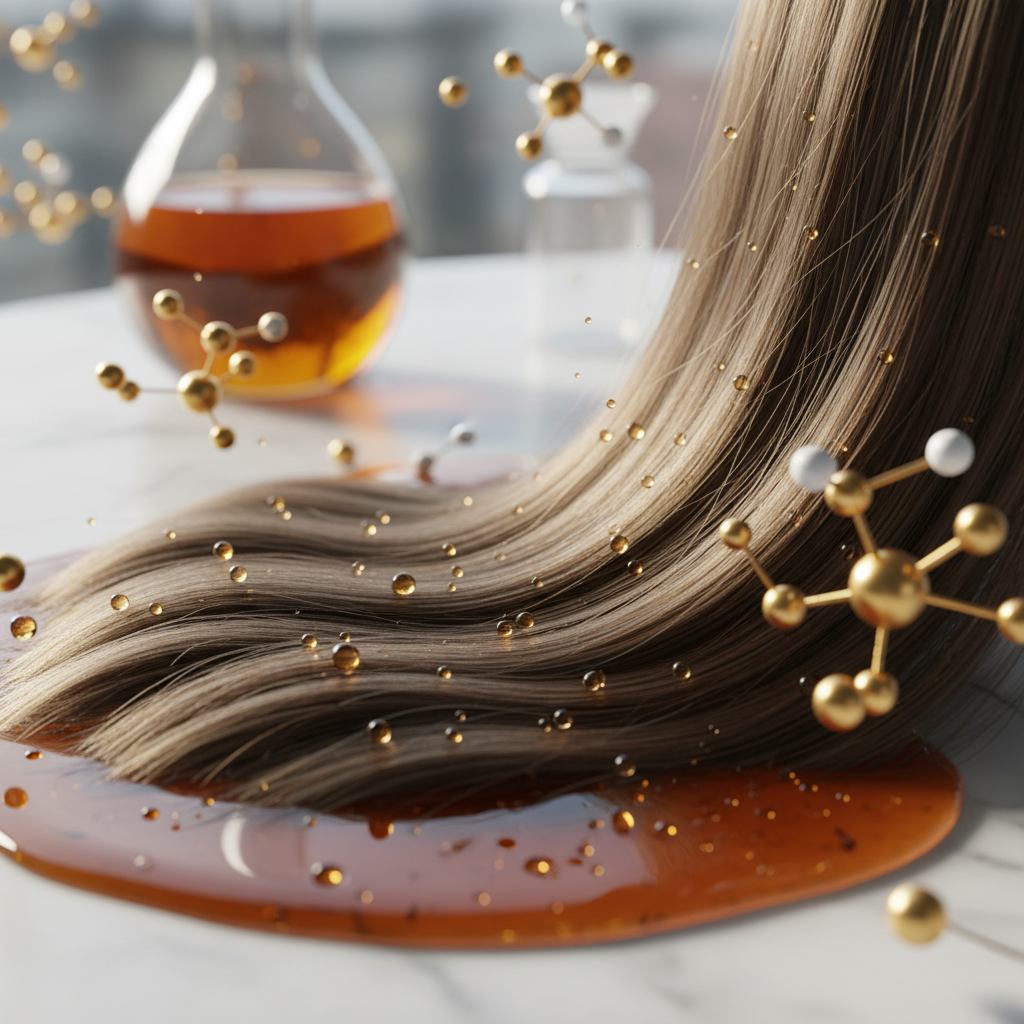
Chemical hydrolysis uses acids, alkalis, or specific enzymes to sever the peptide bonds holding these macromolecular structures together. This process yields fragments ranging anywhere from small oligopeptides (around 500 Daltons) up to moderate fragments (around 3,000 to 5,000 Daltons).
When applied to hair, damaged zones exhibit a net negative electrical charge because cystine bonds have oxidised into cysteic acid groups. Many hydrolysed proteins carry a positive charge under typical cosmetic formulations (pH 4.0 to 5.5). This creates an electrostatic attraction. The peptides adhere strongly to the compromised areas of the cuticle, forming a light, protective film.
In porous, bleached, or heat-damaged hair where the cuticle is lifted or eroded, the lowest molecular weight fractions penetrate past the cuticular sheath into the outer regions of the cortex. Controlled tensile testing in published cosmetic literature shows that this uptake increases the fibre's breaking load under strain, decreases combing friction, and improves overall hair elasticity.
What the evidence does not show
It is critical to separate structural fibre repair from biological hair growth. Hydrolysed proteins will not:
- Permanently weld split ends back together: While they can smooth cuticles and temporarily glue split ends together until your next wash, no cosmetic ingredient can permanently fuse split fibres. Only a mechanical trim eliminates split ends.
- Reverse medical hair loss: Hydrolysed proteins act exclusively on the non-living fibre protruding from your scalp. They have no impact on the hair follicle matrix, dermal papilla signalling, androgen receptors, or shedding cycles like telogen effluvium.
- Replace natural internal keratin permanently: Hair does not possess a living vascular system to integrate exogenous proteins into its permanent biological matrix. Hydrolysed proteins wash out progressively over several cleansing cycles.
- Work equally well on completely undamaged hair: Virgin, low-porosity hair has a dense, intact lipid barrier (the 18-methyl eicosanoic acid layer). Hydrolysed proteins cannot penetrate this barrier easily, meaning excessive use on healthy hair can cause unwanted product build-up.
Mechanism: how molecular weight dictates performance
The functional benefit of any hydrolysed protein depends directly on its molecular size, measured in Daltons (Da). Not all proteins behave the same way on your hair.
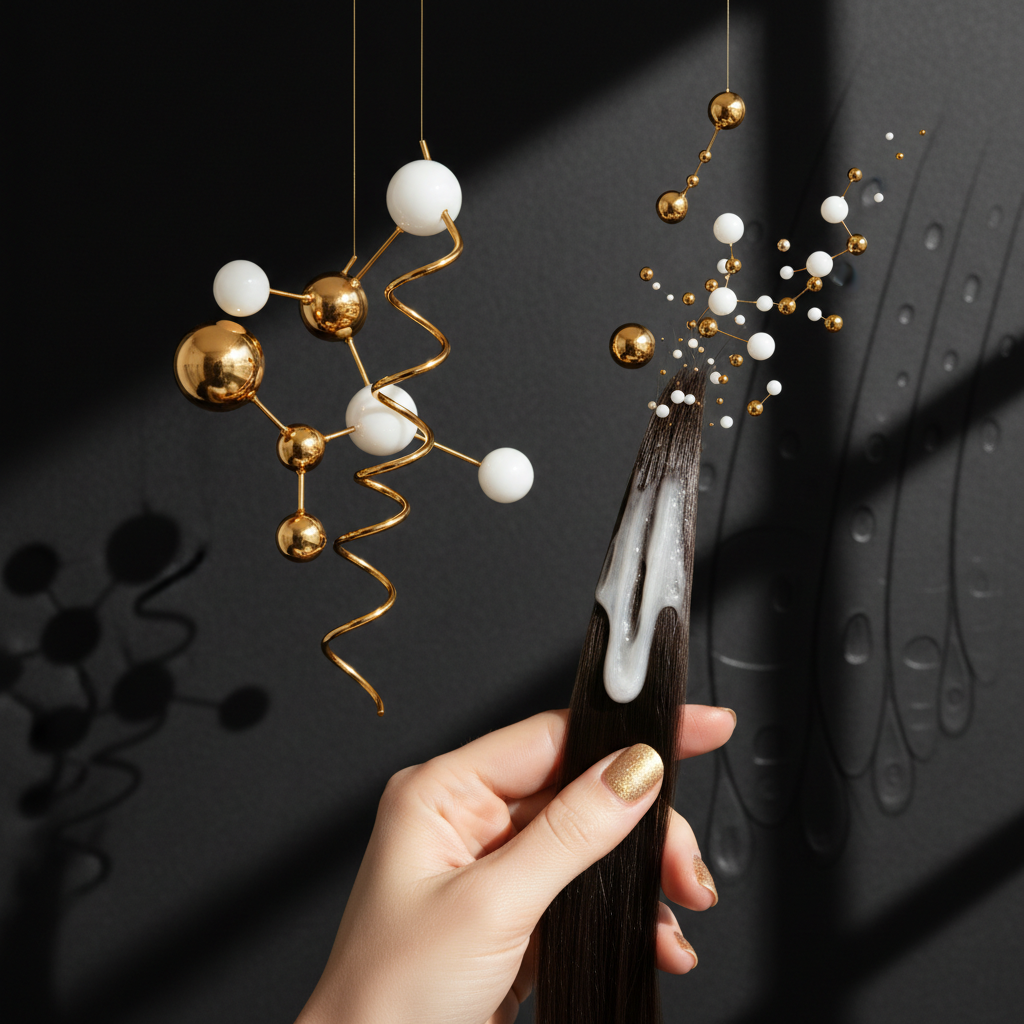
Lower molecular weight hydrolysates (roughly 500 to 1,500 Da) consist of short peptide chains and free amino acids. Because they are tiny, they diffuse into the porous cortex of bleached, relaxed, or severely weathered hair. Once inside, they act as humectants and temporary structural fillers, binding internal water molecules and increasing fibre flexibility.
Higher molecular weight hydrolysates (roughly 2,000 to 5,000 Da) remain largely on the outer surface of the cuticle. They form cohesive, semi-permeable films. These films protect the cuticle scales from friction during styling, reduce moisture loss in dry environments, and provide tactile body and stiffness to fine or limp hair.
| Protein Type | Typical Source | Average Molecular Weight (Daltons) | Primary Function on Hair |
|---|---|---|---|
| Hydrolysed Keratin | Sheep wool, poultry feathers | 600 to 2,500 Da | Structural mimicry, binds tightly to damaged cortex, increases breaking force |
| Hydrolysed Wheat Protein | Wheat gluten | 1,000 to 3,000 Da | Moisture retention, film-forming, boosts body and tensile strength |
| Hydrolysed Silk | Silk fibres | 500 to 2,000 Da | High gloss, surface slip, cuticular smoothing, lightweight conditioning |
| Hydrolysed Soy Protein | Soybeans | 1,500 to 4,000 Da | Surface protection, anti-frizz barrier, improves manageability |
| Hydrolysed Rice Protein | Rice bran/endosperm | 1,000 to 2,500 Da | Adds volume, electrostatic separation of fine strands, surface shine |
| Hydrolysed Collagen | Bovine or marine tissue | 1,000 to 3,000 Da | Elastic film formation, temporary moisture binding, cuticle flexibility |
The signs your hair needs protein
Hair is a delicate balance of protein (which provides strength and rigidity) and moisture (which provides suppleness and flexibility). You can often identify a protein deficiency through mechanical symptoms:
- Excessive stretching without bounce-back: When wet, a healthy strand stretches up to 30% of its length and returns to its original dimension. If the strand stretches out like chewing gum and snaps without bouncing back, the internal protein scaffolding is degraded.
- Mushy or sticky feel when wet: Chemically compromised hair, especially after bleaching, often feels strangely soft, limp, or sponge-like under running water.
- High porosity: If your hair absorbs water instantly, tangles constantly, and dries unusually quickly while looking rough and dull, the protective cuticle is eroded.
- Fibre breakage along the shaft: Seeing small, snap-off pieces of hair on your shoulders or in the sink (without a white root bulb attached) indicates structural failure along the shaft.
Conversely, if your hair feels stiff, straw-like, tangles aggressively, and snaps off when dry, it may have an excess of film-forming proteins and a shortage of softening lipids and moisture.
What you can do to restore protein-moisture balance
To gain the functional benefits of protein treatments without inducing brittleness, follow a measured approach:
- Match frequency to chemical exposure: If your hair is bleached, relaxed, or coloured, incorporate a rinse-off conditioner or mask containing hydrolysed keratin or wheat protein once every 1 to 2 weeks. If your hair is natural or minimally processed, once a month is sufficient.
- Follow protein with conditioning emollients: Always follow an intensive protein treatment with a rich moisturising formula containing fatty alcohols (such as cetyl or stearyl alcohol), plant oils, or conditioning agents to restore mechanical flexibility.
- Check the ingredient label: Look for ingredients beginning with "Hydrolysed" (e.g., Hydrolysed Keratin, Hydrolysed Wheat Protein) in the top half of the ingredient list for intensive treatments, or near the middle for daily maintenance.
- Clarify periodically: Use a gentle clarifying shampoo every 3 to 4 weeks to remove protein film accumulation and product residues that can impede moisture absorption.
When the cause may be something else
It is common to confuse fibre breakage with biological hair loss. If you notice an increased quantity of hair on your brush, look closely at the ends of the strands.
If the fallen strands possess a tiny, white bulb at one tip, the hair has shed naturally from the base of the follicle. Hydrolysed proteins cannot prevent shedding. Conditions such as telogen effluvium (diffuse shedding triggered by illness, high stress, or nutritional deficiencies), female pattern hair loss, and androgenetic alopecia are driven by systemic biology, cellular genetics, and hormones.
If you are losing hair from the root, applying protein masks to your lengths will not stop the shed. In these cases, consult a registered trichologist, GP, or dermatologist to evaluate ferritin, thyroid function, vitamin levels, and scalp health.
The Watermans perspective
At Watermans, healthy hair care begins with distinguishing the living scalp from the non-living hair fibre. While our targeted scalp formulas focus on creating an optimal nutritional and physiological environment for follicles, our conditioning formulas deploy carefully balanced hydrolysed proteins. We utilise these cosmetic ingredients to reinforce the mechanical integrity of the hair shaft, minimise friction-induced breakage, and deliver smooth, fuller-looking body without coating the fibre in heavy, brittle residues.
Frequently asked questions about Hydrolysed Proteins for Hair
Can Hydrolysed Proteins for Hair cause hair loss?
No, Hydrolysed Proteins for Hair do not cause follicular hair loss or shed hair from the scalp. However, if you overuse strong protein treatments without balancing them with moisturising emollients, the hair fibre can become excessively rigid. This rigidity leads to snapping and mechanical breakage along the shaft, which can be mistaken for hair loss.
What is the difference between amino acids and hydrolysed proteins?
Amino acids are the individual building blocks of proteins, with molecular weights typically under 200 Daltons. Hydrolysed proteins are slightly larger peptide fragments consisting of short chains of connected amino acids. Amino acids penetrate the cortex deeply to attract moisture, while hydrolysed proteins act both internally and on the surface to provide structural strength and cuticle protection.
How often should I use hydrolysed protein treatments?
The optimal frequency depends on your hair's porosity and chemical damage. For heavily lightened, relaxed, or heat-styled hair, using a protein-rich mask once a week or every fortnight works well. For virgin, coarse, or low-porosity hair, limit intensive protein treatments to once a month to prevent fibre stiffness and product build-up.
Can hydrolysed protein repair split ends permanently?
No cosmetic treatment can permanently repair split ends. Hydrolysed proteins can temporarily bond split fibres together and smooth the ragged edges until your next wash, which improves appearance and prevents the split from travelling up the shaft immediately. However, the only permanent solution for split ends is cutting them off with sharp shears.
Practical steps for using Hydrolysed Proteins for Hair
Hydrolysed Proteins for Hair remain one of the most effective, research-backed cosmetic tools for strengthening weathered, porous, and chemically treated hair fibres. By delivering low-molecular-weight peptides directly to damaged zones along the cuticle and cortex, they temporarily restore tensile strength, improve elasticity, and reduce everyday breakage. Used in sensible moderation alongside hydrating conditioning agents, they help maintain resilient, healthy-looking hair from wash to wash.
Sources and references
- Journal of Cosmetic Science: Uptake of Hydrolysed Proteins by Hair and Its Effect on Tensile Properties, 1993.
- International Journal of Cosmetic Science: Investigation of the penetration of amino acids and hydrolysed peptides into human hair, 2004.
- Cosmetic and Toiletries Magazine: Proteins in Hair Care: Structure, Function and Molecular Weight Effects, 2012.
- Robbins, C. R.: Chemical and Physical Behavior of Human Hair, 5th Edition, Springer, 2012.
- Society of Cosmetic Chemists: Monograph on Hair Conditioning Agents and Cuticle Adsorption, 2018.
Find these ingredients in Watermans products
- Wheat Amino Acids: you will find this ingredient in our Heat Protection Spray.