Hydrolysed Protein in Hair Care: Evidence, Function, and Application
8 min read ·
Explore the science of Hydrolysed Protein in Hair Care. Learn how peptides penetrate damaged fibres, reduce mechanical breakage, and reinforce hair strength.
Quick answer: Hydrolysed Protein in Hair Care refers to large protein molecules broken down via enzymatic or acid hydrolysis into smaller peptides and amino acids that temporarily bind to or penetrate the hair shaft. These fragments help patch cracks in the cuticle, increase tensile strength, and reduce fibre breakage caused by chemical treatments, heat, and weathering. However, hydrolysed proteins cannot permanently repair living tissue, nor do they cure follicular hair loss; their benefits wash out over time and require consistent replenishment.
Key takeaways
- Molecular size dictates function: Whole proteins are too large to penetrate hair, whereas hydrolysed proteins have molecular weights typically between 500 and 3,000 Daltons, allowing them to adsorb onto or diffuse into the cortex.
- Breakage reduction, not hair growth: Hydrolysed proteins reduce mechanical breakage along the shaft. They do not stimulate hair follicles or reverse alopecia.
- Source matters for performance: Common sources include wheat, keratin, silk, soy, and rice, each offering distinct amino acid profiles and moisture-binding capacities.
- Balance with emollients is critical: Overusing low-molecular-weight proteins without adequate conditioning agents can make hair feel rigid, stiff, and prone to snap.
- Temporary cosmetic repair: Hydrolysed protein bonds via hydrogen and ionic interactions, meaning the structural reinforcement washes away with subsequent surfactant use.
Hydrolysed Protein in Hair Care: what the evidence shows
Hydrolysed Protein in Hair Care works because human hair is roughly 85% to 90% keratin protein by dry weight. Everyday stressors like bleaching, permanent waving, UV radiation, and heat styling oxidise disulphide bonds, chip away cuticle scales, and leave the inner cortex exposed. Native proteins found in nature (such as raw egg or dairy) have molecular weights exceeding 30,000 to 100,000 Daltons. These massive molecules simply sit on the hair surface, dry into an unyielding film, and rinse down the drain.
Hydrolysis uses water and enzymes (or mild acids) to cleave peptide bonds, reducing proteins to fragments ranging from 500 to 10,000 Daltons. Research published in cosmetic science literature confirms that fragments below roughly 1,000 to 1,500 Daltons can penetrate through open cuticle layers into the cortex. Larger fragments (between 1,500 and 5,000 Daltons) adsorb onto the cuticle, filling chips and smoothing the surface.
This dual action produces measurable improvements:
- Increased tensile strength: Penetrating peptides reinforce weakened keratin structures by establishing transient hydrogen and ionic bonds.
- Reduced porosity: Surface-adsorbed fragments seal gaps, slowing down moisture loss and preventing rapid water absorption that leads to hygral fatigue.
- Improved elasticity: Hair flexes more readily before snapping, leading to noticeable reductions in mechanical breakage during brushing.
What the evidence does not show
It is vital to separate cosmetic fibre reinforcement from medical scalp treatment. Hydrolysed proteins do not:
- Stimulate new hair growth: Applying hydrolysed collagen or keratin to the scalp does not awaken dormant follicles or cure pattern baldness.
- Permanently weld split ends: While hydrolysed proteins can temporarily glue split ends together via surface film formation, the effect disappears after washing. The only permanent fix for split ends is a haircut.
- Rebuild natural disulphide bonds: Hydrolysed proteins cannot reconstruct the cystine cross-links broken by chemical bleaches or relaxers. They offer structural scaffolding, not biological regeneration.
Calling fibre breakage "hair loss" causes significant confusion. If hair snaps mid-shaft, you are dealing with structural fragility where hydrolysed proteins help. If full-length hairs shed from the root with the bulb intact, the issue sits inside the follicle, where topical proteins have no therapeutic impact.
Mechanisms: how hydrolysed proteins interact with the hair fibre
The physical interaction between hydrolysed protein and hair relies heavily on charge and molecular dimensions. Damaged hair develops a strong negative (anionic) charge because bleaching and UV exposure oxidise cystine into cysteic acid groups.
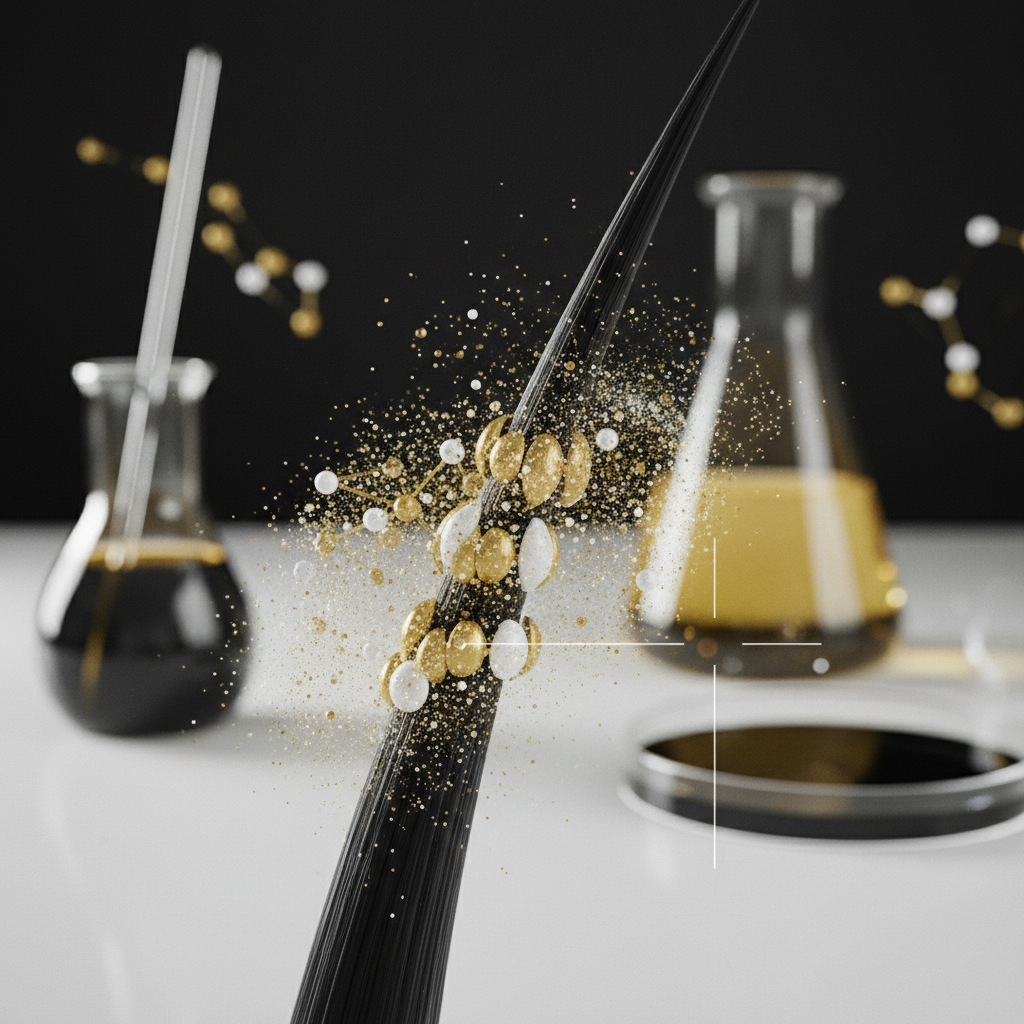
Many hydrolysed proteins carry a net positive (cationic) charge at the slightly acidic pH (4.5 to 5.5) typical of hair conditioners. This opposite charge creates strong electrostatic attraction, drawing the protein peptides directly to the damaged, negatively charged sites along the shaft.
Once there, the peptides perform two roles based on molecular weight:
- Low molecular weight (under 1,000 Daltons): These micro-peptides diffuse between cuticle gaps into the cortex. They act as humectants, binding water internally to improve fibre plasticity.
- Medium to high molecular weight (1,500 to 5,000 Daltons): These form a cohesive, semi-permeable protective film across the cuticle. This shield smooths the surface, reduces friction between adjacent hairs, and lowers comb force.
| Protein Type | Typical Molecular Weight | Primary Mechanism | Best Hair Profile |
|---|---|---|---|
| Hydrolysed Keratin | 500 to 2,000 Daltons | Direct cortex penetration; mimics natural hair composition | Bleached, chemically relaxed, or heat-damaged hair |
| Hydrolysed Wheat Protein | 1,000 to 3,000 Daltons | Moisture retention; increases tensile strength and body | Fine, limp, or moderately porous hair |
| Hydrolysed Silk | 500 to 1,500 Daltons | Smooth film formation; high lustre and slip | Rough, frizzy, or high-friction hair |
| Hydrolysed Rice Protein | 1,500 to 3,000 Daltons | Surface volume enhancement; flexibility | Low-density, fine, or flat hair |
| Hydrolysed Soy Protein | 1,000 to 2,500 Daltons | Elasticity support; reduces combing damage | Coarse, brittle, or chemically treated curls |
Identifying when your hair needs protein
Hair speaks through physical behaviour. When hair lacks protein, its structural framework is compromised.
Key signs your hair requires protein support include:
- Gumminess when wet: If wet strands stretch excessively and do not bounce back, or feel mushy between your fingertips, the internal matrix lacks structural integrity.
- Excessive snapping during styling: Hair breaks with minimal tension during brushing or detangling.
- High porosity: Hair absorbs water instantly in the shower, dries unevenly, and tangles constantly due to lifted, broken cuticles.
- Loss of curl definition: Naturally curly or wavy hair appears limp, stringy, and fails to hold its pattern.
Conversely, overusing concentrated protein without sufficient water and emollients leads to "protein overload." When this occurs, hair feels dry, brittle, stiff, and straw-like. Brushing causes rigid snapping rather than soft flex.
How to use hydrolysed protein effectively
To get the most out of hydrolysed proteins, match the formulation strength to your hair's processing history:
- Assess damage level: If hair has undergone high-lift bleaching, perming, or frequent 200°C heat styling, prioritise leave-in or rinse-off treatments containing hydrolysed keratin or wheat protein high on the ingredients list.
- Balance with moisture: Always pair protein treatments with humectants (like glycerin or panthenol) and fatty alcohols (like cetyl or stearyl alcohol). This prevents the rigid protein film from snapping under tension.
- Control frequency: Use intensive protein masks once every two to four weeks for maintenance, or once weekly for severely compromised hair. For daily care, rinse-off conditioners with lower protein concentrations provide continuous defence without stiffness.
- Mind the pH: Ensure leave-in protein formulas operate at an acidic pH (between 4.0 and 5.5). This contracts the cuticle, locking the deposited peptides securely inside the fibre.
When breakage stems from other causes
If protein treatments fail to stop breakage, look elsewhere. Mineral deposits from hard water (calcium and magnesium carbonate) crystallise on the hair shaft, making it stiff and brittle regardless of protein content. In these cases, a chelating wash must precede protein application.
Additionally, excessive physical traction from tight hairstyles, unbuffered heat tools above 220°C, or aggressive dry brushing can snap completely healthy hair that has zero protein deficiency.
When to seek professional advice
If your hair is shedding in large clumps from the scalp, leaves round bald patches, or if you notice visible scalp inflammation, burning, or flaking, stop self-treating with cosmetic protein products. These are medical symptoms indicative of telogen effluvium, alopecia areata, androgenetic alopecia, or scalp dermatitis. Consult a dermatologist or an accredited trichologist for a clinical diagnosis.
Watermans approaches to hair fibre support
Watermans designs haircare formulas that address hair fibre integrity alongside scalp vitality. For those managing fragile strands prone to mechanical snapping, Watermans products incorporate nourishing botanical extracts, essential amino acids, and balanced proteins designed to reinforce the hair shaft. By combining these structural components with gentle, sulphate-free cleansing bases, Watermans helps support stronger-feeling, fuller-looking hair without disturbing the scalp barrier or leaving the stiff residue often associated with unbuffered protein treatments.
Frequently asked questions about Hydrolysed Protein in Hair Care
Can hydrolysed protein repair hair permanently?
No. Hydrolysed Protein in Hair Care provides temporary cosmetic reinforcement rather than permanent biological repair. The peptides bind to the hair shaft via hydrogen and ionic bonds, meaning they gradually wash away with shampoos and environmental wear. Continuous use of balanced formulations is required to maintain strength.
Does hydrolysed protein cause hair to snap?
Hydrolysed protein itself does not damage hair, but overusing it without balancing emollients and moisture causes a buildup of rigid protein films. This makes the fibre excessively stiff and inflexible, leading to brittleness and breakage when combed. Alternating protein with hydrating conditioners prevents this issue.
Can I leave hydrolysed protein in my hair overnight?
It is generally unnecessary and potentially counterproductive. Most hydrolysed protein conditioners and treatments deposit their active peptides within 5 to 20 minutes. Leaving wet protein treatments on overnight can disrupt the hair cuticle through prolonged swelling (hygral fatigue) and lead to uneven, stiff drying.
What is the difference between keratin and hydrolysed keratin?
Whole keratin is a dense, insoluble protein with a molecular weight too large to penetrate hair. Hydrolysed keratin has undergone chemical or enzymatic breakdown, cutting it into tiny, soluble peptide chains that can actually fit between cuticle scales and bond with the damaged cortex.
Is hydrolysed protein suitable for low-porosity hair?
Yes, but in moderation and with small molecular sizes. Low-porosity hair has tightly sealed cuticles, so large protein molecules tend to sit on the surface, causing stiffness and buildup. Those with low porosity benefit most from very small peptides, such as hydrolysed silk, used infrequently.
Summary: the role of Hydrolysed Protein in Hair Care
Hydrolysed Protein in Hair Care serves as a scientifically proven, indispensable tool for managing structural cuticle erosion and cortex depletion. By breaking massive organic proteins down into bio-compatible peptides, modern haircare can temporarily fill microscopic cracks, increase tensile resilience, and dramatically curb mechanical breakage. When used thoughtfully, balanced with conditioning moisture, and kept clear of unrealistic claims regarding follicle growth, hydrolysed proteins provide the scaffolding damaged hair needs to look and feel resilient.
Sources and references
- Journal of Cosmetic Science: "Penetration of hydrolyzed proteins into hair fibres", 2004.
- International Journal of Cosmetic Science: "Hair breakage and protein adsorption in damaged hair fibres", 2010.
- Cosmetic Science and Technology: Theoretical Principles and Applications, Elsevier, 2017.
- Society of Cosmetic Scientists (SCS): "Proteins and Peptides in Hair and Skin Formulations", 2019.
Find these ingredients in Watermans products
- Panthenol (Provitamin B5): you will find this ingredient in our Heat Protection Spray.