Hydrolysed Keratin vs Plant Proteins: The Science of Hair Fibre Repair
10 min read ·
Comparing hydrolysed keratin vs plant proteins: explore their molecular differences, structural benefits, amino acid profiles, and performance on damaged hair.
Quick answer: Comparing Hydrolysed Keratin vs Plant Proteins reveals distinct functional roles in cosmetic haircare. Hydrolysed keratin closely mirrors the natural amino acid fingerprint of human hair, making it exceptionally effective at binding to porous, chemically bleached or heat-damaged cuticles to reduce fibre breakage. Plant proteins (such as wheat, soy, pea, and rice) offer outstanding film-forming hydration, tensile flexibility, and lightweight volume without animal derivatives. However, neither ingredient permanently repairs structural disulfide bonds or treats medical hair loss at the follicle level.
Key takeaways
- Amino acid homology: Hydrolysed keratin possesses high amounts of cystine, allowing it to adhere tightly to depleted sites along damaged hair cuticles.
- Molecular weight matters: Both keratin and plant proteins must be hydrolysed (broken down into smaller peptide chains between 500 and 3,000 Daltons) to penetrate the fibre cortex rather than merely coating the surface.
- Distinct functional strengths: Keratin excels at repairing surface erosion and resisting tensile snap, whereas plant proteins excel at moisture retention, flexibility, and anti-static conditioning.
- No follicular reversal: Topical proteins reinforce the hair shaft against cosmetic breakage. They do not treat internal genetic thinning or telogen shedding.
- Vegan and ethical preference: Plant proteins offer a high-performance, renewable alternative for consumers seeking formulas free from wool, feather, or horn by-products.
Hydrolysed Keratin vs Plant Proteins: what the evidence shows
The debate surrounding Hydrolysed Keratin vs Plant Proteins centres primarily on their biochemical composition and how deeply they interact with human hair fibres.
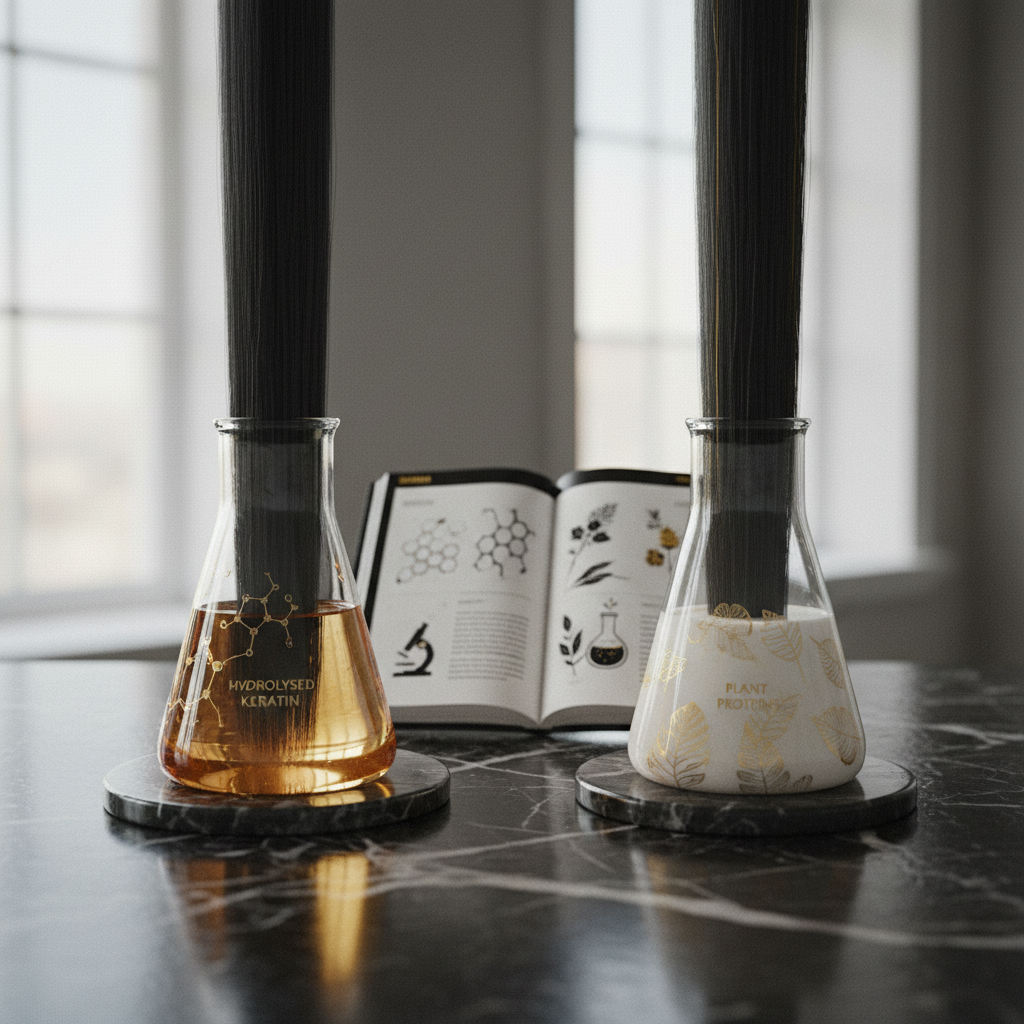
Human hair consists of roughly 85% to 90% keratin protein, rich in the sulfur-containing amino acid cystine. When cosmetic chemists hydrolyse sheep wool or poultry feather keratin into low-molecular-weight peptides, the resulting hydrolysate contains a molecular structure virtually identical to native human hair. Independent investigations published in cosmetic science literature show that hydrolysed keratin binds efficiently to the negative charges exposed along chemically lifted cuticles. This temporary electro-chemical adhesion smooths the fibre surface, decreases combing friction, and lowers the incidence of mechanical breakage.
In contrast, plant proteins are extracted from sources such as hydrolyzed wheat (Triticum vulgare), soy (Glycine soja), pea (Pisum sativum), and rice (Oryza sativa). While these botanicals possess lower levels of cystine compared to keratin, they are exceptionally rich in glutamic acid, proline, arginine, and glycine. Wheat protein hydrolysates demonstrate strong moisture-binding capacity, retaining water inside the hair cortex even in low-humidity environments. Pea and rice proteins create elastic, weightless films around individual strands, boosting strand diameter and delivering noticeable body to fine or limp textures without leaving a rigid residue.
The scientific consensus confirms that both ingredient categories significantly improve the mechanical properties of damaged hair. Keratin delivers slightly superior resistance to wet friction and tensile snapping, while plant proteins provide superior hydration, natural movement, and curl bounce.
| Property | Hydrolysed Keratin | Hydrolysed Plant Proteins (Wheat, Pea, Rice, Soy) |
|---|---|---|
| Primary Source | Animal by-products (sheep wool, poultry feathers) | Botanical grains and legumes (wheat, peas, rice, soybeans) |
| Key Amino Acids | High in cystine and cysteine; mirrors human hair | High in glutamic acid, arginine, proline, and glycine |
| Primary Mechanism | Electrostatic patching of eroded cuticle gaps | Film-forming moisture barrier and cortex hydration |
| Best Used For | Bleached, chemically relaxed, or severely heat-damaged hair | Dry, brittle, fine, or dehydrated hair needing body and elasticity |
| Vegan Suitability | No (animal derived) | Yes (100% plant derived) |
| Breakage Reduction | High (fortifies weakened structural matrix) | Moderate to high (improves flexibility and reduces snap) |
| Fibre Stiffness Risk | Moderate if overused without balancing emollients | Low; generally leaves a softer, more pliable feel |
Understanding the mechanism: molecular weight and penetration
Whether you choose keratin or plant extracts, protein performance depends entirely on the degree of hydrolysis. Intact, unhydrolysed proteins have molecular weights exceeding 100,000 Daltons. These massive molecules cannot pass beneath the cuticle scale; they remain on the outside, creating a stiff, brittle coating that flakes off when brushed.
To exert true conditioning benefits, proteins undergo enzymatic or acid hydrolysis to fragment into smaller peptides:
- Sub-1,000 Daltons: Peptides in this range (roughly 500 to 1,000 Daltons) penetrate past the cuticle scales and migrate into the porous cortex of bleached or relaxed fibres. Here, they temporarily hydrogen-bond to internal keratin filaments, increasing tensile strength and helping the hair retain internal water.
- 1,000 to 3,000 Daltons: Intermediate peptides form a protective cross-linked film over raised cuticle edges. They fill in micro-cracks created by hot tools and oxidative hair dyes.
- Above 3,000 Daltons: These chains remain primarily surface-active, providing slip, shine, and static reduction.
Plant proteins, particularly hydrolysed wheat and rice, are engineered precisely into these lower Dalton bands, enabling them to match keratin's cortex-reinforcing capabilities without relying on animal sources.
What the evidence does not show
There are persistent myths regarding protein treatments that scientific testing does not support.
First, cosmetic proteins cannot permanently "repair" or stitch split ends back together. Split ends represent irreversible mechanical cleavage of the fibre. While hydrolysed proteins and conditioning polymers temporarily paste fractured split ends together until the next wash, only physical shears can remove them.
Second, topical protein cannot regrow hair from an empty follicle. Follicular growth is governed by cellular pathways in the dermal papilla, vascular blood supply, hormonal interactions (such as dihydrotestosterone), and nutritional status. Applying hydrolysed keratin or wheat protein to the scalp conditions the emerging fibre, but it will not alter genetic female or male pattern hair loss.
Third, the concept of "protein overload" is frequently misunderstood. Hair that feels brittle and straw-like after intensive protein treatments is typically experiencing a temporary deficit in plasticising lipids and moisture, not an irreversible structural ruin. Washing with a clarifying shampoo and following with a fatty-alcohol conditioner promptly restores tactile softness.
Signs your hair needs protein vs moisture
Determining whether to reach for a keratin-dense regimen or a botanical protein formula depends on how your hair responds to touch and tension:
- High porosity and mushy texture: If your hair stretches excessively when wet, feels gummy or mushy, and snaps without returning to its original length, the internal cortex is protein-depleted. Hydrolysed keratin provides the dense, targeted scaffolding required to pull the fibre back into structural stability.
- Dry, stiff, and unyielding: If your hair feels coarse, makes a crinkling sound when squeezed, and snaps instantly under minimal stretch, it lacks moisture and lubrication. Heavy keratin applications can make this state worse. A lightweight hydrolysed pea, rice, or wheat protein blend combined with hydrating humectants helps restore elastic rebound.
- Dull, flyaway, and static-prone: Cuticle erosion from regular blow-drying leaves fibres with an unchecked negative surface charge. Both keratin and plant proteins neutralise this friction, although plant proteins often provide a lighter, more touchable finish for everyday maintenance.
Practical steps: how to incorporate hydrolysed proteins
To maximise benefits while avoiding stiffness, use protein products intentionally based on your hair's mechanical state:
- Assess processing history: If your routine involves lightening powders, permanent wave solutions, or high heat exceeding 200 degrees Celsius, introduce hydrolysed keratin treatments once every two to three weeks to mitigate structural breakdown.
- Layer with humectants and emollients: Never use pure protein rinses in isolation. Ensure your leave-in formulas and deep conditioners pair hydrolysed proteins with fatty alcohols (cetyl or cetearyl alcohol) and plant oils to maintain moisture equilibrium.
- Opt for plant proteins for daily styling: For fine, low-density, or wavy hair types prone to looking flat, plant proteins (such as hydrolysed soy or rice) are ideal for daily or frequent washing because they condition without building up heavy structural residue.
- Clarify periodically: Use a gentle, chelating or clarifying shampoo once a month to remove residual surface peptides and mineral buildup from hard wash water.
When breakage is actually hair loss
It is critical to distinguish between hair fibre breakage and root shedding:
- Hair breakage: Short, uneven fragments found on your shoulders, pillowcase, or bathroom counter without a white bulb at the tip. This is a cosmetic, fibre-level issue caused by mechanical, thermal, or chemical trauma. Hydrolysed proteins directly reduce this damage.
- Hair shedding (Telogen Effluvium): Long strands coming out during brushing or washing with a small, rounded white keratin bulb at the root. This indicates a disruption in the biological follicular cycle, often triggered by severe physiological stress, illness, rapid weight loss, or thyroid changes.
- Alopecia: Progressive widening of the part line, temple recession, or distinct circular patches. These patterns involve follicular miniaturisation or immune reactions. Protein shampoos cannot restore miniaturised follicles.
If you observe progressive thinning at the scalp or excessive root shedding exceeding 100 to 150 hairs daily for more than eight weeks, consult a registered trichologist or a board-certified dermatologist.
Supporting hair density and fibre strength with Watermans
While selecting between hydrolysed keratin and botanical proteins addresses the external cosmetic condition of your lengths, long-term hair quality requires a healthy scalp environment. Watermans GrowMe Shampoo brings together hydrolysed lupin protein alongside targeted scalp actives including caffeine, biotin, rosemary extract, niacinamide, and allantoin.
Hydrolysed lupin protein is rich in peptides and glutamine, functioning alongside moisturising conditioning agents to reinforce fragile hair against brushing stress while keeping the scalp clean, balanced, and invigorated. Pairing targeted protein-rich wash products with evidence-based styling habits ensures that new hair growth is supported directly from root to tip.
Frequently asked questions about Hydrolysed Keratin vs Plant Proteins
Can plant proteins fully replace hydrolysed keratin in hair products?
Yes, for the vast majority of consumers, plant proteins can successfully replace keratin. Modern hydrolysed wheat, soy, and pea proteins are engineered to mirror the molecular weights required to penetrate the cortex and seal cuticles. While keratin holds a minor advantage in raw cystine content for severely bleached hair, plant proteins offer comparable tensile reinforcement, superior hydration, and complete compatibility with vegan lifestyles.
When comparing Hydrolysed Keratin vs Plant Proteins, which is better for fine hair?
Hydrolysed plant proteins, especially rice and pea peptides, are typically better suited for fine hair. They form ultra-light, flexible films around the hair shaft that add perceptible body, volume, and static resistance without weighing the hair down. Hydrolysed keratin can occasionally feel too heavy or stiff on fine hair if applied in concentrated leave-in treatments.
Will hydrolysed proteins make my hair feel dry and brittle?
Only if used excessively or without balancing moisturising agents. When low-molecular-weight proteins settle into damaged hair gaps without sufficient lipids or water-binding ingredients, the fibre can temporarily feel stiff. This is easily corrected by reducing the frequency of protein treatments and following up with a deeply hydrating, emollient conditioner.
Can hydrolysed protein products fix split ends permanently?
No topical protein product can permanently repair split ends. Hydrolysed proteins work by smoothing the cuticle and temporarily bonding the fractured edges of the hair shaft, which helps prevent the split from travelling further up the strand. However, these cosmetic bonds wash out over time. A professional trim is the only permanent solution for split ends.
Do protein treatments stimulate new hair growth from the scalp?
No. Topical protein hydrolysates improve the cosmetic integrity, elasticity, and tensile strength of the existing dead hair shaft, effectively preventing snap-breakage. They do not alter follicle behaviour, reverse pattern hair loss, or stimulate dormant dermal papilla cells to produce new hair fibres.
Summary
Deciding between Hydrolysed Keratin vs Plant Proteins comes down to your personal ethical priorities, hair texture, and the extent of cosmetic damage you are addressing. Hydrolysed keratin remains a gold standard in intensive salon repair for chemically depleted, highly porous hair due to its natural biological mimicry of human fibre. Meanwhile, hydrolysed plant proteins deliver an exceptionally versatile, sustainable, and hydrating alternative that imparts lightweight body, elastic bounce, and protection across all hair patterns. By tailoring your protein regimen to your hair's specific porosity and balancing it with emollient moisture, you can keep your strands resilient, smooth, and fortified against everyday breakage.
Sources and references
- Robbins, C. R. (2012). Chemical and Physical Behavior of Human Hair. 5th Edition, Springer-Verlag.
- Cruz, C. F., et al. (2016). "Human Hair Keratin and its Hydrolysates: Preparation, Characterization, and Applications in Cosmetic Formulations." International Journal of Cosmetic Science, 38(4), 323-335.
- Barba, C., et al. (2010). "Peptide delivery into human hair from plant and animal protein hydrolysates." Journal of Applied Polymer Science, 115(2), 1042-1048.
- Cosmetic Ingredient Review (CIR) Expert Panel. (2014). "Safety Assessment of Hydrolysed Wheat Protein and Hydrolysed Wheat Gluten as Used in Cosmetics." CIR Reports.
- Dawber, R. (1996). "Hair: Its structure and response to cosmetic preparations." Clinics in Dermatology, 14(1), 105-112.
Find these ingredients in Watermans products
- Niacinamide: you will find this ingredient in our Hair Mask.
- Wheat Amino Acids: you will find this ingredient in our Heat Protection Spray.