How to Treat Hygral Fatigue: Science, Symptoms, and Fibre Repair
8 min read ·
Learn how to treat hygral fatigue by restoring hair protein balance, using pre-wash oils to limit water uptake, and preventing cuticle damage from over-moisturising.
Quick answer: Knowing how to treat hygral fatigue requires shifting your routine away from constant water absorption toward fibre reinforcement and moisture regulation. Hygral fatigue occurs when the hair shaft repeatedly swells and contracts from excess water, degrading the cell membrane complex and weakening the cuticle. To correct it, incorporate hydrolysed protein treatments, shorten washing sessions, use penetrating oils such as coconut oil to limit water uptake, and balance your hair's pH. However, severely fractured fibres cannot fully regenerate and must eventually be trimmed away.
Key takeaways
- Hygral fatigue is structural cuticle and cortex damage caused by continuous, excessive swelling and deswelling of the hair fibre in water.
- Over-moisturising, prolonged soaking, and sleeping with wet hair are the primary behavioural drivers.
- Hydrolysed proteins and amino acids temporarily reinforce the internal structure and restore tensile resistance.
- Penetrating pre-shampoo oils help limit the volume of water entering the inner cortex during washing.
- Hygral fatigue causes hair breakage along the shaft; it does not originate at the follicle and does not cause follicular hair loss or shedding.
How to Treat Hygral Fatigue: what the evidence shows
Understanding how to treat hygral fatigue starts with recognising the biological limits of the hair shaft. Hair is dead keratinised tissue. Once damaged, it cannot biologically heal itself, so treating hygral fatigue means managing the mechanical environment to arrest further degradation and using cosmetic chemistry to reinforce the weakened fibre.
The first intervention supported by cosmetic science is the application of low-molecular-weight hydrolysed proteins. Proteins derived from wheat, silk, or keratin penetrate beneath the cuticle into the outer cortex, forming temporary hydrogen and ionic bonds. This strengthens the hair shaft, reduces elasticity, and helps restore stiffness to fibres that have become limp and mushy from repeated water saturation.
The second evidence-based strategy involves using penetrating lipid treatments prior to washing. Non-polar oils rich in medium-chain triglycerides, most notably coconut oil, possess a high affinity for hair proteins and can diffuse into the cortex. By partially occupying space within the inner fibre, these lipids significantly reduce the amount of water the cortex can absorb. This limits the excessive radial swelling that strains the cuticle tiles.
Third, adjust the pH of your washday products. The hair fibre sits at an isoelectric point of roughly pH 3.67, while a cosmetic pH between 4.5 and 5.5 keeps the outer cuticle layer compact and flat. Alkaline water or clarifying cleansers lift the cuticle, allowing water to rush into the cortex unchecked. Finishing your wash routine with an acidic leave-in or conditioning rinse contracts the cuticle cells, lowering porosity and slowing moisture exchange.
The mechanism: what causes hygral fatigue?
To resolve this condition, you must understand the underlying biophysics of hair wetting. Normal hair is naturally hygroscopic, meaning it absorbs water vapour and liquid water easily. When exposed to water, a healthy hair fibre can absorb up to 30 percent of its dry weight in water, expanding roughly 14 to 16 percent in diameter while increasing only 1 to 2 percent in length.
This radial expansion pushes the overlapping cuticle scales outward. When the hair dries, the cortex shrinks back to its original dimensions, pulling the cuticle flat again.
Hygral fatigue develops when this cycle happens too frequently, too rapidly, or across excessive durations. The repetitive mechanical stress wears down the cell membrane complex (CMC), the lipid-rich intercellular cement that bonds the cuticle layers together and anchors them to the cortex. Over time, the CMC breaks down, cuticles lift and chip away, and the cortex loses its structural resilience. The fibre is left chronically porous, fragile, and unable to maintain its natural curl or wave pattern.
Signs of hygral fatigue versus protein overload
Because both conditions lead to hair breakage, stylists and consumers frequently confuse hygral fatigue with protein overload. Treating one like the other inevitably worsens the structural damage.
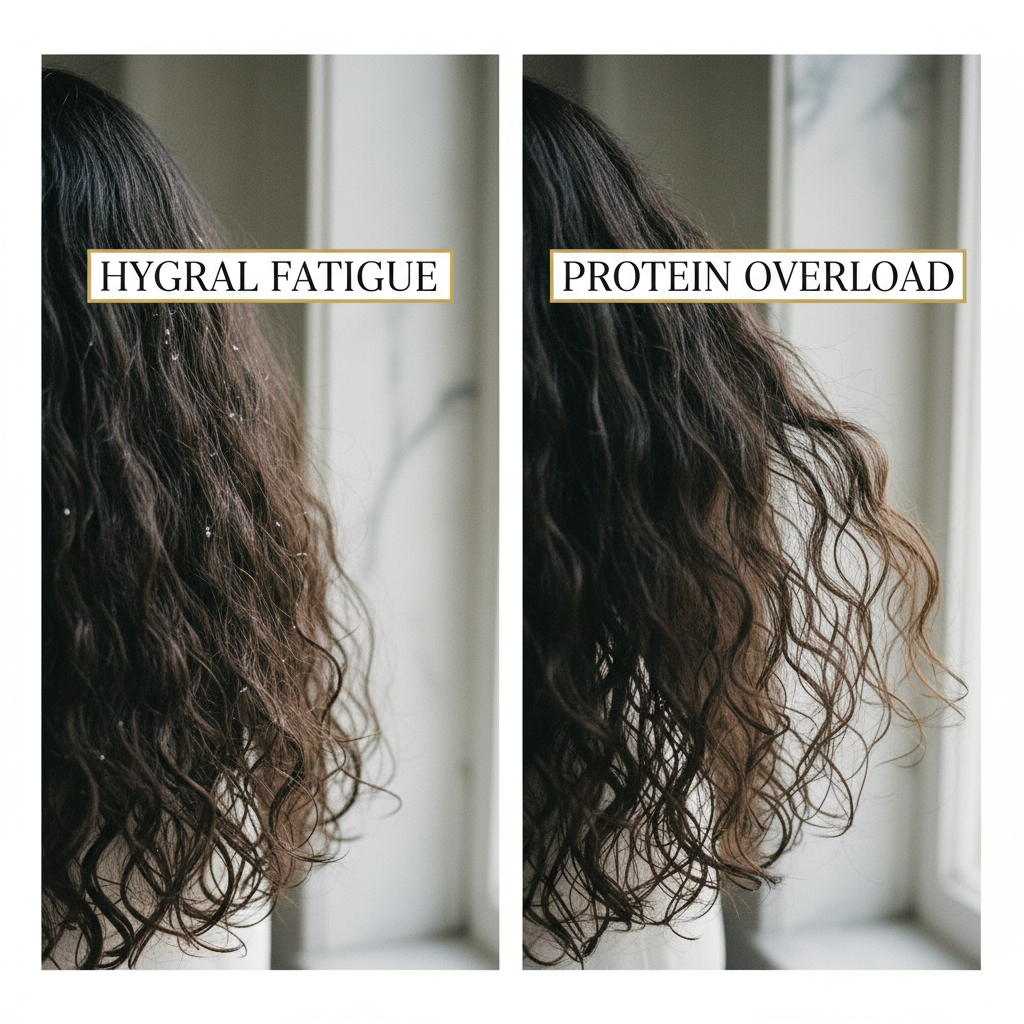
| Characteristic | Hygral Fatigue | Protein Overload |
|---|---|---|
| Feel when wet | Mushy, gummy, limp, excessively soft | Stiff, rough, straw-like, coarse |
| Feel when dry | Lifeless, flat, fluffy, lacks definition | Brittle, scratchy, easily snags |
| Elasticity | Stretches far beyond normal length before snapping; fails to bounce back | Barely stretches at all; snaps immediately under slight tension |
| Primary cause | Excessive soaking, daily deep conditioning, high porosity | Excessive leave-in keratin treatments, lack of emollients |
| Immediate remedy | Hydrolysed protein treatments, penetrating pre-poo oils, acidic rinses | Clarifying wash, deep conditioning without protein, emollients |
Practical steps: what you can do
Halting hygral fatigue requires a structured change in your weekly routine. You can nurse the hair back to functional strength using these specific measures:
- Eliminate overnight conditioning: Never leave deep conditioners, masks, or wet hair caps on overnight. Hair should not remain saturated with water for longer than 30 to 45 minutes during any treatment.
- Apply a pre-shampoo oil barrier: Coat dry mid-lengths and ends with pure coconut oil 30 to 60 minutes before entering the shower. The oil penetrates the cuticle, filling voids in the cortex to physically block excess water uptake.
- Introduce hydrolysed protein masks: Use a protein-rich treatment every 2 to 3 washes until the fibre regains its spring and tensile strength. Look for hydrolysed wheat protein, hydrolysed silk, or keratin amino acids high on the ingredient list.
- Shorten total wash time: Minimise the time your hair spends wet. Gently squeeze out excess water with a microfibre towel or cotton cloth immediately after washing, rather than leaving hair wrapped in a sodden towel.
- Blow-dry gently on low to medium heat: Leaving hair to air-dry over 4 to 8 hours prolongs the swollen state of the cortex. Using a hairdryer on a low-heat, low-speed setting with a heat protectant dries the inner cortex safely, returning the fibre to its resting dimensions faster.
- Maintain an acidic pH balance: Choose rinse-out conditioners and leave-in sprays with an acidic pH (4.0 to 5.5) to keep the cuticular tiles sealed tightly against the cortex.
When the cause may be something else
If your hair appears dull, limp, or snaps when handled, hygral fatigue is a strong candidate, but several other structural and medical issues produce overlapping symptoms:
- Severe bleach or chemical damage: High-lift bleach destroys disulphide bonds inside the cortex. Bleached hair behaves similarly to hygral fatigue (becoming stretchy and gummy when wet), but the primary cause is chemical oxidation rather than solely water-induced mechanical stress.
- Hard water mineral buildup: Calcium and magnesium ions bind to the hair shaft, forming a brittle shell that prevents proper moisture absorption and causes the hair to snap. A chelating treatment is required here, not protein.
- Telogen effluvium or follicular thinning: Hygral fatigue produces hair breakage (fractures along the shaft). If you notice whole strands falling out from the root, characterised by a white bulb at the tip, this is shedding or hair loss originating in the follicle. Water absorption does not cause follicular shedding.
When to seek professional advice
Consult a qualified trichologist or an experienced salon stylist if your hair continues to break off despite 4 to 6 weeks of protein-moisture balancing routines. A trichologist can examine the fibre under a digital trichoscope to verify whether the cuticle has stripped away entirely (weathering) or whether internal cortical fractures like trichorrhexis nodosa are present.
If the cuticle layer has degraded completely, no cosmetic formulation can rebuild it. In those instances, a stylist will need to trim the compromised lengths to prevent splits from migrating upward toward healthy new growth.
Watermans: supporting fibre resilience
While cosmetic products cannot regenerate dead hair tissue, balanced formulations help maintain an optimal environment for healthy-feeling lengths and a clean scalp. Watermans hair care products are engineered to support hair strength, reduce breakage, and promote thicker-, fuller-looking hair without disrupting your moisture balance. Incorporating gentle, nutrient-rich cleansing helps clear styling residue and surface impurities while respecting the delicate outer layers of the hair shaft.
Frequently asked questions about How to Treat Hygral Fatigue
How long does it take to treat hygral fatigue?
Most people see a noticeable improvement in elasticity and hair strength within 2 to 4 weeks of modifying their routine. This timeline requires using weekly hydrolysed protein treatments, applying pre-shampoo oils, and halting prolonged wetting habits like overnight masking. However, hair fibres with severe structural cuticle loss must eventually be trimmed as new hair grows in from the scalp.
Can olaplex or bond builders fix hygral fatigue?
Bond-building treatments focus on reforming broken disulphide bonds within the cortex, which is beneficial if chemical services contributed to the damage. However, when figuring out how to treat hygral fatigue, bond builders alone are not enough. You must pair them with hydrolysed proteins to restore tensile rigidity and lipid barriers to stop excess water penetration.
Does hygral fatigue cause permanent hair loss?
No. Hygral fatigue causes hair breakage along the length of the shaft; it does not affect the hair follicle or trigger alopecia. Because the root remains unaffected, your hair will continue to grow from the scalp at its normal rate. The loss of density associated with hygral fatigue is caused entirely by mechanical snapping of the weakened mid-lengths and ends.
Should I stop washing my hair completely to treat hygral fatigue?
No. Stopping washing allows sebum, dead skin cells, and micro-organisms to accumulate on the scalp, which can lead to scalp irritation. Instead, maintain a normal cleansing cadence of 2 to 3 times per week, but shorten shower duration, use pre-shampoo oils, and avoid letting your hair stay damp for hours.
Actionable steps on how to treat hygral fatigue
Successfully mastering how to treat hygral fatigue relies on discipline, not a product overload. Focus on protecting the internal architecture of the hair shaft: cut down water contact time, use coconut oil as a mechanical shield prior to shampooing, and rebuild tensile balance with hydrolysed protein formulations. By respecting the natural limits of the hair fibre and sealing the cuticle at an optimal acidic pH, you can halt ongoing breakage and protect your lengths as healthy hair continues to grow.
Sources and references
- Robbins, C. R. (2012). Chemical and Physical Behavior of Human Hair (5th ed.). Springer-Verlag.
- Ruetsch, S. B., Kamath, Y. K., Rele, A. S., & Mohile, R. B. (2001). Secondary ion mass spectrometric investigation of penetration of coconut and mineral oils into human hair fibres: its relevance to hair damage. Journal of Cosmetic Science, 52(3), 169-184.
- Gavazzoni Dias, M. F. (2015). Hair cosmetics: an overview. International Journal of Trichology, 7(1), 2-15.
- Evans, T., & Wickett, R. R. (2012). Practical Modern Hair Science. Allured Business Media.