How to Protect the Hair Cuticle: A Guide to Preventing Damage
9 min read ·
Learn how to protect the hair cuticle from chemical, thermal, and friction damage using evidence-based handling, correct pH balance, and targeted conditioning.
Quick answer: Learning how to protect the hair cuticle requires shielding the outermost layer of overlapping keratin cells from friction, chemical erosion, and excessive thermal energy. The cuticle serves as your hair shaft's primary biological armour, maintaining moisture balance and tensile strength. Because the hair fibre is biologically non-living tissue, once cuticle scales chip, lift, or break away entirely, the body cannot regenerate them. True protection depends on preventative handling, maintaining an acidic pH between 4.5 and 5.5, and regular cosmetic conditioning.
Key takeaways
- The hair cuticle consists of 5 to 10 overlapping layers of flat, keratinised cells that protect the delicate inner cortex.
- Hair fibre is dead tissue, meaning worn or missing cuticle scales cannot heal or regenerate biologically.
- Healthy cuticle scales lie flat at a slightly acidic pH of 4.5 to 5.5, whereas alkaline water and treatments force them to flare open.
- Physical friction from rough towel-drying, aggressive detangling, and heat over 180°C are the primary causes of mechanical cuticle erosion.
- Conditioning agents, plant oils, and film-forming polymers coat the cuticle to lower surface friction and temporarily patch structural gaps.
How to Protect the Hair Cuticle: what the evidence shows
Learning how to protect the hair cuticle begins with understanding its physical anatomy. The cuticle forms the outermost protective sheath of the hair shaft. Under an electron microscope, it resembles roof tiles or fish scales, stacked in 5 to 10 layers pointing towards the hair tip.
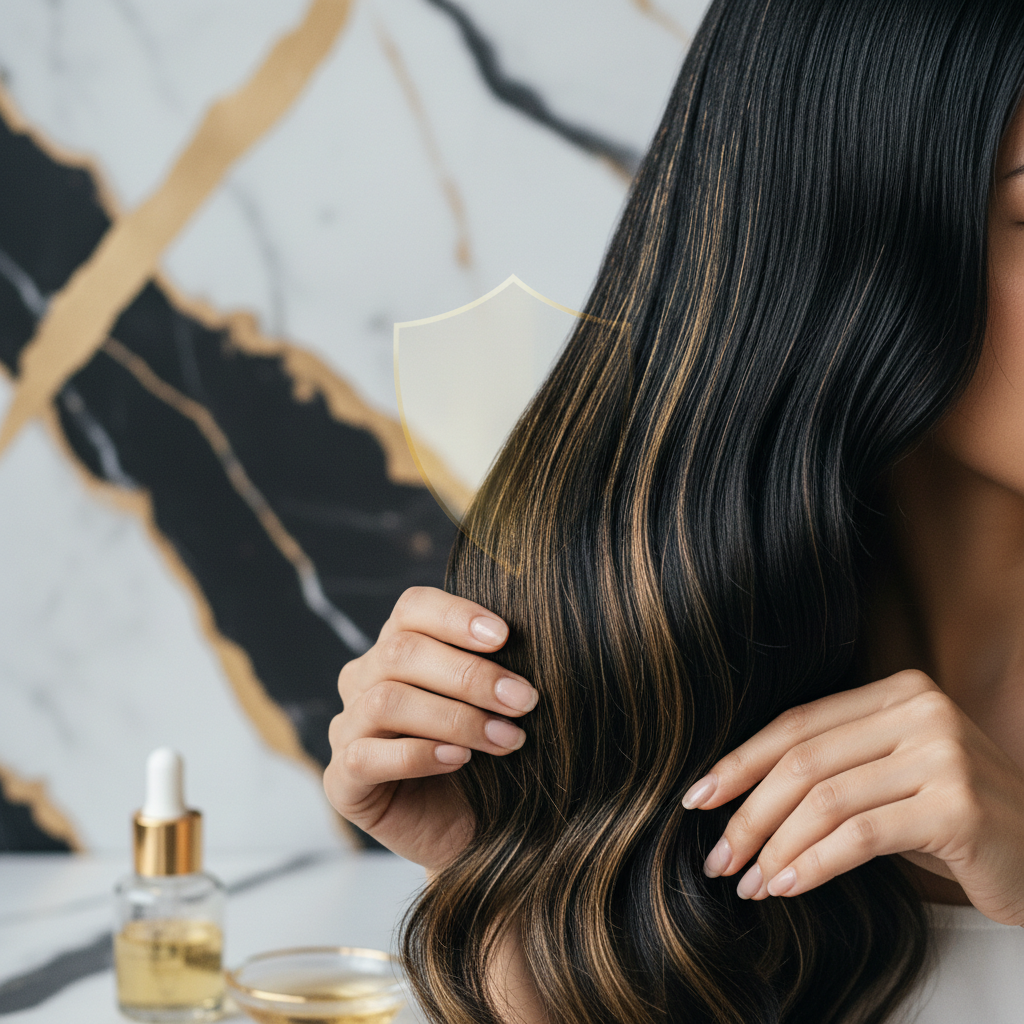
Each cuticle cell contains three distinct sub-layers: the protective epicuticle, the hard exocuticle, and the softer endocuticle. The epicuticle is coated in the 18-methyleicosanoic acid (18-MEA) lipid layer. This thin, covalently bound lipid membrane makes healthy hair naturally water-repellent (hydrophobic), silky to the touch, and resilient against mechanical friction.
 HAIR SHAFT CROSS-SECTION
 ┌──────────────────────────────────────┐
 │ CUTICLE │ <- 5 to 10 overlapping cell layers
 │ ┌────────────────────────────────┐ │ coated with 18-MEA lipid layer
 │ │ CORTEX │ │ <- Contains structural keratin coils
 │ │ ┌──────────────────────────┐ │ │ and natural melanin pigments
 │ │ │ MEDULLA │ │ │ <- Central hollow core
 │ │ │ │ │ │ (absent in fine hair)
 │ │ └──────────────────────────┘ │ │
 │ └────────────────────────────────┘ │
 └──────────────────────────────────────┘
When you subject your hair to chemical processes, ultraviolet light, or mechanical shearing, this hydrophobic lipid layer strips away first. Research published in the International Journal of Trichology demonstrates that once 18-MEA is lost, the cuticle becomes hydrophilic (water-absorbing). This allows water to rush into the inner cortex, causing the shaft to swell and shrink repeatedly during washing, an ongoing cycle known as hygral fatigue.
Repeated swelling forces the cuticle edges to lift and curl outward. As neighbouring fibres rub together, raised cuticle margins catch on each other, chipping fragments off the shaft. To prevent this cascade, daily hair care must prioritise surface lubrication, gentle detangling, and strict pH management.
What the evidence does not show
There is no scientific evidence that any cosmetic product, oil, or supplement can permanently "repair" or regrow a destroyed hair cuticle. The hair shaft visible outside the scalp consists of non-living, non-vascular keratinised cells. While marketing claims often boast about "healing" split ends, cosmetic formulations can only temporarily glue, seal, or lubricate fractured scales.
Furthermore, evidence does not show that natural ingredients are universally safer for the cuticle than synthetic compounds. For example, applying pure baking soda (sodium bicarbonate) with a high pH of roughly 8.3 to 9.0 strips the 18-MEA layer and severely lifts cuticle tiles. Similarly, raw acidic lemon juice with a pH of roughly 2.0 can weaken protein bonds. Balanced cosmetic chemistry is consistently safer than unbuffered kitchen remedies.
The mechanism: why cuticle layers lift, crack, and break
Cuticle integrity relies directly on chemical bonding and charge distribution. A healthy hair cuticle carries an overall negative electrical charge. When hair is clean, hydrated, and sitting at an optimal acidic pH of 4.5 to 5.5, the cuticle scales lie tightly compressed against the cortex.
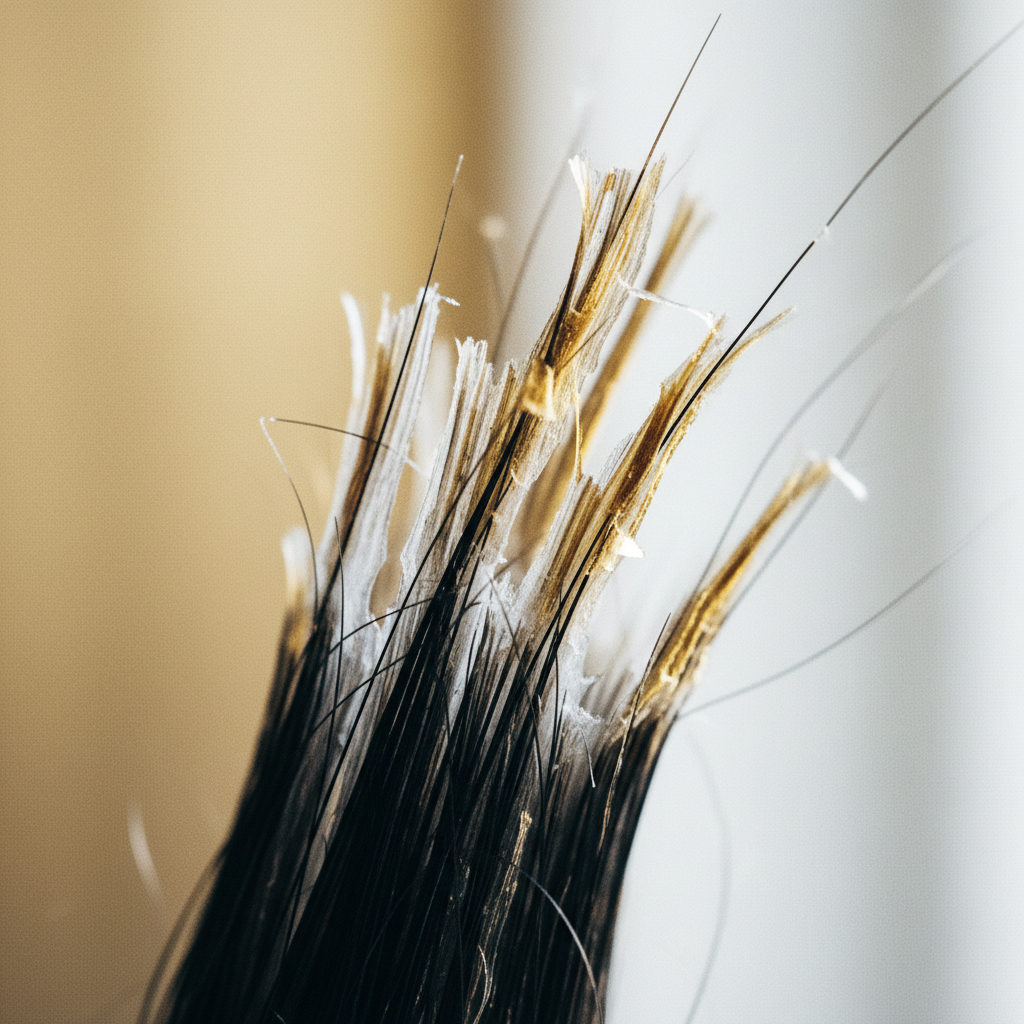
HEALTHY CUTICLE (Acidic pH 4.5 to 5.5)
═══════════════════════════════════
 ───> ───> ───> ───> ───> (Scales lie flat, smooth, and hydrophobic)

DAMAGED / ALKALINE CUTICLE (pH > 7.0 or Heat)
═══════════════════════════════════
 / / / / / (Scales flare open, chip, and catch on friction)
The cuticle is vulnerable to three distinct destructive forces:
- Alkaline swelling: Tap water (often pH 7.0 to 8.5) and chemical alkaline treatments (such as bleaching or ammonia-based dyes at pH 9.0 to 11.0) flood the hair with hydroxide ions. This breaks temporary ionic bonds and lifts the cuticle scales away from the shaft, leaving the cortex exposed.
- Thermal denaturation: Exposing damp hair to temperatures over 150°C flashes water trapped inside the cortex into steam, causing "bubble hair" and popping cuticle plates off the surface. Temperatures exceeding 180°C directly degrade structural alpha-keratin into disordered beta-keratin.
- Mechanical shear: Vigorous dry brushing, backcombing, and coarse cotton towels scrape the edges of raised cuticle scales. This sheer force snaps the brittle exocuticle, exposing the softer endocuticle to accelerated weathering.
| Damage Type | Primary Trigger | Effect on Cuticle | Best Preventative Measure |
|---|---|---|---|
| Chemical / Alkaline | Bleach, permanent dyes, high pH cleansers | Strips 18-MEA lipid layer, flares scales open | Use pH-balanced products (pH 4.5 to 5.5) |
| Thermal | Flat irons, curling tongs (>180°C), rough blow-drying | Blisters cuticle scales, denatures keratin protein | Apply thermal protectants, cap heat at 150°C to 175°C |
| Mechanical | Coarse cotton towels, dry brushing, tight elastics | Chips scale edges, causes friction cracks | Use microfibre towels, wide-tooth combs, silk slips |
| Environmental | Solar UV radiation, chlorinated swimming pools | Oxidises disulphide bonds, dries out epicuticle | Use leave-in UV filters, rinse hair before swimming |
Signs of cuticle erosion to watch for
You can spot cuticle damage before structural breakage snaps the hair fibre entirely. Watch for these distinct diagnostic signs:
- Tangling and snagging: Healthy cuticles glide across neighbouring strands. If your hair catches and knots continuously, raised cuticle tiles are acting like microscopic velcro hooks.
- Dull, matte appearance: Intact, flat cuticle tiles reflect light evenly like a mirror. When scales are chipped or flared, light scatters randomly, leaving hair looking lacklustre.
- Rough texture: Running your fingers from the hair tip upward towards the scalp should create slight resistance. If running your fingers downward feels coarse or raspy, the cuticle layer is degraded.
- Rapid water absorption and drying: Hair that absorbs water instantly when stepped into the shower and dries within minutes has high porosity due to widespread cuticle loss.
Practical steps to protect the hair cuticle
Protecting the cuticle requires continuous friction management and routine moisture sealing.
1. Wash with balanced formulations
Choose shampoos and cleansers formulated within the hair's natural physiological pH range (4.5 to 5.5). Avoid alkaline bar soaps or clarifying washes containing harsh surfactants that strip surface lipids. Massage the scalp with your fingertips rather than scrubbing the mid-lengths and ends together.
2. Condition after every wash
Conditioners contain cationic surfactants (positively charged molecules like behentrimonium chloride) and fatty alcohols. These molecules are electrostatically drawn to the negatively charged, damaged spots on the cuticle. They flatten lifted scales, deposit a sacrificial slip layer, and neutralise static electricity.
3. Handle wet hair with care
Hair fibre swells and loses up to a third of its tensile strength when soaked with water. Never rub wet hair with a standard terrycloth towel. Instead, squeeze excess water out gently using a smooth microfibre towel or a soft cotton t-shirt. Always detangle wet hair starting from the tips and working slowly up to the roots using a wide-tooth comb or a flexible wet detangling brush.
4. Cap thermal styling tools
Keep styling irons below 175°C, or below 150°C if your hair is fine, bleached, or fragile. Always coat damp hair with a silicone- or polymer-based heat protectant before blow-drying. These ingredients distribute thermal energy across the fibre surface, reducing hot spots that blister the cuticle.
5. Reduce overnight friction
Cotton pillowcases generate significant abrasive friction as you move during sleep. Switching to a silk or satin pillowcase allows the cuticle to glide smoothly, preventing overnight roughening and moisture loss.
When the cause may be something else: shedding vs. breakage
It is essential to distinguish between hair breakage caused by cuticle failure and actual follicular hair shedding.
When the hair cuticle is stripped bare, the cortex fractures, causing the hair shaft to snap along its length. You will find short, ragged pieces of hair without a white bulb on your shoulders, floor, or brush. This is mechanical breakage, not follicular hair loss.
In contrast, true hair shedding (such as telogen effluvium or androgenetic alopecia) originates beneath the skin at the follicle level. Shed hairs display a tiny white keratin bulb at the root, signifying that the entire hair has completed its natural growth cycle and detached from the follicle. If you notice wide patches of scalp showing or are shedding more than 100 bulb-bearing hairs daily for several weeks, the primary issue is biological shedding, not cuticle erosion.
Caring for your hair with Watermans
If you want to maintain a healthy scalp environment while shielding your lengths from everyday wear, Watermans offers targeted, balanced formulations designed to support your routine. Watermans GrowMe Shampoo is formulated to thoroughly cleanse without stripping essential moisture, delivering beneficial botanicals such as rosemary extract, biotin, and caffeine alongside hydrolysed lupin protein to support hair resilience.
Following cleansing, Watermans ConditionMe Conditioner provides the surface slip, hydration, and smoothing required to coat lifted cuticle margins. Rich in cholesterol, niacinamide, and natural plant oils, it lubricates the fibre surface, seals the outer layers against friction, and minimises the mechanical snagging that leads to breakage.
Frequently asked questions about How to Protect the Hair Cuticle
Can you repair a damaged hair cuticle permanently?
No, you cannot repair a hair cuticle permanently once it has worn away. Hair is biologically dead tissue without living cells to rebuild missing structures. Conditioning agents, proteins, and plant oils can temporarily fill gaps, coat lifted scales, and smooth the surface until your next wash, but only fresh growth from the follicle will produce an intact cuticle.
How does water temperature affect the hair cuticle?
Warm water relaxes the hair fibre slightly, making it easier for cleansers to dissolve sebum and styling residue. While cool water does not physically "close" the cuticle as a mechanical valve would, cooler water reduces fibre swelling, helping the cuticle settle flatly against the cortex during rinsing.
Does brushing wet hair damage the cuticle?
Yes, brushing wet hair can easily shear cuticle scales off the shaft. When saturated with water, the hair fibre stretches significantly under low mechanical force, making cuticle cells far more vulnerable to snapping. Detangle only with a wide-tooth comb or flexible wet brush, working gently from ends to roots.
What is the most effective way regarding How to Protect the Hair Cuticle from heat?
The most reliable method regarding how to protect the hair cuticle from heat is applying a thermal protectant and capping styling temperatures below 180°C. Thermal protectants use silicones and polymers to conduct heat slowly across the fibre, preventing the internal moisture from vaporising and blistering cuticle scales.
Can chemical dyes permanently destroy the cuticle?
Yes, permanent hair dyes and bleaches require an alkaline agent (such as ammonia or ethanolamine) to lift the cuticle scales artificially so pigments can reach the cortex. This process strips the protective 18-MEA lipid layer permanently, leaving the cuticle scales fragile, rough, and susceptible to chipping.
Safeguarding your hair for long-term health
Understanding how to protect the hair cuticle is the foundation of preventing unnecessary split ends and mid-shaft snapping. Because your hair fibre cannot heal itself, keeping the cuticle intact requires daily, thoughtful prevention. By managing your wash water's pH, using hydrating conditioners, moderating hot styling tools, and detangling gently, you preserve your hair's built-in armour, keeping your lengths smooth, reflective, and resilient for years to come.
Sources and references
- Robbins, C. R. (2012). Chemical and Physical Behavior of Human Hair (5th ed.). Springer-Verlag.
- Gavazzoni Dias, M. F. (2015). Hair cosmetics: An overview. International Journal of Trichology, 7(1), 2-15.
- Bhushan, B. (2010). Biophysics of human hair: Structural, nanomechanical, and nanotribological studies. Springer Series in Materials Science.
- Cruz, C. F., et al. (2016). Human hair characteristics and methods to evaluate hair physical and mechanical properties. Cosmetics, 3(3), 26.
- Dawber, R. (1996). Hair: Its structure and response to cosmetic preparations. Clinics in Dermatology, 14(1), 105-112.
Find these ingredients in Watermans products
- Niacinamide: you will find this ingredient in our Hair Mask.