How to Repair Damaged Bleached Hair: The Complete Evidence-Based Guide
9 min read ·
Learn how to repair damaged bleached hair using evidence-based methods. Discover the science of bond repair, hydrolysed proteins, and how to stop breakage fast.
Quick answer: Knowing how to repair damaged bleached hair starts with understanding that hair is non-living tissue, so true biological regeneration is impossible. Bleaching dissolves the protective lipid layer and breaks structural disulphide bonds, leaving the fibre porous, weak, and brittle. You cannot permanently fuse snapped ends back together, but you can restore tensile strength, patch cuticular gaps, and reduce breakage using targeted bond-building formulations, hydrolysed proteins, and emollient lipid sealants while adjusting your washing and styling habits.
Key takeaways
- Bleaching chemically alters hair by raising the cuticle, stripping the 18-methyl eicosanoic acid (18-MEA) lipid layer, and oxidising disulphide bonds within the cortex.
- Hair is biologically dead once it leaves the follicle, meaning cosmetic "repair" focuses on structural reinforcement and surface smoothing rather than biological healing.
- Differentiate between hair breakage (snapping along the shaft due to chemical trauma) and hair shedding (follicular loss from the scalp).
- Effective management combines bond multipliers to cross-link broken bonds, hydrolysed proteins to temporarily plug cortex gaps, and low-pH conditioning agents to align the cuticle.
- Mechanical stress, heat tools over 150°C, and alkaline tap water significantly accelerate fibre collapse in bleached hair.
How to Repair Damaged Bleached Hair: what the evidence shows
Learning how to repair damaged bleached hair requires a clear scientific perspective. Cosmetic science confirms that while you cannot reverse chemical oxidation permanently, you can artificially mimic the structural integrity of unbleached hair through surface conditioning, bond maintenance, and protein supplementation.
Research published in the Journal of Cosmetic Science shows that bleaching agents (alkaline hydrogen peroxide mixed with persulphate salts) oxidise cystine, the essential amino acid responsible for hair's strength. This reaction turns cystine into cysteic acid. The creation of cysteic acid introduces negative electrical charges across the fibre, which repels lipids, increases porosity, and forces the cuticle scales to flare permanently open.
Cosmetic interventions work by:
- Depositing small-molecule ingredients (such as maleic acid derivatives or specific dicarboxylic acids) into the cortex to bridge ruptured bonds.
- Coating the hair shaft with cationic surfactants that neutralise the high negative charge of bleached keratin, drastically reducing wet and dry friction.
- Applying film-forming polymers and natural oils that reproduce the hydrophobic barrier lost when the bleach stripped away the natural 18-MEA layer.
What the evidence does not show
The evidence does not show that any cosmetic product can permanently restore virgin hair architecture. Split ends cannot be glued back together permanently; temporary adhesives wash away with subsequent shampoos. Furthermore, treatments cannot undo the formation of cysteic acid. Once cystine oxidises, the original natural disulphide bridge is gone for good. Claims that a salon treatment or home mask can "completely renew" or "heal" processed hair are marketing exaggerations unsupported by cosmetic chemistry.
The mechanism: what bleaching does to the hair shaft
To address bleached hair effectively, you must understand the anatomical changes that occur during lightening. Natural hair is wrapped in an epicuticle coated with a specialised fatty acid known as 18-MEA. Beneath this lies the cuticle, consisting of 6 to 10 overlapping scales that protect the thick, fibrous cortex.
Virgin Fibre: [Hydrophobic 18-MEA Lipid Layer] -> [Tightly Flat Cuticles] -> [Intact Disulphide Core]
Bleached Fibre: [Stripped Lipids / Hydrophilic] -> [Flared, Broken Scales] -> [Oxidised Cysteic Acid Core]
When bleach is applied:
- The pH spike: Bleaching formulations operate at an alkaline pH between 9.0 and 11.0. This extreme alkalinity forces the cuticle scales to swell and open wide, letting the oxidiser enter the cortex.
- Melanin dissolution: Peroxide oxidises both eumelanin and pheomelanin pigment granules, bleaching their colour.
- Lipid stripping: The alkaline oxidation strips the covalently bound 18-MEA layer. This transforms the fibre from naturally hydrophobic (water-repelling) to hydrophilic (water-absorbing). Hydrophilic hair absorbs environmental moisture erratically, swelling when wet and becoming exceptionally fragile.
- Disulphide bond cleavage: Approximately 15% to 45% of the structural disulphide bonds in the cortex are cleaved, depending on the volume of developer used and the duration of the lift.
Signs of bleached hair damage: breakage versus shedding
It is critical to distinguish between chemical breakage and physiological shedding, as the treatments for these conditions are entirely different.
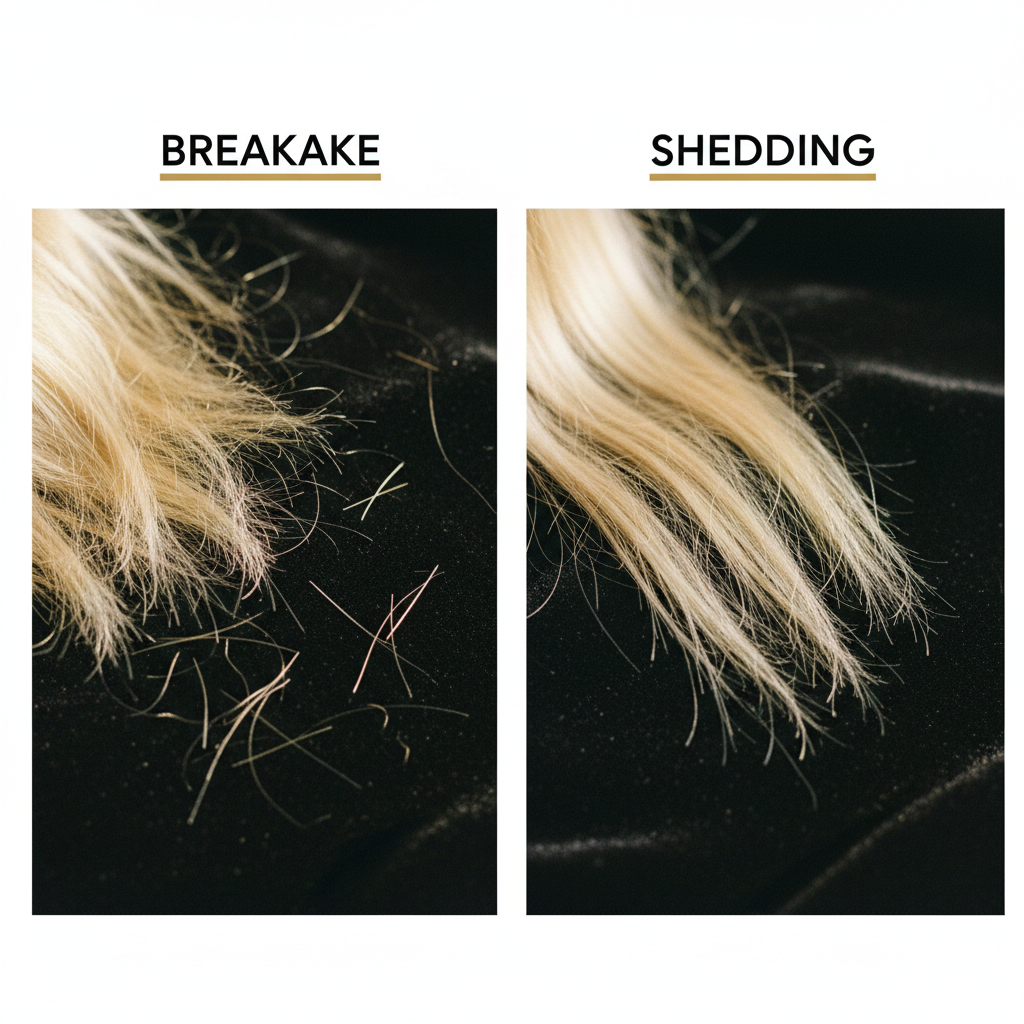
- Hair breakage: The hair fibre snaps along the shaft. You will find short, ragged fragments on your clothes, brush, or bathroom floor without a white bulb at the root. Bleached hair breakage is often accompanied by split ends, white stress dots (trichorrhexis nodosa), extreme tangling, and a "chewing gum" texture when wet.
- Hair shedding: The entire hair strand falls out from the follicle, complete with a tiny white keratin bulb at the tip. Bleach applied correctly to the hair shaft does not cause root shedding. If you experience diffuse thinning across the scalp after bleaching, this may indicate a chemical scalp burn, an allergic contact dermatitis reaction, or an unrelated episode of telogen effluvium triggered by systemic stress.
Scientific comparison of repair strategies
| Intervention Type | Target Site | Mechanism of Action | Longevity | Best For |
|---|---|---|---|---|
| Bond-Building Technology | Cortex | Cross-links broken polypeptide chains; mimics disulphide links | Semi-permanent (3 to 6 washes) | Extreme elasticity loss; gummy wet hair |
| Hydrolysed Proteins | Cuticle & Cortex | Low molecular weight peptides (under 1,500 Da) fill structural voids | Temporary (1 to 3 washes) | High porosity; brittle, snapping strands |
| Cationic Conditioners | Cuticle surface | Positively charged molecules bind to negative cysteic acid sites | Temporary (1 wash) | Friction reduction; combability; static control |
| Lipid & Oil Sealants | Epicuticle | Hydrophobic film coats cuticle to reduce hygral fatigue | Temporary (1 wash) | Dullness; moisture retention; softness |
Practical protocol: how to manage damaged bleached hair
A successful home routine relies on mechanical preservation, low friction, and disciplined protein-moisture balance.
1. Rebuild internal strength with bond builders and proteins
Use an evidence-based bond repair treatment containing bis-aminopropyl diglycol dimaleate or maleic acid weekly. Alternate this with hydrolysed wheat, keratin, or pea protein masks. Keep in mind that protein must always be paired with humectants and emollients; over-applying pure protein without conditioning agents can make compromised fibres stiff and prone to snapping.
2. Lower your cleansing friction and wash frequency
Bleached hair loses structural integrity when wet because water molecules disrupt hydrogen bonds inside an already weakened cortex.
- Reduce shampooing to two or three times per week.
- Select sulphate-free, low-pH shampoos (pH 4.5 to 5.5). Mildly acidic formulas help constrict the cuticle scales.
- Never bunch your lengths on top of your head while lathering. Smooth the cleanser gently down the scalp and let the rinse water wash down the ends.
3. Seal the cuticle against hygral fatigue
Because the natural 18-MEA lipid barrier is gone, your hair rapidly absorbs and loses water. This repeated swelling and shrinking is known as hygral fatigue, and it degrades the cuticle further. Apply a leave-in conditioning spray containing panthenol and follow with lightweight, non-penetrating plant oils (such as argan or jojoba oil) or silicone polymers to seal the cuticle and restore hydrophobicity.
4. Minimise mechanical and thermal stress
- Detangle strictly from ends to roots using a wide-tooth comb or flexible-bristle brush, preferably while saturated with a slip-enhancing conditioner.
- Never use high heat. Keep heated tools below 150°C and always apply a thermal protectant. Heat over 180°C easily degrades the remaining keratin proteins in chemically lifted hair.
- Sleep on a smooth satin or silk pillowcase to prevent abrasive friction during the night.
When the cause may be something else
If your hair appears dull, dry, and unmanageable, chemical bleach may not be the only factor at play:
- Hard water mineral buildup: Calcium, magnesium, and copper ions present in hard water bind readily to the negative charges on bleached hair. Copper can catalyse oxidative stress, while calcium creates a chalky layer that feels coarse and brittle, often mimicking severe chemical damage. A chelating shampoo should be used every few weeks to lift these minerals.
- Underlying nutritional deficits: If new hair emerging from the scalp is thin, brittle, or lacks resilience before it is ever dyed, evaluate your systemic health. Iron deficiency, low vitamin D levels, or insufficient dietary protein can compromise hair fibre development during the anagen phase.
Supporting the scalp and growing fibre: the Watermans approach
While bleached lengths demand intensive surface repair and bond maintenance, maintaining an optimal scalp environment is equally vital for future healthy growth. Chemical processes can disrupt the scalp barrier, leaving it dry or irritated.
Watermans GrowMe Shampoo provides an evidence-based, cosmetic approach to scalp care and fibre vitality. Formulated with biotin, rosemary extract, caffeine, niacinamide, and hydrolysed lupin protein, it delivers a gentle, sulphate-free wash that cleanses the scalp without stripping compromised hair fibres. Complemented by Watermans ConditionMe Conditioner, which features cholesterol, shea butter, and niacinamide, this routine helps replenish surface softness, boost slip, and visibly reduce friction-induced breakage on chemically lightened lengths.
Frequently asked questions about How to Repair Damaged Bleached Hair
Can coconut oil repair bleached hair?
Coconut oil cannot replace broken disulphide bonds, but it can protect bleached hair from structural damage. Lauric acid, the primary fatty acid in coconut oil, has a low molecular weight and a straight hydrocarbon chain, enabling it to penetrate past the cuticle into the cortex. Applying it as a pre-shampoo treatment reduces protein loss during washing and limits the swelling caused by excess water uptake.
How to repair damaged bleached hair that feels gummy when wet?
Hair that feels gummy, mushy, or stretches excessively without springing back has experienced severe cortical disulphide bond destruction. To treat it, avoid all high-heat styling and stop using aggressive clarifying shampoos. Immediately apply a dedicated bond-building treatment followed by a low-molecular-weight hydrolysed protein mask to add temporary structural rigidity. Avoid wet combing without plenty of leave-in slip.
How often should I get a haircut when repairing bleached hair?
You should have your ends trimmed every 6 to 8 weeks. While topical treatments improve manageability and tensile strength, they cannot seal split ends indefinitely. Once a split starts, the physical separation travels up the hair shaft, destroying healthy hair above it. Trimming half a centimetre to a centimetre regularly removes split points before they worsen.
How long does it take to repair damaged bleached hair?
Cosmetic improvements can be seen immediately after using high-performance bond builders, silicones, and protein conditioners. However, genuine structural resilience takes several weeks of consistent, low-friction care. Keep in mind that severely bleached lengths will remain fundamentally vulnerable until they are gradually trimmed away and replaced by healthy, new hair growth from the scalp.
Bringing bleached hair back to life
Understanding how to repair damaged bleached hair comes down to respecting the physical limits of the hair fibre. Bleach causes irreversible chemical changes by oxidising disulphide bridges and removing the protective lipid surface. However, by combining scientifically backed bond builders, targeted hydrolysed proteins, and low-friction styling methods, you can halt ongoing breakage, seal the cuticle, and restore softness and shine while fresh hair grows in.
Sources and references
- Journal of Cosmetic Science: "Chemical and Physical Alterations in Bleached Human Hair", 2008.
- International Journal of Trichology: "Hair Cosmetics: An Overview", 2015.
- Robbins, C. R.: Chemical and Physical Behavior of Human Hair, 5th ed., Springer, 2012.
- Journal of the Society of Cosmetic Chemists: "The Effect of Bleaching on the Structure of Human Hair Keratin", 1993.
Find these ingredients in Watermans products
- Vitamin D: you will find this ingredient in our Hair Vitamins.
- Shea Butter: you will find this ingredient in our Curly Hair Conditioner.