How Bleach and Chemical Processing Affect Hair: An Evidence-Based Guide
9 min read ·
Learn how bleach and chemical processing affect hair structure, break down keratin bonds, and increase porosity, plus proven tips to manage breakage.
Quick answer: Understanding How Bleach and Chemical Processing Affect Hair begins with the hair fibre's internal architecture. Alkaline chemicals such as ammonium hydroxide lift the protective cuticle, allowing persulphates or reducing agents to enter the cortex. Bleach oxidises natural melanin while cleaving vital disulphide bonds, leaving the fibre porous, weaker, and prone to mechanical breakage. While modern conditioning agents can temporarily smooth lifted cuticles and improve tensile feel, chemical damage to the keratin matrix is permanent until new hair grows.
Key takeaways
- Bleaching and chemical processing raise the hair cuticle by swelling the fibre using high pH agents (typically pH 9.0 to 11.0).
- Oxidative bleaching dissolves melanin pigments but simultaneously breaks down cystine into cysteic acid, permanently weakening the hair shaft.
- Chemical processing causes hair breakage along the shaft rather than true follicular hair loss or shedding, unless severe chemical burns irritate the scalp.
- Porosity increases dramatically after chemical services, causing hair to absorb water rapidly, lose internal moisture quickly, and tangle easily.
- Cuticle damage is irreversible, but targeted bond builders, protein hydrolysates, and acidifying post-treatments significantly reduce snapping.
How Bleach and Chemical Processing Affect Hair: what the evidence shows
Peer-reviewed cosmetic chemistry shows that How Bleach and Chemical Processing Affect Hair relies on a series of aggressive chemical reactions designed to bypass the fibre's natural defence system. Human hair consists of three primary layers: an outermost protective cuticle of overlapping scales, an inner structural cortex made of keratin protein filaments, and, in coarser fibres, a central medulla.
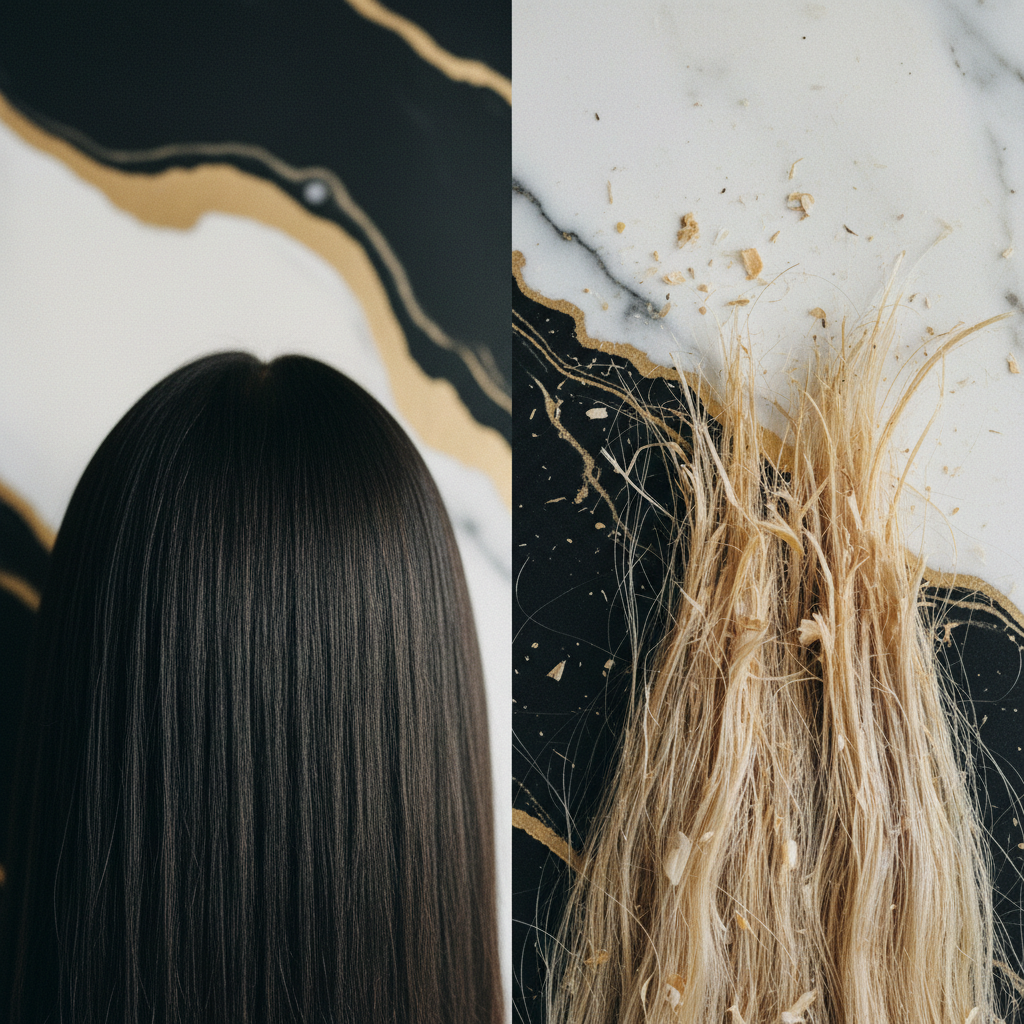
The intact cuticle is sealed with a microscopic lipid layer (18-methyleicosanoic acid, or 18-MEA), which makes healthy hair naturally hydrophobic. Water rolls off it, friction remains low, and internal moisture levels remain balanced.
When you apply alkaline bleach (hydrogen peroxide paired with ammonium or potassium persulphate salts) or chemical relaxers and permanent waves, this lipid seal is stripped away. The high alkaline environment forces the cuticle scales to lift and swell. Persulphate ions penetrate the cortex to oxidise and degrade natural eumelanin and pheomelanin pigments. During this oxidative cascade, the chemical mixture does not discriminate between pigment granules and structural keratin. It attacks cystine, an amino acid responsible for cross-linking protein chains via covalent disulphide bonds.
These disulphide bonds give hair its mechanical elasticity, bounce, and tensile strength. Studies using scanning electron microscopy (SEM) and amino acid analysis reveal that a single heavy bleaching session can convert up to 15 to 25 percent of hair's cystine into cysteic acid. Double-processing or poorly timed overlapping can increase this oxidation further, leaving the hair fibre with significantly reduced wet and dry tensile strength.
| Chemical Process | Typical pH | Primary Structural Target | Key Physical Impact on Fibre |
|---|---|---|---|
| Powder Bleach / Lightener | 9.0 to 11.0 | Melanin granules and cystine bonds | Severe lipid loss, high porosity, high cysteic acid formation |
| Permanent Hair Colour | 9.0 to 10.5 | Cortex melanin and intermediate dyes | Moderate cuticle lifting, mild to moderate protein loss |
| Alkaline Perms (Ammonium Thioglycolate) | 8.5 to 9.5 | Disulphide bonds (reduced then neutralised) | Altered fibre shape, reduced tensile strength |
| Sodium Hydroxide Relaxers (Lye) | 12.0 to 14.0 | Disulphide bonds (lanthionisation) | Complete bond cleavage, fragile fibre, structural fatigue |
| Acid Perms (Glyceryl Monothioglycolate) | 6.5 to 8.0 | Selected disulphide bonds | Gentler cuticle swelling, requires external heat |
The internal mechanism: cuticle erosion and protein degradation
To see why chemically processed hair behaves differently, we must look at the structural degradation under the surface. Once 18-MEA is removed during bleaching or relaxing, the fibre turns from hydrophobic to hydrophilic. Hydrophilic hair absorbs atmospheric moisture eagerly, leading to acute frizz in humid conditions, yet struggles to retain the lipid-bound moisture required for suppleness.
Furthermore, lifting the cuticle creates friction. When hair is wet, water enters the cortex freely, swelling the diameter of the strand. In an uncompromised strand, hair can stretch up to 30 percent of its resting length and return without snapping. In chemically bleached hair, the loss of cross-linking disulphide bonds causes the fibre to yield prematurely under tension. This manifests as that spongy, gummy sensation when wet, followed by sudden snapping when combed.
In severe cases of over-processing, the cuticle layers are not merely lifted; they are completely chipped away, exposing the raw cortical fibres underneath. Trichoptilosis (split ends) and trichorrhexis nodosa (microscopic fracture nodes along the shaft) develop rapidly.
What the evidence does not show: myths versus reality
There is widespread confusion surrounding chemical processing and scalp health. It is essential to separate physical fibre damage from follicular hair loss.
- Bleach does not cause hereditary pattern hair loss: Oxidative lightening works exclusively on the non-living hair shaft protruding from the scalp. It does not alter genetic programming, androgen sensitivity, or follicular miniaturisation (androgenetic alopecia).
- Processing does not cause telogen effluvium: Chemical damage does not prompt hair bulbs to prematurely enter the resting phase, unless a severe contact allergy or chemical burn causes systemic scalp inflammation.
- You are observing breakage, not shedding: When people find handfuls of short, uneven strands in their brush after bleaching, they are experiencing hair breakage. Shed hairs feature a small white bulb at the root; broken hairs feature a blunt or frayed snap point without a bulb.
- No cosmetic product permanently "repairs" broken bonds: While dicarboxylic acid complexes and amino acid treatments temporarily cross-link damaged sites or coat the cuticle, they do not reconstitute the original biological protein matrix. Maintenance must be ongoing.
Signs that your hair has experienced chemical fatigue
Chemically altered hair displays distinct diagnostic signs:
- Extreme wet elasticity followed by snapping: The hair stretches out like an elastic band when damp, fails to recoil, and breaks under minimal pressure.
- High porosity and rapid drying: Strands sink instantly in water and absorb liquid rapidly, but feel straw-like and stiff within minutes of towel drying.
- Severe mechanical tangling: Without the smooth 18-MEA lipid layer, opposing cuticle scales snag against one another like microscopic velcro, creating stubborn knots at the nape and ends.
- Loss of curl pattern: In wavy, curly, or coily textures, disrupted disulphide bonds prevent the keratin filaments from holding their natural spiral geometry, leaving curls limp, loose, or uneven.
- Dullness and colour fading: Chipped and raised cuticles scatter light randomly instead of reflecting it evenly, robbing the hair of natural shine.
Practical steps: mitigating and managing chemical damage
You cannot reverse chemical processing, but you can alter your daily regimen to protect the remaining cortex and seal the cuticle:
- Lower the pH after processing: Following any alkaline service, use an acidifying rinse or treatment (pH 3.5 to 4.5). Acidic environments neutralise residual alkalinity, contract the swelling, and encourage raised cuticle scales to lie flat against the shaft.
- Reintroduce structural proteins and lipids: Weekly treatments formulated with hydrolysed wheat, soy, or keratin protein slip into microscopic gaps along the damaged cortex. Follow protein applications with lipid-rich emollients containing fatty acids (such as cetyl alcohol and natural plant oils) to mimic the missing 18-MEA barrier.
- Adopt gentle mechanical handling: Switch to wide-tooth detangling combs or flexible-bristle brushes. Always detangle from the tips upward toward the roots, preferably while coated in a slippery conditioner to reduce friction coefficients.
- Minimise secondary stressors: Chemically processed hair has zero tolerance for aggressive heat styling. If blow-drying or heat-straightening, limit tool temperatures to below 150 degrees Celsius and always apply a film-forming heat protectant.
- Regular micro-trims: Trimming 5 to 10 millimetres every six to eight weeks stops shaft fractures from traveling upward into healthier lengths.
When the cause may be something else
If you are noticing hair falling from the scalp in diffuse sheets, or if you find intact hairs containing distinct white bulbs on your pillow, chemical processing is not the sole culprit. Nutritional deficiencies (such as low serum ferritin or vitamin D), thyroid dysfunction, postpartum hormonal shifts, and acute physiological stress can trigger telogen effluvium.
Similarly, if you experience redness, burning, crusting, or prolonged tenderness on your scalp after a salon service, you may have developed acute contact dermatitis or a chemical burn from peroxide coming into prolonged contact with the skin.
When to seek professional advice
Consult a registered trichologist or a dermatologist specialising in hair disorders if:
- You notice patchy, circular areas of complete hair loss.
- Your scalp burns, oozes, or develops persistent sores following a chemical service.
- Hair shedding from the root exceeds 100 to 150 strands daily for more than six consecutive weeks.
- You cannot establish whether your hair is experiencing diffuse breakage or true follicular shedding.
Supportive care from Watermans
While damaged cuticles and broken disulphide bonds cannot be permanently glued back together, keeping your scalp environment balanced and your emerging hair resilient is vital. Watermans offers targeted, sulphate-free formulations designed to cleanse gently without stripping vulnerable lipids. By supporting your scalp and fortifying lengths with nutrient-dense washes, you minimise routine friction and help emerging growth thrive without unnecessary mechanical stress.
Frequently asked questions about How Bleach and Chemical Processing Affect Hair
Can bleached hair ever go back to being healthy?
No, the hair shaft cannot biologically heal itself because it is non-living tissue. Once bleach oxidises melanin and breaks disulphide bonds, those structural changes remain until the hair is trimmed away. However, by using acidic conditioning agents, hydrolysed proteins, and leave-in lipids, you can restore surface slip, improve tensile elasticity, and keep the strand intact as healthy, untreated hair grows from your scalp.
How does bleach differ from permanent hair dye in its damage profile?
Both processes rely on alkaline agents to open the cuticle, but their goals differ. Permanent hair dye uses a modest volume of peroxide to swell the cuticle, lift some natural pigment, and deposit artificial colour molecules. Bleach uses higher concentrations of peroxide combined with persulphate salts to aggressively dissolve pigment granules and structural proteins, resulting in significantly higher cuticle erosion and bond loss.
Does chemical processing cause actual baldness?
No, not under normal circumstances. Understanding How Bleach and Chemical Processing Affect Hair means recognising that chemicals target the non-living fibre above the skin. Unless bleach or relaxer is left on the scalp long enough to cause a deep chemical burn that scars hair follicles, processing causes mid-shaft breakage rather than root-level follicular hair loss.
How often can I safely bleach or chemically process my hair?
Colourists generally recommend waiting a minimum of six to ten weeks between chemical services to allow the scalp to rest and to ensure treatments are applied solely to new outgrowth. Re-bleaching or overlapping previously processed hair compounds structural fatigue, rapidly leading to severe cuticle loss and breakage.
Why does bleached hair feel gummy or stretchy when wet?
Bleach destroys the covalent disulphide bonds that give keratin its natural resilience. When submerged in water, compromised hair absorbs excessive moisture and swells. Without adequate internal cross-linking bonds to pull the protein chains back into position, the wet hair fibre stretches unnaturally like elastic and easily snaps if pulled.
The bottom line on chemical processing and hair integrity
Navigating How Bleach and Chemical Processing Affect Hair comes down to understanding the trade-off between aesthetic transformation and structural compromise. Every lightening or reforming service permanently changes the keratin matrix, strips protective surface lipids, and raises porosity. By treating chemically altered hair with exceptional mechanical gentleness, rebalancing fibre pH, and supplying consistent moisture and protein, you can keep processed strands looking vibrant and intact while your natural hair grows out.
Sources and references
- Robbins, C. R. (2012). Chemical and Physical Behavior of Human Hair. 5th Edition, Springer-Verlag.
- Journal of Cosmetic Science: "The Effects of Bleaching on the Structure of Human Hair" (Society of Cosmetic Chemists).
- International Journal of Trichology: "Hair Cosmetics: An Overview" (2015).
- British Association of Dermatologists: "Hair Breakage and Damage Guidelines".
- Dawber, R. (1996). "Hair: Its Structure and Response to Cosmetic Preparations", Clinics in Dermatology.
Find these ingredients in Watermans products
- Vitamin D: you will find this ingredient in our Hair Vitamins.