How Bleach Affects Hair Protein: The Science of Chemical Damage
9 min read ·
Learn how bleach affects hair protein, from disulphide bond oxidation to keratin mass loss, and discover practical methods to strengthen fragile, lightened strands.
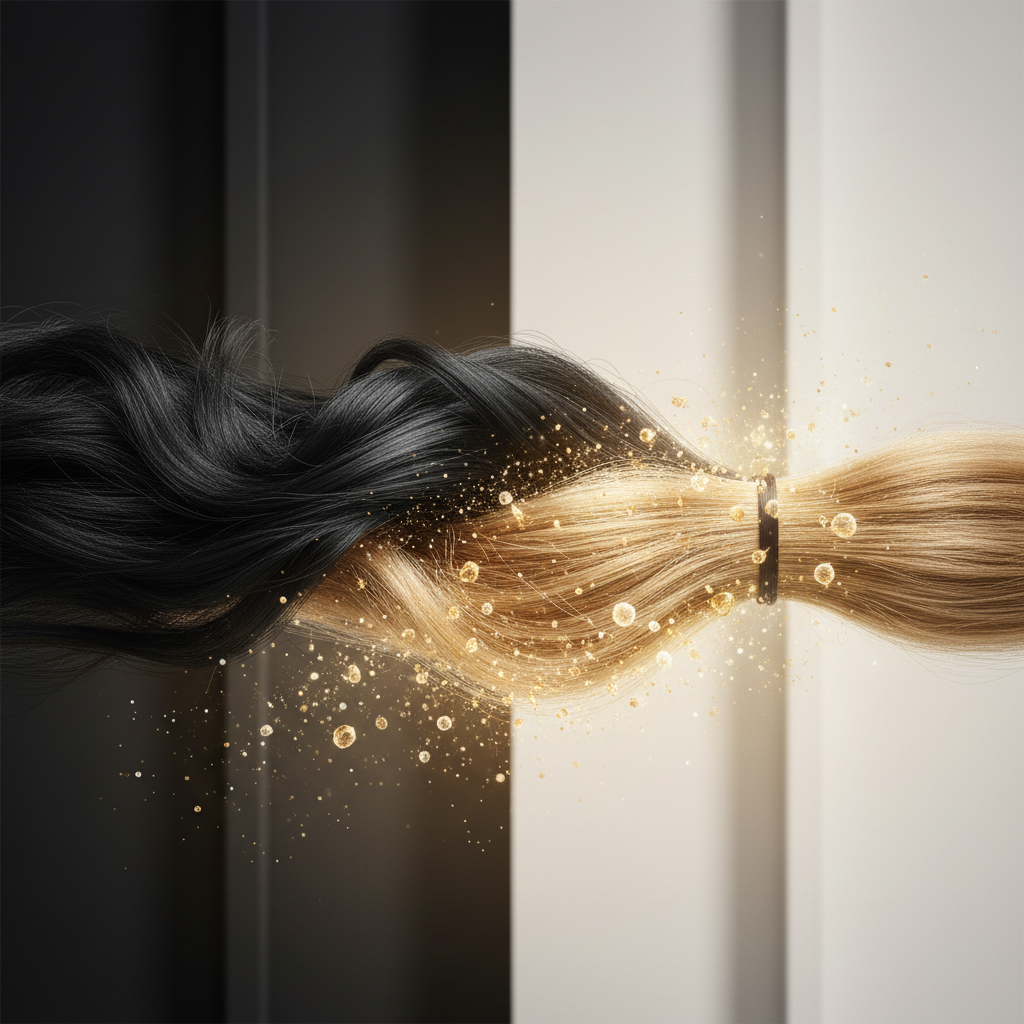
Quick answer: Understanding how bleach affects hair protein reveals why lightened hair loses its strength and elasticity. Bleach works by oxidising natural melanin, but this alkaline chemical reaction simultaneously destroys the cystine disulphide bonds that give hair keratin its structural integrity. Oxidised keratin converts into cysteic acid, stripping up to 15 to 20 percent of the fibre's total protein content. The main limitation is that lost protein and ruptured disulphide bonds cannot be permanently regenerated, requiring ongoing maintenance to prevent severe breakage.
Key takeaways
- Hair is composed of roughly 85 to 90 percent keratin protein, which relies on strong disulphide bonds for tensile strength.
- Hair bleach combines an alkaline agent (such as ammonium hydroxide) with hydrogen peroxide to lift the cuticle and oxidise pigment.
- During lightening, oxidising agents attack the amino acid cystine, converting structural disulphide bonds into soluble cysteic acid.
- Bleaching can dissolve the protective lipid layer (18-MEA) and degrade up to 20 percent of the fibre's internal protein mass.
- Protein loss increases hair porosity, leaving strands vulnerable to moisture loss, tangling, and mechanical snapping.
- Ruptured disulphide bonds cannot be biologically regrown in the hair shaft, but targeted treatments can temporarily reinforce weakened keratin.
How Bleach Affects Hair Protein: what the evidence shows
Textile and cosmetic science has documented how bleach affects hair protein under rigorous laboratory conditions. Hair is predominantly composed of fibrous keratin proteins rich in the sulfur-containing amino acid cystine. These cystine residues join together via covalent disulphide bonds, forming a cross-linked matrix that gives hair its remarkable tensile strength, resilience, and elasticity.
When a bleaching mixture of persulphates, hydrogen peroxide, and an alkaline carrier (typically operating at a high pH between 9.0 and 11.0) is applied, the hair fibre undergoes rapid structural disruption. The high pH swells the outer cuticle scales, forcing them open so that free radicals can penetrate the cortex to dissolve melanin granules.
However, bleaching oxidants do not discriminate between natural pigment and the structural proteins around it. Research published in the Journal of Cosmetic Science and the International Journal of Cosmetic Science demonstrates that the primary pathway of chemical damage is the oxidation of disulphide bonds. The peroxide reaction cleaves the sulfur-sulfur bridges of cystine, producing cysteic acid groups. This process permanently reduces the density of cross-links within the keratin filaments. Without these bridges, the inner cortex softens, weakens, and sheds soluble peptide fragments every time the hair is washed or styled.
Intact Keratin (Cystine Disulphide Bond):
[Keratin Chain], CH₂, S, S, CH₂, [Keratin Chain]
 │
 (Bleaching / Oxidation)
 ▼
Degraded Keratin (Cysteic Acid Residues):
[Keratin Chain], CH₂, SO₃⁻ ⁺O₃S, CH₂, [Keratin Chain]
The chemical mechanism of protein degradation
To understand the full scope of bleaching damage, it helps to examine the three structural zones of the hair fibre:
1. The F-layer and epicuticle lipids
Before bleaching agents reach the keratin cortex, they must breach the epicuticle. The epicuticle is coated in 18-methyleicosanoic acid (18-MEA), a protective fatty acid layer covalently bonded to protein. Alkaline bleach rapidly strips this lipid sheath. Losing the F-layer turns a naturally hydrophobic (water-repelling) fibre into a hydrophilic (water-absorbing) sponge, leaving the underlying keratin proteins completely exposed to water fatigue and environmental degradation.
2. Cuticle protein erosion
The cuticle consists of flattened, overlapping cells made of hard, amorphous keratin. Bleaching causes these scales to lift, curl, and fragment. As the cell membrane complex (CMC) between cuticle layers dissolves under alkaline stress, individual cuticle scales chip off entirely. This exposes the softer cortex beneath and eliminates the fibre's outer mechanical shield.
3. Cortex oxidation and cysteic acid formation
Within the cortex, keratin intermediate filaments reside inside an amorphous, sulfur-rich protein matrix. Bleaching agents break the covalent disulphide bonds connecting these proteins, oxidising them into negatively charged cysteic acid. Studies show that heavily bleached hair can experience a 50 percent or greater loss of intact cystine. The introduction of negative charges causes electrostatic repulsion between adjacent keratin chains, loosening the tight bundle of intermediate filaments and allowing protein fragments to leach out of the shaft during shampooing.
| Hair Condition | Intact Cystine Level | Cysteic Acid Level | Fibre Porosity | Tensile Strength |
|---|---|---|---|---|
| Virgin, Untreated Hair | High (~16 to 18% of amino acids) | Low / Negligible | Low (Hydrophobic) | High (Normal elasticity) |
| Single Bleach Lift (1 to 3 Levels) | Moderate (~12 to 14%) | Moderate | Medium | Mild reduction (5 to 10%) |
| High Lift / Double Process | Low (~6 to 9%) | Very High | High (Hydrophilic) | Moderate reduction (25 to 35%) |
| Over-Processed / Compromised | Severely Depleted (<5%) | Extremely High | Severe (Spongy) | Severe reduction (>50%, snaps wet) |
What the evidence does not show
There are several persistent myths regarding hair lightening that scientific testing disproves:
- Bleach does not cause genetic hair loss: Bleaching damages the hair shaft (the dead, keratinised fibre above the skin), causing breakage. It does not cause androgenetic alopecia or damage the biological hair follicle deep inside the dermis, provided the bleach does not cause chemical scalp burns.
- Bond-building products do not make hair invincible: While maleate and bis-aminopropyl diglycol dimaleate compounds can form artificial bridges across damaged keratin chains, they do not restore 100 percent of original hair strength. They reduce damage; they do not eliminate it.
- Protein treatments do not permanently rebuild hair: Hydrolysed proteins applied through conditioners adhere to the cuticle surface via weak hydrogen bonds and electrostatic attraction. They patch temporary gaps, but they wash out over successive shampoos and cannot re-knit the biological protein structure.
Identifying the signs of protein loss
When keratin architecture collapses, the visual and physical properties of the fibre change dramatically. Recognising these signs helps you distinguish between dehydration and true protein destruction:
- Wet elasticity loss (the "bubblegum" effect): Hair that stretches excessively when wet without returning to its original length, or turns gummy and snaps immediately under slight tension, has suffered severe disulphide bond destruction.
- Extreme porosity: Severely bleached hair absorbs immense amounts of water very quickly, takes hours to air dry, and feels rough and dry the moment water evaporates.
- Split ends and mid-shaft snapping: Cuticle erosion leaves the cortex unprotected, leading to longitudinal splitting (split ends) and transverse fractures along the hair shaft.
- Loss of curl pattern: In textured or curly hair, the loss of cross-linked keratin bonds causes curl patterns to loosen, flatten, or become irregularly frizzy because the internal scaffolding that holds the wave shape is gone.
Practical steps to reinforce bleached hair
Because the hair shaft is biologically non-living tissue, oxidised disulphide bonds and leached proteins cannot heal on their own. However, you can manage the degradation through structured cosmetic care:
Incorporate hydrolysed proteins
Look for products formulated with hydrolysed wheat, soy, silk, or vegetable proteins with molecular weights between 500 and 2,000 Daltons. These smaller peptide chains can temporarily penetrate the open cuticle to fill micro-voids in the damaged cortex, offering temporary tensile support.
Balance protein with conditioning emollients
Pure protein without conditioning lipids leaves damaged hair feeling stiff, brittle, and prone to mechanical breakage. Alternate hydrolysed protein treatments with fatty alcohols (such as cetyl or stearyl alcohol), ceramides, and natural plant oils to mimic the lost 18-MEA layer and restore flexibility.
Minimise secondary mechanical and heat stress
Bleached keratin has a significantly lower thermal denaturation threshold than virgin hair. Keratin begins to denature at lower temperatures when disulphide bonds are absent. Limit hot styling tools to under 160°C, always apply a protective thermal barrier, and switch to wide-tooth detangling tools on wet hair to avoid tensile fracture.
Gentle cleansing routines
Damaged, porous hair is exceptionally vulnerable to friction and anionic surfactant swelling. Use sulfate-free, low-foaming cleansers with an acidic pH (between 4.5 and 5.5) to help contract the lifted cuticle scales and prevent further protein leaching during washing.
Watermans offers nutrient-dense hair and scalp solutions, including Grow Me Shampoo and Condition Me Conditioner, designed to revitalise the look of distressed strands. Packed with hydrolysed lupin protein, niacinamide, biotin, and restorative botanicals, the system helps smooth the cuticle, boost moisture retention, and reinforce the feel of chemically treated, fragile hair.
When the cause may be something else
If hair is breaking or thinning rapidly after a bleaching service, ensure you differentiate between shaft breakage and true follicular shedding.
If hairs are falling out from the root with the white bulb attached, the culprit is shedding rather than fibre destruction. This could point to telogen effluvium triggered by physical stress, nutritional deficiencies, thyroid fluctuations, or contact dermatitis from the bleaching agent irritating the scalp. If the hair snaps off mid-shaft with jagged, fraying ends and no bulb, it is mechanical breakage directly caused by bleach-induced protein degradation.
When to seek professional advice
Consult a qualified trichologist or dermatologist if you experience scalp blisters, intense burning, persistent redness, or extensive hair shedding from the scalp after a bleaching service. Chemical burns from high-volume peroxide or ammonium persulphate require medical evaluation to prevent scalp scarring. For extensive mid-shaft snapping, consult an experienced professional stylist who can perform a salon-grade bond-repair service or cut away unsalvageable sections before splits travel higher up the shaft.
Frequently asked questions about How Bleach Affects Hair Protein
Can hair protein recover naturally after bleaching?
No. Because hair is non-living keratinised tissue, it cannot biologically self-repair. The way how bleach affects hair protein involves permanently oxidising cystine bonds into cysteic acid. While you can use hydrolysed proteins and bonding treatments to reinforce the fibre cosmetically, the only way to have completely undamaged protein structures is to let new hair grow from the follicle.
Does bleaching completely dissolve hair protein?
Bleaching does not dissolve the entire hair strand unless it is left on far too long or mixed with excessively high developer. However, a single standard bleaching session typically oxidises and removes roughly 10 to 20 percent of the hair fibre's internal protein matrix. Severe over-processing can dissolve substantial cortical protein, causing the hair to melt or break off completely.
How does bleach affect hair protein compared to permanent hair dye?
Permanent hair dye uses a lower concentration of hydrogen peroxide and alkaline agents (like ammonia or MEA) than bleach. While permanent colour lifts the cuticle and oxidises some disulphide bonds to deposit artificial pigments, bleach contains aggressive persulphate salts that aggressively degrade melanin and oxidise far more keratin protein in the cortex.
Why does bleached hair feel dry if bleach affects protein rather than moisture?
Proteins and moisture levels are fundamentally linked. Bleach destroys the hair's external 18-MEA lipid layer and creates porous voids within the keratin cortex. Without this protective barrier and dense protein structure, the hair can no longer trap or retain water, causing it to lose hydration rapidly to the surrounding air and feel perpetually dry.
Navigating bleach and hair strength
Gaining a thorough perspective on how bleach affects hair protein clarifies the trade-off inherent in high-lift lightening services. While modern persulphates and peroxides deliver dramatic colour transformations, the chemical process inherently dismantles the cystine disulphide bonds that preserve structural integrity. By recognising the loss of keratin mass, using targeted hydrolysed protein conditioners, balancing elasticity with emollients, and minimising heat exposure, you can effectively manage chemically treated hair and minimise breakage along the shaft.
Sources and references
- Journal of Cosmetic Science, "Chemical and physical changes in hair caused by bleaching," 2008.
- International Journal of Cosmetic Science, "The effect of chemical treatments on the hair cuticle and cortex," 2014.
- Robbins, C. R., Chemical and Physical Behavior of Human Hair, 5th ed., Springer, 2012.
- Textile Research Journal, "Oxidation of cystine in human hair during chemical bleaching," 2016.
Find these ingredients in Watermans products
- Niacinamide: you will find this ingredient in our Hair Mask.