Heat Protectant Mechanisms: The Science of Thermal Defence
8 min read ·
Explore the science behind Heat Protectant Mechanisms. Learn how polymers and silicones lower thermal conduction, buffer moisture, and limit styling damage.
Quick answer: Understanding Heat Protectant Mechanisms reveals how cosmetic formulations shield hair fibres from thermal styling tools. Rather than creating an impenetrable shield, these products function by reducing thermal conduction rates, evenly distributing heat hotspots, sealing cuticles, and limiting moisture evaporation during styling. However, their primary limitation is that no formulation offers total immunity. Even advanced polymer and silicone matrices only mitigate approximately 30 to 50 percent of thermal damage, meaning excessively high temperatures or repeated passes will still degrade hair keratin.
Key takeaways
- Thermal stylers often operate between 185°C and 230°C, temperatures high enough to alter keratin from an alpha-helix to a disordered beta-sheet structure.
- Core Heat Protectant Mechanisms rely on lowering thermal conductivity, dispersing energy across the fibre, and preserving internal cortex moisture.
- Common active agents include polydimethylsiloxanes (dimethicone), quaternary polymers (polyquaternium compounds), and hydrolysed plant proteins.
- Heat protectants reduce fibre breakage and surface cuticle cracking, but they cannot prevent damage if temperatures exceed the thermal decomposition threshold of hair.
- Applying product evenly to damp or dry hair prior to any thermal styling is essential to avoid unprotected hotspots.
Heat Protectant Mechanisms: what the evidence shows
Scientific evaluation of Heat Protectant Mechanisms demonstrates that topical formulations genuinely reduce structural and cosmetic degradation when hair encounters hot tools. Research published in the Journal of Cosmetic Science confirms that untreated hair exposed to flat irons at 200°C suffers rapid cuticle lifting, surface pitting, and cortex oxidation. Formulations engineered for thermal defence counteract these outcomes through specific physical and chemical interventions.
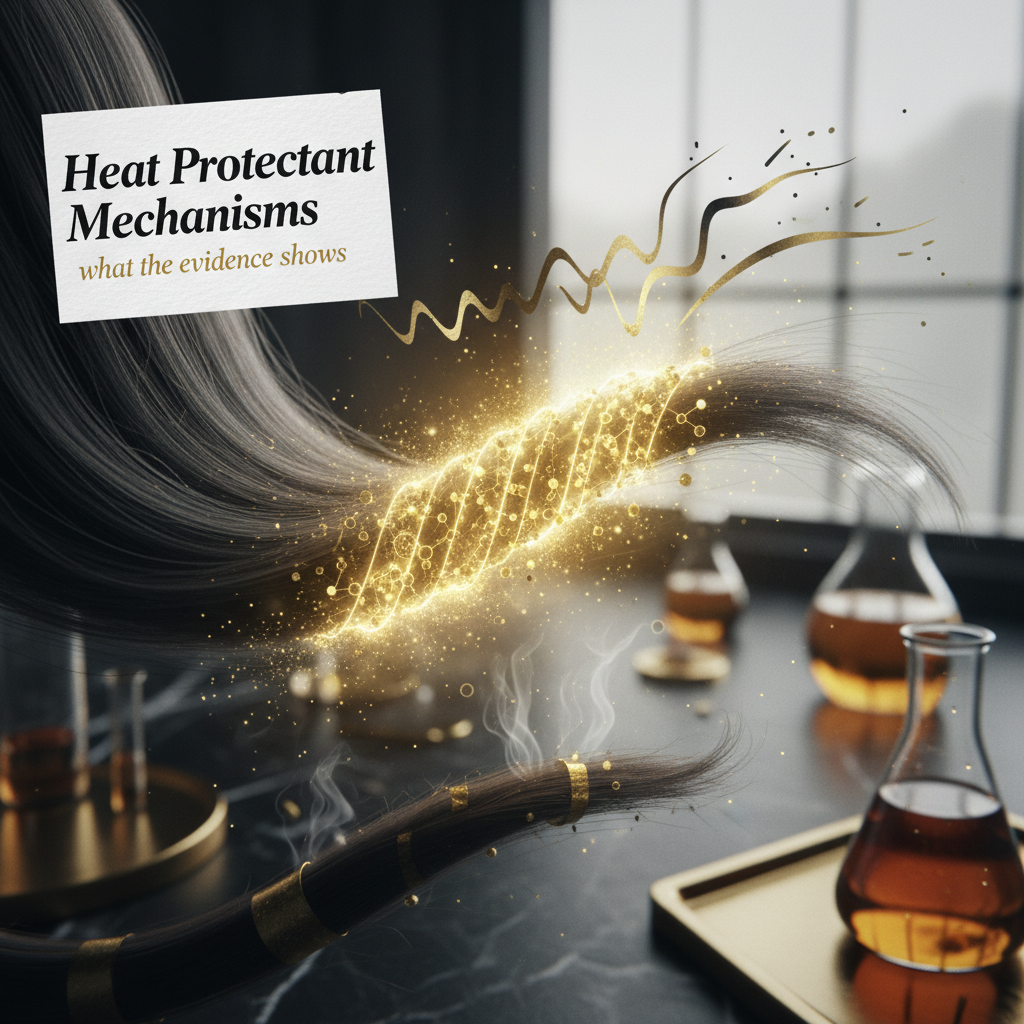
Thermal stylers transfer energy through direct conduction. Keratin, the primary protein of hair, undergoes irreversible denaturation starting around 155°C, with severe crystalline phase transitions occurring past 190°C. At 230°C, tryptophan degrades, leading to yellowing, and cystine bonds cleave rapidly.
The primary action of a thermal protectant is lowering the rate of heat transfer. Polymers and silicones have significantly lower thermal conductivity than water or bare keratin. When applied to the hair fibre, these ingredients form a uniform, microscopic film. This boundary layer slows down the speed at which heat penetrates the cortex, allowing the styling plate to shape the hair before the interior reaches critical degradation thresholds.
Secondly, protectants assist in heat dissipation. When a hot ceramic or titanium plate touches an unprotected hair shaft, thermal hotspots form at the points of contact. Low-conductivity silicone films disperse this heat over a wider surface area. This prevents localised burns, blistered cuticles, and the rapid evaporation of internal water known as "bubble hair."
Heat Source (185°C, 230°C)
 │
 ▼
[ Protective Polymer / Silicone Film ] <-- Lowers thermal conduction & dissipates hotspots
 │
 ▼ (Dampened Heat Transfer)
[ Cuticle Layer (F-layer & Epicuticle) ] <-- Minimises lipid stripping & scale lifting
 │
 ▼ (Controlled Moisture Evaporation)
[ Hair Cortex & Keratin Matrix ] <-- Preserves alpha-helix structure & tensile strength
How protective ingredients interact with hair structure
Thermal defence relies on diverse chemical classes working in tandem across the hair fibre surface.
Silicones and thermal conductivity
Silicones such as dimethicone, amodimethicone, and cyclopentasiloxane act as the foundation of many thermal sprays. Dimethicone has a thermal conductivity of roughly 0.15 W/(m·K), compared to water at roughly 0.6 W/(m·K). By coating the cuticle, silicones slow heat migration into the cortex. Furthermore, amodimethicone carries an amine functional group with a positive charge. This charge binds selectively to negatively charged, damaged cuticle sites, providing targeted thermal cushioning where the hair is most vulnerable.
Quaternary polymers and film formers
Synthetic polymers, including Polyquaternium-55, Polyquaternium-28, and copolymer blends, dry to form continuous, flexible films over the fibre. These films create a semi-permeable thermal barrier that moderates moisture loss. If hair heats too quickly, free water inside the cortex boils instantly, expanding rapidly and creating permanent voids inside the shaft. Polymer films slow this flash evaporation, preserving mechanical elasticity.
Hydrolysed proteins and moisture buffers
Hydrolysed wheat, soy, and silk proteins possess low molecular weights (often between 500 and 2,000 Daltons). They can penetrate the outer cuticle layers and deposit on the surface. When heat strikes, these proteins absorb a portion of the thermal load and act as sacrificial moisture buffers, degrading slightly so the structural cortex proteins remain intact.
Thermal protection ingredients compared
| Ingredient Class | Typical Examples | Primary Mechanism | Best Suited For |
|---|---|---|---|
| Volatile Silicones | Cyclopentasiloxane, Disiloxane | Even product spreading, reduces drag without heavy residue | Fine hair, blow-drying |
| Non-Volatile Silicones | Dimethicone, Dimethiconol | Low thermal conduction barrier, seals cuticles, adds shine | Coarse hair, flat irons |
| Cationic Silicones | Amodimethicone | Targeted deposition on damaged sites, anti-static alignment | Chemically treated, porous hair |
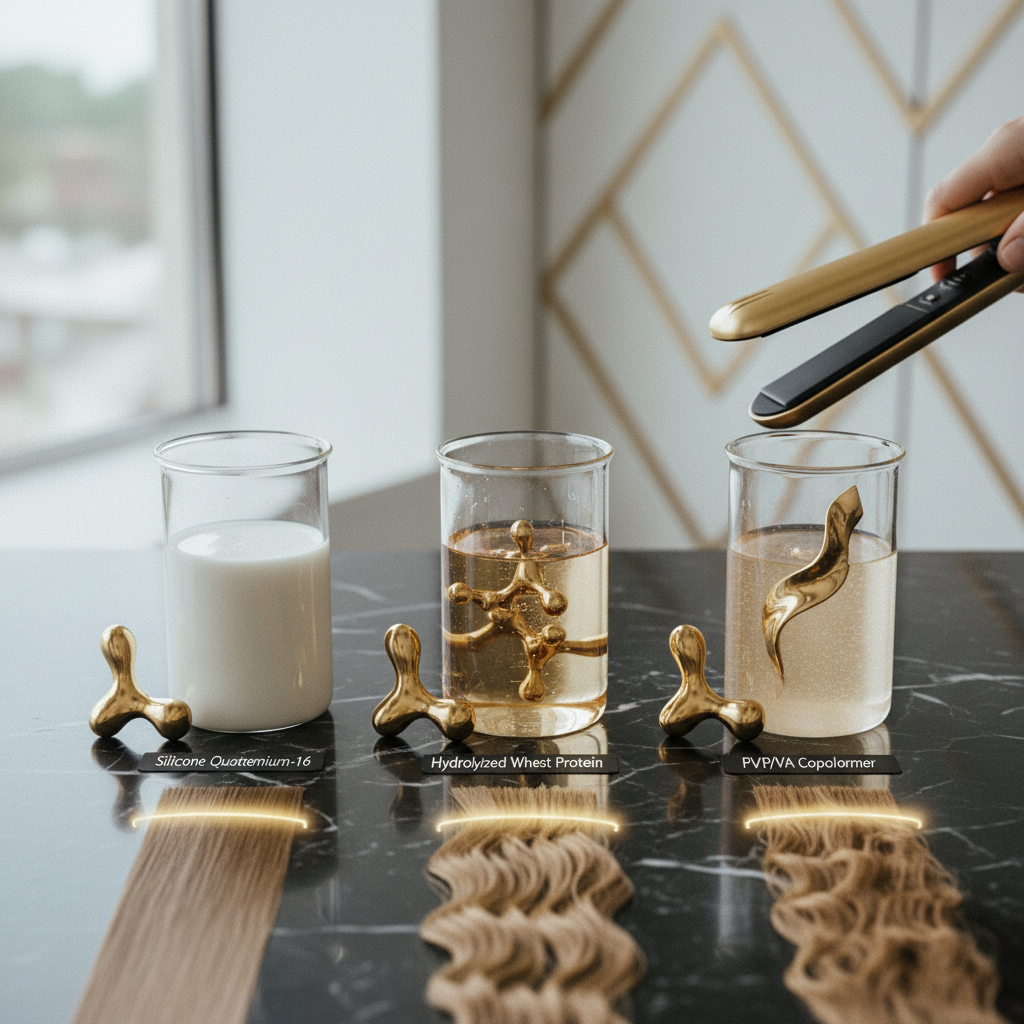
| Cationic Polymers | Polyquaternium-55, PVP/VA Copolymer | Forms flexible, insulating film to control moisture loss | Curling wands, style memory |
| Hydrolysed Proteins | Hydrolysed wheat protein, Hydrolysed vegetable protein | Sacrificial thermal buffers, moisture retention | Weakened hair prone to snapping |
What the evidence does not show
While laboratory testing confirms that protectants reduce surface roughness and maintain tensile strength, the science does not support claims of complete protection.
First, protectants do not make hair impervious to high heat. Exposing a treated fibre to 230°C for multiple seconds will still strip the 18-methyleicosanoic acid (18-MEA) lipid layer, oxidise melanin, and weaken internal disulphide bonds. Studies generally show a 30 to 50 percent retention of mechanical strength compared to untreated hair, not 100 percent preservation.
Second, thermal protectants cannot repair existing fibre fractures. If hair already exhibits trichorrhexis nodosa (node-like swelling along the shaft where fibres have fractured) or split ends, topical protectants will merely smooth down lifted edges temporarily. They do not re-fuse broken peptide chains.
Finally, heat protectants cannot prevent hair shedding or follicular hair loss. The thermal styling process impacts the non-living fibre shaft outside the scalp. When people notice increased hair fall following heat styling, this is typically physical fibre snapping (breakage) rather than shedding from the follicle (telogen effluvium), unless the heat tool was applied directly to the scalp, causing a contact burn.
Identifying thermal damage
Stylists and consumers can recognise heat-induced structural failure through distinct physical changes in the fibre:
- Cuticle cracking and roughness: The hair feels dry, rasping, or catches when sliding fingers from root to tip.
- Loss of elasticity: The hair snaps under minimal tension rather than stretching slightly and returning to shape.
- Colour shift and dullness: Dyed hair fades rapidly, while natural grey or blonde hair displays yellowish oxidation caused by tryptophan degradation.
- Split ends and trichorrhexis nodosa: Tiny white dots appear along the shaft where the cortex has burst, leading to transverse fractures.
- Bubble hair: Under microscopic inspection, small gas-filled cavities are visible inside the fibre, caused by trapped moisture boiling during rapid heating.
Best practices for thermal styling
To maximise the efficacy of thermal defence formulations, application technique matters just as much as the formulation itself.
- Lower the temperature: Keep heat tools below 185°C whenever possible. Thick, coarse hair may require up to 200°C for styling efficiency, but 230°C should be avoided for routine maintenance.
- Ensure complete dryness before flat ironing: Never use clamping tools on damp hair. The presence of excess free water creates rapid steam generation, producing internal steam explosions within the cortex.
- Section the hair before application: Spritzing only the outer layer leaves the underside exposed. Divide hair into quadrants and apply product evenly to ensure every strand is coated.
- Use wide-tooth combs for distribution: Comb the product through from mid-lengths to ends to avoid uneven silicone deposits and eliminate unprotected hotspots.
- Minimise tool contact time: Avoid holding a hot iron in one place. Move the tool smoothly down the hair shaft in a single, fluid pass rather than dragging it multiple times across the same section.
Supporting fibre resilience with Watermans
Thermal defence does not end at the styling station; maintaining hair that can withstand daily mechanical and environmental stress requires baseline fibre resilience. Watermans approaches hair wellness by supporting the scalp environment and reinforcing natural condition.
Using gentle, sulphate-free options like Watermans GrowMe Shampoo cleanses the scalp without stripping protective surface lipids. Following with Watermans ConditionMe Conditioner supplies hydrolysed proteins, cholesterol, and natural oils that smooth the cuticle scale and replenish moisture. While these products are not replacements for a dedicated leave-in thermal protectant prior to flat ironing, maintaining a strong, conditioned cuticle structure ensures your hair retains greater tensile strength before thermal styling begins.
Frequently asked questions about Heat Protectant Mechanisms
How do Heat Protectant Mechanisms differ between sprays and serums?
Sprays generally rely on water-soluble polymers, light conditioning agents, and volatile silicones to provide uniform, lightweight coverage ideal for blow-drying. Serums often use heavier, non-volatile dimethicones and oils that create a thicker boundary layer. While both use identical core Heat Protectant Mechanisms by slowing thermal transfer, serums are better suited to high-friction flat ironing on coarse or thick textures.
Can natural oils replace formulated heat protectants?
No. Pure oils like argan, olive, or coconut lack the uniform, low-conductivity polymer films engineered into cosmetic protectants. Moreover, unrefined oils can smoke and oxidise at temperatures between 160°C and 200°C. Once an oil exceeds its smoke point, it undergoes free-radical decomposition that can accelerate cuticle degradation rather than protecting the fibre.
Do heat protectants work on wet hair?
Protectants engineered for blow-drying are meant for towel-dried hair. They mix with residual surface water and coat the shaft as it dries. However, protectants formulated for flat irons or curling wands should be applied to fully dry hair, as applying high-temperature clamping tools to damp hair causes moisture to boil instantly, causing internal fibre bubbling.
Does a heat protectant block 100 percent of damage?
No cosmetic formulation provides total immunity from heat. Testing indicates that protectants typically reduce cuticle abrasion and protein loss by 30 to 50 percent compared to unprotected styling. Exposing fibres to temperatures above 200°C will always cause some structural fatigue over time.
Summary of thermal defence
Familiarity with Heat Protectant Mechanisms allows stylists and individuals to make informed decisions about their thermal routines. Protective sprays and serums work by depositing polymers, silicones, and proteins that decrease thermal conductivity, buffer internal moisture, and disperse intense surface energy across the hair shaft.
However, chemical defence is only one half of the equation. To keep hair resilient, pair protective formulations with sensible temperature settings, thorough distribution, and gentle cleansing routines that preserve structural hair integrity.
Sources and references
- Journal of Cosmetic Science, "Thermal analysis of hair treated with thermal styling protectants", 2011.
- International Journal of Cosmetic Science, "Effect of heat on hair chemical and physical properties", 2004.
- Society of Cosmetic Chemists, "The interaction of heat styling tools with human hair fibres", 2015.
- Robbins, C. R., Chemical and Physical Behavior of Human Hair, 5th ed., Springer, 2012.