Hair Types Explained: Understanding Your Hair's Unique Characteristics
9 min read ·
Hair Types Explained involves categorising hair based on its texture and characteristics, which helps in tailoring a personalised and effective haircare routine.
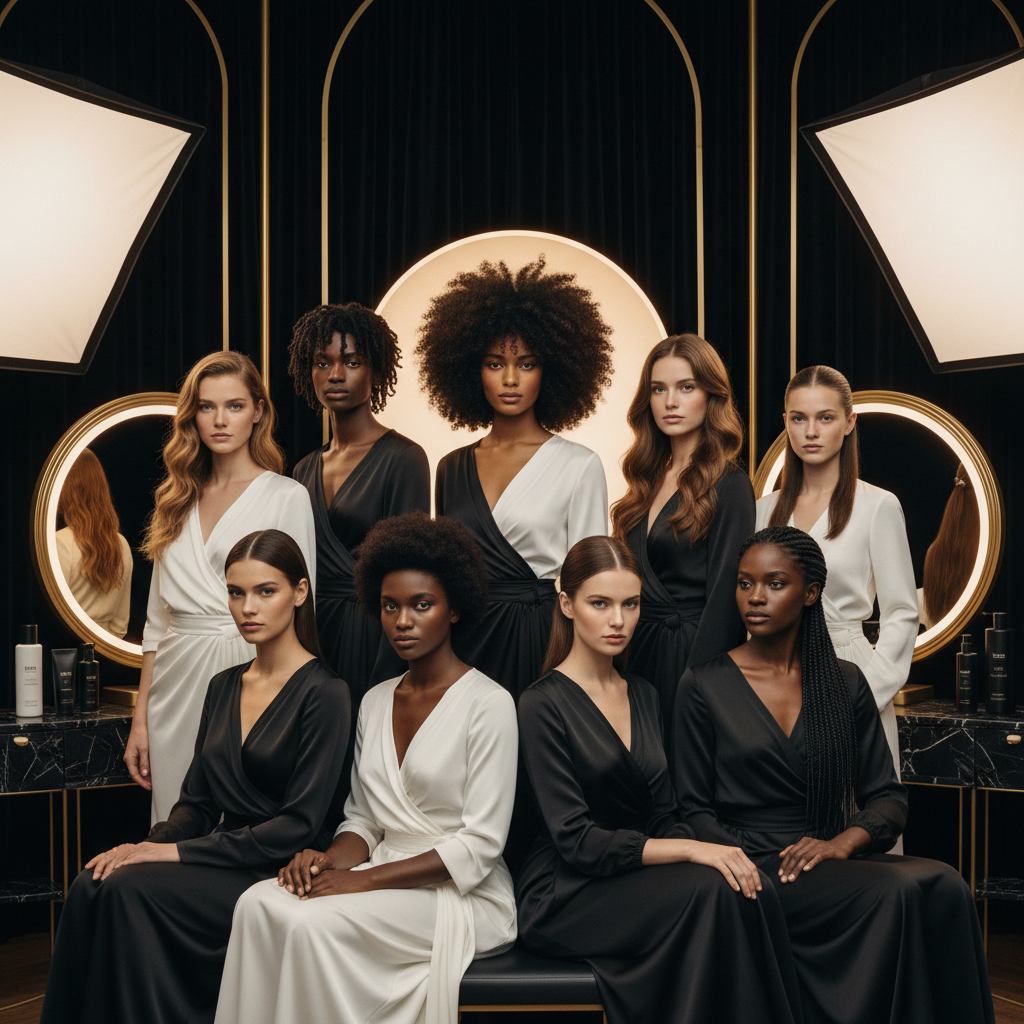
Quick answer: Hair Types Explained refers to systems that classify hair based on its natural texture, primarily its curl pattern, ranging from straight to coily. Understanding these classifications can help you choose appropriate haircare products and techniques. However, it's important to recognise that hair typing is a simplified model and other factors like porosity, density, and strand width also significantly influence hair behaviour and care needs.
Key takeaways
- Hair typing systems, like the Andre Walker system, categorise hair based on its natural curl pattern into straight (Type 1), wavy (Type 2), curly (Type 3), and coily (Type 4).
- Each primary type has sub-classifications (e.g., 1A, 2B, 3C) indicating variations in curl tightness and thickness.
- While useful, hair typing is a general guide; individual hair characteristics like porosity, density, and strand width play an equally important role in determining hair care needs.
- Genetics largely determine your hair type, but environmental factors, chemical treatments, and styling practices can influence its condition and appearance.
- Understanding your hair type helps you select suitable shampoos, conditioners, and styling products to promote hair health and manageability.
- No single hair type is inherently 'better' than another; each has unique properties and requires tailored care.
Hair Types Explained: what the evidence shows
Hair typing systems provide a framework for classifying the natural texture of hair, primarily focusing on its curl pattern. The most widely recognised system, often attributed to stylist Andre Walker, categorises hair into four main types: Type 1 (straight), Type 2 (wavy), Type 3 (curly), and Type 4 (coily). Within these main categories, further sub-classifications (A, B, C) denote variations in the tightness of the curl or wave, and sometimes the strand's thickness.
This classification is based on the shape of the hair follicle from which the hair shaft emerges. A perfectly round follicle tends to produce straight hair, while increasingly oval or flattened follicles result in wavy, curly, or coily hair. The more asymmetrical the follicle, the tighter the curl or coil pattern. The distribution of keratin proteins within the hair shaft also influences its shape, contributing to its texture.
Type 1: Straight Hair
Straight hair shows no natural curl or wave pattern. It tends to be smooth and reflects light well due to the cuticle layers lying flat. This smooth surface allows natural scalp oils (sebum) to travel down the hair shaft easily, which can lead to an oily scalp and hair that appears greasy quickly. Type 1 hair often has less natural volume but can be very shiny.
- 1A: This is typically very fine, soft, and completely straight, often struggling to hold a curl.
- 1B: Straight hair with a medium texture and some body. It holds curls better than 1A.
- 1C: Straight, thick, and sometimes coarse, with a tendency to be resistant to curling and occasionally having a slight bend, although not a true wave.
Type 2: Wavy Hair
Wavy hair exhibits a distinct 'S'-shaped pattern. It sits between straight and curly hair, often having more volume than straight hair but can be prone to frizz, especially in humid conditions. The cuticle layers may not lie as flat as in straight hair, making it slightly more susceptible to moisture loss.
- 2A: Characterised by loose, stretched-out waves, often fine and easy to straighten or curl.
- 2B: More defined 'S'-shaped waves that begin closer to the scalp. It can have some frizz around the crown.
- 2C: Distinct 'S'-shaped waves mixed with occasional loose curls, often having more volume and a higher tendency for frizz.
Type 3: Curly Hair
Curly hair features well-defined spiral curls, ranging from loose loops to tight corkscrews. Due to its helical structure, sebum struggles to travel down the hair shaft effectively, making curly hair naturally drier and more prone to frizz and breakage compared to straight or wavy hair. The cuticle layers are often more raised, contributing to this dryness.
- 3A: Large, loose, well-defined curls, with a circumference similar to a piece of sidewalk chalk.
- 3B: Springy, medium-sized ringlets, often with the circumference of a marker pen.
- 3C: Tight, densely packed corkscrew curls, typically the size of a pencil in circumference, leading to significant volume.
Type 4: Coily Hair
Coily hair, also known as kinky hair, has the tightest curl pattern, forming very small, tight coils or zig-zags directly from the scalp. It experiences the most shrinkage, meaning its apparent length is much shorter than its actual length. This hair type is typically the driest and most fragile due to the intricate curl pattern making it extremely difficult for sebum to distribute and the cuticle being naturally more lifted. It requires significant moisture and gentle handling to prevent breakage.
- 4A: Densely packed, 'S'-shaped coils that are clearly defined when wet, with a circumference similar to a crochet needle.
- 4B: Hair with a less defined, 'Z'-shaped pattern, featuring sharp angles rather than smooth curves. It can be tightly coiled with a cotton-like texture.
- 4C: Densely packed, very tight zig-zag patterns. This hair type experiences the most shrinkage and is the most fragile, requiring meticulous moisturising and detangling. For more on this, see our article on Caring for Afro Hair.
Limitations of Hair Typing: What the System Doesn't Fully Explain
While the hair typing system offers a helpful starting point for understanding your hair, it's important to recognise its limitations. It primarily focuses on curl pattern and doesn't fully account for other crucial characteristics that impact hair health and appearance. These include:
- Hair Porosity: This refers to your hair's ability to absorb and retain moisture. It's determined by the condition of the hair's outermost layer, the cuticle. Understanding your hair porosity is often more critical for product selection than just curl type alone. Our article Understanding Hair Porosity: How Your Hair Absorbs and Retains Moisture delves deeper into this.
- Hair Density: This is the number of individual hair strands per square inch on your scalp. You can have fine hair (in terms of strand width) but high density (many strands).
- Strand Width (Fine, Medium, Coarse): This describes the diameter of an individual hair strand. Fine hair is thin, medium is average, and coarse hair is thick. This is distinct from density.
- Scalp Health: The condition of your scalp (oily, dry, sensitive, prone to dandruff) significantly influences hair health, regardless of curl pattern. See Understanding Scalp Health for more information.
Considering these additional factors alongside your hair type provides a much more comprehensive understanding of your hair's unique needs.
Tailoring your haircare to your Hair Type
Once you have a general idea of your hair type and other characteristics, you can make more informed choices about your haircare routine. The goal is to support your hair's natural structure and address its specific needs.
| Hair Type | Common Characteristics | General Care Approach | Recommended Products/Practices |
|---|---|---|---|
| Type 1 (Straight) | Oily roots, shiny, lacks volume, can be fine | Focus on volume, oil control at roots, minimal heavy products | Lightweight shampoos and conditioners, clarifying washes (see How to Do a Clarifying Wash), avoid heavy oils. |
| Type 2 (Wavy) | Can be oily at roots, prone to frizz, more volume than Type 1 | Balance moisture, define waves, manage frizz | Anti-frizz products (see How to Reduce Frizz in Hair), lightweight curl-defining creams, avoid over-brushing when dry. |
| Type 3 (Curly) | Prone to dryness, frizz, shrinkage, can be fragile | Hydration is key, gentle cleansing, curl definition, minimise heat | Moisturising shampoos and conditioners, leave-in conditioners, styling creams, deep conditioning, protective styling (see Protective Styling: A Comprehensive Guide). |
| Type 4 (Coily) | Very dry, very fragile, extreme shrinkage, prone to tangles | Maximize moisture, extreme gentleness, protective styling | Rich, hydrating cleansers, deep conditioners, heavy emollients, oils for sealing, finger detangling (see How to Detangle Afro Hair Without Breakage), avoiding harsh chemicals. |
Remember, these are general guidelines. Your hair may exhibit characteristics from different types or have specific needs (e.g., colour-treated, damaged, low porosity) that require further customisation. Always listen to your hair and adjust your routine accordingly.
Frequently asked questions about Hair Types Explained
What is my hair type and how do I find it?
Your hair type is determined by the natural pattern of your hair strands as they emerge from your scalp when wet, without any product. Observe whether your hair is straight, wavy, curly, or coily, and then look for the specific sub-patterns (A, B, C) within those categories. A simple observation of your air-dried, product-free hair can help you identify your general Hair Types Explained category, which is a good starting point for tailored care.
Can my hair type change over time?
Yes, your hair type can change. While genetics establish your primary hair type, factors like hormonal shifts (e.g., pregnancy, puberty, menopause), aging, chemical treatments (like relaxers or perms), or even certain medications can alter your hair's texture and curl pattern. Significant damage can also change how your hair behaves, making it appear different from its natural state. These changes are typically observed over months or years.
Is one hair type healthier than another?
No, no single hair type is inherently healthier than another. Hair health is determined by its condition, strength, and integrity, not its curl pattern. A Type 1 straight hair can be unhealthy if it's damaged and prone to breakage, just as a Type 4 coily hair can be very healthy if it's well-moisturised and cared for. Each hair type has its unique strengths and vulnerabilities.
Why is understanding my hair type important?
Understanding your hair type is important because it helps you select the most appropriate products and care techniques. For instance, a heavy cream suitable for coily hair might weigh down fine, straight hair, while a lightweight shampoo for oily hair might not provide enough moisture for very dry, curly hair. Knowing your type helps you optimise your routine to minimise damage, maximise health, and achieve your desired look.
How does hair porosity relate to Hair Types Explained?
Hair porosity is a distinct characteristic from hair type, but it's equally important for effective haircare. While hair type describes the curl pattern, porosity describes how well your hair absorbs and retains moisture. You can have any hair type (straight, wavy, curly, coily) with any porosity level (low, medium, high). Both factors together provide a more complete picture of your hair's needs. For instance, low porosity curly hair requires different product choices than high porosity curly hair.
Understanding Hair Types Explained for Optimal Hair Health
Deciphering your Hair Types Explained and understanding its unique characteristics is a foundational step in establishing an effective haircare routine. While the classification system provides a valuable starting point, remember to consider other factors such as porosity, density, and strand width. By combining this knowledge, you can make informed choices about products and practices that truly nurture your hair, leading to improved health, strength, and manageability. Tailoring your approach ensures your hair receives the specific care it needs to thrive.
Sources and references
- American Academy of Dermatology Association. Hair Care Tips. (Current data available on their website).
- National Center for Biotechnology Information (NCBI), PubMed. Various studies on hair structure and characteristics (e.g., research on keratin, hair follicle morphology).
- Society of Cosmetic Chemists. Journals and publications discussing hair science and ingredient efficacy.
- British Association of Dermatologists. Patient information leaflets and expert advice on hair and scalp conditions.
- The Trichological Society. Resources on hair and scalp science and health.