Hair Type Classification Systems
5 min read ·
Hair typing describes systems used to categorize natural hair, primarily by curl pattern, to help individuals understand its characteristics and better care for it.
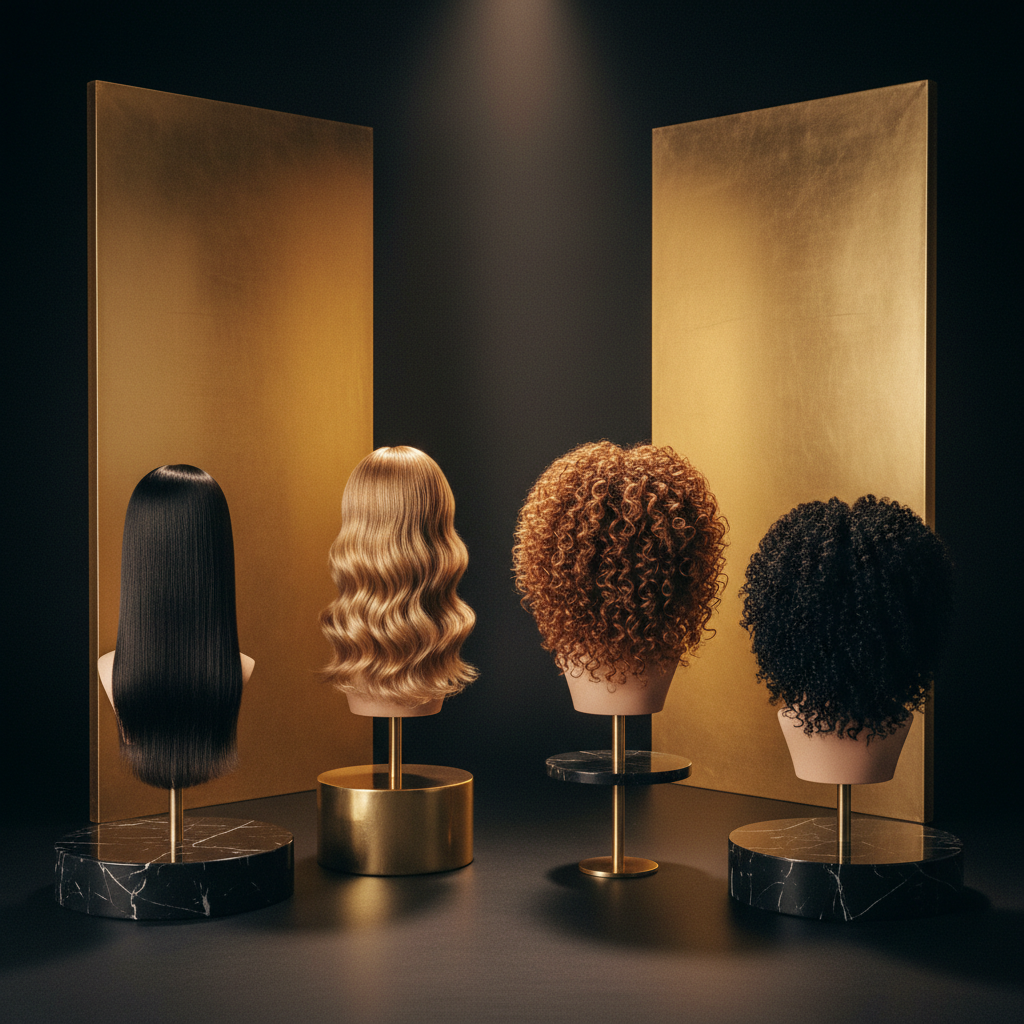
Understanding Hair Type Classification
Hair typing refers to methods of categorizing natural hair based primarily on its curl pattern, ranging from straight to coily. These systems serve as practical guides for individuals to understand their hair's inherent characteristics, predict how it will behave, and select appropriate care routines and products.
While various hair typing systems exist, the most widely recognized and utilized was popularized by stylist Andre Walker. This system classifies hair into four main types, with several subcategories, moving from straight to increasingly coily textures. It is important to remember that these systems are generalizations; an individual may have multiple hair types on their head, and genetics, ethnicity, and environmental factors all play a role in hair's appearance and needs.
The Andre Walker Hair Typing System
Type 1: Straight Hair
Type 1 hair is characterized by a complete absence of curl. The hair strands fall without curving. This hair type tends to be shiny due to the cuticle lying flat, which reflects light effectively. The flat cuticle also allows natural oils from the scalp to travel down the hair shaft easily, often leading to a tendency towards oiliness at the scalp and a need for frequent shampooing.
- 1A: Pin-straight, fine, and thin hair. It often struggles to hold a curl.
- 1B: Straight hair that is medium-textured and has some body. It can hold a curl more readily than 1A.
- 1C: Straight, thick, and coarse hair with some body. It can be resistant to curling and may have a slight wave, but it is not uniformly wavy.
Type 2: Wavy Hair
Type 2 hair exhibits a distinct "S" shape pattern, ranging from loose, elongated waves to more defined S-curves. It typically has more body and texture than Type 1 hair, and its natural oils may not travel down the hair shaft as evenly, leading to a drier mid-shaft and ends.
- 2A: Fine, wavy hair with a loose, stretched-out S-pattern. It is relatively easy to straighten or curl.
- 2B: Wavy hair with a more defined S-pattern, often medium-textured. It may be slightly frizz-prone.
- 2C: Coarse, very wavy hair with well-defined S-bends, sometimes accompanied by a few scattered curls. It is prone to frizz and can be more difficult to style due to its thickness and pattern.
Type 3: Curly Hair
Type 3 hair forms distinct, well-defined curls that can range from loose loops to tight, springy corkscrews. This hair type tends to be voluminous and more susceptible to frizz due to the raised cuticle layers, which prevent natural oils from easily coating the entire strand. Hydration is crucial for Type 3 hair.
- 3A: Large, loose curls that are well-defined, often the size of a sidewalk chalk stick. It tends to be shiny and can be easily stretched.
- 3B: Springy, tighter curls with a circumference similar to a Sharpie marker. This type can experience more shrinkage and frizz than 3A.
- 3C: Tightly packed, voluminous corkscrew curls, often the size of a pencil. This hair type experiences significant shrinkage and requires consistent moisture to combat dryness and frizz.
Type 4: Coily/Kinky Hair
Type 4 hair is characterized by very tight, often Z-shaped or S-shaped coils that are densely packed. Despite appearing robust, this hair type is often the most fragile due to fewer cuticle layers and a smaller circumference per strand. It experiences the most shrinkage and is highly prone to dryness, requiring intensive moisture and gentle handling.
- 4A: Densely packed, S-shaped coils that are often visible and have a circumference similar to a knitting needle. It retains moisture better than 4B and 4C.
- 4B: Z-shaped coils that have sharper angles and are less defined than 4A. It can feel like cotton and is very prone to shrinkage and dryness.
- 4C: Densely packed, very tight Z-shaped coils that may not have a defined curl pattern without manipulation. It is the most fragile hair type, experiences maximal shrinkage, and is highly susceptible to dryness.
Beyond Curl Pattern: Other Hair Characteristics
While the Andre Walker system focuses on curl pattern, other characteristics are equally important for a complete understanding of hair and effective care:
- Texture/Strand Thickness: Refers to the thickness of individual hair strands, fine, medium, or coarse. This is distinct from density (how many hairs per square inch).
- Porosity: Indicates how well your hair cuticle absorbs and retains moisture. High porosity means the cuticle is open (absorbing and losing moisture quickly), while low porosity means it is tightly closed (resisting moisture absorption).
- Density: The number of hair strands per square inch on the scalp, thin, medium, or thick.
- Elasticity: The hair's ability to stretch and return to its original state without breaking. Healthy hair has good elasticity.
- Sebum Production: The amount of natural oil (sebum) produced by the scalp, influencing how oily or dry the hair tends to be.
Why Hair Typing Matters
Understanding your hair type and its accompanying characteristics allows for a more targeted approach to hair care. For example:
- Product Selection: Fine, straight hair (Type 1A) will likely be weighed down by heavy butters, whereas coily hair (Type 4C) thrives on such rich moisturisers. Conversely, lightweight leave-in conditioners are often essential for Type 4 hair but unnecessary for Type 1.
- Styling Techniques: Techniques like "wash and go" are very different for Type 2 and Type 4 hair. Heat styling precautions also vary considerably.
- Moisture Needs: Hair types with a more open cuticle structure (e.g., Type 3 and 4) require consistent and deep moisturization to prevent dryness and breakage.
| Hair Type | Key Characteristic | Primary Concern | Recommended Care Focus |
|---|---|---|---|
| Type 1 (Straight) | No curl; flat cuticle | Oiliness, lack of volume | Volumizing, light hydration |
| Type 2 (Wavy) | "S" pattern, some body | Frizz, dryness mid-shaft | Define waves, moderate moisture |
| Type 3 (Curly) | Defined curls, spirals | Frizz, dryness, shrinkage | Hydration, curl definition |
| Type 4 (Coily) | Tight coils, Z-patterns | Dryness, fragility, shrinkage | Deep moisture, protective styles |
While the Andre Walker system provides a useful framework, remember that it is a starting point. Individual hair needs are complex and multifaceted, requiring observation and experimentation to discover what works best.
Where Watermans fits
If you want a routine built around the science above, these are the products from the range that apply here: