Hair Fibre Diameter: The Complete Science and Care Guide
8 min read ·
Understand Hair Fibre Diameter: explore the science of fine, medium, and coarse hair, cross-sectional geometry, miniaturisation causes, and how to assess thickness.
Quick answer: Hair Fibre Diameter refers to the physical thickness or width of an individual strand of human hair, typically ranging between 40 and 120 micrometres (microns). It determines whether an individual has fine, medium, or coarse hair, directly influencing tensile strength, porosity, stiffness, and chemical processing times. However, measuring Hair Fibre Diameter reflects individual strand thickness rather than total follicular density on the scalp, meaning you can have high-density fine hair or low-density coarse hair.
Key takeaways
- Individual hair width typically measures between 40 micrometres (very fine) and 120 micrometres (coarse), with the global average sitting around 70 micrometres.
- Hair Fibre Diameter is biologically determined by the size and shape of the hair follicle dermal papilla and matrix cells.
- Fibre diameter is distinct from hair density. Density measures follicles per square centimetre, whereas diameter measures the cross-sectional thickness of one strand.
- Hair fibres are rarely circular. European hair is slightly oval, Asian hair is largely cylindrical, and Afro hair is markedly elliptical with high variation along the shaft.
- Medical conditions, hormonal shifts, nutritional deficiencies, and ageing can reduce fibre diameter through follicular miniaturisation.
Hair Fibre Diameter: what the science reveals
Human hair thickness varies widely between individuals and across different regions of the same scalp. The scientific measurement of Hair Fibre Diameter relies on micrometres (µm), where one micrometre equals one-thousandth of a millimetre. Forensic, trichological, and cosmetic laboratories typically use laser scan micrometres or cross-sectional light microscopy to capture accurate measurements.
Genetics establish the baseline diameter of your hair fibres. Follicles with a large dermal papilla contain more matrix cells, which synthesise a thicker cortical layer and an expansive cross-section. Thicker fibres possess greater cross-sectional area, giving them higher tensile strength against snapping compared to fine hair, though they are structurally stiffer and more resistant to mechanical bending.
| Category | Typical Diameter Range | Cross-Sectional Geometry | Relative Cortex-to-Cuticle Ratio | Styling & Care Behaviour |
|---|---|---|---|---|
| Fine Hair | 40 to 60 µm | Small oval or circle | Thin cortex, delicate cuticle layer | Prone to mechanical breakage; weighs down easily with heavy oils |
| Medium Hair | 60 to 80 µm | Oval to circular | Balanced cortex and protective cuticle | Adaptable, holds styles well, moderate product tolerance |
| Coarse Hair | 80 to 120+ µm | Large circular, oval, or flattened ellipse | Robust cortex, often includes a continuous medulla | High structural stiffness; requires rich emollients to improve pliability |
The internal biological mechanism
The diameter of each hair shaft is dictated primarily by the cortex, which constitutes roughly 80 to 85 percent of the total fibre volume. The cortex is packed with tightly aligned, keratinised intermediate filaments embedded in a sulphur-rich protein matrix.
When a hair follicle operates at peak metabolic capacity, the matrix cells divide rapidly in the bulb, creating concentric rings of cells that harden as they move upward through the zone of keratinisation. Thicker strands often develop a central core called the medulla, consisting of specialised, air-filled, loosely packed cells. Fine strands frequently lack a medulla entirely.
Cross-sectional geometry also shapes the mechanical behaviour of the fibre. Cylindrical fibres (common in East Asian hair) distribute tension evenly across the diameter. Flattened, ribbon-like ellipses (characteristic of Afro-textured hair) show uneven diameter measurements depending on whether the strand is measured across its major or minor axis. This geometric variability creates localised points of mechanical stress along the hair shaft.
What affects Hair Fibre Diameter over time?
While your baseline width is genetic, the diameter of individual fibres is not permanently fixed. Several systemic and biological factors can alter it:
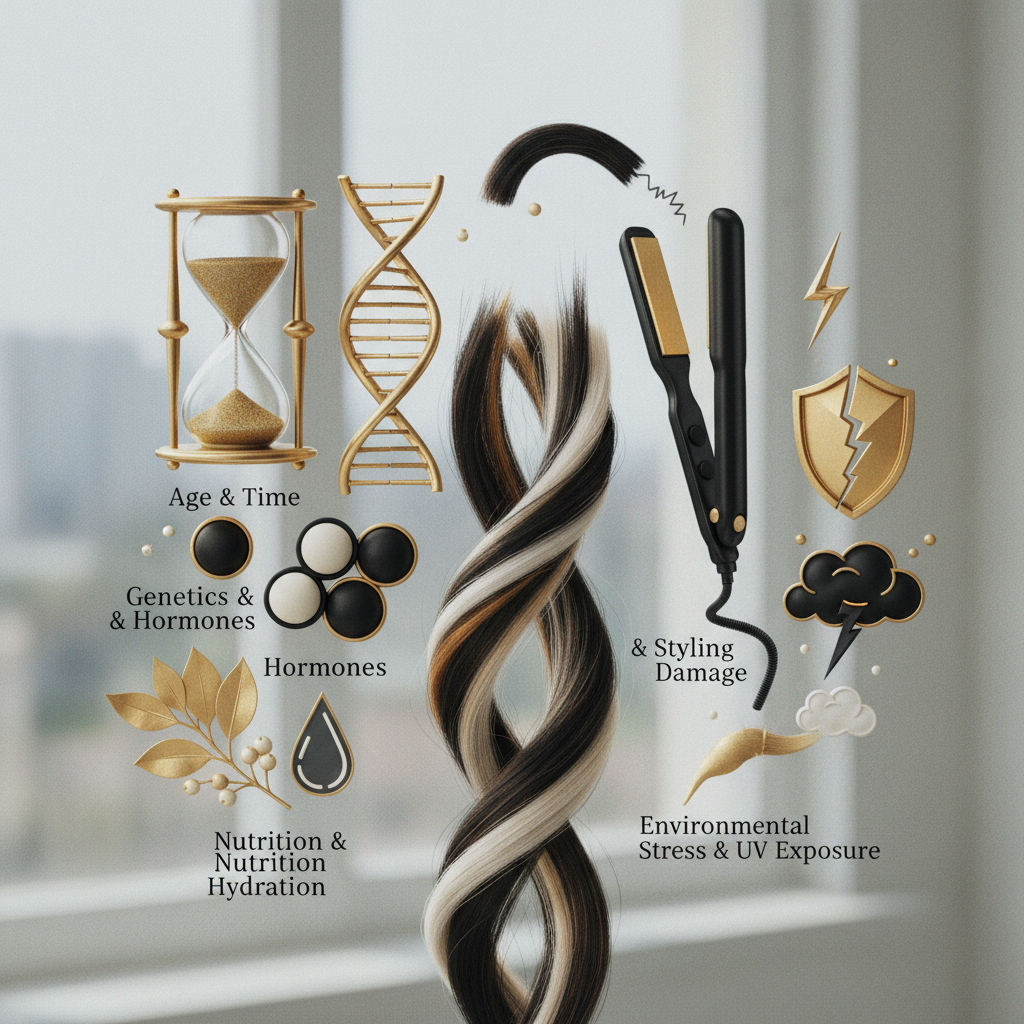
- Androgenic miniaturisation: In pattern hair loss (androgenetic alopecia), dihydrotestosterone (DHT) binds to androgen receptors in genetically susceptible follicles. Over successive growth cycles, the follicle shrinks, producing strands with progressively narrower diameters until they become vellus-like hairs.
- Ageing: Longitudinal trichology studies indicate that hair calibre tends to increase from childhood into early adulthood, peaks between ages 20 and 40, and gradually declines thereafter as cellular turnover slows.
- Nutritional availability: Inadequate dietary protein, severe caloric restriction, or micronutrient deficiencies (such as iron or zinc) can starve the follicle of essential amino acids, resulting in the production of structurally thinner hair fibres.
- Hormonal fluctuations: Thyroid hormones regulate cellular metabolism in the dermal papilla. Hypothyroidism typically causes hair to become uniformly thinner, duller, and more brittle.
What cosmetic treatments can and cannot do
Cosmetic haircare products cannot physically expand the living dermal papilla inside the scalp to change your genetic hair type. However, topical formulations can alter the temporary diameter of existing strands through functional surface coatings.
Hydrolysed proteins, synthetic polymers, and panthenol (pro-vitamin B5) can penetrate microscopic fissures in the cuticle or adhere to the outer fibre surface. This deposition can temporarily increase individual strand diameter by 2 to 10 percent until the next wash, creating perceived volume and fuller-looking hair.
Conversely, chemical processes such as bleaching, high-pH relaxing, and oxidative colouring strip the natural lipid layer (18-methyl eicosanoic acid) and dissolve cortical proteins. This degradation causes a net loss of structural mass, reducing effective fibre integrity even if structural swelling temporarily makes the strand feel rougher.
How to assess your strand thickness at home
Stylists and trichologists use simple tactile and visual tests to distinguish between fine, medium, and coarse fibres:
- The single strand roll: Take a single shed hair between your thumb and index finger. If you can barely feel the strand, it is fine. If you feel a distinct, slight thread, it is medium. If the strand feels stiff, thick, or wire-like, it is coarse.
- The sewing thread comparison: Place a single clean shed strand next to a piece of standard sewing thread on a white sheet of paper. Fine hair is less than half the thickness of the thread, medium hair is roughly half, and coarse hair approaches or equals the thickness of the thread.
- The stiffness check: Hold a 5 cm section of hair horizontally between your fingertips. Fine hair wilts and flops immediately under its own weight, whereas coarse hair often supports its own structure and points outward.
Supporting hair health and fibre fullness
While you cannot transform naturally fine hair into naturally coarse hair, you can maximise the natural density, strength, and structural resilience of your fibres:
- Protect the cuticle layer: Use leave-in conditioners and light heat protectants containing silicones or plant lipids to prevent cuticle erosion. Stripped cuticles expose the cortex, leading to fibre thinning and snapping.
- Balance scalp cleansing: Keep follicles clear of oxidative sebum buildup and product residue. A clean, balanced scalp environment supports unobstructed hair growth.
- Optimise protein and micronutrient intake: Ensure adequate dietary intake of complete proteins, l-lysine, ferritin, and B vitamins to provide the basic biochemical building blocks for keratin synthesis.
- Incorporate targeted topical care: Shampoos and conditioners enriched with biotin, caffeine, rosemary, and niacinamide help condition the scalp surface and support a fuller, healthier appearance. Watermans GrowMe Shampoo delivers these botanical ingredients alongside hydrolysed lupin protein to revitalise the scalp environment and leave individual strands feeling stronger and noticeably thicker.
When to seek medical advice
A subtle, gradual variation in Hair Fibre Diameter across decades is normal. However, sudden or localised thinning requires investigation.
If you notice your ponytail circumference shrinking rapidly, your parting widening, or shed hairs looking visibly thinner and shorter at the root than they used to, consult a qualified trichologist or dermatologist. These changes frequently signal early androgenetic alopecia, diffuse chronic telogen effluvium, or an underlying thyroid or metabolic irregularity. Early clinical intervention can halt follicular miniaturisation before the follicle becomes completely inactive.
Frequently asked questions about Hair Fibre Diameter
Does a low Hair Fibre Diameter mean my hair is thinning?
No. Having a low Hair Fibre Diameter simply means you have fine hair, which is a structural hair type, not a pathology. You can have fine hair with an exceptionally high follicular density, giving you an abundant head of hair. Pathological thinning occurs when previously thick fibres progressively shrink over successive growth cycles.
Can chemical relaxers or bleach permanently reduce Hair Fibre Diameter?
Yes, chemical treatments can permanently reduce the diameter of the treated portion of the hair. Bleach dissolves cortical protein matrix bonds, and chemical relaxers break disulfide cross-links. While the strand swells during processing, the resulting loss of internal mass leaves the finished, dried fibre physically lighter, weaker, and structurally thinner.
Does cutting or shaving hair increase individual Hair Fibre Diameter?
No, cutting or shaving does not alter Hair Fibre Diameter in any way. Hair fibres are non-living biological structures above the scalp line. Shaving cuts the strand at its blunt, widest point near the scalp surface, making stubble feel stiff and coarse, but the follicle beneath continues producing hair at its genetically predetermined calibre.
Can natural oils physically thicken individual hair strands?
No, natural oils cannot permanently thicken individual hair strands. Oils like argan, coconut, or jojoba coat the exterior cuticle and can reduce moisture loss and friction. However, they do not permanently bind into the cortical protein matrix to increase structural mass. Only certain small-molecule proteins and film-forming polymers can temporarily boost strand thickness.
Maintaining optimal fibre resilience
Understanding your Hair Fibre Diameter is essential for designing an effective haircare regimen, selecting suitable chemical services, and identifying the early signs of follicular miniaturisation. Fine hair requires lightweight, protein-rich protection against mechanical breakage, while coarse hair demands intensive emollient softening to counteract natural structural stiffness. By monitoring changes in strand calibre and protecting the structural cortex from chemical and environmental damage, you can maintain strong, resilient, and healthy-looking hair at every stage of life.
Sources and references
- British Association of Dermatologists. Clinical Guidelines for the Management of Alopecia Areata and Androgenetic Alopecia, 2021.
- Robbins, C. R. Chemical and Physical Behavior of Human Hair, 5th ed. Springer-Verlag, 2012.
- Dawber, R. P. R. Diseases of the Hair and Scalp, Blackwell Science, 1997.
- Wolfram, L. J. "Human hair: A unique physicochemical composite." Journal of the American Academy of Dermatology, 2003.
- Franbourg, A. Et al. "Current research on ethnic hair." Journal of the American Academy of Dermatology, 2003. DOI: 10.1067/mjd.2003.277.
Find these ingredients in Watermans products
- Zinc: you will find this ingredient in our Hair Vitamins.
- Niacinamide: you will find this ingredient in our Hair Mask.
- Panthenol (Provitamin B5): you will find this ingredient in our Heat Protection Spray.