Hair Tensile Strength: The Science of Fibre Resilience and Breakage
10 min read ·
Discover the science of Hair Tensile Strength. Learn how keratin bonds, moisture, and chemical treatments affect fibre elasticity and how to prevent breakage.
Quick answer: Hair Tensile Strength measures the maximum pulling force a single strand of hair can withstand before snapping. In healthy hair, a single fibre can typically support 50 to 100 grams of weight and stretch by 20 to 30 percent dry (or up to 50 percent wet) before breaking. The primary limitation is that once internal keratin bonds break from chemical bleaching, heat, or UV radiation, cosmetic products cannot physically rebuild those lost covalent links, meaning true baseline tensile capacity cannot be fully restored permanently.
Key takeaways
- Hair Tensile Strength depends on the integrity of the cortex, particularly its cross-linked keratin intermediate filaments and cystine disulphide bonds.
- Healthy dry hair can stretch by 20 to 30 percent of its original length, while wet hair can stretch up to 50 percent before reaching its breaking point.
- Chemical processes like bleaching, permanent waving, and relaxing cause the sharpest drops in tensile capacity by converting disulphide bonds into cysteic acid.
- Cosmetic treatments, conditioning agents, and film-formers can reduce friction and temporarily improve elasticity, but they do not permanently replace severed covalent bonds.
- Fibre snapping caused by low tensile resilience is mechanical breakage, which is entirely distinct from root shedding (telogen effluvium) or follicle miniaturisation (androgenetic alopecia).
Hair Tensile Strength: what the evidence shows
Hair Tensile Strength reflects the structural health of the hair cortex, which makes up roughly 85 to 90 percent of the total fibre volume. In laboratory settings, cosmetic scientists measure tensile properties using an automated tensile tester (such as an Instron or miniature tensile tester). These instruments pull a single strand at a controlled rate and record a stress-strain curve, which divides the hair's mechanical behaviour into three distinct regions: the Hookean (elastic) region, the yield region, and the post-yield region.
In the initial Hookean region (up to roughly 2 to 3 percent extension), the strain is fully reversible. The hydrogen bonds and alpha-helical keratin structures deform under tension, but they spring back immediately once released. When tension increases beyond this point, the fibre enters the yield region (between roughly 3 and 25 to 30 percent extension). Here, alpha-helical proteins unfold into beta-pleated sheets, and structural resistance softens noticeably. Finally, in the post-yield region, the strain hardens until the ultimate tensile strength is breached, resulting in catastrophic fibre fracture.
Stress (Load)
 ^
 | / Post-yield Region (Covalent bond strain)
 | Yield Region /
 | +------------+ <- Alpha-to-beta transition
 | /
 | / Hookean (Elastic) Region (Reversible strain)
 | /
 +-------------------------------------> Strain (Elongation %)
Published cosmetic science literature demonstrates that a healthy, intact human hair strand requires roughly 50 to 100 grams-force (approximately 0.5 to 1.0 Newton) to break, depending on its cross-sectional area. Normalised for thickness, the tensile strength of virgin human hair typically averages 150 to 200 megapascals (MPa).
| Hair Condition | Elastic Limit (% Extension) | Elongation at Break (% Dry) | Approximate Break Force (Grams-Force) | Disulphide Bond Integrity |
|---|---|---|---|---|
| Virgin (Undamaged) | 2% to 3% | 25% to 35% | 80 to 120 g | High (intact cystine bonds) |
| Heat-Damaged (200°C+) | 1.5% to 2% | 15% to 22% | 50 to 70 g | Moderate (keratin denatured) |
| Lightened / Bleached | 1% to 1.5% | 10% to 18% | 30 to 50 g | Very Low (cysteic acid formation) |
| Relaxed / Chemically Straightened | < 1% | 8% to 15% | 25 to 45 g | Critically Depleted (lanthionine conversion) |
The table above illustrates how chemical and thermal aggression degrades structural performance. When hair is heavily lightened, alkaline persulphate salts oxidise cystine, depleting disulphide links by 30 to 50 percent or more. The consequence is immediate: the slope of the yield region collapses, and the fibre snaps under loads that virgin hair would easily tolerate.
What the evidence does not show
Research does not show that any cosmetic ingredient, vitamin, or [deep conditioner](https://watermanshair.com/products/masque-me-luxurious-hair-mask) can physically regenerate severed disulphide bonds to identical virgin levels. While bonding complexes that use polycarboxylic acids or dialdehydes can create temporary ionic bridges or secondary cross-links within the cortex, they do not permanently restore the exact macromolecular lattice of native cystine.
Furthermore, laboratory data does not support the idea that dietary supplements improve the tensile strength of hair that has already emerged from the scalp. The hair shaft is biologically non-living tissue. Once a fibre exits the follicular infundibulum, systemic nutrition, biotin, and collagen drinks have zero biochemical pathway to alter its existing protein architecture. Nutrition affects only the developing matrix cells deep within the active anagen follicle.
Finally, evidence does not show that low tensile strength causes hair loss. A snapped strand represents mechanical breakage along the shaft. It does not reflect follicle detachment, miniaturisation, or premature transition into the telogen phase.
The biological and chemical mechanism
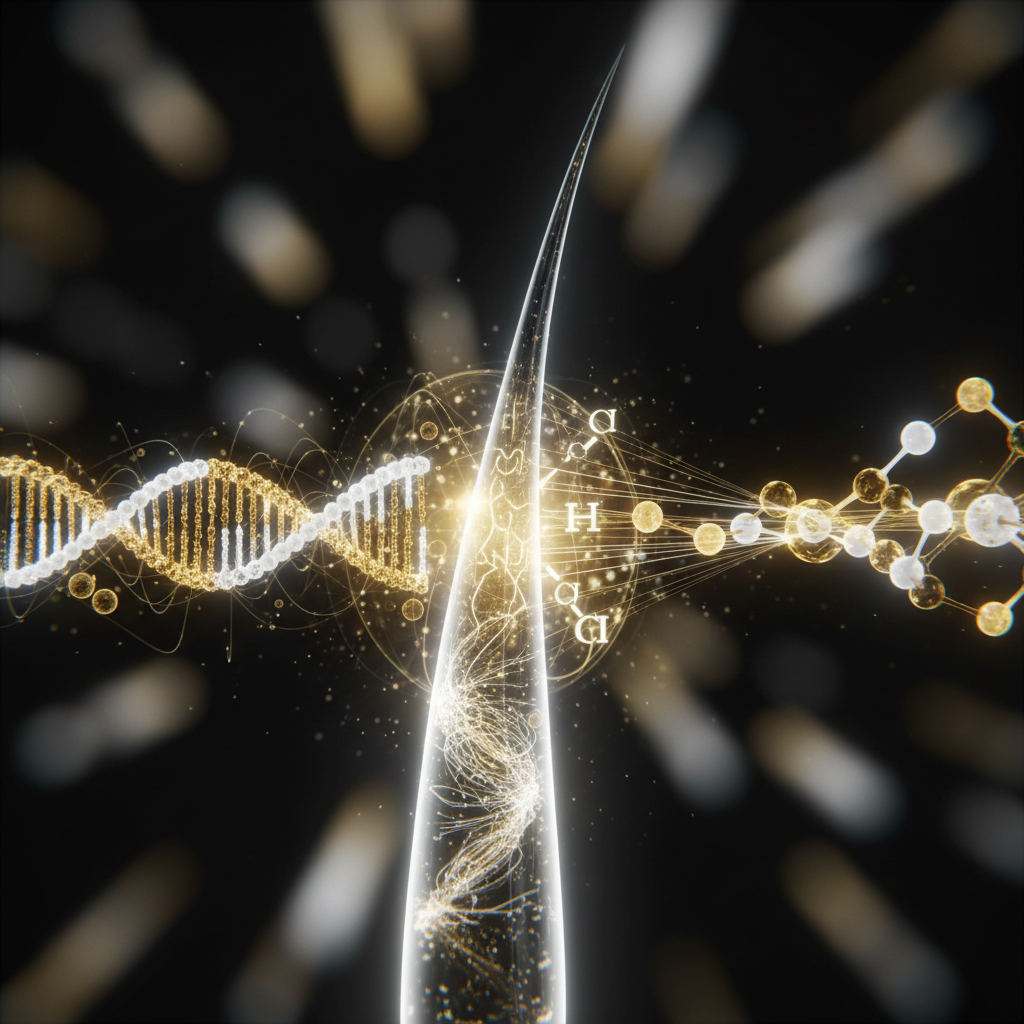
The mechanical resistance of hair originates at the nanometre scale inside cortical cells. Cortical cells are packed with macrofibrils, which contain intermediate filaments (microfibrils) embedded in a sulphur-rich, non-filamentous protein matrix.
[Hair Shaft]
 └── Cuticle (Protective barrier)
 └── Cortex (Mechanical core)
 └── Cortical Cells
 └── Macrofibrils
 └── Intermediate Filaments (Alpha-helices)
 └── Disulphide cross-links within cystine-rich matrix
Keratin intermediate filaments consist of coiled-coil alpha-helical protein chains rich in the amino acids leucine, glutamic acid, and alanine. Surrounding these crystalline filaments is the matrix, composed of high-sulphur and high-glycine-tyrosine proteins. Cystine, a dimeric amino acid linked by a disulphide bond (-S-S-), is the foundational anchor of this matrix.
When you stretch a dry hair strand, you initially stretch hydrogen bonds between the turns of the alpha-helix. As tensile stress escalates, the alpha-helices unwind cooperatively into extended beta-sheet structures. The sulphur-rich matrix acts as a three-dimensional elastomeric spring, sharing the mechanical load.
Water dramatically modulates this process. Water molecules penetrate the porous cortex and compete for secondary hydrogen bonds, acting as a molecular plasticiser. This is why wet hair exhibits a lower initial elastic modulus (it feels softer and stretches more easily under small loads), but it can stretch up to 50 percent before total breakage occurs. However, because wet hair requires less absolute force to enter its destructive yield region, vigorous wet brushing frequently causes irreversible elongation, cuticle peeling, and snap fractures.
Signs of depleted tensile strength
Depleted tensile resilience presents with clear physical behaviours that you can identify during routine handling:
- The stretch-and-snap response: Healthy wet hair stretches gently and contracts back toward its original length when released. Fibre with depleted tensile capacity either stretches like soft chewing gum without snapping back, or it snaps instantly with little resistance.
- Short, rootless broken pieces: Finding fragments of hair on your shoulders, pillowcase, or bathroom counter without a white bulb at the end indicates shaft fracture, not follicular shedding.
- Micro-fractures and trichorrhexis nodosa: Under magnification, weak fibres show local swellings where cortical fibres have split apart longitudinally, resembling two paintbrushes pushed against each other.
- Excessive tangling and knotting: Severely weakened fibres display raised or eroded cuticles. As naked cortex rubs against naked cortex, friction spikes, causing knots that snap the compromised shaft during detangling.
What you can do to preserve and support fibre strength
Because you cannot re-grow a broken hair shaft, your daily goal is to preserve existing structural bonds and minimise cumulative mechanical strain.
- Moderate chemical processing: Avoid overlapping bleach applications or alkaline relaxers on previously processed hair. Bleach oxidation creates cysteic acid, permanently diminishing the internal disulphide network.
- Limit thermal degradation: Keep heated styling tools below 185°C. At temperatures above 200°C, alpha-helical keratin begins thermal denaturation, transforming organised crystalline protein into disordered, brittle structures.
- Use film-forming conditioning agents: Quaternary ammonium compounds, silicones, and hydrolysed vegetable proteins do not rebuild the living cortex, but they deposit protective outer coatings. By dramatically decreasing inter-fibre friction during wet and dry combing, they reduce the mechanical load applied to the internal bonds.
- Detangle damp hair with care: Never rip a fine-toothed comb through wet hair. Instead, apply a high-slip conditioner, use a flexible-bristle detangling brush or wide-toothed comb, and work methodically from the tips upward to the roots.
- Protect against environmental oxidation: Prolonged ultraviolet (UV) radiation generates reactive oxygen species (ROS) that degrade both melanin and amino acids like tryptophan and cystine, reducing tensile resistance over time.
When the cause may be internal or medical
While physical or chemical abuse accounts for most tensile failures, structural fragility can occasionally stem from systemic or genetic factors affecting follicular protein synthesis.
- Congenital shaft disorders: Conditions such as trichorrhexis invaginata (bamboo hair, seen in Netherton syndrome) or monilethrix (beaded hair) create hereditary defects in cortex formation, causing hair to break under normal combing.
- Severe nutritional deficiencies: Extreme protein-energy malnutrition or profound zinc and iron deficiencies can disrupt the mitotic activity of the hair matrix, resulting in narrower, mechanically compromised hair fibres with diminished tensile capacity.
- Endocrine disorders: Untreated hypothyroidism can alter metabolic rates in the follicle, occasionally producing dry, coarse hair that is structurally brittle and prone to breakage.
If your hair snaps without any history of chemical processing, high heat, or rough handling, consult a dermatologist or a registered trichologist. They can perform polarising light microscopy or trichoscopy to differentiate between acquired structural weathering and an underlying shaft disorder.
Supporting the scalp environment with Watermans
When managing hair prone to mechanical breakage, supporting the scalp where new fibres form is vital. The Watermans Grow Me range is engineered to maintain optimal scalp cleanliness and provide conditioning care without weighing hair down.
While topical shampoos and conditioners cannot reconnect severed covalent disulphide bonds within damaged ends, proper cosmetic conditioning improves surface lubricity. By reducing surface friction and providing humectants, gentle botanical-infused cleansers and conditioners help shield emerging fibres against routine combing friction, keeping the existing length looking fuller and feeling more resilient.
Frequently asked questions about Hair Tensile Strength
What is the normal Hair Tensile Strength of a healthy strand?
Healthy human hair has an average tensile strength of 150 to 200 megapascals (MPa). In practical terms, an individual dry strand can typically withstand a load of 50 to 100 grams-force before snapping. It can also stretch by 20 to 30 percent of its resting length without breaking.
How does bleaching reduce Hair Tensile Strength?
Bleaching uses alkaline hydrogen peroxide and persulphate salts to oxidise melanin pigments. In the process, it indiscriminately oxidises cystine, the sulphur-rich amino acid responsible for cross-linking keratin. This converts cystine into cysteic acid, destroying disulphide bonds and reducing the hair's breaking force by up to 50 percent.
Is hair stronger when it is wet or dry?
Dry hair is stronger in terms of breaking force (it requires a higher absolute load to snap). Wet hair is more elastic, stretching up to 50 percent of its length before breaking. However, water weakens hydrogen bonds, making wet hair deform at much lower forces, which makes it particularly vulnerable to combing breakage.
Can hair oils increase Hair Tensile Strength?
Hair oils do not strengthen internal disulphide bonds or restore structural protein matrices. However, penetrating oils (such as coconut oil) can reduce water absorption during washing, limiting hygral fatigue. Non-penetrating oils coat the cuticle, reducing friction during brushing, which indirectly protects compromised fibres from snapping.
Does low Hair Tensile Strength cause baldness?
No. Low tensile strength causes hair breakage along the shaft, whereas baldness (such as androgenetic alopecia) is driven by follicle miniaturisation and hormonal sensitivity. Breakage leaves the root intact inside the follicle, meaning the hair can continue its natural growth cycle.
Conclusion
Understanding Hair Tensile Strength clarifies the boundary between genetic hair retention and mechanical fibre care. Tensile strength reflects the physical integrity of the hair's internal keratin lattice, anchored by disulphide bonds and alpha-helical proteins. While chemical lightening, thermal styling, and vigorous mechanical handling strip this structural integrity, thoughtful detangling, heat moderation, and friction-reducing conditioning protect remaining tensile capacity, preventing unnecessary shaft fracture and preserving healthy length.
Sources and references
- Robbins, C. R. (2012). Chemical and Physical Behavior of Human Hair (5th ed.). Springer-Verlag New York.
- Wolfram, L. J. (2003). Human hair: A unique physicochemical composite. Journal of the American Academy of Dermatology, 48(6), S106-S114.
- Swift, J. A. (1999). Human hair cuticular cell membrane complex. International Journal of Cosmetic Science, 21(6), 387-404.
- Cruz, C. F., Costa, C., Gomes, A. C., Matamá, T., & Cavaco-Paulo, A. (2016). Human hair characteristics and methods to evaluate hair physical and mechanical properties. Cosmetics, 3(4), 37.
- Dawber, R. (1996). Hair: Its structure and response to cosmetic preparations. Clinics in Dermatology, 14(1), 105-112.
Find these ingredients in Watermans products
- Biotin: you will find this ingredient in our Hair Growth Shampoo.