Hair Fibre Breakage vs Follicular Loss: Causes, Signs, and Practical Care
9 min read ·
Understand Hair Fibre Breakage vs Follicular Loss with our clinical guide. Learn how to tell split shafts from root shedding and find the right solution.
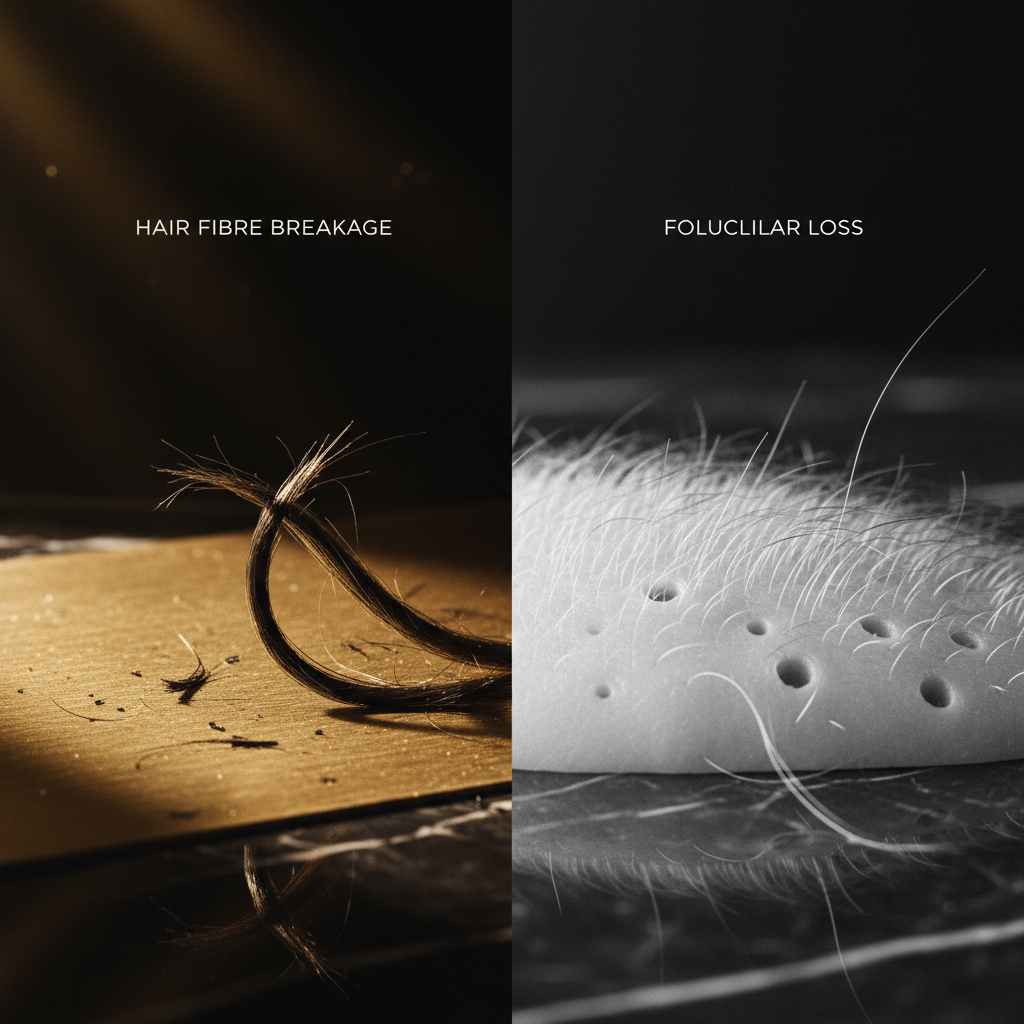
Quick answer: Understanding Hair Fibre Breakage vs Follicular Loss comes down to anatomy: breakage occurs when the external protein shaft fractures along its length, whereas follicular loss happens inside the skin when the hair bulb releases from the root or the follicle miniaturises. You can identify breakage by short, ragged fragments lacking a white bulb, while shed hairs show a distinct bulb at one end. Cosmetic care repairs structural weakness, but follicular loss requires medical or dermatological evaluation.
Key takeaways
- The root tells the story: Hair that falls from the follicle carries a visible, rounded bulb at the proximal tip. Broken hair has blunt, split, or frayed ends without a bulb.
- Location of damage: Fibre breakage is a mechanical, chemical, or thermal failure of the keratin cortex outside the scalp. Follicular loss stems from internal cellular triggers, genetics, hormones, or systemic stress beneath the scalp surface.
- Fibre length varies: Breakage produces uneven lengths, visible flyaways, frizzy mid-lengths, and thinned ends. Follicular shedding generally sheds full-length strands.
- Reversibility differs: Breakage resolves through altered hair routines, conditioning, and trimming. True follicular loss may indicate telogen effluvium, androgenetic alopecia, or scarring conditions requiring clinical treatment.
Hair Fibre Breakage vs Follicular Loss: what the evidence shows
Dermatologists and trichologists divide thinning hair into structural shaft disorders and cycle-related follicular shedding. In trichology, conflating the two leads to ineffective treatments. The distinction between Hair Fibre Breakage vs Follicular Loss governs every diagnostic step in a clinical consultation.
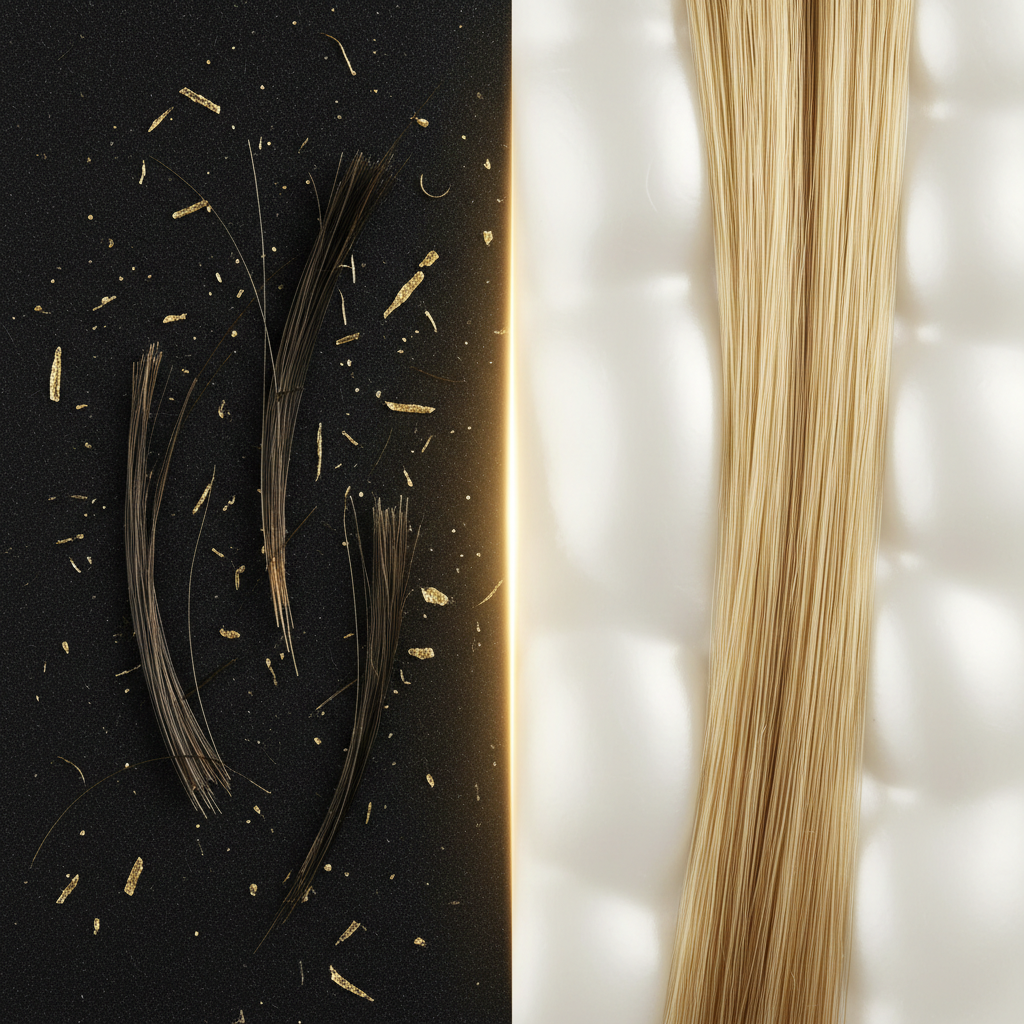
Hair fibres are composed of roughly 85% to 90% keratin protein, held together by disulphide bonds, hydrogen bonds, and salt linkages. Surrounding this cortex is the cuticle, consisting of 6 to 10 overlapping cellular layers sealed by 18-methyleicosanoic acid (18-MEA), a protective lipid layer. When chemical treatments such as bleaching or permanent waving raise the pH above 9.0, they strip this lipid barrier, oxidise disulphide bonds into cysteic acid, and leave the cortex porous. Heat tools above 185°C denature keratin and boil residual water in the shaft, causing microscopic bubble hair and transverse fractures (trichorrhexis nodosa). This is hair fibre breakage. The follicle remains healthy, active, and firmly anchored in the scalp tissue.
Follicular loss, by contrast, takes place inside the dermal papilla and follicle bulb. Human scalp hair cycles through anagen (active growth, lasting 2 to 7 years), catagen (regression, lasting 2 to 3 weeks), and telogen (resting, lasting roughly 3 months), concluding in exogen (shedding). The average scalp sheds 50 to 100 telogen hairs each day. In acute telogen effluvium, physiological shock, high fevers, hormonal shifts, or severe nutritional deficits prompt up to 30% or more of anagen hairs to shift prematurely into telogen, shedding en masse roughly two to three months later. In androgenetic alopecia, dihydrotestosterone (DHT) binds to follicular receptors, shortening anagen cycles and progressively shrinking the follicle until terminal fibres turn into vellus fuzz. The hair shaft itself may be healthy, but the root structure detaches.
Anatomical comparison: structural breakage vs root shedding
| Feature | Hair Fibre Breakage | Follicular Loss (Shedding / Alopecia) |
|---|---|---|
| Origin point | Along the hair shaft (mid-lengths or ends) | Beneath the scalp surface (dermal papilla) |
| Visible bulb | Absent; ends appear frayed, ragged, or snapped | Present; tiny white, rounded keratin bulb at base |
| Length of dropped hair | Varied, mostly short fragments | Full length of your current hair cycle |
| Scalp density | Follicles remain visible; density at scalp unchanged | Scalp becomes more visible; part line widens |
| Primary triggers | Heat (>185°C), bleach, relaxers, rough brushing | Genetics, DHT, postpartum shifts, illness, thyroid issues |
| Corrective approach | Trims, lipid conditioners, reduced heat, gentle detangling | Blood panels, dermatological assessment, topical treatments |
Mechanisms: what causes the hair shaft to snap
Healthy hair fibres withstand a tensile load of roughly 100 grams before snapping. When damaged, their tensile threshold drops significantly.
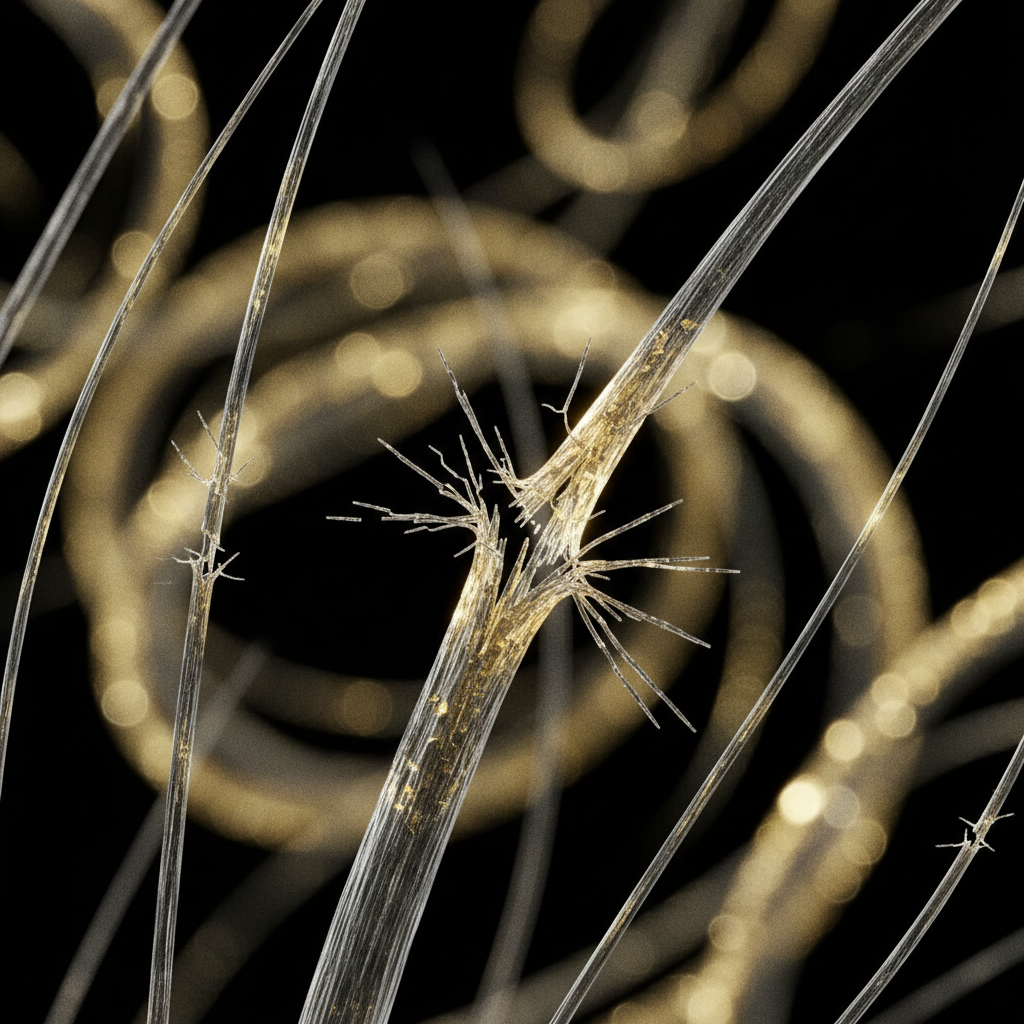
- Chemical degradation: Alkaline lifting agents (pH 9.0 to 11.0) dissolve the hydrophobic epicuticle. Bleaching oxidises cystine, reducing mechanical elasticity by up to 50%.
- Thermal breakdown: Blow-drying or flat-ironing damp hair causes water inside the cortex to flash to steam. This creates cortex voids and fractures known as trichoclasis.
- Mechanical shear: Brushing wet hair, which is swollen with water and can stretch up to 30% beyond its resting state, stresses the internal hydrogen bonds beyond recovery, resulting in clean transverse fractures.
- Frictional attrition: Rough pillowcases, harsh towel drying, and tight elastic bands exert localized tension that chips away at the cuticle tiles, leaving the core exposed to shearing forces.
Mechanisms: why the follicle expels the hair
Follicular shedding is governed by cellular signals, vascular supply, and endocrine activity:
- Cycle dysregulation (Telogen Effluvium): Systemic stressors trigger inflammatory cytokines (such as IL-1 and TNF-alpha) that arrest follicle keratinocyte proliferation, shunting fibres abruptly into the telogen resting phase.
- Hormonal miniaturisation (Androgenetic Alopecia): The enzyme 5-alpha reductase converts circulating testosterone into DHT. When DHT attaches to genetically susceptible receptors in the dermal papilla, it inhibits growth factors and accelerates follicular miniaturisation.
- Autoimmune attack (Alopecia Areata): T-cells breach the immune privilege of the anagen bulb, prompting rapid dystrophy and detachment without scarring.
- Nutritional depletion: Ferritin levels under 30 ug/L, severe zinc deficiencies, or protein starvation deprive the fast-dividing matrix cells of critical energy, arresting the production of the fibre from within.
Signs to look for: how to self-assess your fallen hair
You can determine whether you are facing shaft breakage or follicular shedding with three simple checks at home:
- The White Bulb Test: Collect 5 to 10 fallen strands from your brush or shower drain. Spread them on a dark, flat surface under good lighting. Inspect both ends. If one end terminates in a rounded, white or translucent bead, that hair released from the root. If both ends look blunt, frayed, or split, the hair snapped.
- The Length Check: Compare the length of the dropped strands against your overall hair length. Breakage typically yields small shards of varying lengths, often 1 to 5 centimetres long. Shedding produces full-length strands that match your current cut.
- The Scalp Part Assessment: Look closely at your scalp under bright light. If your part line is widening or your crown shows increased skin exposure, follicular loss is at work. If your scalp coverage remains dense but your ponytail feels thin, uneven, or prone to flyaways, fibre breakage is the culprit.
Practical steps for managing hair fibre breakage
Cosmetic hair routines directly resolve breakage by reinforcing the shaft surface and cutting down friction:
- Lower heat exposure: Keep thermal tools below 180°C and always apply heat protectants containing silicones or hydrolysed proteins to distribute heat evenly.
- Manage wash pH: Use shampoos balanced between pH 4.5 and 5.5. An acidic environment flattens the cuticle shingles, reduces swelling, and prevents moisture absorption that weakens the fibre.
- Hydrate and lubricate: Apply conditioners rich in fatty alcohols (cetyl and stearyl alcohol) and natural lipids to replace lost 18-MEA and lower the friction coefficient during detangling.
- Gentle detangling: Always detangle with a wide-tooth comb from ends upward, working on damp hair pre-treated with a leave-in detangler.
Supportive care: Watermans haircare approach
Cosmetic products cannot alter underlying hormonal or genetic follicular loss, but maintaining a clean, balanced scalp environment and strengthening individual fibres reduces everyday breakage. Watermans GrowMe Shampoo and ConditionMe Conditioner are formulated to wash away sebum, debris, and cosmetic buildup around the follicle opening while conditioning fragile mid-lengths. Featuring hydrolysed lupin protein, biotin, rosemary extract, and niacinamide, this regimen improves hair manageability, delivers vital surface slip to reduce mechanical snapping, and leaves the hair looking visibly thicker and full-bodied.
When to seek professional advice
Consult a GP, dermatologist, or qualified trichologist if you notice any of the following:
- Sudden shedding exceeding 100 to 150 hairs daily for more than 6 weeks.
- Circular, patchy bald spots developing across the scalp, brows, or beard.
- Redness, scaling, burning, pain, or pustules around the hair follicles, which may signal a cicatricial (scarring) alopecia.
- Significant widening of the central parting line alongside thinning at the temples.
Clinicians can perform a trichoscopy, run comprehensive blood panels (including serum ferritin, thyroid-stimulating hormone, vitamin D, and full blood counts), or conduct a scalp biopsy to pinpoint the exact root cause.
Frequently asked questions about Hair Fibre Breakage vs Follicular Loss
Can a hair mask stop follicular loss?
No. Hair masks are cosmetic treatments formulated to coat, lubricate, and condition the dead keratin fibre along the shaft. They improve elasticity and reduce breakage, but they do not penetrate the dermal papilla or modify internal hormonal, metabolic, or autoimmune factors that cause root-level follicular loss.
What is the most reliable way to tell Hair Fibre Breakage vs Follicular Loss apart?
The most reliable sign is the presence of the root bulb. In Hair Fibre Breakage vs Follicular Loss, broken hairs have uneven, jagged, or split ends on both sides, while shed hairs from the follicle carry a distinct, rounded white or pale bulb at the proximal root end.
Can you experience fibre breakage and follicular shedding at the same time?
Yes. Many people experience both simultaneously. For instance, someone with genetic follicular thinning who also uses bleach or heat tools will have thinner hair emerging from the scalp that subsequently breaks mid-shaft due to chemical stress.
Does brushing stimulate the follicle or cause breakage?
Brushing distributes scalp sebum along the hair shaft, which helps lubricate fibres. However, vigorous brushing, especially on wet or tangly hair, creates mechanical tension that snaps the cuticle and cortex. Brushing does not stimulate follicle growth and will worsen structural breakage if done aggressively.
How long does it take to recover from hair breakage?
Once a hair fibre fractures, that specific snapped strand cannot fuse back together. Trimming split ends stops fractures from travelling up the shaft. With proper conditioning, heat reduction, and gentle handling, newly emerging hair will stay intact, and density will visibly improve as it grows over 6 to 12 months.
Summary on Hair Fibre Breakage vs Follicular Loss
Distinguishing Hair Fibre Breakage vs Follicular Loss is essential for choosing the right hair care routine. Breakage is an external mechanical and chemical issue solved through gentle handling, bond-supporting conditioners, and heat moderation. Follicular loss is a biological event that requires patience, systemic health evaluations, and medical guidance. By checking the fallen fibre for a white bulb and assessing whether your density loss is at the scalp or the ends, you can target the real cause and protect your hair from the root to the tip.
Sources and references
- British Association of Dermatologists: Telogen Effluvium Guidelines (2021).
- Gavazzoni Dias, M. F. (2015). Hair cosmetics: An overview. International Journal of Trichology, 7(1), 2-15.
- Robbins, C. R. (2012). Chemical and Physical Behavior of Human Hair (5th ed.). Springer-Verlag.
- Sinclair, R. (2007). Healthy hair: what is it? Journal of Investigative Dermatology Symposium Proceedings, 12(2), 2-5.
- Trüeb, R. M. (2015). The impact of oxidative stress on hair. International Journal of Cosmetic Science, 37(S2), 25-30.
Find these ingredients in Watermans products
- Zinc: you will find this ingredient in our Hair Vitamins.
- Niacinamide: you will find this ingredient in our Hair Mask.