Hair Elasticity Tests: The Complete Guide to Fibre Strength and Stretch
8 min read ·
Learn how hair elasticity tests assess cortex health, tensile strength, and moisture-protein balance to prevent breakage and guide your haircare routine.
Quick answer: Hair elasticity tests assess the internal cortex of a hair strand by measuring how far a wet fibre can stretch before returning to its original length or snapping. Healthy, hydrated hair stretches up to 30 percent when dry and up to 50 percent when wet without breaking. The main limitation of manual hair elasticity tests performed at home is human error: inconsistent pulling tension, varying moisture levels, and pre-existing cuticle damage can produce inaccurate readings compared to laboratory tensile testing.
Key takeaways
- Elasticity reflects the structural integrity of keratin polypeptide chains and disulphide bonds within the hair cortex.
- Healthy wet hair can stretch between 30 and 50 percent of its resting length and recoil without snapping.
- Low elasticity signals structural degradation, typically caused by bleaching, heat tools, or excessive chemical processing.
- High elasticity paired with a limp, mushy texture indicates moisture overload and insufficient protein cross-linking.
- Manual pull tests are helpful salon diagnostics, but they cannot replace calibrated laboratory extensiometry.
Hair Elasticity Tests: what the evidence shows
Hair elasticity tests are physical evaluations used by trichologists and cosmetic scientists to measure the tensile strength and inner health of hair fibres. When scientists evaluate hair strength in laboratory settings, they use specialized micro-extensiometers that stretch individual strands at controlled rates while logging the force required to break them. In a salon or at home, manual tests mimic this process on a basic level by gently stretching a wet strand between two fingers.
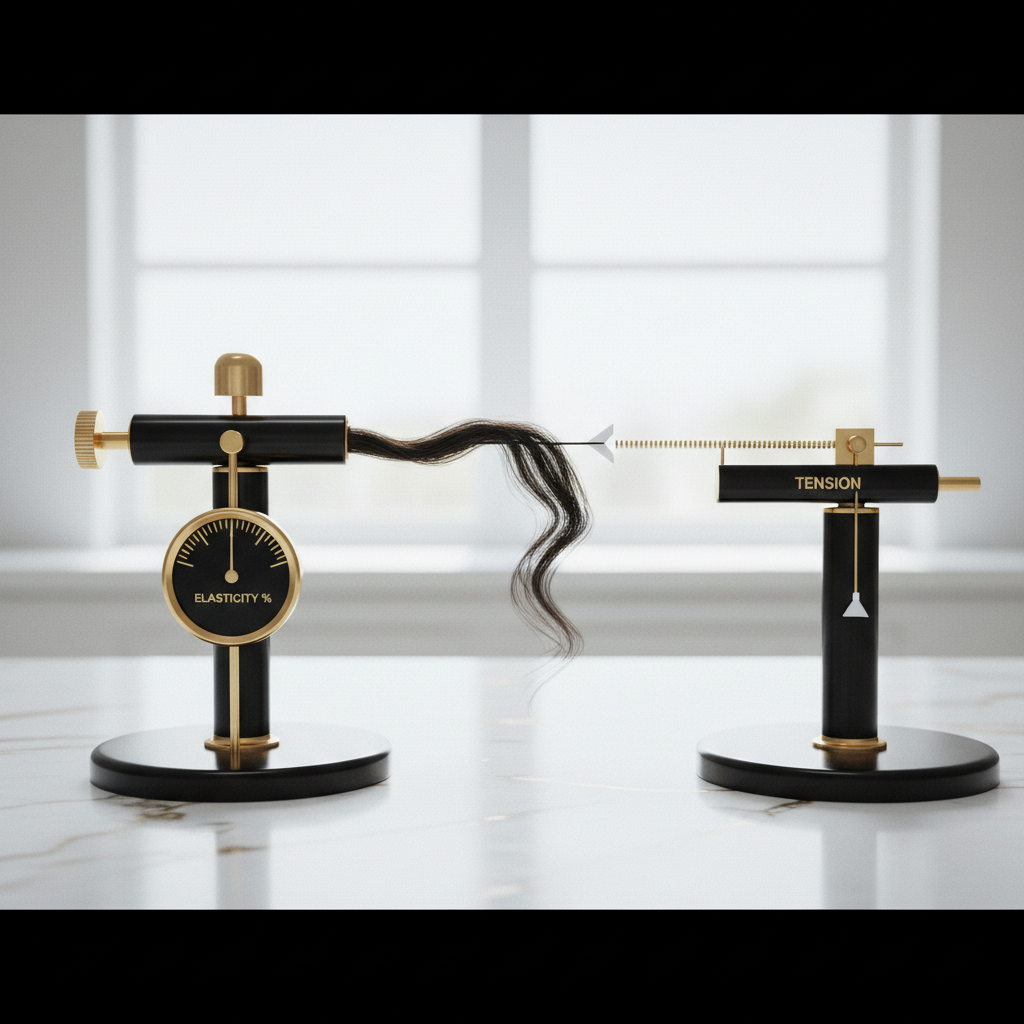
Cosmetic chemistry literature confirms that hair fibre elasticity depends almost entirely on the cortex. The cortex accounts for roughly 85 to 90 percent of the total fibre mass and consists of helical keratin protein filaments embedded in a sulphur-rich matrix. When hair is pulled gently, these coiled protein spirals uncoil, allowing the fibre to extend. When released, the cross-linking disulphide bonds snap the proteins back into place.
Research shows that moisture content dramatically changes this behaviour. Water molecules break weak hydrogen bonds between keratin chains, allowing the fibre to stretch significantly more when damp than when dry. A virgin, undamaged hair strand with balanced hydration can stretch up to 50 percent of its original length when completely wet before it breaks. When dry, that same strand will usually break after extending roughly 20 to 30 percent.
What the manual stretch test does not show
Manual pull tests give a quick snapshot of mechanical strength, but they have distinct limitations. A manual pull cannot distinguish between genetic variations in fibre diameter and acquired structural damage. Fine hair naturally tolerates less total pulling force than coarse hair simply because it has a smaller cross-sectional area, even if its internal keratin matrix is completely undamaged.
Manual testing also cannot pinpoint the exact chemical cause of structural failure. A strand that snaps quickly might suffer from ruptured disulphide bonds caused by alkaline relaxers, or it might suffer from acute lipid depletion caused by repeated heat styling. Furthermore, human fingers cannot apply uniform, measurable force in increments of grams. Pulling too quickly or with uneven tension will snap healthy hair, leading to a false diagnosis of protein deficiency.
The biological mechanism of hair elasticity
Hair elasticity operates at a molecular level within the cortical cells. The basic building block of the cortex is alpha-keratin, a spring-like coiled-coil protein. These coils assemble into intermediate filaments surrounded by an amorphous matrix rich in cystine, an amino acid that forms covalent disulphide bonds.
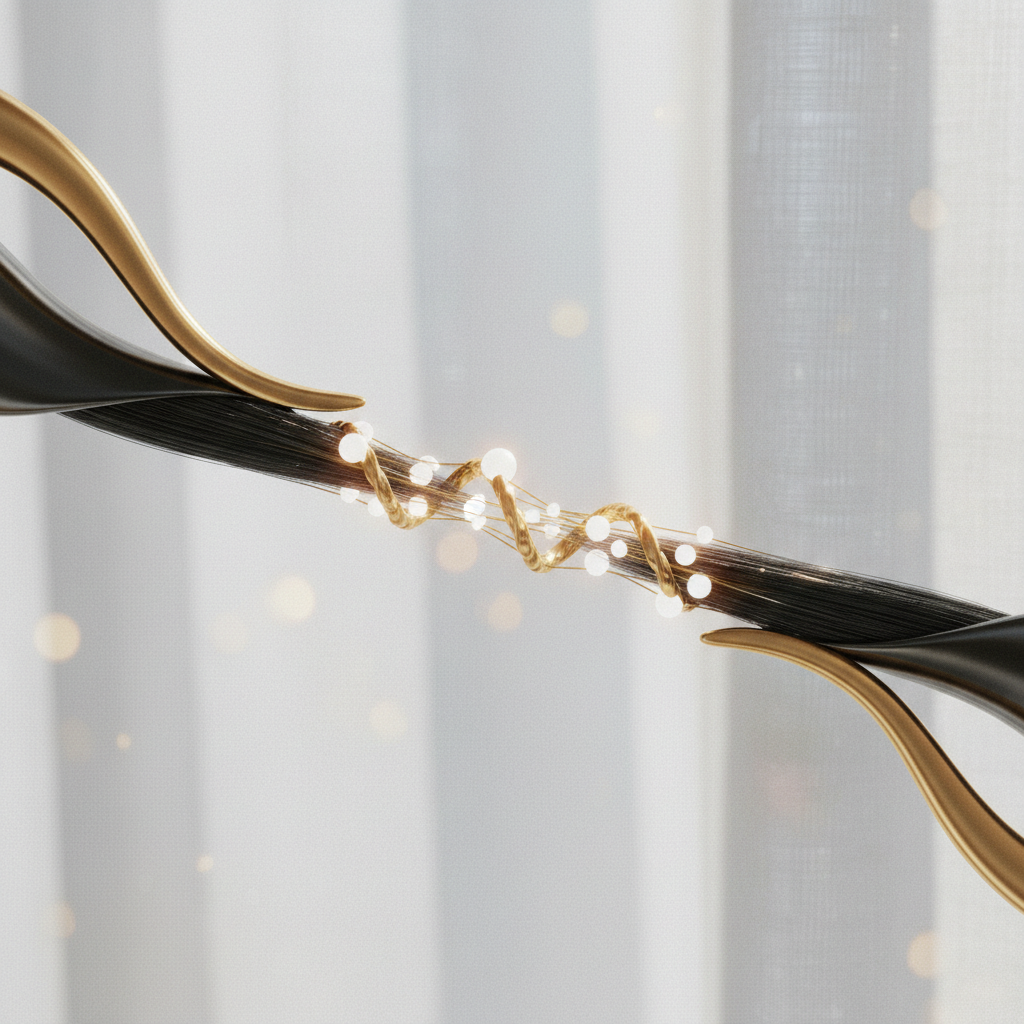
When hair undergoes mechanical tension, the deformation occurs in three distinct phases:
- The Hookean (elastic) region: During the initial stretch (up to roughly 2 to 3 percent extension), the mechanical resistance is high. The alpha-helical structures deform slightly, but the fibre behaves like a classic spring and recovers completely upon release.
- The yield region: As pulling continues beyond 3 percent, hydrogen bonds rupture and the alpha-helical keratin begins unravelling into extended beta-sheet structures. The fibre stretches with relatively little resistance.
- The post-yield region: At extensions beyond 25 to 30 percent, the protein backbone itself bears the load alongside covalent disulphide bonds. Resistance increases sharply until the cross-links fracture and the fibre snaps.
Bleaching, permanent waving, and straighteners attack this system by oxidising or breaking disulphide bonds. When these covalent links are destroyed, the cortical matrix loses its restorative spring, resulting in brittle breakage or perpetual stretching without recoil.
How to perform a manual hair elasticity test
Performing an elasticity check correctly requires clean, wet hair to ensure hydrogen bonds are properly loosened.
- Cleanse the hair: Wash the hair with a gentle, residue-free shampoo to remove silicone films, oils, and styling polymers that could artificially stiffen or lubricate the fibre.
- Select individual strands: Isolate a single strand from an area prone to damage (such as the crown or hair ends) and another from a protected area (like the lower nape) for comparison. You can test a strand still attached to the scalp or one that has naturally shed with an intact root bulb.
- Ensure even wetness: Dampen the strand thoroughly with lukewarm water.
- Anchor and stretch: Hold the strand firmly between your thumb and forefinger with one hand. With the other hand, grip the strand roughly 2 to 3 centimetres away.
- Observe the recoil: Pull smoothly and slowly. Observe whether the strand extends, whether it snaps immediately, or whether it returns to its original length when released.
| Test Result | Physical Behaviour | Underlying Structural State | Recommended Regimen |
|---|---|---|---|
| Normal Elasticity | Stretches 30 to 50 percent when wet, then snaps back to original length | Intact cortex, balanced disulphide bonds, optimal hydration | Maintenance with balanced pH shampoo and light conditioning |
| Low Elasticity | Snaps almost immediately under minimal pulling force with zero stretch | Severe disulphide bond degradation, depleted lipids, brittle cortex | Hydrating masks, emollients, and bond-building repair treatments |
| High / Mushy Elasticity | Stretches excessively beyond 50 percent, feels gummy, does not bounce back | Extreme cortex breakdown, excessive moisture uptake, absent protein integrity | Hydrolysed protein treatments, reconstructors, reduction of heavy wet conditioning |
The protein and moisture balance
Interpreting the results of hair elasticity tests often comes down to the balance between protein structure and moisture retention. A common misconception in home haircare is that dry, snapping hair simply needs water. If hair snaps with minimal stretch, the cortex lacks both internal flexibility and moisture-retaining lipids. Applying pure moisture without restoring tensile strength will not resolve the problem.
Conversely, hair that stretches endlessly like a rubber band and feels soft, spongy, or sticky when wet is suffering from excessive cortical disruption. Water swells the strand excessively because the compromised cuticle and cortex can no longer regulate fluid uptake. In this state, hair requires hydrolysed vegetable or keratin proteins with molecular weights small enough to penetrate the fibre and reinforce internal cross-links.
When breakage is not an elasticity problem
Not all hair breakage stems from cortical elasticity loss. External cuticle wear can cause hair to snag, tangle, and shear off under normal brushing even when the internal cortex is sound. Similarly, structural hair shaft abnormalities such as trichorrhexis nodosa (node-like swelling along the shaft) or pili torti (twisted hair fibres) cause localised weak points that break regardless of baseline elasticity.
It is equally vital to distinguish fibre breakage from hair shedding. If hair is coming away from the scalp with the tiny white bulb intact, this indicates normal telogen shedding or a follicular hair loss condition (such as telogen effluvium or androgenetic alopecia). Elasticity tests only assess fibre integrity along the shaft, not follicular activity or scalp health.
Supporting tensile strength: Watermans approach
When manual elasticity checks reveal weakened, snapping strands, your routine needs structural reinforcement alongside gentle handling. Watermans GrowMe Shampoo is formulated to cleanse the scalp thoroughly while delivering hydrolysed lupin protein, biotin, and rosemary extract to the hair environment. The hydrolysed proteins help condition the surface and improve the feel and manageable resilience of fragile, snapping strands without weighing them down. Pairing gentle washing with reduced thermal styling allows the hair fibre to retain its natural tensile strength over time.
Summary of testing and fibre recovery
Hair elasticity tests serve as a practical window into the mechanical condition of the hair cortex. While manual stretching lacks the precision of laboratory equipment, it provides clear direction on whether your hair needs structural proteins, emollient moisture, or simply a break from chemical processing. Respect the natural limits of the hair fibre, minimise high-heat tools, and adjust your routine based on how your hair actually stretches and responds.
Frequently asked questions about Hair Elasticity Tests
Should hair elasticity tests be done on wet or dry hair?
Hair elasticity tests should primarily be conducted on wet hair. Water temporarily disassociates weak hydrogen bonds within the cortex, allowing the alpha-keratin coils to stretch up to 50 percent of their length without immediate fracture. Performing the test dry restricts maximum stretch to roughly 20 to 30 percent, making it difficult to differentiate between genuine cortical damage and normal dry stiffness.
Can low elasticity hair be permanently repaired?
Hair is non-living tissue, so damaged keratin cannot biologically regenerate. However, low elasticity can be managed and cosmetically improved. Bond-building formulations and hydrolysed proteins temporarily cross-link damaged areas within the cortex, while deep conditioning treatments replenish protective lipids. These interventions improve tensile strength and reduce snapping until damaged lengths can gradually be trimmed away.
Why does my hair feel gummy and stretch without bouncing back?
When hair stretches excessively, feels gummy, and fails to recoil, the cortical matrix has suffered extreme chemical trauma, usually from over-bleaching or overlapping relaxers. The internal disulphide bonds that provide structural recoil have been extensively degraded. Hair in this condition requires intensive protein-restructuring treatments and immediate cessation of heat and chemical services.
Does fine hair naturally have lower elasticity than coarse hair?
Fine hair has a smaller diameter and fewer cortical cells, which means it snaps under lower absolute force than thick, coarse hair. However, its percentage of elastic extension should still reach 30 to 50 percent when wet if it is undamaged. True elasticity measures relative stretch and recoil, not just the sheer pulling weight required to break the fibre.
Sources and references
- Robbins, C. R. (2012). Chemical and Physical Behavior of Human Hair. 5th ed. Springer-Verlag New York.
- Wolfram, L. J. (2003). "Human hair: A unique physicochemical composite." Journal of the American Academy of Dermatology, 48(6), S106-S114.
- Swift, J. A. (1999). "The mechanics of human hair." International Journal of Cosmetic Science, 21(4), 227-239.
- Dawber, R. (1996). "Hair: Its structure and response to cosmetic preparations." Clinics in Dermatology, 14(1), 105-112.