Hair Elasticity Testing: The Science, Method, and Results
9 min read ·
Discover how Hair Elasticity Testing measures cortex strength and prevents breakage. Learn to perform the wet stretch test and restore your hair's resilience.
Quick answer: Hair Elasticity Testing is a diagnostic method used by trichologists and salon stylists to assess the internal cortex strength, hydration levels, and structural integrity of a hair fibre. Healthy wet hair can stretch by roughly 30% to 50% of its resting length and return without snapping. Hair Elasticity Testing identifies mechanical or chemical cuticle and cortex degradation, but a manual stretch test cannot measure follicular health or differentiate between complex internal protein deficits and temporary surface dehydration.
Key takeaways
- Healthy, hydrated human hair fibres stretch up to 30% when dry and up to 50% when wet before returning to their original length.
- Low elasticity signals structural degradation within the cortex, usually caused by chemical processing, excessive heat styling, or chronic UV exposure.
- Hair Elasticity Testing distinguishes true fibre breakage from root-level hair shedding, helping you choose correct corrective treatments.
- High elasticity without springback (gummy or mushy hair) indicates severe disulfide bond destruction, often following aggressive bleaching or relaxing.
- Manual stretch tests offer a quick assessment at home or in the salon, but laboratory tensile testing instruments provide true quantitative measurements.
Hair Elasticity Testing: what the evidence shows
Hair Elasticity Testing evaluates how well the cortex of a hair strand withstands tensile stress. The hair shaft consists of an outer protective cuticle, an inner cortex, and an occasional central medulla. The cortex makes up approximately 85% to 90% of the fibre's total volume and contains millions of long keratin protein chains coiled into alpha-helices. These protein coils are held together by three types of chemical bonds: hydrogen bonds, salt bridges, and covalent disulfide bonds.
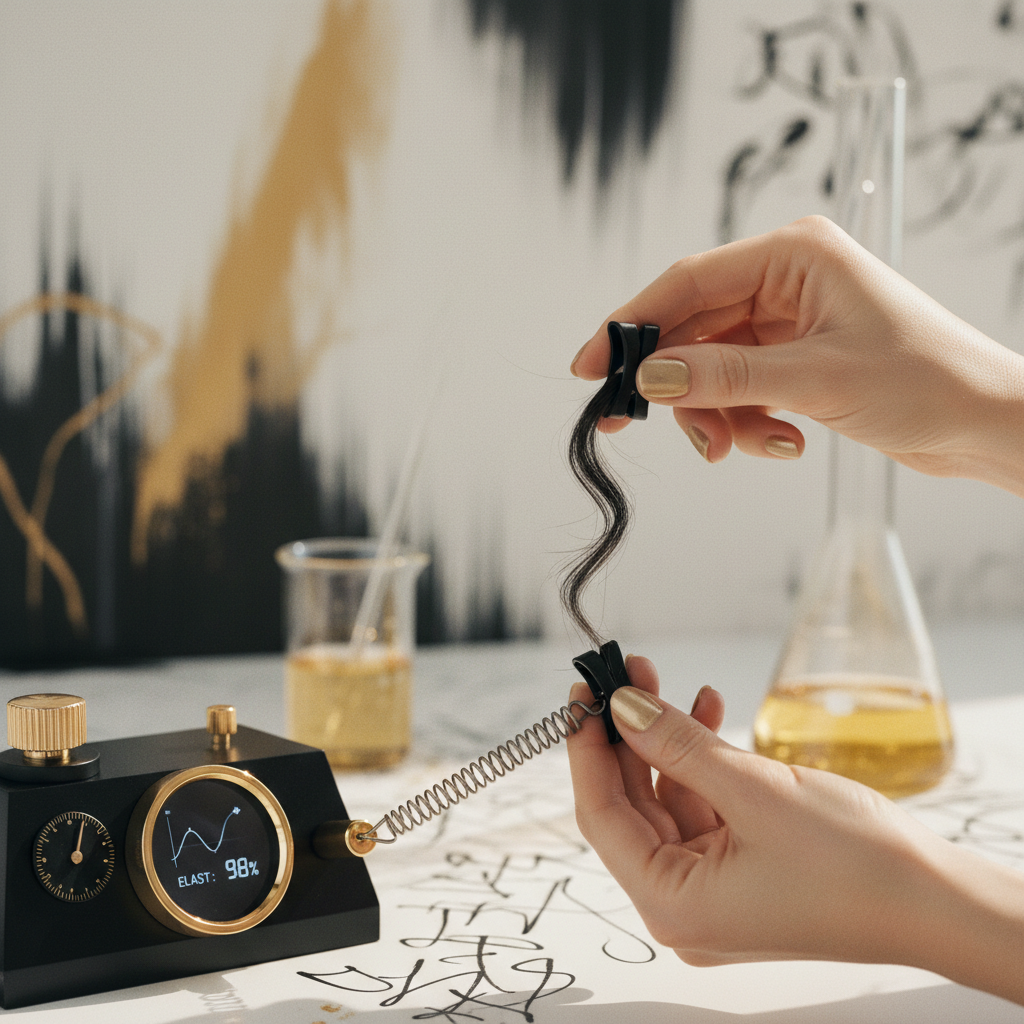
When you pull a hair strand, these alpha-helical keratin structures physically uncoil into beta-sheet forms. Once you release the tension, the resilient disulfide bonds pull the structure back into its resting state, provided the internal matrix is intact.
Scientific literature on hair biophysics, published in journals such as the International Journal of Cosmetic Science, divides tensile extension into three distinct phases:
- The Hookean (Elastic) Region: The fibre stretches up to roughly 2% to 3% elongation. In this zone, stress and strain are strictly proportional, and deformation is completely reversible.
- The Yield Region: Stretching between roughly 3% and 25% to 30% elongation. The alpha-helical keratin coils uncoil into extended beta-sheet configurations. The resistance remains relatively flat as water molecules within the cortex lubricate the sliding keratin microfibrils.
- The Post-Yield Region: Stretching beyond 30% until rupture. The remaining chemical bonds resist extreme mechanical pull until the fibre snaps.
When hair lacks moisture or suffers from disrupted disulfide bonds, it bypasses the yield region and snaps immediately under minimal load. Hair Elasticity Testing exposes this vulnerability before severe fibre breakage occurs across the scalp.
How to perform a manual stretch test correctly
Performing a manual stretch test requires precision. Conducting the test incorrectly on dry, tangly, or heavily coated hair produces false readings.
To perform the test:
- Isolate a clean, wet strand: Work with hair that has been washed with a mild shampoo and thoroughly rinsed, free from silicones, heavy oils, or styling polymers. Wet hair is standard because water breaks temporary hydrogen bonds, allowing you to isolate the strength of the permanent disulfide bonds and cortex matrix.
- Hold the fibre securely: Take a single strand (either a naturally shed strand with the white bulb intact, or an isolated strand attached to the crown). Hold it firmly between the thumb and forefinger of one hand, about 2 to 3 centimetres from the base.
- Apply gentle tension: Grip the strand 5 centimetres further down with your other hand. Slowly and steadily pull the strand outward. Do not yank or jerk the hair.
- Observe the movement: Notice how far the strand stretches before you feel resistance. Release the tension gently and observe whether it returns to its original length, stays stretched and crinkled, or breaks immediately.
| Elasticity Rating | Physical Reaction During Test | Internal Structural State | Recommended Action |
|---|---|---|---|
| High / Normal | Stretches 30% to 50% wet, returns completely to original length | Intact cortex, balanced moisture and disulfide bonds | Maintain current routine; focus on protective care |
| Low / Brittle | Stretches very little (under 10%) and snaps abruptly | Severe moisture loss or excessive protein rigidity | Deep conditioning, humectants, and reduced heat |
| Poor / Gummy | Stretches excessively, feels mushy, does not return; curls or snaps | Broken disulfide bonds from chemical bleaching/relaxing | Bond repair treatments, gentle protein replenishment |
What the evidence does not show
Hair Elasticity Testing is a biomechanical assessment of dead keratinised fibres. It provides zero diagnostic data regarding follicle activity, hair growth cycles, or scalp pathologies.
A failed elasticity test does not mean you have alopecia, hormonal imbalances, or nutrient deficiencies. It simply indicates that the existing hair shaft has sustained mechanical, thermal, or chemical trauma along its length. Furthermore, a manual stretch test cannot quantify exact force loads. While a professional extensiometer measures force down to millinewtons, your fingers rely on subjective perception. Stylists must avoid diagnosing medical conditions based entirely on how a wet hair strand stretches at the wash basin.
Mechanisms: why hair loses its spring
Hair loses its elasticity through specific biological and chemical pathways:
Chemical processing
Bleaching agents, permanent hair dyes, chemical relaxers, and perming solutions alter the cortex to achieve their cosmetic results. Alkaline agents lift the protective cuticle scales, allowing hydrogen peroxide or ammonium thioglycolate to enter the cortex. In doing so, they oxidize or cleave cystine, which forms disulfide cross-links. When you reduce the density of disulfide bonds, the internal "spring" mechanism fails, leaving the hair limp, weak, or prone to snapping.
Thermal denaturation
Styling tools heated above 180 degrees Celsius convert the moisture inside the cortex into steam. If heated rapidly, this causes structural cavities within the fibre, a condition known as bubble hair. Prolonged heat also denatures alpha-keratin proteins into disordered, amorphous structures that cannot recoil when stretched.
Environmental weathering and UV radiation
Ultraviolet radiation generates reactive oxygen species on the fibre surface. Photochemical degradation targets amino acids like cystine, tryptophan, and tyrosine, weakening the hair shaft from the outside in. Combined with environmental pollution, this degrades the cell membrane complex (CMC), which acts as the intercellular glue holding cortical cells together.
Signs of poor elasticity in daily routines
You do not always need an isolated test to spot poor elasticity. Watch for these common signs:
- Short, broken pieces of hair littering your sink, shoulders, or bathroom floor without white root bulbs attached.
- Wet hair that feels spongy, stringy, or excessively stretchy when washed, clumping together like damp cotton wool.
- Tangles that do not slide free under a wide-tooth comb, snapping with a soft popping sound under minimal friction.
- Curls or waves that have lost their spring, hanging limp even after applying styling creams.
- Severe split ends (trichoptilosis) that travel up the hair shaft.
Corrective steps: restoring hair integrity
If your hair demonstrates low or compromised elasticity, you must adjust the moisture-protein balance in your hair care routine:
- Introduce targeted humectants: Ingredients like glycerin, panthenol (provitamin B5), and aloe vera draw water molecules into the dried cortex matrix, restoring the plasticising effect necessary for normal elongation.
- Incorporate hydrolysed proteins: Hydrolysed keratin, wheat protein, or silk amino acids are small enough to temporarily fill gaps in the damaged cuticle and outer cortex. They reinforce fragile areas and reduce fracture rates. Use them moderately to prevent hair from becoming overly stiff.
- Lower your heat styling temperatures: Keep heat tools below 150 degrees Celsius, and always use a protective thermal styling shield to minimise protein degradation.
- Minimise mechanical tension: Switch to gentle, wide-tooth combs, detangle exclusively when saturated with slip-enhancing conditioner, and sleep on silk or satin pillowcases to reduce nocturnal friction.
Supporting hair health from root to tip: Watermans
While elasticity reflects the physical condition of the hair shaft, long-term fibre resilience relies on healthy growth from the follicle. A weakened strand breaks easily, but weak output from an under-nourished scalp creates thinner, more vulnerable fibres right from the start.
Watermans approaches hair maintenance holistically. Incorporating products like Watermans Grow Me Shampoo into your routine supports the scalp environment with ingredients such as biotin, rosemary extract, caffeine, and hydrolysed lupin protein. Clean, invigorated roots produce well-structured fibres, while surface-conditioning agents reduce mechanical friction during washing, protecting the hair from breakage as it grows.
When the cause may be something else
It is vital to distinguish between fibre breakage caused by compromised elasticity and true hair shedding.
If strands falling from your head feature a distinct, tiny white bulb at one end, those hairs have detached from the follicle. This is natural shedding (telogen phase) or an underlying scalp issue such as telogen effluvium, androgenetic alopecia, or traction alopecia. Elasticity treatments and protein masks cannot stop follicular shedding. If you notice wide patches of scalp showing, diffuse overall thinning, or sudden clumps of hair shedding from the root, seek a consultation with a certified trichologist, dermatologist, or your GP.
Frequently asked questions about Hair Elasticity Testing
Can I do Hair Elasticity Testing on dry hair?
You can test dry hair, but wet testing is far more accurate. Dry hair normally stretches up to 30% before breaking because temporary hydrogen bonds keep the structure rigid. Testing wet hair breaks those hydrogen bonds, allowing you to assess the underlying disulfide bonds and cortex proteins without interference from surface dryness.
What is the difference between hair porosity and hair elasticity?
Hair porosity measures the cuticle layer's ability to absorb and retain moisture, while hair elasticity measures the internal cortex's structural strength and tensile recoil. Highly porous hair often exhibits low elasticity because lifted or missing cuticles leave the cortex vulnerable to damage, but they remain two distinct physical properties.
Can broken hair elasticity be permanently repaired?
No. Because hair fibres consist of non-living keratin, structural cortex damage cannot biologically heal. Protein treatments, bond builders, and deep conditioners can temporarily patch weaknesses, cross-link broken bonds, and restore suppleness, but these wash out over time and must be maintained until healthy hair replaces the damaged lengths.
Why does my hair snap immediately during a stretch test?
Hair that snaps immediately has very low elasticity, indicating severe cortical dehydration or structural protein embrittlement. This frequently happens after excessive heat use, over-processing with colour, or using too many concentrated protein treatments without balancing them with moisturising humectants and conditioning lipids.
Conclusion
Hair Elasticity Testing remains one of the simplest, most revealing diagnostic tools available for assessing fibre health. By carefully stretching an isolated wet hair strand, you can immediately assess the strength of its internal keratin structure and adjust your washing, conditioning, and styling habits accordingly. Balancing hydrolysed proteins with rich humectants protects fragile strands from mechanical breakage, keeping your hair resilient, shiny, and strong.
Sources and references
- Robbins, C. R. (2012). Chemical and Physical Behavior of Human Hair. 5th ed. Springer Science & Business Media.
- International Journal of Cosmetic Science (2009). "Tensile properties of human hair: influence of chemical treatments and cosmetic repair."
- Journal of Cosmetic Dermatology (2017). "Hair shaft damage from heat and chemical processing: structural and mechanical analysis."
- British Association of Dermatologists (2021). "Hair breakage versus hair loss: clinical distinctions and diagnostic approaches."
- Sinclair, R. D. (2007). "Healthy hair: what is it and how is it achieved?" Journal of Investigative Dermatology Symposium Proceedings.
Find these ingredients in Watermans products
- Panthenol (Provitamin B5): you will find this ingredient in our Heat Protection Spray.
- Aloe Vera: you will find this ingredient in our Curly Hair Conditioner.