Hair Dye Allergies Explained: Science, Symptoms, and Scalp Safety
7 min read ·
Learn the mechanisms behind hair dye allergies explained, including PPD sensitisation, signs of contact dermatitis, testing methods, and safe alternatives.
Quick answer: With hair dye allergies explained, the core issue is almost always an immune response to chemical colour precursors, most notably paraphenylenediamine (PPD) and its derivatives. When sensitised individuals apply permanent or semi-permanent colour, immune cells trigger allergic contact dermatitis, causing intense itching, erythema, swelling, and blistering. However, having hair dye allergies explained also means recognising that patch testing cannot predict every reaction, and mild irritant responses are frequently mistaken for true, life-long immunological allergies.
Key takeaways
- Paraphenylenediamine (PPD) and paratoluenediamine (PTD) are the primary chemical culprits responsible for severe allergic contact dermatitis from hair colourants.
- True dye allergies involve a Type IV delayed hypersensitivity immune reaction, typically peaking 48 to 72 hours after exposure.
- Irritant contact dermatitis is different from an allergy; it causes immediate stinging from alkaline agents or peroxides without involving immune sensitisation.
- Sensitisation is permanent. Once your immune system develops antibodies and memory T-cells against PPD, subsequent exposures often trigger faster and more severe reactions.
- An open patch test 48 hours prior to every single chemical colour application remains the clinical frontline defense against severe reactions.
Hair Dye Allergies Explained: what the evidence shows
Clinical dermatology categorises adverse reactions to hair colourants into two distinct biological events: allergic contact dermatitis and irritant contact dermatitis. In this guide with hair dye allergies explained, the focus rests on true immunological hypersensitivity.
When permanent hair colour is applied, small, unoxidised aromatic amines penetrate the hair cuticle and the upper layers of the epidermis. PPD (paraphenylenediamine) is widely used because its small molecular size allows it to enter the hair shaft before oxidising into large, coloured polymers. Unfortunately, this low molecular weight also enables it to act as a potent hapten. A hapten is a tiny molecule that binds to epidermal proteins, forming a complete antigen that immune Langerhans cells recognise as a foreign threat.
Once your immune system registers the PPD-protein complex, it activates memory T-lymphocytes. This initial phase, known as sensitisation, rarely produces noticeable symptoms. You can dye your hair without incident for years. However, once sensitisation is established, any subsequent exposure triggers elicitation. The memory T-cells release inflammatory cytokines, flooding the scalp and surrounding tissue with white blood cells. This results in the classic presentation: intense burning, swelling, red weeping plaques, and scaling across the scalp, ears, neck, and eyelids.
Under European Union and UK cosmetics regulations, the maximum permitted concentration of PPD in hair dye formulations applied to the hair is strictly capped at 2.0 percent (calculated as free base). Despite these regulatory ceilings, dermatological patch test clinics across Europe consistently find PPD among the top ten most frequent contact allergens, with positive patch test rates ranging between 4 and 6 percent among dermatitis patients.
+--------------------------+---------------------------------+----------------------------------+
| Characteristic | Allergic Contact Dermatitis | Irritant Contact Dermatitis |
+--------------------------+---------------------------------+----------------------------------+
| Primary Mechanism | Type IV cell-mediated immunity | Direct chemical barrier damage |
| Common Trigger Chemicals | PPD, PTD, resorcinol | Ammonia, hydrogen peroxide |
| Onset Time | 24 to 72 hours post-application | Immediate to a few hours |
| Typical Sensitisation | Permanent immune memory | Temporary, non-immunological |
| Clinical Presentation | Spreading erythema, blisters | Localised redness, dryness |
| Margins of Reaction | Often spreads beyond scalp | Strictly confined to contact area|
+--------------------------+---------------------------------+----------------------------------+
What the evidence does not show
Research does not support several persistent myths surrounding hair colour safety.
First, natural or organic labelling does not guarantee freedom from allergic reactions. Many commercial hair dyes marketed as herbal, natural, or organic still contain PPD, PTD, or related aromatic amines to achieve permanent coverage. Henna itself (Lawsonia inermis) has a low sensitisation profile, but so-called black henna frequently contains illegally high levels of industrial PPD to accelerate staining. The British Association of Dermatologists warns that exposure to black henna temporary tattoos is a leading cause of severe, lifelong PPD sensitisation in teenagers and young adults.
Second, experiencing a reaction does not mean you have experienced hair loss. Hair dye dermatitis attacks the epidermis and superficial dermis. It causes hair breakage if the alkaline chemical process weakens the keratin fibre, and intense crusting may disrupt surface shed hair. However, it does not destroy healthy subcutaneous follicles or cause permanent follicular scarring unless an untreated, severe secondary bacterial infection takes hold.
Finally, a negative patch test does not offer a 100 percent guarantee of zero risk. While 48-hour consumer open patch tests catch the vast majority of sensitised individuals, false negatives occur if the test application area is too small, rinsed off prematurely, or evaluated before the 48-hour window closes.
Signs and symptoms to watch for
Symptoms of hair dye allergies range from mild scalp tenderness to life-threatening systemic emergencies. Recognising the gradient helps you act promptly.
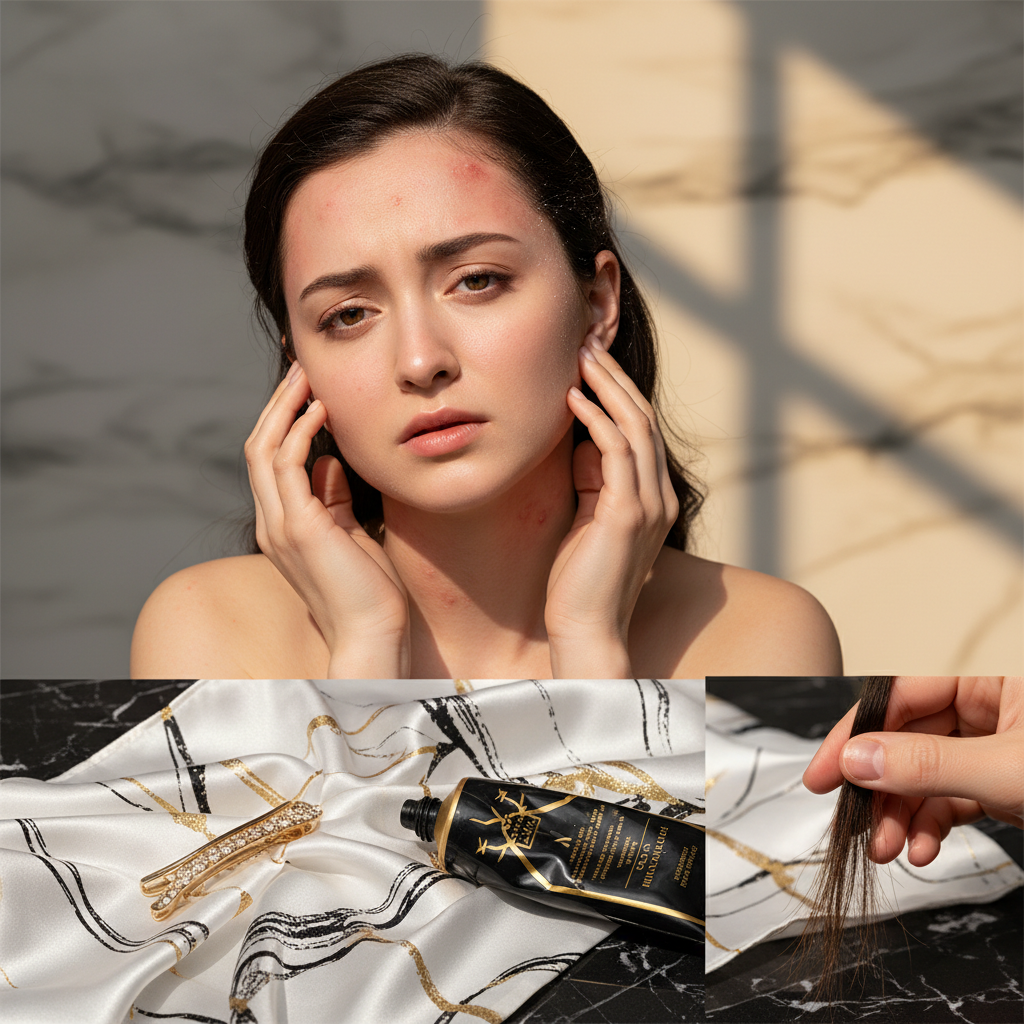
Early or mild signs typically appear 24 to 48 hours following salon treatment or home colouring:
- Persistent, prickling scalp itch that worsens rather than improves after washing.
- Redness (erythema) along the hairline, behind the ears, and across the nape.
- Dry, flaky, or tight-feeling patches on the skin where the product made contact.
Moderate to severe presentations develop between 48 and 72 hours:
- Significant facial oedema, particularly swelling of the eyelids and forehead.
- Weeping vesicular blisters on the scalp that crust over.
- Spreading dermatitis moving onto the neck, chest, and shoulders.
Very rarely, hair colour triggers a Type I immediate hypersensitivity reaction. This manifests within minutes of application as urticaria (hives), respiratory difficulty, dizziness, and anaphylaxis. This is a medical emergency requiring immediate intervention.
Why the cause may be something else
Before assuming you have a permanent PPD allergy, evaluate alternative culprits.
Ammonia and ethanolamine, used to swell the cuticle and raise the pH of hair dyes to around 9.0 to 10.5, can cause chemical irritant contact dermatitis. This feels like an acute stinging or burning sensation during the application process itself and subsides once washed out. Hydrogen peroxide, the oxidising developer, is another common irritant that damages the skin barrier without engaging the immune system.
Furthermore, other ingredients in haircare products can cause reactions. Preservatives like methylisothiazolinone (MI) in shampoos, fragrances, and botanical extracts can produce contact dermatitis that coincides with colour appointments simply because hair is washed and styled with multiple products simultaneously.
Practical steps and patch testing protocols
If you suspect you are reacting to hair colour, prompt action limits dermal damage:
- Rinse immediately: Wash your scalp thoroughly with lukewarm water and a gentle, fragrance-free cleanser to remove unreacted dye molecules.
- Avoid further chemical processing: Do not bleach, perm, or recolour the hair while the barrier is compromised.
- Consult a medical professional: A GP or dermatologist can prescribe topical corticosteroids to settle severe inflammation. If systemic swelling occurs, seek emergency care.
- Request diagnostic patch testing: Ask for a European Standard Series patch test conducted by a dermatologist. This isolates whether PPD, PTD, resorcinol, or fragrance chemicals are responsible.
For ongoing haircare, maintaining a calm, well-hydrated scalp barrier is essential once inflammation clears. Watermans formulated their cleansing range around gentle, scalp-supportive botanicals and nutrient-dense washes designed to maintain the cutaneous barrier without harsh sulphates or stripping agents. While no cosmetic wash can reverse an existing PPD allergy, using non-irritating, sulphate-free cleansers protects fragile hair fibres from unnecessary breakage and soothes sensitive post-reaction scalps.
Frequently asked questions about Hair Dye Allergies Explained
Can I become allergic to a dye I have used for years?
Yes. With hair dye allergies explained by clinical immunologists, sensitisation is an acquired process. Your immune system can tolerate an antigen across dozens of applications before suddenly developing memory T-cells that recognise PPD as an allergen. Once sensitisation occurs, all subsequent applications will produce allergic contact dermatitis.
Is PTD a safe alternative for someone allergic to PPD?
Not always. Paratoluenediamine (PTD) is chemically similar to PPD. While some individuals tolerate PTD-based colourants, dermatological studies reveal high cross-reactivity rates (roughly 50 percent). Anyone with a diagnosed PPD allergy must undergo formal patch testing before trying PTD-based formulations.
How long does a hair dye allergy reaction usually last?
Without treatment, an acute contact dermatitis flare from hair colour can persist for 10 to 21 days. The dye molecules bind chemically to keratin in the skin and hair shaft, remaining present until the outer stratum corneum naturally exfoliates and sheds.
Does washing my hair immediately stop an allergic reaction?
Washing removes residual, unreacted dye from the surface of the scalp, which prevents further chemical absorption. However, once the immune cascade has started, washing will not immediately halt the swelling and itch. Medical intervention with topical or oral anti-inflammatories may still be required.
Summary of hair dye allergies explained
Having hair dye allergies explained reveals that adverse reactions to colourants stem from real, measurable physiological processes rather than random sensitivity. PPD remains an indispensable industrial ingredient for long-lasting pigment, but its potent hapten properties make it a prominent contact allergen. By respecting the 48-hour patch test rule, distinguishing between temporary irritation and genuine immune sensitisation, and seeking clinical patch testing when symptoms emerge, you can protect both your skin barrier and your long-term health.
Sources and references
- British Association of Dermatologists. Paraphenylenediamine (PPD) Allergy Information Leaflet. 2021.
- European Commission Scientific Committee on Consumer Safety (SCCS). Opinion on p-Phenylenediamine. SCCS/1443/11. 2012.
- National Health Service (NHS). Hair dye reactions: Symptoms, treatment and prevention. 2022.
- McFadden JP, et al. Clinical and experimental aspects of p-phenylenediamine allergy. Contact Dermatitis. 2007.
- Thyssen JP, et al. Contact sensitisation to p-phenylenediamine: European patch test data. Contact Dermatitis. 2010.
Where Watermans fits
If you want a routine built around the science above, these are the products from the range that apply here: