Scalp Psoriasis vs Dandruff: Evidence, Signs, and Management
10 min read ·
Learn the essential differences between Scalp Psoriasis vs Dandruff, including biological causes, plaque appearances, and evidence-based treatments for long-term scalp health.
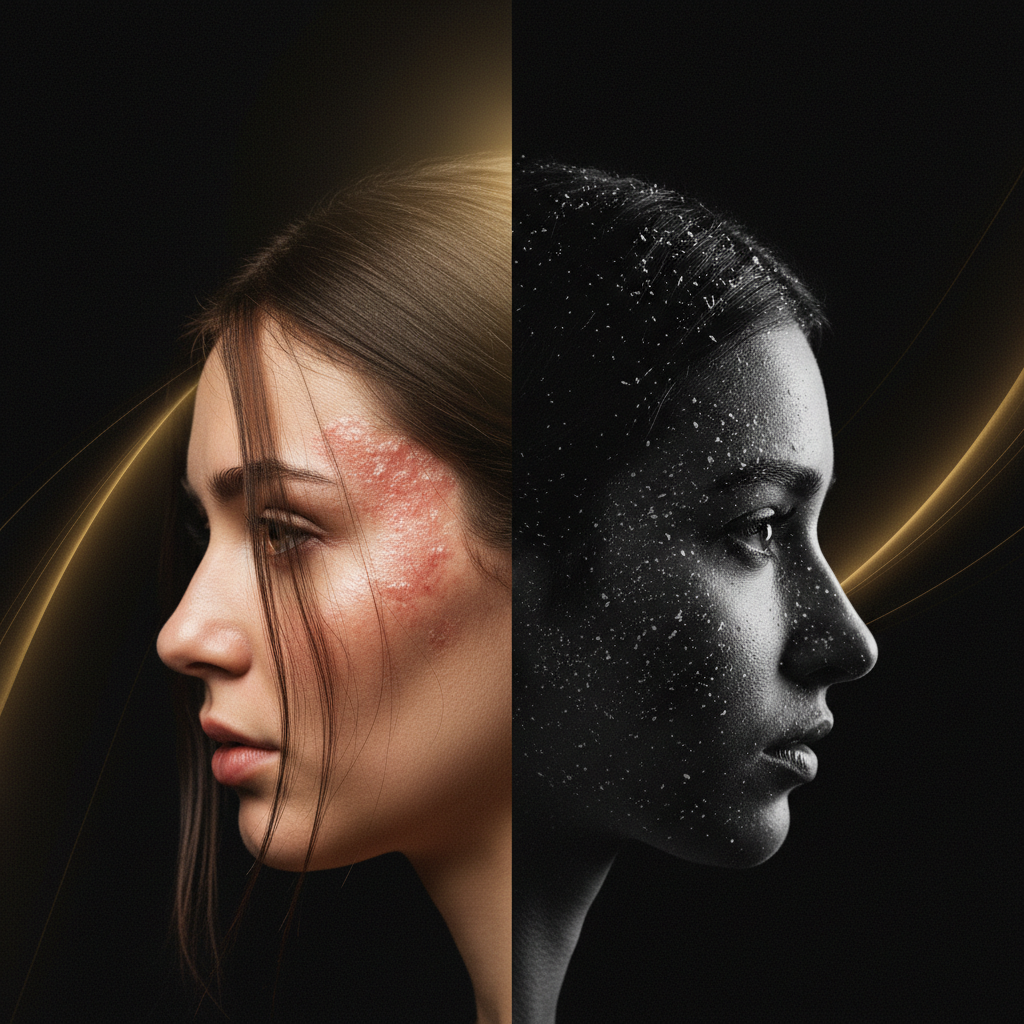
Quick answer: When evaluating Scalp Psoriasis vs Dandruff, the primary distinction lies in their biological causes and physical appearance. Dandruff is a mild, non-inflammatory shedding of fine white or yellow flakes driven by scalp yeast (Malassezia) and sebum breakdown. Scalp psoriasis is an autoimmune disorder causing rapid skin cell turnover, presenting as thick, well-defined plaques with silvery scales that often extend past the hairline. Cosmetic treatments can manage dandruff, but scalp psoriasis requires formal medical oversight to control underlying inflammation.
Key takeaways
- Different mechanisms: Dandruff stems from yeast overgrowth and excess sebum production, whereas scalp psoriasis is a chronic autoimmune condition.
- Visual differences: Dandruff produces loose, greasy or dry flakes scattered across hair fibres; psoriasis forms thick, raised, circumscribed red or purple plaques with silvery scale.
- Distribution boundaries: Dandruff rarely crosses the hairline, whereas scalp psoriasis often creeps onto the forehead, nape of the neck, and behind the ears.
- Bleeding risks: Lifting psoriasis scales often reveals pinprick bleeding (the Auspitz sign), a phenomenon never seen in plain dandruff.
- Care approaches: Over-the-counter anti-dandruff shampoos target fungal populations and cell turnover, while psoriasis often demands prescription topical steroids, vitamin D analogues, or systemic therapies.
Scalp Psoriasis vs Dandruff: what the evidence shows
Differentiating Scalp Psoriasis vs Dandruff requires an understanding of how skin behaves under two completely different biological triggers. While both conditions cause flaking, irritation, and scalp discomfort, clinical research demonstrates that they operate through distinct physiological pathways and require divergent management plans.
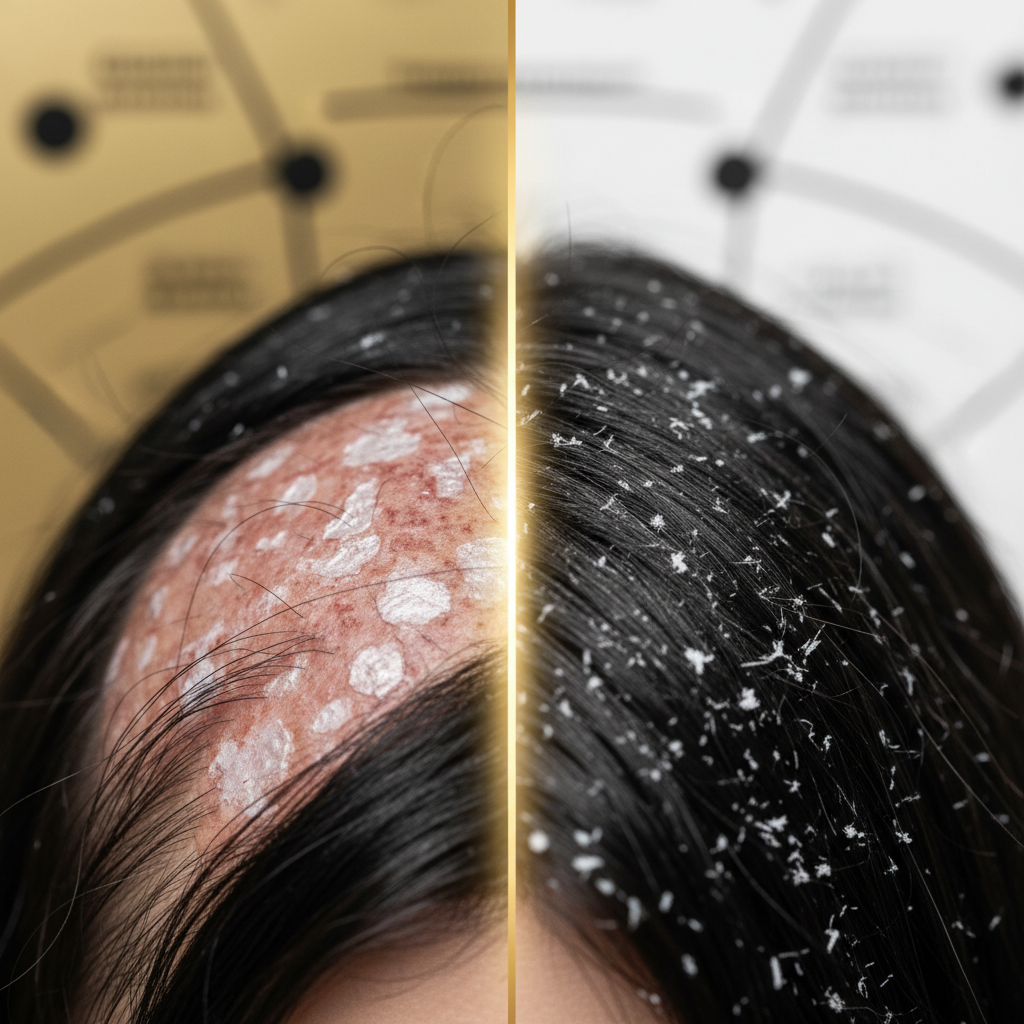
Dandruff affects approximately 50 percent of the global adult population at some stage. Dermatologists consider it the mildest, non-inflammatory form of seborrhoeic dermatitis. By contrast, psoriasis affects roughly 2 to 3 percent of the worldwide population, with up to 80 percent of those individuals experiencing scalp involvement.
Because both issues cause visible shedding across the shoulders and styling difficulties, they are frequently confused in the early stages. However, misidentifying psoriasis as common dandruff can lead to prolonged discomfort, skin barrier damage, and hair thinning caused by aggressive scrubbing or inappropriate topical products.
| Characteristic | Dandruff (Pityriasis Capitis) | Scalp Psoriasis |
|---|---|---|
| Primary Root Cause | Reaction to Malassezia yeast metabolites and sebum | Autoimmune-mediated hyperproliferation of epidermal keratinocytes |
| Plaque Formation | None; skin underneath remains flat and relatively pale | Thick, raised, well-demarcated plaques |
| Scale Appearance | Small, fine, white to yellowish, greasy or powdery flakes | Thick, adherent, silvery-white or micaceous scales |
| Auspitz Sign (Bleeding) | Absent | Frequently present when plaques are scraped or picked |
| Location & Spread | Confined strictly to hair-bearing areas of the scalp | Often crosses the hairline onto the forehead, neck, and ears |
| Pruritus (Itching) | Mild to moderate | Moderate to severe, often described as burning or tight |
| Associated Body Signs | None, or mild facial flaking (eyebrows, nasolabial folds) | Pitted nails, joint pain (psoriatic arthritis), elbow/knee plaques |
| Typical First-Line Care | Ketoconazole, zinc pyrithione, piroctone olamine, salicylic acid | Prescription corticosteroids, calcipotriol, coal tar, phototherapy |
Understanding the biological mechanisms
The fundamental difference between these two conditions lies at the cellular level.
In dandruff, normal skin desquamation accelerates due to an interaction between three factors: individual sebum composition, the epidermal barrier function, and the activity of Malassezia globosa and Malassezia restricta yeasts. These yeasts feed on scalp triglycerides, producing free fatty acids such as oleic acid. In susceptible individuals, oleic acid breaches the stratum corneum, provoking hyperkeratosis. Skin cells shed before they mature fully, clumping together in groups of 100 to 1,000 cells to form visible flakes.
In scalp psoriasis, the immune system drives the entire process. T-cells mistakenly trigger the release of pro-inflammatory cytokines, specifically interleukin-17 (IL-17), interleukin-23 (IL-23), and tumour necrosis factor-alpha (TNF-alpha). These chemical messengers command basal keratinocytes to divide at an unnatural rate. A normal skin cell lifecycle takes roughly 28 days from production to desquamation. In psoriatic skin, this cycle collapses down to just 3 to 5 days. Immature keratinocytes rush to the skin surface, compacting into dense, stratified layers capped by silvery, parakeratotic plaques.
What the evidence does not show
There is no scientific evidence that poor personal hygiene causes either dandruff or scalp psoriasis. Both conditions exist independent of how frequently someone washes their hair, though infrequent washing can allow dandruff flakes to accumulate and become more noticeable.
Furthermore, evidence does not show that either condition directly destroys hair follicles. Neither dandruff nor scalp psoriasis causes scarring alopecia on its own. While severe flaking and plaque buildup can induce temporary telogen effluvium (diffuse hair shedding), or severe scratching can snap fibres along the shaft, the follicles themselves remain intact and fully capable of regrowing hair once inflammation calms down.
Finally, diet alone has not been proven to cause or cure either condition. While balanced nutrition supports general skin health and systemic anti-inflammatory habits can complement medical psoriasis care, eliminating single food groups will not eradicate either issue.
Key signs to look for
To determine what is happening on your scalp, observe both the texture of the flakes and the perimeter of the irritation:
- Inspect flake thickness: Dandruff flakes are generally light, loose, and easily combed out. Psoriasis scales are tightly adherent, dense, and feel like a thick crust on the scalp skin.
- Examine the hairline: Part your hair and look at your forehead and behind the ears. If the redness and flaking cross cleanly onto bare skin, psoriasis is the more probable suspect.
- Check other body areas: Psoriasis rarely stays confined to the scalp forever. Inspect your elbows, knees, lower back, and fingernails. Small pits or yellow discolouration on the nail bed strongly indicate psoriasis.
- Notice post-scratching symptoms: If scratching a stubborn flake away leaves a distinct pinprick droplet of blood, you are likely witnessing the Auspitz sign, which reflects dilated capillaries beneath psoriatic plaques.
What you can do: management approaches
Effective care depends entirely on an accurate diagnosis. Treating psoriasis with light cosmetic anti-dandruff shampoos will yield poor results, while using potent medical therapies on plain dandruff exposes you to unnecessary side effects.
Managing dandruff
Dandruff typically responds well to topical cosmetic and over-the-counter cleansers formulated to reduce fungal populations and normalise stratum corneum turnover:
- Antifungal agents: Look for active ingredients like piroctone olamine, ketoconazole (1 to 2 percent), or zinc pyrithione. These suppress Malassezia populations, reducing inflammatory oleic acid release.
- Keratolytic cleansers: Shampoos containing salicylic acid (1 to 3 percent) break down the protein bonds holding dead flakes together, facilitating clean rinsing without mechanical scrubbing.
- Gentle washing cadence: Wash the scalp regularly using lukewarm water. High water temperatures strip moisture and irritate delicate surface barriers, triggering reactive oil production.
Managing scalp psoriasis
Because scalp psoriasis involves autoimmune cascades, management focuses on dampening the immune response and removing dense plaques:
- Prescription topicals: High-potency topical corticosteroids (such as clobetasol propionate) applied as lotions, foams, or gels reduce localized redness and cell division. They are often combined with vitamin D analogues (such as calcipotriol).
- Descaling treatments: Coconut oil, mineral oil, or medical-grade salicylic acid preparations are left on the scalp under a shower cap for 30 to 60 minutes to soften thick scales before gentle washing. Never scratch or forcibly pick plaques off dry skin.
- Coal tar formulations: Coal tar has been shown to slow epidermal DNA synthesis, easing plaque formation.
- Systemic treatments: For moderate to severe scalp psoriasis that resists topical care, dermatologists may prescribe biologics targeting IL-17 or IL-23 pathways, or oral PDE4 inhibitors.
When the cause may be something else
Several other dermatological conditions mimic the symptoms of both dandruff and psoriasis:
- Seborrhoeic dermatitis (moderate to severe): When dandruff advances to inflamed, greasy, red patches spreading across the eyebrows, chest, and sides of the nose, it is diagnosed as full seborrhoeic dermatitis.
- Sebopsoriasis: An overlapping condition displaying features of both seborrhoeic dermatitis and psoriasis, featuring thin, greasy, pink plaques that sit midway between both presentations.
- Contact dermatitis: An allergic reaction to hair dyes, preservatives, or fragrance chemicals can cause sudden, intense flaking, weeping, and itching that closely resembles a flare-up.
- Tinea capitis: A fungal ringworm infection that can cause scaly patches accompanied by localized hair breakage, most commonly seen in children.
When to seek professional advice
Consult a GP or dermatologist if your scalp exhibits any of the following warning signs:
- Flaking fails to respond to four weeks of targeted over-the-counter anti-dandruff care.
- Thick, raised plaques form or extend past the hairline onto your forehead or neck.
- You observe bleeding spots, fluid weeping, crusting, or signs of secondary bacterial infection.
- The scalp feels painfully tight, burns, or wakes you up at night with intense itching.
- You notice noticeable hair shedding alongside scaly patches.
Supporting the scalp barrier
Once active medical conditions are properly identified and treated under professional guidance, everyday cosmetic care should protect the moisture barrier and encourage healthy-feeling hair growth. Gentle, nutrient-rich cleansing helps wash away daily grime without disrupting skin pH.
Watermans Grow Me Shampoo provides a nourishing, revitalising environment for thinning-looking hair and normal-to-dry scalps. Packed with biotin, rosemary, caffeine, and argan oil, it cleanses without harsh sulphates, leaving the scalp refreshed and the hair fibre feeling fortified. It is an ideal cosmetic maintenance companion once inflammatory episodes are brought under clinical control.
Frequently asked questions about Scalp Psoriasis vs Dandruff
Can dandruff turn into scalp psoriasis over time?
No. Dandruff cannot turn into scalp psoriasis because they have completely different biological origins. Dandruff is a cosmetic issue related to yeast and oil, while psoriasis is a genetically linked autoimmune condition. However, it is possible for someone with mild dandruff to develop scalp psoriasis independently later in life.
How can I tell the difference between Scalp Psoriasis vs Dandruff at home?
Look at flake structure and boundaries. Dandruff produces fine, loose white or greasy yellow flakes confined strictly within the hair. Scalp psoriasis presents as thick, raised, red or dark plaques coated with dense silvery scales that often spread beyond the hairline to the forehead or ears.
Does scalp psoriasis cause permanent hair loss?
Scalp psoriasis does not usually cause permanent hair loss. Hair loss linked to psoriasis is typically temporary hair shedding (telogen effluvium) caused by deep inflammation, or mechanical hair breakage from scratching thick plaques. Once the underlying autoimmune flare is managed, hair follicles resume normal growth cycles.
Can diet alone clear up scalp psoriasis or dandruff?
No clinical evidence shows diet alone can eliminate either condition. While a balanced diet rich in omega-3 fatty acids and antioxidants supports general barrier repair and reduces systemic inflammation, it cannot replace medical therapies for psoriasis or targeted antifungal treatments for stubborn dandruff.
Why do anti-dandruff shampoos fail to clear scalp psoriasis?
Anti-dandruff shampoos target Malassezia yeast and reduce surface skin shedding. Because scalp psoriasis is driven by rapid cell division deep within the epidermis via an overactive immune system, superficial antifungal ingredients are not potent enough to halt the underlying inflammatory process.
Maintaining scalp health
Navigating Scalp Psoriasis vs Dandruff begins with accurate recognition. Dandruff is a manageable, surface-level condition that responds well to routine antifungal care and balanced cleansing. Scalp psoriasis is a systemic immune disorder requiring targeted medical treatments to prevent plaque accumulation and discomfort. By monitoring your symptoms, avoiding the urge to pick at scales, and consulting a healthcare professional when over-the-counter options fail, you can maintain a comfortable scalp and support strong, healthy-looking hair.
Sources and references
- British Association of Dermatologists (BAD). Psoriasis - an overview and management guidelines. 2022.
- National Health Service (NHS). Dandruff: Causes, treatments, and symptoms. 2023.
- National Health Service (NHS). Psoriasis: Symptoms and diagnosis. 2024.
- Borda, L. J., & Wikramanayake, T. C. Seborrheic Dermatitis and Dandruff: A Comprehensive Review. Journal of Clinical and Investigative Dermatology, 2015.
- Armstrong, A. W., & Read, C. Pathophysiology, Clinical Presentation, and Treatment of Psoriasis: A Review. JAMA, 2020.
Find these ingredients in Watermans products
- Zinc: you will find this ingredient in our Hair Vitamins.
- Oleic Acid: you will find this ingredient in our Camellia & Black Castor Hair & Body Oil.