Female Pattern Hair Loss Guide: Evidence, Causes, and Care
9 min read ·
A complete, evidence-based Female Pattern Hair Loss Guide covering causes, clinical signs, diagnosis, medical treatments, and daily scalp care strategies.

Quick answer: This Female Pattern Hair Loss Guide covers androgenetic alopecia in women, a progressive condition characterised by diffuse hair thinning across the mid-frontal scalp and crown while usually preserving the frontal hairline. Driven by genetic sensitivity to androgens and progressive follicular miniaturisation, it affects roughly 40% of women by age 50. The main limitation is that medical therapies stabilise progression or stimulate modest regrowth, but they cannot permanently cure the underlying genetic predisposition.
Key takeaways
- Female pattern hair loss (FPHL) involves the progressive miniaturisation of hair follicles, shortening the anagen (growth) phase and producing finer, shorter fibres over time.
- Unlike male pattern baldness, FPHL typically presents as diffuse thinning across the crown and a widening central parting, rarely leading to complete baldness.
- Accurate diagnosis requires differentiating true androgenetic loss from diffuse shedding (telogen effluvium) or mechanical fibre breakage.
- First-line clinical interventions focus on halting progression; early treatment delivers the highest rates of follicle preservation.
- Cosmetic haircare, including topical caffeine, biotin, and rosemary extracts, supports the scalp environment and fibre strength but does not replace medical therapies for severe alopecia.
Female Pattern Hair Loss Guide: what the evidence shows
Female pattern hair loss is the most common cause of persistent hair thinning in adult women. Peer-reviewed dermatological research demonstrates that FPHL is driven by a complex interplay of genetic susceptibility, local androgen metabolism, and microvascular factors around the dermal papilla. Within sensitive follicles, testosterone is converted by the enzyme 5-alpha reductase into dihydrotestosterone (DHT). DHT binds to androgen receptors, triggering signalling pathways that progressively constrict the hair follicle.

With each subsequent hair cycle, the growth (anagen) phase shortens from its typical duration of two to seven years down to mere months or weeks. Simultaneously, the resting (telogen) phase lengthens. The follicle shrinks in diameter, transforming thick, pigmented terminal hairs into thin, unpigmented vellus-like hairs. Because this process happens asynchronously across thousands of follicles, women rarely experience patchy bald spots. Instead, they notice a global loss of volume over the top of the scalp.
Epidemiological studies indicate that the prevalence of FPHL increases significantly with age. While roughly 12% of women show signs before age 30, prevalence rises to between 30% and 40% by age 50, and reaches over 50% in women over 70. Hormonal shifts, particularly the drop in protective oestrogens during perimenopause and menopause, often unmask or accelerate the genetic tendency.
What the evidence does not show
Scientific evidence does not show that female pattern hair loss is caused by poor hygiene, frequent shampooing, wearing hats, or using cosmetic styling products. Washing your hair dislodges fibres that have already entered the shedding phase; it does not trigger the miniaturisation process at the dermal papilla.
Furthermore, clinical trials do not support the idea that nutritional supplements alone can reverse established FPHL in the absence of a diagnosed vitamin or mineral deficiency. While low ferritin or vitamin D levels can exacerbate shedding, correcting these levels will not alter androgen receptor sensitivity in genetically vulnerable follicles. Finally, evidence does not show that general salon treatments or conditioning masks can cure follicular miniaturisation, as their action is limited to the dead keratin structure of the hair shaft.
Clinical signs and diagnostic staging
The earliest indication of FPHL is rarely sudden shedding. Instead, women typically notice subtle changes in hair density and behaviour:
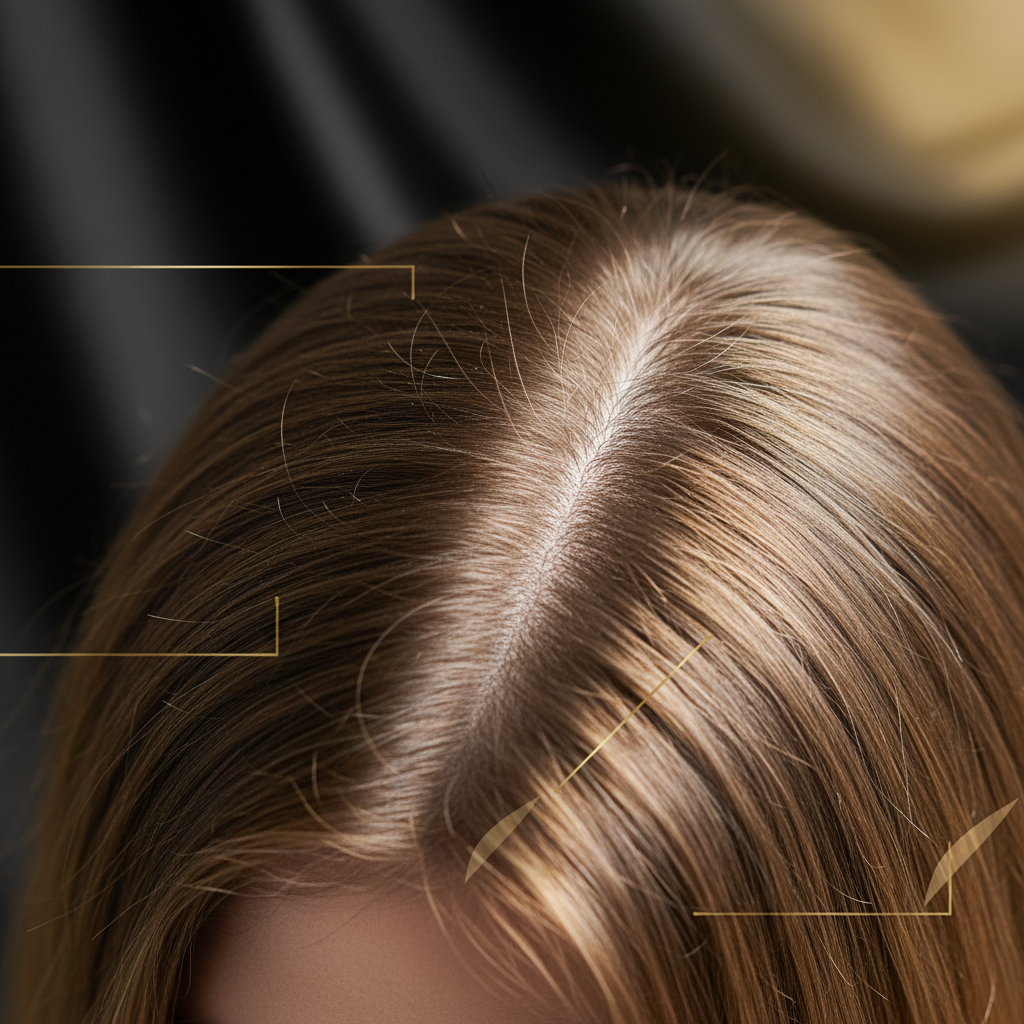
- Widening central part: When hair is parted down the middle, the scalp becomes noticeably more visible, often resembling an inverted "Christmas tree" pattern that is widest at the front.
- Reduced ponytail thickness: A progressive reduction in overall ponytail circumference over several months or years.
- Increased scalp visibility under bright light: Diffuse thinning across the vertex (crown) and mid-scalp while the frontal hairline remains intact.
- Variable fibre diameters: Known as hair diameter diversity or miniaturisation, visible under a dermatoscope as a mix of thick terminal hairs and very fine vellus hairs in the same scalp area.
Dermatologists classify FPHL using clinical scales. The Ludwig Scale remains the standard benchmark, categorising progression into three grades: Grade I (mild thinning along the parting), Grade II (pronounced widening of the part and noticeable diffuse thinning), and Grade III (severe, extensive thinning across the crown with a transparent appearance). The Sinclair Scale uses a five-point photographic system running from normal density (Grade 1) to advanced diffuse loss (Grade 5).
| Feature | Female Pattern Hair Loss (FPHL) | Telogen Effluvium (TE) | Hair Fibre Breakage |
|---|---|---|---|
| Primary Mechanism | Follicular miniaturisation via DHT sensitivity | Premature shift of follicles into resting phase | Structural failure of the hair shaft |
| Onset | Gradual, progressive over months to years | Sudden, acute shedding 2 to 3 months post-trigger | Gradual or sudden depending on chemical/heat trauma |
| Pattern | Mid-scalp, crown, widening central parting | Diffuse shedding across the entire scalp | Uneven lengths, split ends, localized to styled zones |
| Hairline Impact | Frontal hairline usually preserved | Frontal hairline preserved | Often noticeable at temples or crown from heat |
| Shed Fibre Morphology | High ratio of miniaturised, fine hairs | Full-length terminal hairs with white keratin bulbs | Short, snapped segments without follicular bulbs |
| Reversibility | Requires ongoing maintenance; progressive without care | High; usually self-limiting within 6 months | High; trims and conditioning restore fibre integrity |
Differential diagnosis: when the cause is something else
Accurate identification is vital because treating the wrong condition delays appropriate management.
Telogen effluvium is the condition most frequently confused with FPHL. While FPHL is a slow, miniaturising process, telogen effluvium is an abrupt, reactive shedding event triggered by physiological stress, severe illness, rapid weight loss, thyroid dysfunction, or postpartum hormonal shifts. In telogen effluvium, you may shed 300 or more full-length hairs per day with white bulbs attached, but the follicles do not undergo structural miniaturisation.
Cicatricial (scarring) alopecias, such as frontal fibrosing alopecia (FFA) or lichen planopilaris (LPP), represent another distinct group. These inflammatory conditions destroy the follicle entirely and replace it with fibrous scar tissue. Warning signs of scarring alopecia include scalp redness, burning, itching, perifollicular scaling, and recession of the frontal hairline or loss of eyebrow hair.
Hair breakage, by contrast, is purely mechanical or chemical. Excessive heat styling, chemical relaxers, or bleaching compromise the cuticular layers and cortex of the hair fibre, causing it to snap mid-shaft. Breakage produces no changes at the follicular level.
Evidence-based management strategies
Managing FPHL requires a long-term approach combining medical interventions, supportive cosmetic formulations, and lifestyle optimisation.
Medical and clinical therapies
Topical minoxidil (available as a 2% solution or 5% foam) is the gold-standard, clinically proven topical intervention licensed for female pattern hair loss. Applied daily to the dry scalp, minoxidil acts as a potassium channel opener, shortening the telogen phase and widening local blood vessels around the follicle to prolong the anagen growth cycle. Results generally require three to six months of consistent use, and cessation leads to a gradual return to baseline thinning.
For women with pronounced androgen sensitivity, clinicians may evaluate systemic anti-androgens such as spironolactone or finasteride, though these require strict medical supervision and are contraindicated during pregnancy. Low-level laser therapy (LLLT) devices operating at wavelengths around 650 nm have also received regulatory clearance as adjunctive treatments, using photobiomodulation to stimulate cellular respiration in the dermal papilla.
Supportive cosmetic haircare: Watermans Grow Me
While prescription treatments target internal vascular and hormonal pathways, cosmetic haircare plays a complementary role by fortifying the physical fibre, optimising scalp hygiene, and creating a fuller appearance.
Watermans Grow Me Shampoo and Conditioner are formulated to support the scalp environment during thinning. Containing cosmetic actives such as caffeine, biotin, rosemary extract, argan oil, and niacinamide, these formulas help remove micro-debris and sebum from follicular openings without stripping the scalp's natural lipid barrier (pH 5.5). Peer-reviewed laboratory data indicates that topical caffeine can help protect against oxidative stress at the surface, while hydrolysed lupin protein helps condition the fibre to minimise breakage. Using dedicated cosmetic formulations ensures that the hair emerging from miniaturised follicles is shielded from structural stress, helping you retain every millimetre of existing density.
When to seek professional advice
You should consult a GP, board-certified dermatologist, or registered trichologist if you notice:
- Sudden, widespread shedding that persists beyond eight to twelve weeks.
- Visible patches of complete bareness or irregular, circular shedding spots.
- Concomitant symptoms such as scalp itching, burning, tenderness, pain, or prominent flaking.
- Irregular menstrual cycles, adult-onset cystic acne, or unexpected facial hair growth (hirsutism), which can indicate underlying polycystic ovary syndrome (PCOS).
- Recession of the frontal hairline or thinning of the eyebrows.
A specialist will perform a physical examination, potentially using non-invasive dermoscopy (trichoscopy) to measure follicular diameter diversity. They may also order blood panels to evaluate serum ferritin, thyroid-stimulating hormone (TSH), free and total testosterone, and vitamin D levels.
Frequently asked questions about Female Pattern Hair Loss Guide
What is the most effective initial step in this Female Pattern Hair Loss Guide?
The most critical initial step is obtaining a professional diagnosis from a dermatologist or trichologist. They will confirm whether miniaturisation is present via dermoscopy, ruling out acute telogen effluvium, thyroid disease, or iron deficiency before establishing an evidence-based regimen such as topical minoxidil alongside supportive cosmetic scalp care.
Can female pattern hair loss be reversed naturally?
FPHL cannot be reversed purely through natural remedies, dietary changes, or essential oils. Because it is an inherited sensitivity of the hair follicle to androgens, natural approaches cannot permanently change follicular genetics. However, balanced nutrition, stress reduction, and gentle haircare support overall follicular health and prevent concurrent shedding.
How does menopause affect female pattern hair loss?
Menopause accelerates female pattern hair loss because the natural decline in oestrogen and progesterone shifts the hormonal balance toward circulating androgens. Without the protective effects of oestrogen on the hair cycle, follicles that carry a genetic vulnerability to DHT miniaturise more rapidly, often leading to a noticeable drop in crown density.
Does washing hair frequently worsen female pattern thinning?
No, washing hair frequently does not worsen female pattern hair loss. The fibres seen in the shower drain have already detached from the dermal papilla weeks earlier during the telogen phase. Maintaining clean hair removes sebum, sweat, and environmental pollutants, fostering a healthy scalp microbiome that supports normal follicular activity.
A realistic approach to female pattern hair loss
Navigating thinning hair requires realistic expectations and scientifically grounded methods. While female pattern hair loss is a chronic and progressive condition, modern dermatology and targeted cosmetic care provide effective tools to halt its progression, preserve your existing follicles, and improve overall fibre diameter. The key to long-term success lies in acting early: by combining professional medical advice with gentle, evidence-based daily haircare routines, you can protect your scalp health and regain control over your hair density.
Sources and references
- British Association of Dermatologists. (2020). Female Pattern Hair Loss: Clinical Guidelines and Patient Information.
- National Institute for Health and Care Excellence (NICE). (2022). Alopecia, androgenetic - Clinical Knowledge Summary.
- Journal of the American Academy of Dermatology. (2018). Diagnosis and management of female pattern hair loss: An evidence-based review. DOI: 10.1016/j.jaad.2017.12.062.
- Sinclair, R. (2004). Female pattern hair loss: a guide to diagnosis and management. Australian Family Physician, 33(10), 809-813.
- International Journal of Trichology. (2019). Trichoscopy in the Evaluation of Hair Loss: A Comprehensive Review. DOI: 10.4103/ijt.ijt_32_19.
Find these ingredients in Watermans products
- Niacinamide: you will find this ingredient in our Hair Mask.