Essential Oils for Hair Growth: Evidence, Safety, and Follicular Science
8 min read ·
Explore the clinical evidence behind essential oils for hair growth, including rosemary and peppermint, safe dilution rules, and their true biological limits.
Quick answer: Research into essential oils for hair growth shows modest, preliminary promise for specific plant extracts, notably rosemary, peppermint, and cedarwood. These botanical compounds can stimulate microcirculation around follicles, offer antimicrobial benefits, and prolong the anagen (growth) phase of the hair cycle. However, their primary limitation is clinical scale: most studies are small, conducted on animal models, or measure cosmetic improvements rather than reversing genetic pattern baldness. They support scalp health rather than serving as standalone cures for medical hair loss.
Key takeaways
- Rosemary and peppermint show the strongest preliminary evidence for encouraging follicular activity and local blood flow.
- Essential oils are highly concentrated botanicals that must always be diluted in a carrier oil to prevent severe contact dermatitis and chemical burns.
- Cosmetic enhancement is not medical reversal: essential oils may improve hair density and reduce breakage, but they do not alter the underlying genetics of androgenetic alopecia.
- Consistency takes months: visible improvements in hair quality or retention typically require at least three to six months of regular, properly diluted application.
- Patch testing is mandatory before applying any concentrated plant extract to your scalp, especially if you have a compromised epidermal barrier.
Essential oils for hair growth: what the evidence shows
The scientific interest in essential oils for hair growth centres on how volatile botanical compounds influence cellular metabolism and blood flow in dermal papilla cells. While social media often presents these oils as miracle remedies, dermatology views them through the lens of controlled biological mechanisms.
Several key essential oils have undergone formal investigation:
Rosemary oil (Rosmarinus officinalis)
A landmark comparative trial published in Skinmed in 2015 evaluated rosemary oil against a standard 2% minoxidil solution in patients with androgenetic alopecia. Over a six-month period, both groups showed a statistically significant increase in hair count. Crucially, the rosemary group experienced significantly less scalp itching than the minoxidil group. The proposed mechanism involves carnosic acid, an active compound that heals tissue and improves vascularity around the follicle bulb.
Peppermint oil (Mentha piperita)
A 2014 study published in Toxicological Research compared peppermint oil, jojoba oil, saline, and 3% minoxidil in laboratory models. At a 3% dilution, peppermint oil demonstrated remarkable follicular elongation, increased dermal thickness, and elevated expression of alkaline phosphatase, an enzymatic marker of hair growth. The cooling agent menthol acts as a vasodilator, widening micro-vessels to deliver oxygen and nutrients directly to starving follicles.
Cedarwood, thyme, and lavender
A historical double-blind trial conducted at the Aberdeen Royal Infirmary in 1998 examined 86 patients diagnosed with alopecia areata. Participants massaged a blend of cedarwood, lavender, thyme, and rosemary in carrier oils (jojoba and grapeseed) into their scalps daily. After seven months, 44% of the essential oil group showed visible improvement compared to only 15% in the carrier-oil-only control group, suggesting an immunomodulatory or circulation-boosting benefit.
Tea tree oil (Melaleuca alternifolia)
Tea tree oil does not directly accelerate the anagen growth phase. Instead, its high concentration of terpinen-4-ol targets Malassezia yeast and bacterial colonisation. By resolving inflammatory scalp conditions such as seborrhoeic dermatitis and heavy dandruff, tea tree removes inflammatory blockages that cause premature shedding (telogen effluvium).
| Essential oil | Primary active compound | Key biological mechanism | Strongest clinical evidence level |
|---|---|---|---|
| Rosemary | Carnosic acid, 1,8-cineole | Microcirculation enhancement, anti-inflammatory | Small human comparative trial (2015) |
| Peppermint | Menthol | Vasodilation, anagen induction | Animal model (2014) |
| Lavender | Linalool, linalyl acetate | Cell proliferation, antimicrobial | Animal model (2016) |
| Cedarwood | Cedrol | Antiseptic, circulation stimulant | Small human trial for alopecia areata (1998) |
| Tea Tree | Terpinen-4-ol | Antifungal, clears follicular clogging | Human trials for dandruff/dermatitis |
What the evidence does not show
It is critical to separate genuine follicular stimulation from online hyperbole. Controlled clinical research has not found that essential oils can:
- Permanently block systemic DHT: While some in vitro research suggests botanical polyphenols may weakly inhibit 5-alpha reductase, essential oils do not match pharmaceutical anti-androgens in binding affinity or systemic suppression.
- Revive dormant or fibrosed follicles: Once a hair follicle has undergone complete scarring or advanced miniaturisation, no topical essential oil can recreate the lost biological structure.
- Replace medical treatment for autoimmune hair loss: While the 1998 Aberdeen trial showed partial regrowth in patchy alopecia areata, essential oils cannot halt severe, progressive autoimmune attacks like alopecia totalis or frontal fibrosing alopecia.
Confusing hair breakage with hair shedding is another common pitfall. Essential oils applied to the scalp cannot mend split ends along the hair shaft. Hair breakage requires cuticle repair, protein reinforcement, and conditioning moisture, not scalp stimulation.
How to use essential oils safely on your scalp
Because pure essential oils are exceptionally potent, applying them directly to the scalp without a carrier base is a recipe for irritant contact dermatitis, flaking, and reactive hair shedding.
Dilution ratios
Safe topical application requires a dilution rate of 1% to 2%:
- 1% dilution: 3 drops of essential oil per 10 ml of carrier oil (ideal for sensitive scalps).
- 2% dilution: 6 drops of essential oil per 10 ml of carrier oil (standard strength).
Excellent carrier oils include jojoba oil (which closely mimics natural human sebum), squalane, or argan oil.
Step-by-step application
- Perform a patch test: Place two drops of your diluted mixture on your inner forearm. Wait 24 to 48 hours to confirm there is no redness, swelling, or pruritus.
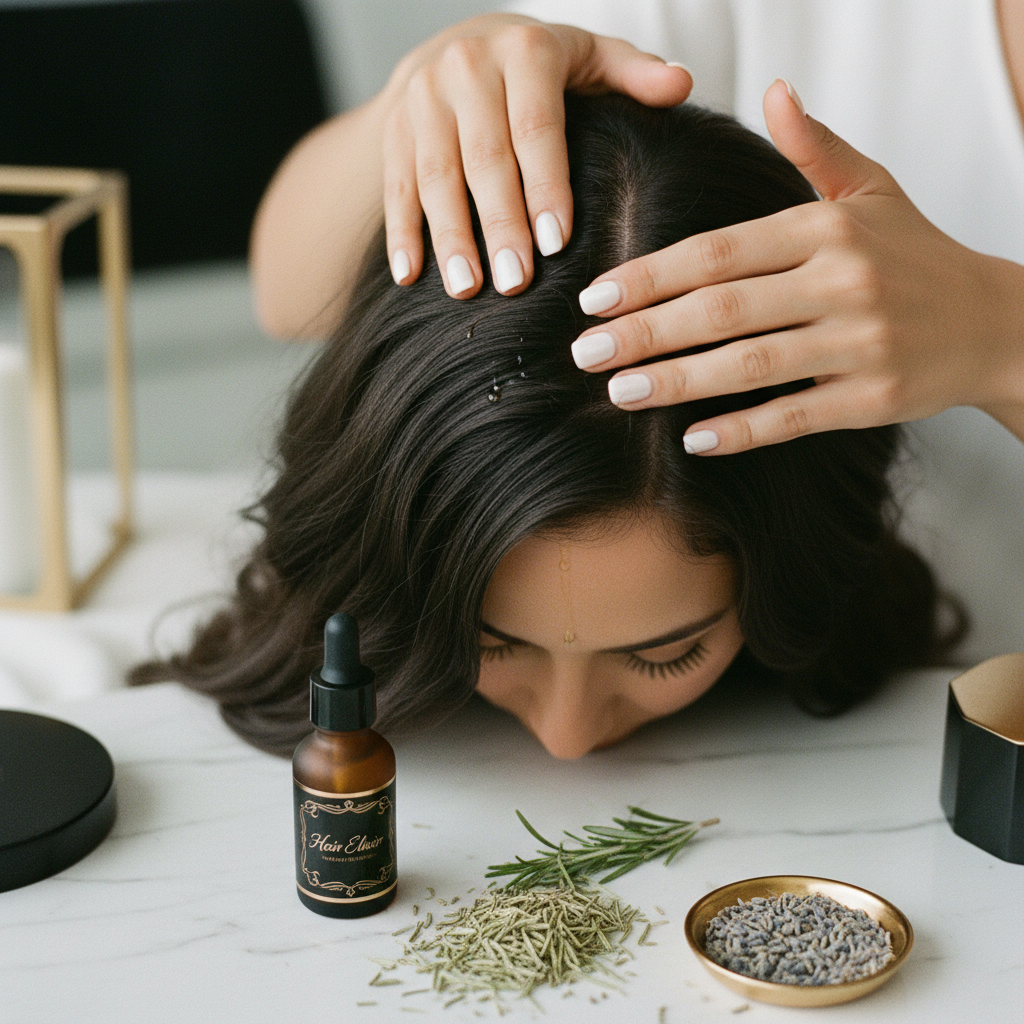
- Apply to clean skin: Part your hair into sections and distribute 5 to 10 drops of the diluted mixture across your scalp using your fingertips.
- Gentle scalp massage: Massage in firm, circular motions for four to five minutes. This physical mobilisation aids mechanical blood flow alongside the biochemical action of the oils.
- Leave-in or wash-out: For normal to dry scalps, you can leave the oil on overnight. For oily or acne-prone scalps, let it sit for 30 to 60 minutes before cleansing thoroughly with a gentle shampoo.
When the underlying cause is something else
If your hair is shedding excessively from the root (bulbs visible at the end of fallen hairs), topical oils alone may not address the underlying issue. Significant hair loss often stems from internal disruptions:
- Nutritional deficiencies: Insufficient serum ferritin (iron stores below 30 to 50 ug/L), vitamin D deficiency, or severe zinc shortfalls impair the high metabolic demands of follicle matrix cells.
- Thyroid dysfunction: Both hypothyroidism and hyperthyroidism disrupt the biological hair growth cycle, causing diffuse telogen shedding.
- Acute telogen effluvium: Triggered by high fevers, surgery, intense psychological stress, or sudden hormonal shifts (such as postpartum recovery). This type of shedding typically resolves on its own within six to nine months once the biological trigger is managed.
- Scarring alopecias: Lichen planopilaris or central centrifugal cicatricial alopecia destroy the stem cell niche in the follicle and require urgent dermatological intervention.
Supporting follicular health: a balanced approach
For those who prefer a well-rounded cosmetic regimen without the mess of mixing raw carrier and essential oils at home, advanced haircare formulations can deliver targeted botanical actives cleanly.
Watermans creates premium scalp-support formulations designed around this balanced philosophy. By combining targeted botanical ingredients with caffeine, biotin, and hydrolysed lupin protein, their blends support microcirculation and foster an optimal, clean scalp environment to help hair feel thicker and reduce breakage along the fibre.
When to seek professional advice
Consult a GP, dermatologist, or registered trichologist if you notice:
- Sudden, patchy bald spots that appear overnight.
- Redness, burning, tenderness, or scaly crusting on your scalp.
- Diffuse shedding that continues unabated for more than four consecutive months.
- Distinct widening of your central parting accompanied by miniaturisation (hair strands growing back progressively finer).
Frequently asked questions about essential oils for hair growth
Which is the best of the essential oils for hair growth?
Rosemary oil has the strongest comparative clinical evidence among essential oils for hair growth. In human trials, it performed comparably to a 2% minoxidil solution over six months for androgenetic thinning, while causing less irritation. Peppermint oil also demonstrates strong potential in laboratory research for increasing follicle depth.
Can I leave essential oils in my hair overnight?
You can leave essential oils on your scalp overnight only if they are properly diluted in a nourishing carrier oil at a 1% to 2% concentration. Never leave undiluted pure essential oils on your skin. If you have seborrhoeic dermatitis or an oily scalp, wash the oil out after 30 to 60 minutes.
How long does it take for essential oils to show hair results?
Hair grows roughly 1 to 1.25 cm per month. Because follicles take time to transition from telogen (resting) back to anagen (active growth), you must apply your diluted essential oil consistently two to three times a week for at least three to six months before expecting noticeable changes in hair thickness or scalp coverage.
Can essential oils cause hair loss?
Yes, if used incorrectly. Pure, undiluted essential oils or excessive concentrations can cause allergic contact dermatitis, chemical burns, and severe scalp inflammation. This inflammation shocks the hair roots, inducing acute telogen effluvium and increasing hair shedding until the skin barrier fully heals.
Conclusion
Understanding the true utility of essential oils for hair growth allows you to set realistic expectations and protect your scalp health. Plant extracts like rosemary and peppermint provide valuable, natural support for microcirculation, antimicrobial defence, and cosmetic hair retention. When diluted responsibly, patch-tested, and paired with consistent care, they represent a safe and pleasant supportive ritual for maintaining a vibrant scalp ecosystem.
Sources and references
- Panahi, Y. Et al. (2015) 'Rosemary oil vs minoxidil 2% for the treatment of androgenetic alopecia: a randomized comparative trial', Skinmed, 13(1), pp. 15-21.
- Oh, J.Y. Et al. (2014) 'Peppermint Oil Promotes Hair Growth without Toxic Signs', Toxicological Research, 30(4), pp. 297-304.
- Hay, I.C. Et al. (1998) 'Randomized trial of aromatherapy. Successful treatment for alopecia areata', Archives of Dermatology, 134(11), pp. 1349-1352.
- British Association of Dermatologists (2020) 'Telogen Effluvium Guidelines and Patient Information', bad.org.uk.
- National Institute for Health and Care Excellence (NICE) (2022) 'Alopecia androgenetica: Clinical Knowledge Summary', nice.org.uk.
Find these ingredients in Watermans products
- Zinc: you will find this ingredient in our Hair Vitamins.