Effects of Heat Damage on Hair: Mechanisms and Prevention
8 min read ·
Explore the physical effects of heat damage on hair. Understand keratin breakdown, cuticle degradation, temperature limits, and how to protect hair fibres.
Quick answer: The effects of heat damage on hair stem from the structural breakdown of keratin proteins, the melting of protective surface lipids, and rapid moisture loss within the fibre. Temperatures above 150°C crack the outer cuticle, while heat exceeding 200°C degrades the inner cortex, causing chronic dryness, split ends, and mechanical breakage. The primary limitation is that fully heat-damaged hair cannot biologically repair itself, meaning restorative care can only patch the fibre cosmetically until new hair grows.
Key takeaways
- Heat styling tools operating above 150°C compromise the 18-methyleicosanoic acid (18-MEA) lipid layer, stripping natural shine and hydrophobicity.
- Wet heat from flat irons or curling wands can cause steam to expand explosively within the cortex, resulting in a permanent defect known as bubble hair.
- Thermal degradation is cumulative and permanent; hair is non-living biological tissue and cannot biologically regenerate broken protein bonds.
- Heat-damaged hair breaks along the shaft and does not cause hair loss at the follicle level unless burns physically damage the scalp tissue.
- Thermal protectant sprays and conditioning polymers reduce heat transfer rates, sealing the cuticle to reduce moisture evaporation by up to 50 percent.
Effects of Heat Damage on Hair: what the evidence shows
Scientific evaluation reveals that the effects of heat damage on hair occur in progressive stages dictated by temperature, moisture levels, and exposure duration. Hair is primarily composed of alpha-keratin, a fibrous protein organised into coiled polypeptide chains, bound together by disulphide, hydrogen, and ionic bonds. Surrounding this cortex is the cuticle, composed of overlapping, shingle-like scales sealed with a naturally water-repellent lipid layer called 18-MEA.
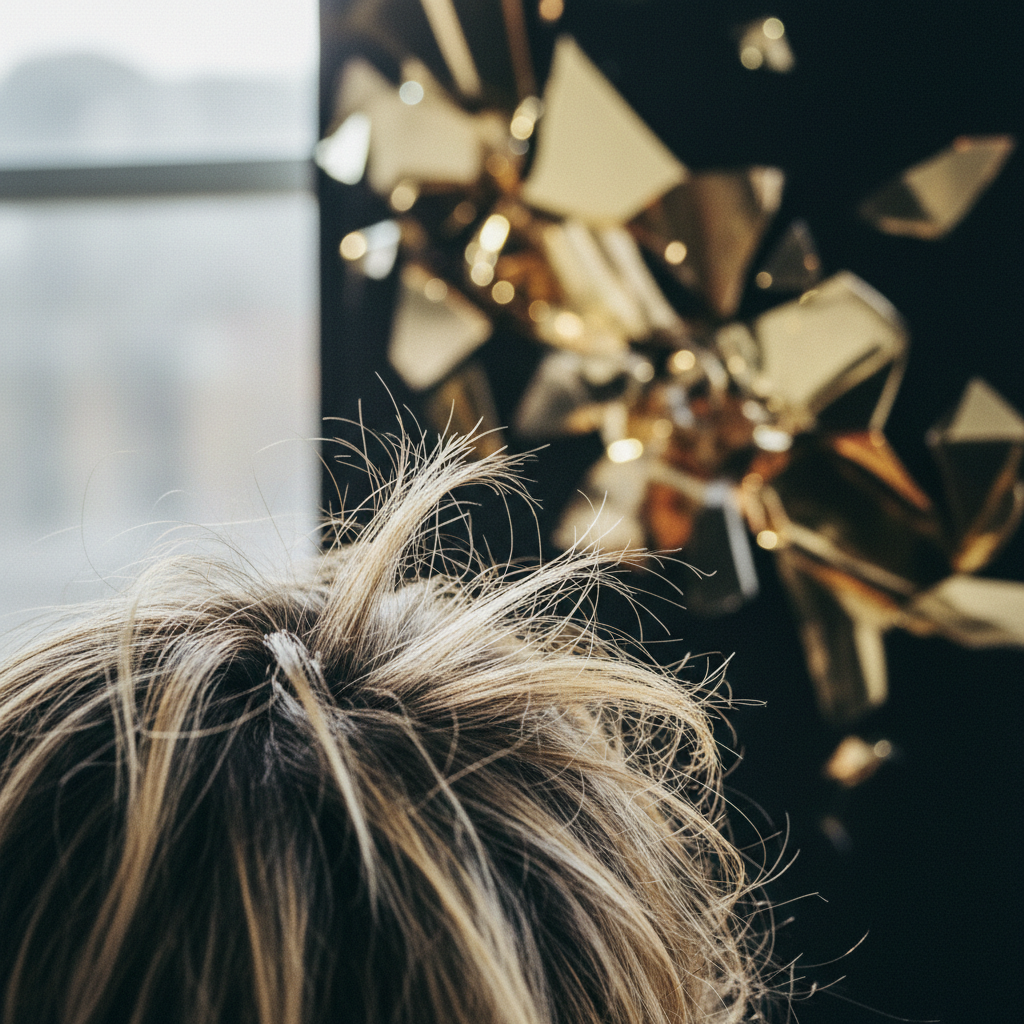
Thermal exposure strips these defences methodically:
- Lipid erosion (Below 140°C): Heat softens and evaporates the surface lipid layer. The fibre loses its natural hydrophobicity, absorbing ambient humidity irregularly and turning frizzy and dull.
- Cuticle lifting and cracking (140°C to 160°C): The edges of the cuticle scales begin to curl upward, chip, and lift away from the shaft. The hair feels rough to the touch and catches against neighbouring strands.
- Moisture vaporisation and denaturation (160°C to 190°C): Trapped water inside the hair fibre vaporises. If applied rapidly or to damp hair, water flashes into steam faster than it can escape through the cuticle, forming microscopic voids and causing permanent shaft deformation.
- Protein degradation and melting (Above 200°C): Keratin proteins undergo irreversible denaturation. Alpha-helical structures unravel into disordered beta-sheet configurations. The disulphide bonds break, causing severe structural weakening and inevitable fibre breakage.
The physical signs of thermal hair damage
Recognising thermal damage early allows you to alter your styling habits before widespread breakage occurs. Stylists and trichologists look for distinct physical markers:
- Altered curl patterns: Naturally wavy, curly, or coily hair loses its spring and elasticity. Damaged sections hang limp, straight, or irregularly wavy because the internal structural proteins no longer hold their original alignment.
- Rough, straw-like texture: Because the cuticle scales are lifted or missing, fingers encounter resistance when sliding downward from root to tip.
- White bulb-like specks along the shaft: Often mistaken for follicular bulbs, these tiny white dots are trichorrhexis nodosa, sites where the cortex has fragmented and swollen, ready to snap under minor tension.
- Excessive breakage and split ends: Trichoptilosis (longitudinal splitting) and breakage occur easily during light combing or washing. You will notice short, snapped pieces falling into the sink rather than full-length shed hairs with a white root bulb.
- Dullness and colour fading: Without a smooth cuticle layer to reflect light evenly, hair appears matte. Artificially coloured hair oxidises rapidly under heat, leading to brassiness or premature fading.
| Heat Range | Structural Impact on Fibre | Visible Symptoms | Reversibility |
|---|---|---|---|
| Under 140°C | 18-MEA lipid degradation; surface moisture loss | Minor dryness, loss of shine | High (manageable with conditioning) |
| 140°C to 180°C | Cuticle lifting, cracking, cortical dehydration | Frizz, tangling, rough texture | Moderate (cuticle patching only) |
| 185°C to 215°C | Protein denaturation; disulphide bond cleavage | Split ends, loss of curl pattern, breakage | Low (permanent fibre compromise) |
| Above 220°C | Keratin melting; cuticle destruction; cortex voids | Trichorrhexis nodosa, severe snapping | None (damaged sections must be trimmed) |
What the evidence does not show
It is critical to distinguish between marketing myths and clinical reality. Thermal tools do not cause follicular hair loss or alopecia under normal conditions. Heat damage is purely an external, shaft-level mechanical problem. When you notice short strands on your shoulders after using a straightener, that is breakage, not shedding from the follicle. The follicle underneath your scalp remains alive, intact, and capable of producing new hair.
Furthermore, no cosmetic serum, oil, or treatment can "heal" or permanently restore heat-damaged hair. Because the hair shaft is biologically dead tissue without cellular metabolic activity, severed keratin chains cannot knit back together naturally. Cosmetic bond-builders and proteins provide temporary cross-linking and synthetic structural reinforcement, but these effects wash away over time and require consistent upkeep.
When the cause may be something else
Before attributing all brittleness and breakage solely to hot tools, rule out other contributing factors. Chemical processing, such as bleaching, high-lift colouring, permanent waving, or relaxing, alters the fibre's internal pH and dissolves disulphide bonds chemically, rendering hair far more vulnerable to even modest thermal styling.
Hard water minerals like calcium and magnesium can also coat the hair shaft, preventing moisture from penetrating and making the fibre stiff and brittle. Finally, true hair loss where you see hairs shedding from the scalp with a small white root bulb attached points toward physiological factors like telogen effluvium, nutritional deficiencies (such as iron or vitamin D), or hormonal changes, rather than thermal tools.
Practical steps to minimise and manage heat damage
Preventing thermal degradation requires controlling heat transfer and reinforcing the fibre's surface.
Calibrate your styling temperature
Most hair types do not require the maximum 230°C setting found on consumer flat irons. Fine or chemically processed hair should be styled between 120°C and 150°C. Medium or wavy hair tolerates 150°C to 180°C, while coarse or thick hair rarely requires more than 180°C to 200°C. Never make multiple slow passes over the same section; one smooth, deliberate pass causes far less heat absorption than repeated dragging.
Never apply direct iron heat to damp hair
Applying a 180°C flat iron or curling tong to hair that retains free water causes steam expansion within the cortex, literally blowing holes in the cuticle and cortex. Ensure your hair is completely dry before introducing hot plates.
Use evidence-backed thermal protectants
Thermal protectants work by slowing down the transfer of heat from the tool to the hair fibre and distributing heat more evenly across the surface. Look for formulations containing silicones (such as dimethicone or amodimethicone), polyquaternium compounds, and hydrolysed wheat or pea proteins. These ingredients form a sacrificial barrier that absorbs the initial thermal shock and reduces moisture loss.
Support scalp and fibre resilience with Watermans
While heat works externally on the hair fibre, growing strong, resilient hair from the start provides a sturdier foundation against daily styling stress. Watermans Grow Me Shampoo and Condition Me Conditioner are formulated to maintain an optimal scalp environment while supplying structural support to the lengths. Featuring hydrolysed lupin protein, biotin, caffeine, and argan oil, the range coats and smooths lifted cuticles, restoring moisture balance and improving hair elasticity so strands can better withstand physical manipulation.
Frequently asked questions about Effects of Heat Damage on Hair
Can the effects of heat damage on hair be reversed?
No, the structural effects of heat damage on hair cannot be reversed biologically. Once extreme temperatures unravel the keratin protein helix and break disulphide bonds, the fibre cannot rebuild itself. You can temporarily patch lifted cuticles and fill cortical voids using deep conditioning treatments, hydrolysed proteins, and cosmetic bonding products, but damaged ends must eventually be trimmed away to stop splits from travelling up the shaft.
What is bubble hair and how does heat cause it?
Bubble hair is a permanent physical deformity where microscopic, gas-filled cavities form inside the hair shaft. It happens when flat irons or curling tools are applied to wet or damp hair. The trapped water flash-boils into steam, expanding violently within the cortex. The hair becomes extremely brittle and snaps off precisely at the site of these cortical bubbles under normal brushing.
Does a blow dryer cause the same damage as a straightener?
Blow dryers cause less severe protein denaturation than flat irons because the airflow disperses heat and the tool rarely touches the hair directly. However, blow drying held too close to the fibre or set to high heat still strips surface lipids and evaporates moisture rapidly. Keeping the nozzle at least 15 centimetres away and using a diffuser or medium heat setting keeps damage to a minimum.
How often can I safely use heat styling tools?
Limiting direct contact heat styling to once or twice a week gives hair fibres time to rebalance their moisture content between sessions. Daily use of flat irons or curling tongs compound lipid erosion and protein breakdown, rapidly outpacing your ability to restore moisture and elasticity with conditioners.
Protective styling and maintenance
Understanding the true effects of heat damage on hair helps you make informed decisions about your daily routine. By respecting the thermal thresholds of keratin, using protective conditioning barriers, and avoiding wet heat applications, you can maintain healthy styling habits without sacrificing the integrity of your hair fibre.
Sources and references
- Journal of Cosmetic Science: Thermal degradation of hair keratin, 2004.
- International Journal of Trichology: Hair shaft damage from heat and cosmetic treatments, 2011.
- British Association of Dermatologists: Hair breakage versus hair loss: clinical distinctions, 2019.
- Journal of the Society of Cosmetic Chemists: The effect of temperature on hair morphology and tensile properties, 1998.
Find these ingredients in Watermans products
- Biotin: you will find this ingredient in our Hair Growth Shampoo.
- Vitamin D: you will find this ingredient in our Hair Vitamins.