Dry Hair Care: The Dermatological Science of Fibre Hydration
9 min read ·
Discover the science behind Dry Hair Care. Learn how cuticle lipid layers protect moisture, how to balance pH, and practical steps to restore fibre suppleness.
Quick answer: Effective Dry Hair Care focuses on repairing the hydrophobic lipid layer of the hair fibre, sealing lifted cuticle scales, and minimising moisture loss from the inner cortex. Because hair fibre is non-living tissue, it cannot biologically heal itself. Dry Hair Care relies on topical conditioning agents, gentle cleansing routines, and thermal protection to temporarily restore elasticity and surface smoothness, rather than providing a permanent biological cure.
Key takeaways
- Dry hair occurs when the outer protective cuticle lifts or loses its essential surface lipid, 18-methyleicosanoic acid (18-MEA).
- Cosmetic products can replenish surface lubricity and coat the shaft, but they cannot regenerate non-living keratin fibres permanently.
- Harsh surfactants, high thermal heat above 180 degrees Celsius, chemical processing, and hard water minerals rapidly accelerate moisture depletion.
- Incorporating acidic conditioning rinses (pH 4.0 to 5.5) helps flatten the cuticle layer, reducing friction and moisture evaporation.
- Consistent preventative maintenance prevents cuticle erosion from progressing to cortical fracture and physical breakage.
Dry Hair Care: what the evidence shows
Dry Hair Care relies heavily on biophysical principles of surface chemistry and polymer science. At its core, healthy hair possesses a naturally hydrophobic (water-repelling) exterior layer composed primarily of a branched fatty acid known as 18-methyleicosanoic acid (18-MEA). This thin lipid veneer is covalently bonded to the outermost subcomponent of the cuticle, the epicuticle. When hair is exposed to repeated ultraviolet radiation, alkaline chemical treatments such as bleaching or permanent waving, and aggressive anionic surfactants, this lipid layer is stripped away.
Once 18-MEA is lost, hair switches from being hydrophobic to hydrophilic. Hydrophilic hair readily absorbs water from the ambient air, yet fails to retain internal equilibrium. The cuticle scales swell irregularly, lifting away from the central cortex and creating microscopic gaps. These gaps permit internal moisture to escape while generating mechanical friction between adjacent strands. Scientific evaluations demonstrate that conditioning treatments containing cationic surfactants (such as cetrimonium chloride or behentrimonium methosulfate), fatty alcohols, and hydrolysed proteins temporarily mimic the protective function of lost lipids. These positively charged compounds electrostatically adhere to the negatively charged, damaged sites on the keratin fibre, smoothing the cuticle, lowering wet-combing friction by up to 50 percent, and reducing water evaporation from the cortex.
What the evidence does not show
Research does not support the common belief that dry hair can be permanently repaired through cosmetic formulations. Because the hair shaft is an acellular structure composed of non-living, cross-linked keratin proteins, dead cells cannot biologically regenerate. No serum, oil, or mask can restore lost 18-MEA through natural biological synthesis. Every cosmetic benefit provided by leave-in treatments, deep conditioners, and silicones is temporary and washes away over successive cleansing cycles.
Furthermore, applying pure biological oils (such as mineral oil, argan oil, or olive oil) to dry hair does not hydrate the cortex on its own. Water hydrates; lipids seal. Applying oils to unconditioned, dehydrated strands without prior water or humectant exposure creates an occlusive barrier that repels environmental humidity while trapping the hair in its existing brittle state. Oils must be viewed strictly as emollients and occlusives, not as intrinsic hydration sources.
The biological mechanisms behind moisture loss
Human hair fibres are structured into three distinct concentric layers: the outer cuticle, the intermediate cortex, and the inner medulla. The cortex makes up approximately 80 to 90 percent of the hair's bulk and holds its mechanical strength, melanin, and natural structural water content, which normally fluctuates between 10 and 15 percent by weight under standard atmospheric conditions.
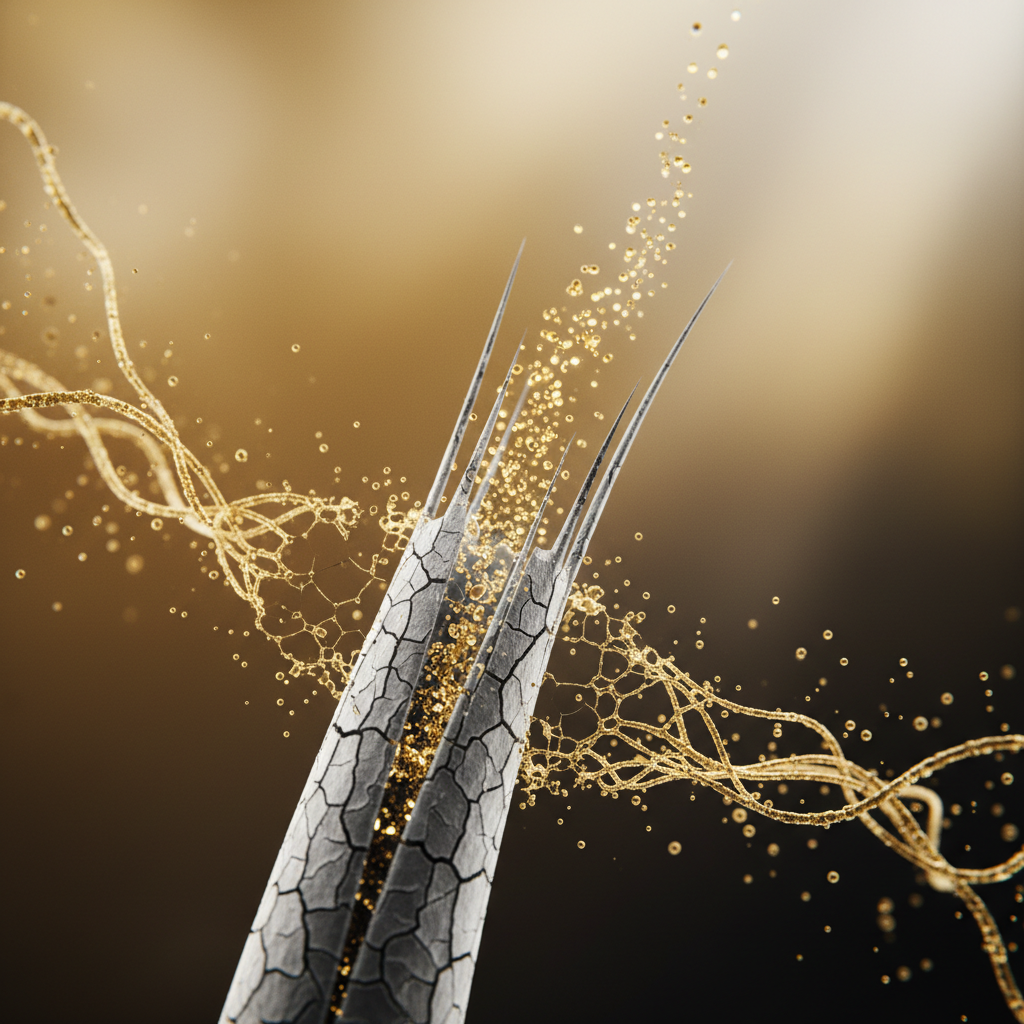
The cuticle consists of five to ten overlapping flat cells that lay flush against one another, resembling tiles on a roof. These scales remain bound together by a complex lipid-protein matrix known as the cell membrane complex (CMC). When cosmetic or mechanical stressors degrade the CMC:
- Cuticle lifting: High pH exposures (such as standard tap water or alkaline soaps above pH 7.0) cause the keratin scales to flare open.
- Cortical dehydration: The internal moisture reservoir within the cortex is exposed to external airflow, dropping cortex water retention below the normal 10 percent threshold.
- Frictional erosion: Exposed, lifted scales catch on neighbouring strands during brushing or styling, generating mechanical shear stress that breaks off the tips of cuticle cells.
- Tensile loss: Deprived of plasticising water molecules, the keratin polypeptide bonds within the cortex lose elasticity, leaving strands stiff and prone to transverse fracture under modest tension.
Signs of dry hair versus true breakage
Differentiating between surface dehydration and genuine structural fracture is critical for targeted care. Dry hair displays tactile stiffness, lack of lustre, and rough surface texture. Breakage, by contrast, is the physical snapping of the shaft itself, leaving uneven lengths and split ends.
| Attribute | Healthy Hair | Dehydrated Hair | Structurally Broken Hair |
|---|---|---|---|
| Cuticle Condition | Flat, intact 18-MEA layer | Lifted scales, partial lipid loss | Sheared scales, exposed cortex |
| Surface Feel | Smooth, pliable, soft | Rough, stiff, straw-like | Jagged ends, snagging knots |
| Elasticity | Stretches up to 30% wet, bounces back | Stretches poorly, feels brittle | Snaps rapidly under light tension |
| Porosity | Low to medium | High; absorbs water rapidly | Extreme; patchy liquid uptake |
| Primary Remedy | Preventative maintenance | Humectants, lipids, acidic pH | Trimming, bond-builders, protein |
What you can do: an evidence-based routine
Executing a successful routine requires synchronising surfactant chemistry, pH balance, and mechanical protection.
1. Shift to milder cleansing surfactants
Standard shampoos containing concentrated sodium lauryl sulphate (SLS) lift the cuticle and strip natural sebum along with the delicate CMC lipids. Switch to formulas utilising amphoteric surfactants (such as cocamidopropyl betaine) or non-ionic glucosides (such as decyl glucoside). Cleanse primarily at the scalp level, allowing the diluted runoff to cleanse the mid-lengths and ends without stripping them bare.
2. Prioritise pH-balanced conditioning
Hair naturally rests at an acidic isoelectric point between pH 3.67 and 5.5. Cleansers and tap water often register at neutral or alkaline levels (pH 7.0 to 8.5), which inevitably causes cuticle swelling. Choose conditioners formulated at an acidic pH (between 4.0 and 5.0) containing cationic conditioning agents. The acid contracts the cuticle scales, while cationic molecules bind to damaged, porous keratin sites.
3. Layer humectants beneath occlusives
Apply humectants (such as vegetable glycerin, panthenol, or hyaluronic acid) to damp hair first. These molecules capture water molecules and bind them to the outer regions of the shaft. Follow immediately with a lightweight emollient or lipid layer, such as jojoba oil or dimethicone, to trap that moisture against the shaft and block rapid evaporation.
4. Moderate heat styling
Keep heated styling tools below 150 to 180 degrees Celsius. Above 200 degrees Celsius, the structural water in the cortex vaporises violently, causing microscopic bubbles inside the hair shaft (known pathologically as "bubble hair"). Always apply a thermal protectant containing polymers like polyquaternium-55 or amodimethicone, which form heat-dissipating films across the fibre.
When the cause may be internal or environmental
Dry hair is not always caused by improper product choices. Environmental factors can rapidly leach moisture:
- Hard water minerals: High concentrations of calcium carbonate and magnesium sulphate in municipal water supplies bond to damaged keratin sites, forming a chalky mineral film that prevents conditioning agents from penetrating.
- Low ambient humidity: In dry winter climates or heavily air-conditioned indoor spaces, low relative humidity pulls moisture directly out of the cortex.
- Systemic thyroid issues: Hypothyroidism frequently alters sebum production and disrupts follicular metabolic output, producing coarse, abnormally dry strands across the entire scalp.
- Nutritional deficiencies: Diets severely lacking essential fatty acids (omega-3 and omega-6), zinc, or adequate protein can result in poor sebum quality and compromised initial hair fibre formation.
Supporting moisture retention with Watermans
When formulating a regimen for dehydrated lengths, maintaining a clean, balanced scalp environment is essential for supporting optimal hair quality from root to tip. Watermans GrowMe Shampoo is formulated without harsh, stripping sulphates, using gentle surfactants that lift excess sebum without aggressively stripping the hair fibre of essential moisture. Its blend incorporates hydrolysed lupin protein, niacinamide, and argan oil to provide surface-level conditioning and support fibre suppleness.
Following cleansing with a targeted conditioner such as Watermans ConditionMe Conditioner provides the cationic conditioning agents and natural oils required to coat lifted cuticles, reducing combing friction and restoring a soft, pliable feel to parched mid-lengths.
Frequently asked questions about Dry Hair Care
Can drinking more water cure dry hair?
While chronic dehydration compromises overall bodily health, drinking extra water will not resolve dry, damaged hair strands. The hair shaft is non-living tissue. The moisture level within the hair shaft depends almost entirely on external relative humidity, cuticle integrity, and topical lipids that prevent water from evaporating out of the cortex.
How often should someone with dry hair wash their hair?
Individuals managing dry hair typically achieve the best results by washing their hair two to three times per week. Over-washing strips away sebum, while under-washing can lead to scalp microflora imbalances and buildup. Adjust this frequency depending on personal sebum output, styling product usage, and local environmental conditions.
What is the most effective approach to Dry Hair Care?
The most effective approach to Dry Hair Care involves combining mild, low-foaming surfactants with an acidic, cationic conditioner and a protective leave-in emollient. This three-step strategy limits structural cuticle damage during cleansing, re-aligns the cuticle layer, and physically blocks water evaporation from the internal cortex.
Are natural oils sufficient on their own for dry hair?
No. Pure oils act as occlusive agents and lubricants, meaning they trap existing moisture and reduce friction. They do not introduce water into the shaft. If you apply oil to bone-dry hair, it seals moisture out rather than locking it in. Always apply oils over damp or conditioned hair.
Does cold water really close the hair cuticle?
Cold water has a negligible physical impact on keratin scales compared to product pH. Cuticle scales swell in alkaline environments and lie flat in acidic environments. While a cool rinse causes minor, temporary contraction, using a pH-balanced conditioner between pH 4.0 and 5.0 is far more effective at flattening cuticle scales.
A holistic view on maintaining hair hydration
Successful Dry Hair Care requires viewing the hair fibre as a fragile, non-living textile that requires continuous mechanical and chemical protection. By understanding the critical role of the outer lipid layer, respecting the hair's acidic isoelectric point, and preventing heat damage, you can effectively manage parched strands. While cosmetic products cannot permanently revive damaged keratin, a consistent, evidence-based routine restores suppleness, boosts shine, and prevents surface dehydration from spiralling into physical breakage.
Sources and references
- Robbins, C. R. (2012). Chemical and Physical Behavior of Human Hair. 5th ed. Springer-Verlag.
- Gavazzoni Dias, M. F. (2015). Hair cosmetics: An overview. International Journal of Trichology, 7(1), 2-15.
- D'Souza, P., & Rathi, S. K. (2015). Shampoo and conditioners: What a dermatologist should know? Indian Journal of Dermatology, 60(3), 248-254.
- Sinclair, R. D. (2007). Healthy hair: What is it? Journal of Investigative Dermatology Symposium Proceedings, 12(2), 2-5.
- Evans, T., & Wickett, R. R. (2012). Practical Modern Hair Science. Allured Business Media.
Find these ingredients in Watermans products
- Zinc: you will find this ingredient in our Hair Vitamins.