Distinguishing Hair Shedding from Breakage: The Complete Diagnostic Guide
9 min read ·
Learn the exact visual and structural differences for Distinguishing Hair Shedding from Breakage to choose the right care routine for your scalp and strands.
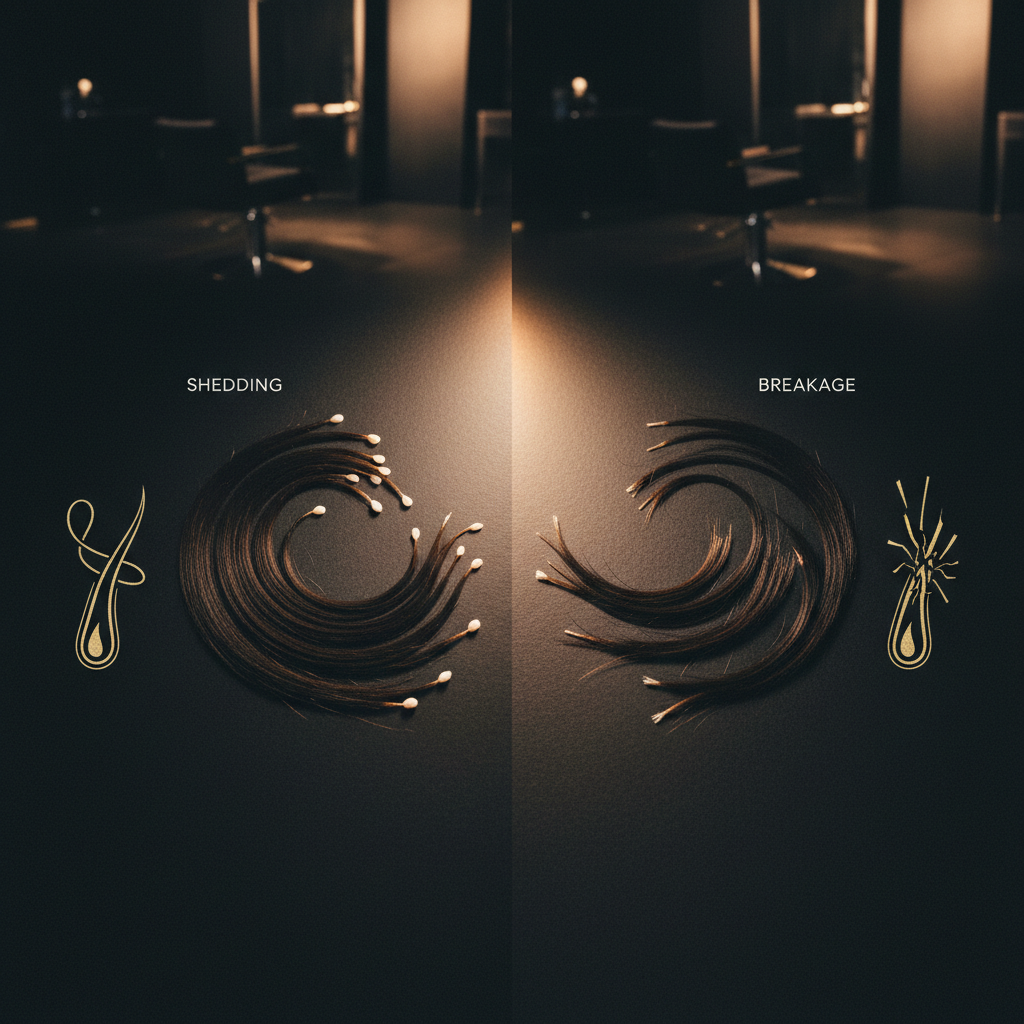
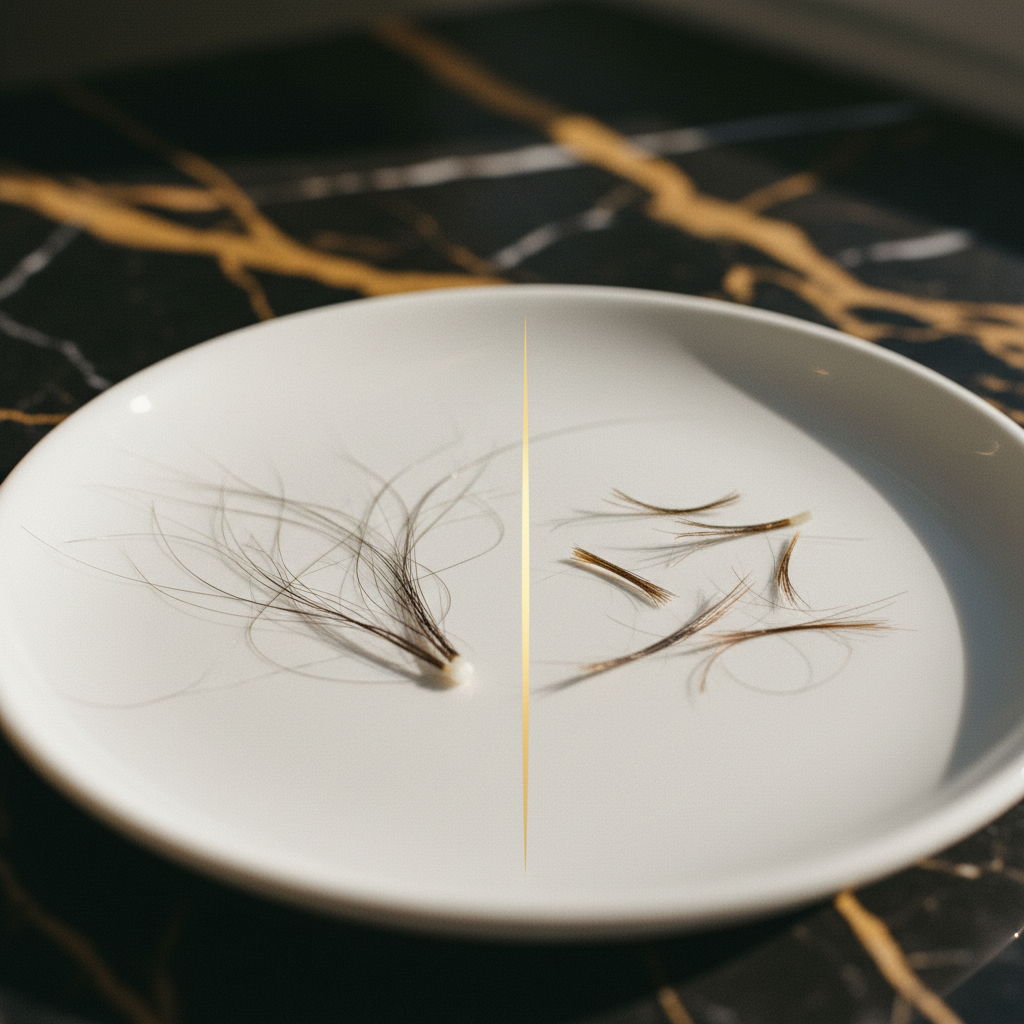
Quick answer: Distinguishing Hair Shedding from Breakage comes down to examining the root of the fallen strand. Shedding occurs when a full-length hair leaves the follicle at the end of its natural growth cycle, marked by a tiny, white keratinised bulb at one end. Breakage happens when structural weakness snaps the fibre along the shaft, leaving blunt, frayed ends without a root bulb. The main limitation is that both can happen simultaneously, requiring distinct approaches to resolve.
Key takeaways
- A small white or translucent bulb at the end of the strand confirms the hair shed naturally from the follicle.
- Broken strands are typically shorter, lack a root bulb, and feature uneven, split, or frayed ends.
- Natural shedding ranges between 50 to 100 hairs per day as follicles enter the telogen phase.
- Breakage stems from mechanical tension, chemical services, heat styling, or moisture loss, never follicular cycling.
- Shedding requires scalp and systemic support, while breakage demands cuticle protection and fibre repair.
Distinguishing Hair Shedding from Breakage: what the evidence shows
Dermatological research shows that hair loss complaints generally split into two distinct categories: follicular shedding and fibre fracture. Distinguishing Hair Shedding from Breakage is essential because treating one with remedies intended for the other produces no improvement.
The human scalp hosts roughly 100,000 hair follicles. At any given moment, approximately 85 to 90 percent sit in the anagen (active growth) phase, 1 to 2 percent in catagen (transition), and roughly 9 to 10 percent in telogen (resting). Once telogen concludes, an exogen phase releases the fibre so a new hair can emerge. Losing 50 to 100 hairs daily is a normal physiological process.
Breakage, by contrast, involves no cellular or follicular timing. It represents physical failure of the hair shaft. Hair consists of an inner cortex packed with parallel keratin filaments bound by disulphide bonds, wrapped in an outer protective cuticle of overlapping scales. When the cuticle suffers physical or chemical erosion, the cortex is exposed. Without its protective sheath, the cortex loses tensile strength, bends under stress, and snaps.
| Feature | Hair Shedding | Hair Breakage |
|---|---|---|
| Root Bulb Present | Yes (small, white, club-shaped) | No (both ends are bare) |
| Length of Strand | Full length (matches your overall hair length) | Variable, often short pieces and fragments |
| End Appearance | Tapered tip at one end, bulb at the other | Blunt, snapped, split, or frayed at ends |
| Primary Cause | Follicular cycle, stress, hormones, illness | Heat, chemicals, friction, lack of moisture |
| Scalp Involvement | Directly involves the follicle | Scalp is uninvolved; purely fibre-level |
| Primary Solution | Scalp nutrition, systemic health, time | Conditioning, gentle handling, protein balance |
What the evidence does not show
Controlled dermatological evidence does not support the common belief that regular shampooing increases shedding. Cleansing merely dislodges hairs that detached from the follicle days earlier during the exogen phase.
Similarly, evidence does not show that topical oils or conditioning masks can stop biological shedding. While conditioning agents smooth the cuticle and dramatically reduce mechanical breakage, they do not alter the internal follicular clock. Conversely, evidence shows that nutritional supplements cannot mend broken fibre shafts; once keratinised fibre fractures outside the scalp, only external conditioning and structural trims can manage the damage.
The biological mechanisms behind each condition
Understanding what happens beneath the scalp and within the fibre clarifies why these two issues behave differently.
The shedding mechanism (Telogen and Exogen)
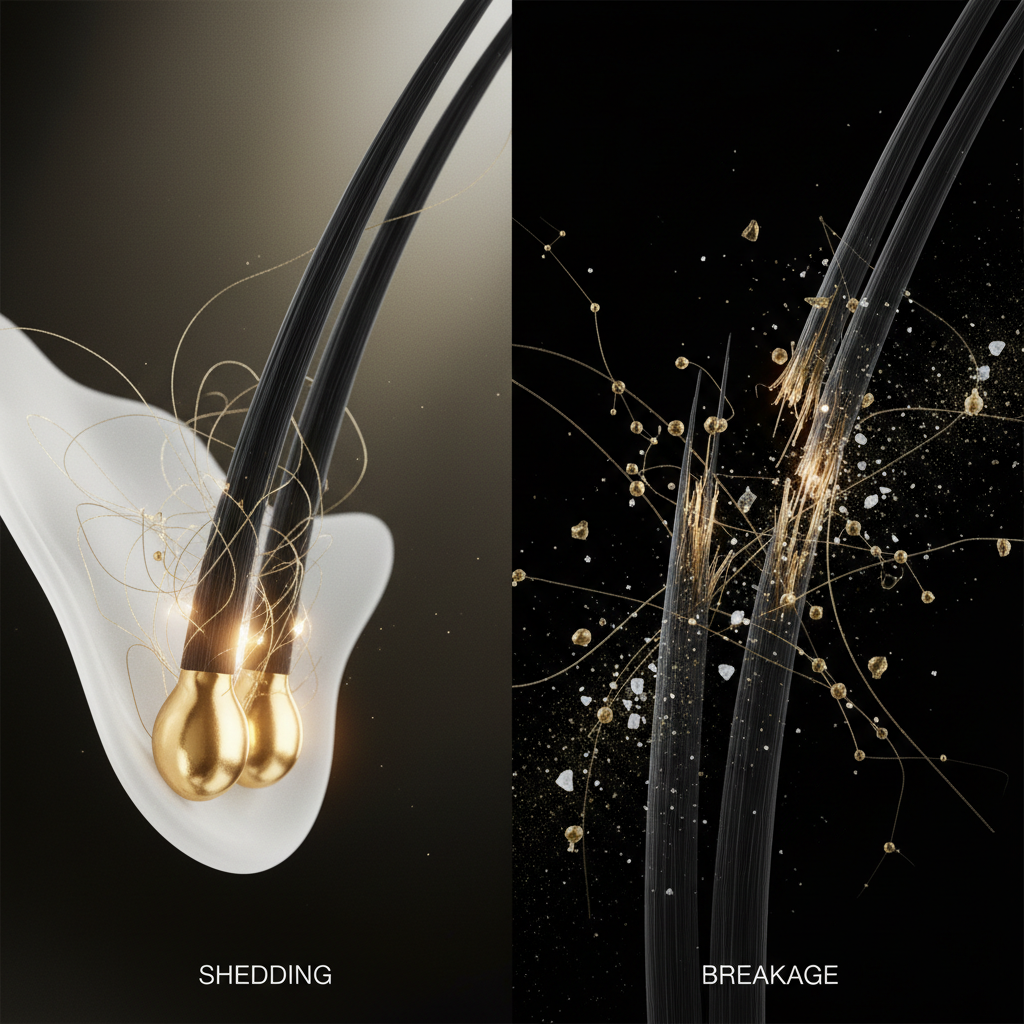
When a follicle enters telogen, hair production halts. The lower portion of the follicle regresses, and the base of the hair fibre condenses into a hard, rounded structure known as a club hair. During exogen, enzymatic action releases the club hair from the base of the follicle. Under normal conditions, a new anagen hair is already forming beneath it. If a physiological shock occurs (such as high fever, severe psychological stress, childbirth, or rapid weight loss), up to 30 percent of anagen hairs can prematurely shift into telogen. Two to three months later, massive shedding occurs, known clinically as telogen effluvium.
The breakage mechanism (Cuticle degradation and cortex collapse)
Breakage is an engineering failure of the hair shaft. A healthy cuticle has 6 to 8 layers of overlapping scales sealed with 18-methyleicosanoic acid (18-MEA), a natural lipid layer that repels water and reduces friction. High-heat tools (above 185°C), chemical bleaching, and alkaline relaxers strip this lipid layer and lift the cuticle scales. When you brush or style hair in this compromised state, friction spikes. Micro-fractures develop along the cortex, leading to trichorrhexis nodosa (node-like swellings where the fibre splits) or transverse fractures where the strand snaps completely.
Practical tests: how to identify what you are seeing
You can run two straightforward physical checks at home or in the salon to determine whether you are dealing with shedding or breakage.
The white bulb inspection
Collect five to ten fallen strands from your brush, pillowcase, or shower drain. Lay them across a dark, flat surface under strong lighting:
- Look closely at the ends of each strand.
- If you see a small, firm, whitish nodule at one tip, that strand shed from the follicle.
- If both ends terminate flatly, split into branches, or show a white, crushed point rather than an intact bulb, the strand broke.
The stretch and snap test
Take a single damp strand that has detached:
- Hold it between your thumb and forefinger at both ends.
- Gently pull.
- Healthy hair stretches up to 30 percent of its original length before returning without damage.
- Hair prone to breakage snaps immediately with minimal tension, indicating severe protein depletion or extreme moisture loss. Hair that stretches out and stays limp without bouncing back lacks internal protein structure.
What you can do to address each issue
Because the mechanisms differ, your routine must match the actual diagnosis.
If you are experiencing excessive shedding:
- Examine your timeline: Trace back 8 to 12 weeks. Shedding spikes usually follow a distinct trigger like illness, medication adjustments, or severe life stress.
- Support the scalp environment: Use gentle, circulation-supporting scalp formulations designed to clear sebum and debris without stripping natural oils.
- Review blood work: Ask a general practitioner to evaluate ferritin (iron storage), vitamin D, zinc, and thyroid panels (TSH and free T4), as deficiencies here frequently prolong telogen shedding.
If you are dealing with fibre breakage:
- Introduce hydrolysed proteins: Formulations containing hydrolysed wheat or vegetable proteins penetrate microscopic fissures in the cortex, temporarily reinforcing tensile strength.
- Neutralise mechanical friction: Switch to a wide-tooth comb for detangling, starting strictly from the ends upward. Use a smooth satin or silk pillowcase to prevent overnight abrasion.
- Lower your thermal ceiling: Keep heat-styling tools below 180°C and apply a silicone- or polymer-based thermal protectant beforehand to reduce heat transfer to the cortex.
- Schedule micro-trims: Trimming 5 to 10 mm every 8 to 12 weeks prevents split ends from travelling up the shaft and causing higher fractures.
When to seek professional clinical advice
Occasional shifts in hair shed and minor breakage are normal. However, you should consult a dermatologist or qualified trichologist if you observe:
- Sudden diffuse thinning that exposes visible patches of scalp.
- Hair shedding that exceeds 100 to 150 hairs daily for more than three months.
- Localised circular bald patches (which may indicate alopecia areata).
- Scalp symptoms such as intense burning, persistent itching, scaling, or redness.
- Strands breaking off within 2 to 3 cm of the scalp across large sections of your head.
Watermans approaches to healthy hair and scalp
Watermans focuses on the reality that great hair requires dual care: nurturing the scalp to maintain an optimal environment for growing hair, and conditioning the fibre to limit mechanical loss. The Watermans Grow Me range delivers scalp-stimulating botanical extracts, biotin, rosemary, and caffeine directly where hair emerges, supporting the appearance of density and vitality. Paired with restorative conditioning that smooths lifted cuticles, this balanced approach helps keep existing strands resilient against daily wear while supporting clean, invigorated scalp conditions.
Frequently asked questions about Distinguishing Hair Shedding from Breakage
Can a hair strand suffer from both shedding and breakage?
Yes. A single hair strand can shed naturally from the follicle with its bulb intact, while simultaneously exhibiting split ends or mid-shaft fractures. Furthermore, someone experiencing high shedding from telogen effluvium might also have brittle, chemically treated hair that breaks easily during brushing, meaning both issues occur at once.
Does a white bulb mean the hair will never grow back?
No. The white bulb is simply keratinised tissue that forms naturally around the base of a telogen hair before it releases. Its presence is completely normal and indicates the follicle has completed a natural cycle. Under healthy conditions, the dermal papilla remains active beneath the surface, preparing to produce a fresh anagen strand.
What is the most reliable method for Distinguishing Hair Shedding from Breakage?
The most reliable method is assessing the length and ends of the fallen fibre. Hair shedding produces full-length strands displaying a bulb at one end, whereas breakage results in uneven, shorter fragments with blunt or frayed tips and no bulb.
Why does my hair seem to break only when wet?
Wet hair is substantially more vulnerable to mechanical failure. Water breaks the temporary hydrogen bonds that give hair its rigidity, increasing elasticity while reducing tensile strength. If wet hair is pulled aggressively with a brush, it stretches past its elastic limit of roughly 30 percent and snaps cleanly along the shaft.
How many shed hairs per day is considered normal?
Dermatological consensus establishes that shedding 50 to 100 hairs daily is normal for adults. People with very long or thick hair may perceive this volume as substantial, but as long as shedding remains balanced by new anagen growth, scalp density stays consistent.
Making the distinction for healthier hair
Distinguishing Hair Shedding from Breakage is the critical first step toward choosing the right care routine. Take a moment to look closely at what is coming out in your brush: look for the tiny club bulb to identify a shed strand, or inspect blunt, uneven ends to catch fibre breakage. By diagnosing the root cause accurately, you can apply targeted scalp support for shedding or restorative conditioning for breakage, keeping your hair looking full, strong, and resilient.
Sources and references
- British Association of Dermatologists. Telogen Effluvium: An Information Leaflet. 2021.
- Robbins, C. R. Chemical and Physical Behavior of Human Hair. 5th ed. Springer-Verlag, 2012.
- Sinclair, R. D. Healthy hair: what is it? Journal of Investigative Dermatology Symposium Proceedings, 2007.
- Trüeb, R. M. Shampoos: Ingredients, efficacy and adverse effects. JDDG: Journal der Deutschen Dermatologischen Gesellschaft, 2007.
- Dawber, R. Hair and Scalp Disorders: Common Presenting Signs, Differential Diagnosis. Martin Dunitz, 1995.
Find these ingredients in Watermans products
- Biotin: you will find this ingredient in our Hair Growth Shampoo.