Dandruff Causes and Management: An Evidence-Based Guide
6 min read ·
Learn the science behind dandruff causes and management, from Malassezia overgrowth to targeted active treatments for lasting scalp comfort.
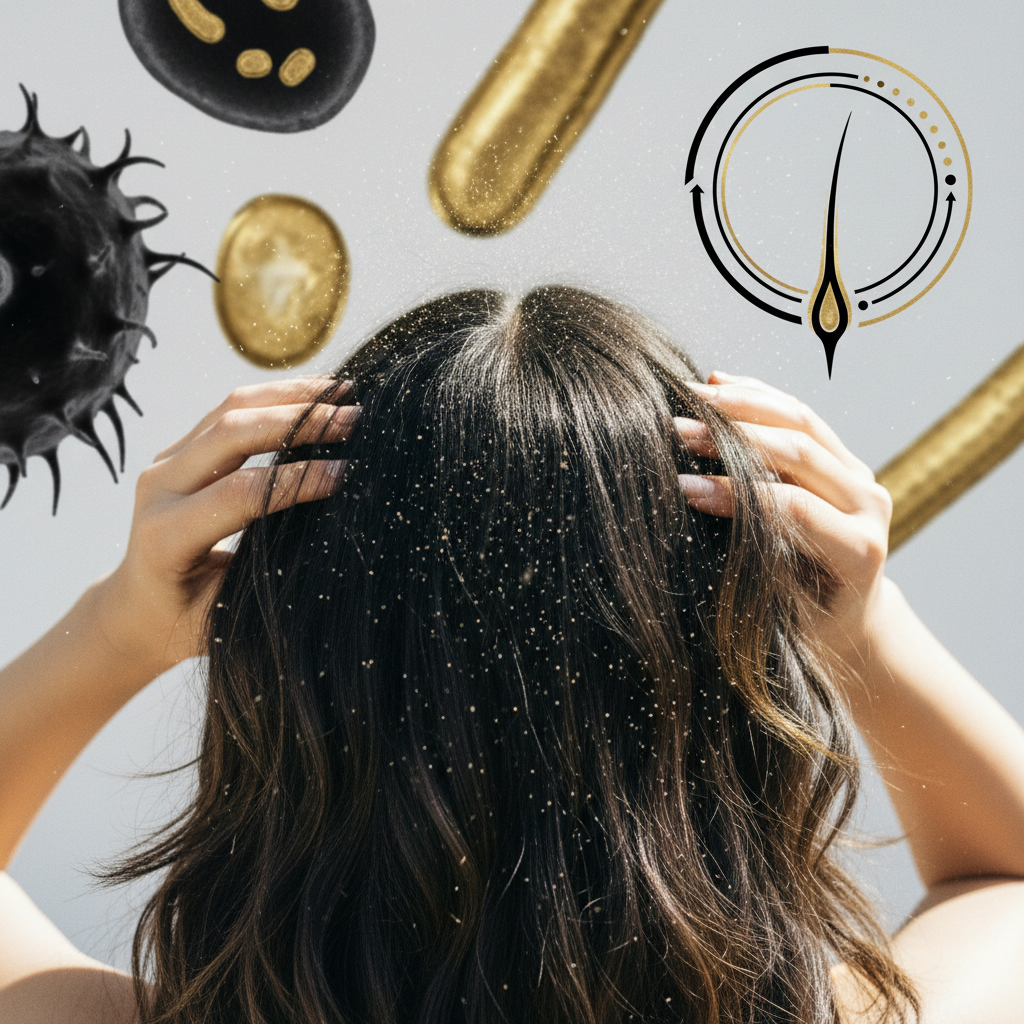
Quick answer: Understanding dandruff causes and management requires looking closely at scalp biology rather than simple hygiene. Dandruff is a mild, non-inflammatory form of seborrhoeic dermatitis driven by an overgrowth of Malassezia yeast, natural sebum production, and an individual epidermal barrier sensitivity. Effective management relies on targeted antimicrobial washes and scalp care routines that reduce fungal loads and regulate flaking. However, topical cosmetic products cannot permanently cure the underlying genetic predisposition or alter internal sebum production indefinitely.
Key takeaways
- Dandruff is primarily driven by the interaction between scalp sebum, lipid-dependent Malassezia yeasts, and individual skin barrier sensitivity.
- It is not caused by poor hygiene, though infrequent washing allows sebum and dead corneocytes to accumulate, worsening visible flaking.
- Dry scalp and dandruff are biologically distinct: dry scalp sheds small, powdery white flakes due to moisture loss, whereas dandruff produces larger, oily, clumping flakes.
- Management centres on targeted active ingredients, including zinc pyrithione, piroctone olamine, ketoconazole, and salicylic acid.
- Persistent scaling accompanied by intense erythema, swelling, or crusting often indicates other conditions like scalp psoriasis or contact dermatitis, which require medical evaluation.
Dandruff Causes and Management: what the evidence shows
Clinical research into dandruff causes and management shows that dandruff affects up to 50 percent of the adult population worldwide. It is classified as an uninflamed form of seborrhoeic dermatitis confined strictly to the scalp. Dermatologists confirm that three primary factors must converge for dandruff to develop: active sebaceous glands, the presence of commensal Malassezia globosa or Malassezia restricta yeasts, and individual susceptibility to oleic acid irritation.
Scalp sebum contains triglycerides, wax esters, squalene, and free fatty acids. Malassezia species lack the enzymes required to synthesise their own fatty acids, so they produce lipases that hydrolyse human sebum triglycerides. This process releases free fatty acids, specifically oleic acid.
In susceptible individuals, oleic acid penetrates the stratum corneum, disrupting its lipid organisation. This triggers rapid, irregular epidermal proliferation. Rather than shedding invisibly as single cells, keratinocytes clump together in aggregates of hundreds or thousands, manifesting as visible flakes.
Sebaceous Secretion (Sebum)
 │
 ▼
Hydrolysed by Malassezia Lipases
 │
 ▼
Release of Free Fatty Acids (Oleic Acid)
 │
 ▼
Penetration of Compromised Stratum Corneum
 │
 ▼
Hyperproliferation & Clumping of Keratinocytes (Visible Flakes)
What the evidence does not show
Controlled research has not found that dandruff stems from contagious pathogens, poor diet alone, or infrequent shampooing. You cannot catch dandruff from sharing a brush or pillowcase.
Furthermore, evidence does not support the common myth that natural oils, such as pure coconut or olive oil, eradicate dandruff. Applying heavy plant oils often provides an additional lipid food source for Malassezia, potentially exacerbating the overgrowth and worsening flaking.
Signs to look for: distinguishing dandruff from other conditions
Correct management depends on making an accurate distinction between dandruff, dry scalp, and more severe inflammatory scalp disorders.
Dandruff flakes tend to appear off-white or yellowish, feel greasy or waxy between the fingers, and often cluster near the hair root. Pruritus (itching) is common, but visible inflammation or redness on the underlying scalp skin is minimal.
| Feature | Dandruff (Pityriasis Capitis) | Dry Scalp | Scalp Psoriasis |
|---|---|---|---|
| Flake appearance | Off-white or yellow, greasy, clumping | Small, white, dry, powdery | Thick, silvery-white, adherent plaques |
| Scalp sensation | Moderate to intense itching | Tightness, mild itching | Soreness, burning, intense itching |
| Underlying erythema | None or very mild pinkness | None | Well-demarcated, raised red plaques |
| Underlying trigger | Malassezia reaction and sebum | Moisture loss, low humidity, harsh detergents | Autoimmune-mediated keratinocyte turnover |
| Response to wash | Improves with antimicrobial actives | Improves with gentle hydration and milder surfactants | Requires clinical topical steroids or keratolytics |
Evidence-based management strategies
Managing dandruff involves a dual strategy: suppressing the metabolic activity of Malassezia and gently removing accumulated scales without stripping the scalp's delicate barrier.

Active ingredients supported by clinical data
- Piroctone Olamine: A broad-spectrum antifungal and antioxidant agent that reduces Malassezia populations while demonstrating high tolerability and minimal drying effect on hair fibres.
- Zinc Pyrithione: A coordination complex of zinc that disrupts fungal cell membrane transport and inhibits fungal mitochondrial function.
- Ketoconazole: An imidazole antifungal widely studied in clinical trials. It inhibits fungal ergosterol synthesis and provides sustained relief from scaling and itching.
- Salicylic Acid: A beta-hydroxy acid that acts as a keratolytic. It breaks down desmosomal bonds between dead corneocytes, loosening thick scales so they rinse away cleanly.
Application technique and frequency
Shampooing frequency plays a practical role in flake control. Dermatological guidelines recommend using targeted shampoos two to three times per week during active flaking phases.
The lather must contact the scalp skin directly for at least three to five minutes before rinsing. This contact time allows the active antimicrobials to penetrate the stratum corneum and sebaceous follicles. Once symptoms resolve, reducing use to once weekly or fortnightly helps prevent recurrence while avoiding cosmetic dryness along the hair shaft.
When the cause may be something else
If flaking fails to respond after four weeks of appropriate antimicrobial cleansing, the underlying condition may not be simple dandruff.
- Seborrhoeic dermatitis: Characterised by pronounced erythema, greasy yellow crusts, and spread beyond the hairline to the eyebrows, nasolabial folds, and behind the ears.
- Scalp psoriasis: Involves thick, silvery scales on sharply demarcated plaques that may extend beyond the scalp margins. Removing these scales often reveals pinpoint capillary bleeding (Auspitz's sign).
- Allergic contact dermatitis: A delayed hypersensitivity reaction to hair dyes, fragrances, or preservatives, causing widespread redness, swelling, burning, and micro-vesicles alongside flaking.
- Tinea capitis: A dermatophyte fungal infection seen more frequently in children, causing circular scaly patches, brittle broken hairs, and sometimes localised alopecia.
When to seek professional advice
Consult a GP, dermatologist, or qualified trichologist if your scalp demonstrates any of the following signs:
- Marked erythema, swelling, or pain on the scalp.
- Honey-coloured crusting, weeping, or signs of secondary bacterial infection.
- Flaking accompanied by patch-like hair loss or shedding.
- Persistent symptoms that show zero improvement after four weeks of dedicated over-the-counter management.
- Plaques spreading to the face, neck, or body.
Supporting scalp balance with Watermans
Maintaining an optimal scalp environment supports long-term flake control and overall hair resilience. Formulations such as Watermans Grow Me Shampoo incorporate botanical extracts, niacinamide, allantoin, and rosemary, which work synergistically to cleanse excess sebum gently while maintaining a balanced scalp microbiome. A balanced, non-stripping cleanser helps sustain a refreshed, comfortable scalp environment, preventing the heavy lipid buildup that encourages fungal irritation.
Concluding thoughts on dandruff causes and management
Successfully addressing dandruff causes and management requires viewing the scalp as a living ecosystem where sebum, microbiome balance, and barrier integrity intersect. While dandruff is a persistent and recurring tendency for many, understanding its biological mechanisms allows you to choose targeted active cleansers, apply them correctly, and maintain a calm, healthy-looking scalp over the long term.
Sources and references
- British Association of Dermatologists. Seborrhoeic Dermatitis Patient Information Leaflet. 2020.
- National Institute for Health and Care Excellence (NICE). Seborrhoeic dermatitis: Scenario: Scalp seborrhoeic dermatitis in adults. CKS, 2023.
- Journal of Investigative Dermatology. Malassezia globosa and restricta: Breakthroughs in understanding dandruff pathogenesis. 2018.
- Dawson, T. L. Malassezia globosa and restricta: Solved and unsolved mysteries of the scalp. Journal of Investigative Dermatology Symposium Proceedings, 2007.
- American Academy of Dermatology. How to treat dandruff. 2022.
Find these ingredients in Watermans products
- Zinc: you will find this ingredient in our Hair Vitamins.
- Oleic Acid: you will find this ingredient in our Camellia & Black Castor Hair & Body Oil.
- Niacinamide: you will find this ingredient in our Hair Mask.