Cuticle Porosity and Moisture Retention: The Complete Scientific Guide
9 min read ·
Understand how cuticle porosity and moisture retention dictate hair health, breakage risk, and hydration. Learn the science of low, medium, and high porosity hair.
Quick answer: Understanding Cuticle Porosity and Moisture Retention is essential for maintaining hair strength and elasticity. Hair porosity refers to how easily water, oils, and chemical treatments pass through the protective outer cuticle layer into the inner cortex. Moisture retention measures how well the fibre holds onto that hydration. While genetic cuticle architecture sets your baseline, environmental, thermal, and chemical damage can alter your cuticle structure permanently until new hair grows, meaning damaged fibres require tailored cosmetic regimens to minimise breakage.
Key takeaways
- Porosity describes the condition of the overlapping keratin scales that form the cuticle layer of the hair fibre.
- Low porosity hair has tightly packed cuticle tiles that resist water absorption, whereas high porosity hair has lifted or missing cuticle scales that absorb and lose water rapidly.
- Moisture retention is heavily influenced by the presence of 18-methyleicosanoic acid (18-MEA), a protective lipid layer bound to the cuticle surface that repels excess water.
- High porosity fibres suffer from hygral fatigue, a cycle of swelling and contracting during washing that weakens the cortex and causes physical breakage.
- Topical cosmetic treatments cannot biologically "repair" or regenerate missing cuticles, but they can patch gaps, smooth edges, and reduce moisture loss through occlusive conditioning.
Cuticle Porosity and Moisture Retention: what the evidence shows
The relationship between Cuticle Porosity and Moisture Retention governs almost every physical behaviour of human hair, from combability and shine to tensile strength. Under an electron microscope, a healthy human hair shaft exhibits an outer cuticle formed of 5 to 10 overlapping layers of flat, keratinised cells. These cells point towards the tip of the fibre, resembling shingles on a roof.
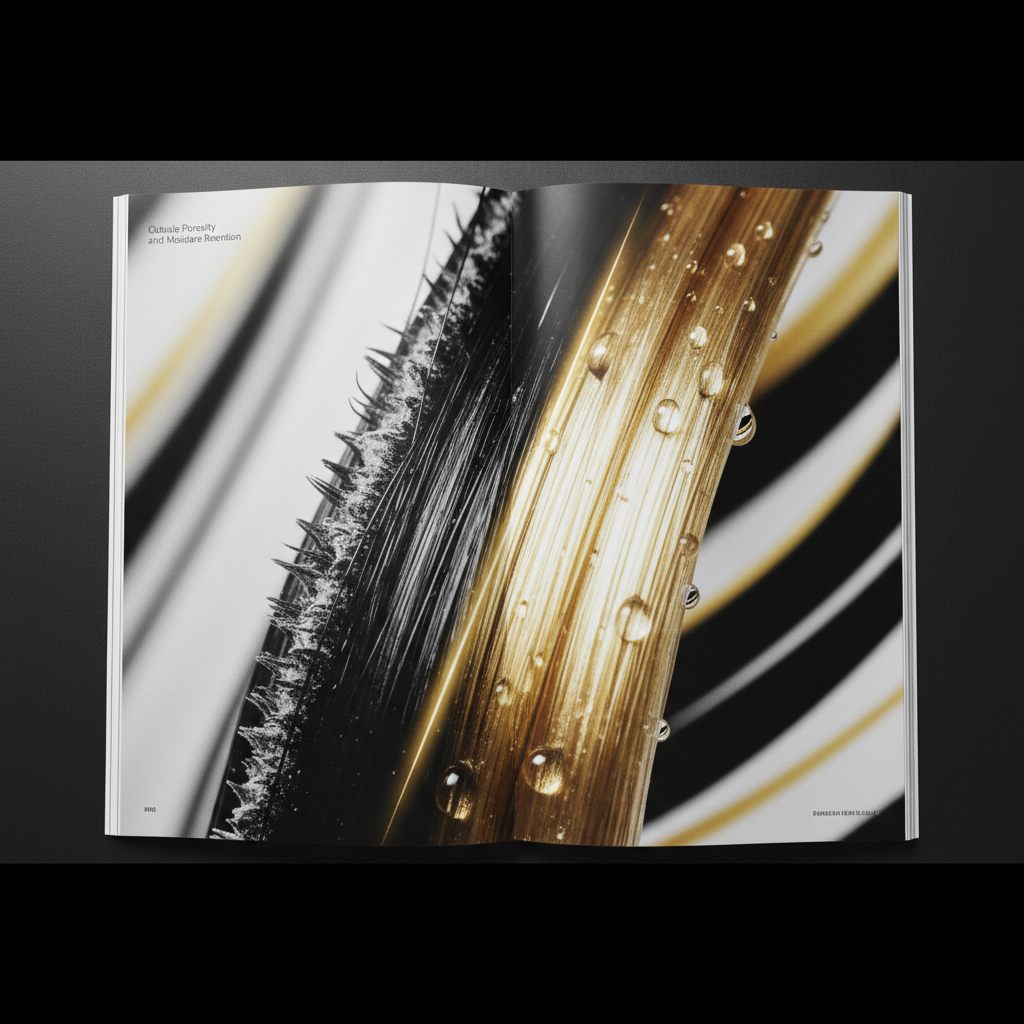
In healthy, low-to-medium porosity hair, these scales lie flat and tight. They create a semi-permeable barrier regulated by the cell membrane complex (CMC) and a surface coating of fatty acids, primarily 18-methyleicosanoic acid (18-MEA). When 18-MEA is intact, the hair surface is hydrophobic (water-repelling). This lipid shield prevents the hair from absorbing too much environmental moisture while locking in the natural plasticising water within the cortex.
When hair undergoes chemical bleaching, permanent dyeing, alkaline relaxers, or repeated heat styling above 185°C, this lipid layer is stripped away. The cuticle scales lift, crack, or completely break off, exposing the proteinaceous cortex underneath. Research published in the Journal of Cosmetic Science shows that damaged, high porosity hair shifts from being hydrophobic to hydrophilic (water-attracting). It rapidly soaks up water, yet it possesses almost zero capacity for moisture retention because the barrier that prevents evaporation is gone.
 Low Porosity Hair High Porosity Hair
 (Tight, Overlapping Scales) (Lifted, Broken Scales)

 ┌───┐ ┌───┐ ┌───┐ ┌───┐ /───/ ┌───┐
 / / / / / / / / / / / /
 / / / / / / / / / / / /
 └───┘ └───┘ └───┘ └───┘ └───┘
 [Resists water penetration] [Loses water rapidly]
 [Retains internal moisture] [Prone to hygral fatigue]
The biological mechanisms behind porosity
The physics of hair moisture relies on three interconnected structures:
- The Epicuticle and 18-MEA Layer: This sub-microscopic lipid layer is covalently bonded to the outer protein membrane. It dictates surface energy. High surface energy (damaged, porous hair) pulls water molecules in quickly. Low surface energy (intact, non-porous hair) causes water to bead on the surface.
- The Cuticle Scales (Exocuticle and Endocuticle): The exocuticle is rich in cystine (a sulphur-containing amino acid) and provides rigid structural resilience. The underlying endocuticle contains less cystine and swells significantly when wet. In healthy hair, the rigid exocuticle limits this swelling. When damaged, the endocuticle swells unchecked.
- The Cell Membrane Complex (CMC): Acting as the intercellular "cement" between cuticle cells and cortical cells, the CMC consists of lipids and proteins. When harsh detergents, alkaline solutions (pH above 8.0), or bleach dissolve these lipids, pathways open up through the fibre, dramatically increasing internal porosity.
What the evidence does not show
There are several persistent myths regarding hair porosity:
- The "floating hair" glass of water test is scientifically unreliable. Placing shed strands in a glass of water to gauge porosity is compromised by surface tension, natural scalp sebum, and residue from leave-in conditioners. A clean, high-porosity strand coated in silicone can float indefinitely, while a low-porosity strand pushed past the water tension will sink.
- Porosity cannot be permanently "fixed". Hair fibres are non-living biological structures. Once the cuticle cells snap off or the 18-MEA layer is oxidised by bleaching, hair cannot regenerate them. Treatments can temporarily seal, coat, or fill defects, but the underlying porosity remains high until that section is cut away.
- High porosity hair does not cause alopecia. It is crucial to separate hair breakage from follicular hair loss. High porosity leads to brittle fibres that snap along the shaft during brushing or styling. It does not cause follicular shedding (telogen effluvium) or pattern hair loss (androgenetic alopecia), which take place below the scalp surface.
Signs of differing porosity levels
Identifying where your hair falls on the porosity spectrum helps you adapt your styling and wash routines.
| Characteristic | Low Porosity | Medium (Balanced) Porosity | High Porosity |
|---|---|---|---|
| Water Absorption | Very slow; water beads on surface | Moderate; wets evenly in 1 to 2 minutes | Instantaneous; absorbs water immediately |
| Drying Time | Extended; can take many hours to air-dry | Average; dries predictably | Deceptively fast, yet feels dry and rough |
| Product Behaviour | Products sit on surface; prone to buildup | Absorbs products easily without heavy residue | Drinks up oils and creams quickly, but remains brittle |
| Cuticle Condition | Tightly closed, intact 18-MEA lipid layer | Uniformly aligned, minimal chipping | Chipped, lifted, or missing cuticle scales |
| Elasticity | Resistant to stretching; snaps if pulled dry | Stretches roughly 30% when wet and bounces back | Stretches excessively without returning, or snaps instantly |
| Primary Risk | Product buildup and stiffness | Minimal; normal wear and tear | Severe hygral fatigue and shaft breakage |
Managing low porosity hair
Low porosity fibres have tightly bound cuticles that resist moisture ingress. When water or products do enter, however, they retain it well.
To care for low porosity hair:
- Use gentle warmth: Moderate heat (such as a warm towel or indirect bonnet dryer) during deep conditioning temporarily expands the cuticle gaps, allowing humectants and conditioning agents to pass into the outer layers of the cortex.
- Avoid heavy, coating butters: Heavy, unrefined plant butters can accumulate on tightly closed cuticles, resulting in a dull, greasy film that repels water entirely. Opt for lightweight humectants like glycerin, panthenol, and light plant oils (such as jojoba or argan).
- Clarify periodically: Because products sit on the surface, low porosity hair is vulnerable to mineral and surfactant buildup, which further blocks moisture absorption. Use a clarifying wash every 3 to 4 weeks.
Managing high porosity hair
High porosity hair requires reinforcement to slow down the relentless cycle of water absorption and rapid evaporation. When water floods high-porosity hair, the cortex swells; when it dries, it shrinks rapidly. This structural fluctuation, known as hygral fatigue, breaks the internal keratin bonds over time.
To care for high porosity hair:
- Incorporate hydrolysed proteins: Because structural cuticles are missing, proteins with small molecular weights (such as hydrolysed wheat, silk, or keratin proteins) can temporarily adsorb to the damaged keratin matrix, reinforcing the fibre's tensile strength.
- Use acidic formulations: Products balanced to an acidic pH (between 3.5 and 5.0) help smooth down whatever intact cuticle edges remain, reducing friction between adjacent hair fibres.
- Seal with occlusives: Layering a water-based leave-in conditioner followed by a lipid-rich oil or butter helps recreate an artificial barrier, replacing the lost 18-MEA layer and drastically improving moisture retention.
When to seek professional advice
If your hair snaps under minimal tension despite using appropriate conditioners, consult a qualified trichologist or an experienced hair stylist. A professional can examine your fibres under a digital trichoscope or polarising microscope to evaluate whether the breakage stems from cuticle degradation, structural cortex defects (like trichorrhexis nodosa), or an internal nutritional or endocrine issue impacting keratin production at the follicle.
Cuticle health and cosmetic support
Cosmetic formulations play a functional role in supporting the hair shaft. Because damaged cuticles expose the inner cortex to environmental wear, using balanced shampoos and conditioners is vital. Formulations designed to maintain an optimal scalp environment and reduce mechanical friction can safeguard the hair shaft against unnecessary breakage. Watermans haircare products, including the GrowMe Shampoo and ConditionMe Conditioner, are formulated with hydrolysed lupin protein, niacinamide, and natural plant extracts. These ingredients deposit structural support onto the hair fibre, helping to smooth lifted cuticles, improve surface lubricity, and protect strands against the daily mechanical friction that accelerates porosity damage.
Frequently asked questions about Cuticle Porosity and Moisture Retention
Can you change your natural hair porosity permanently?
No, you cannot permanently alter your natural baseline porosity. Genetic factors determine whether your cuticle scales grow naturally compact or looser. While chemical processing, heat styling, and environmental UV exposure can permanently raise your porosity by stripping cuticles away, you cannot chemically seal them shut permanently once lost. You can only manage high porosity with temporary topical conditioners until undamaged hair emerges from the follicle.
How does Cuticle Porosity and Moisture Retention affect coloured hair?
Cuticle Porosity and Moisture Retention directly dictates colour longevity. High porosity hair allows artificial colour molecules to penetrate deeply, but because the cuticle scales are compromised, those same pigments wash out rapidly during shampooing, leading to fast fading. Low porosity hair resists initial colour penetration, often requiring alkaline lifting agents to swell the cuticle, but retains the colour much longer once deposited.
Does hard water impact hair porosity?
Hard water does not necessarily raise porosity by stripping cuticles directly, but calcium and magnesium ions bind electrostatically to the hair's keratin. These mineral deposits lift cuticle edges, making the hair feel stiff, dry, and artificially porous. Using a chelating shampoo removes these mineral coats and allows conditioners to restore moisture balance.
What is hygral fatigue in high porosity hair?
Hygral fatigue occurs when the hair cortex repeatedly expands as it absorbs water and contracts as it dries. In high porosity hair lacking an intact 18-MEA lipid layer, water rushes in unchecked, putting stress on the cellular membrane complex. Over time, this constant mechanical strain leads to cuticle peeling, micro-fractures along the shaft, and progressive hair breakage.
Is protein or moisture more important for porous hair?
Both are equally essential, but they serve different mechanical roles. Moisture (water plasticised by humectants) provides hair with flexibility and elasticity, preventing it from feeling brittle. Protein (hydrolysed amino acid complexes) fills structural voids along the damaged cuticle and cortex to give the strand tensile strength. High porosity hair requires a careful balance of both to avoid either snapping from rigidity or breaking from over-stretching.
Managing your hair's moisture balance
Mastering Cuticle Porosity and Moisture Retention comes down to respecting the physical limits of your hair fibre. Healthy hair depends on an intact cuticle structure to regulate water movement. While you cannot biologically rebuild lost cuticle scales, adopting an evidence-based haircare routine, balancing humectants with occlusives, minimising thermal stress, and using hydrolysed proteins allows even heavily compromised, high-porosity hair to remain resilient, supple, and shielded from daily breakage.
Sources and references
- Robbins, C. R. (2012). Chemical and Physical Behavior of Human Hair. 5th ed. Springer-Verlag New York.
- Journal of Cosmetic Science: "The effect of chemical treatments on the hydrophobic nature of human hair" (Society of Cosmetic Chemists).
- International Journal of Trichology: "Hair Cosmetics: An Overview" (2015).
- Dawber, R. (1996). "Hair: Its structure and response to cosmetic preparations." Clinics in Dermatology, 14(1), 105-112.
- Cosmetics & Toiletries: "18-MEA and the Hair Cuticle: Preserving the Hydrophobic Shield."
Find these ingredients in Watermans products
- Niacinamide: you will find this ingredient in our Hair Mask.
- Panthenol (Provitamin B5): you will find this ingredient in our Heat Protection Spray.