Cuticle Layer Architecture: The Biological Shield of Human Hair
8 min read ·
Understand Cuticle Layer Architecture: how overlapping keratin scales protect the hair shaft, why lifted cuticles cause breakage, and how to maintain hair shine.
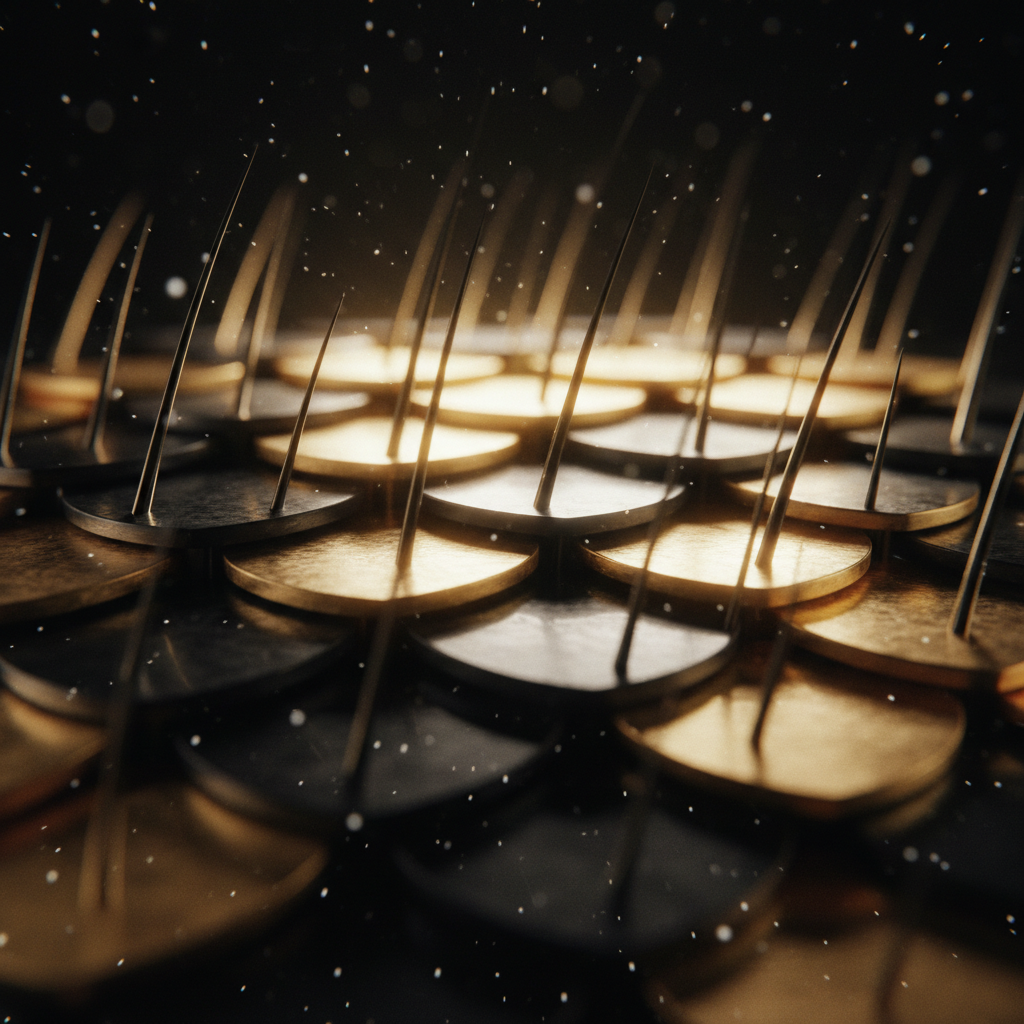
Quick answer: The Cuticle Layer Architecture refers to the organised, overlapping protective shield of dead, flattened keratinised cells that encase the cortex of human hair. Arranged like roof tiles pointing toward the tip, these 5 to 10 scale layers seal in moisture, resist mechanical abrasions, and dictate shine. However, while topical treatments can coat and temporarily smooth damaged scales, no cosmetic product can biologically rebuild lost or chipped scales once cuticle architecture degrades, making preventative protection essential.
Key takeaways
- Human hair cuticle consists of 5 to 10 overlapping cellular layers, each roughly 0.5 to 1.0 micrometres thick.
- Individual cuticle scales are divided into three distinct sub-layers: the hydrophobic epicuticle, the heavily cross-linked exocuticle, and the softer endocuticle.
- Cuticle cells are bound together by the Cell Membrane Complex (CMC), which is rich in lipids such as 18-methyleicosanoic acid (18-MEA).
- Alkaline environments (pH above 7.0) cause cuticle scales to swell and lift, whereas mildly acidic conditions (pH 4.5 to 5.5) promote a flat, aligned orientation.
- Cosmetic conditioning agents can temporarily mimic or replace missing surface lipids, but they cannot biologically regenerate detached keratin scales.
Cuticle Layer Architecture: what the evidence shows
The Cuticle Layer Architecture forms the outermost envelope of the human hair shaft. When examined under scanning electron microscopy, hair shows a shingle-like pattern of flattened cells pointing from root to tip. In healthy scalp hair, this barrier comprises 5 to 10 overlapping layers, with each scale measuring roughly 0.5 to 1.0 micrometres in thickness and up to 45 to 60 micrometres in length.
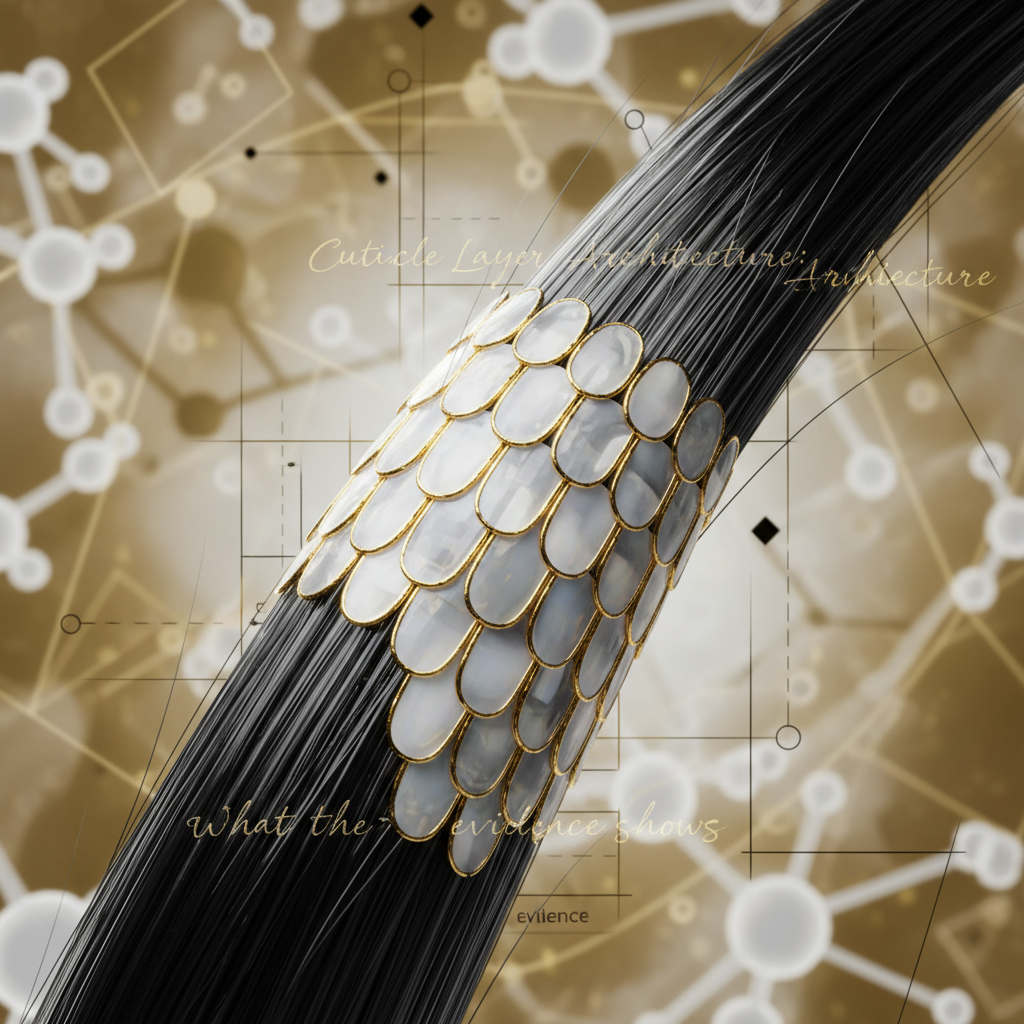
Cosmetic chemists and trichologists divide each individual cuticle scale into three principal layers, wrapped in a protective lipid membrane:
- The Epicuticle: The outermost boundary of the scale, this ultra-thin membrane (approximately 5 to 10 nanometres thick) is rich in cystine (around 12%) and covalently linked to a layer of fatty acids, predominantly 18-methyleicosanoic acid (18-MEA). This makes virgin hair naturally hydrophobic, causing water to bead on its surface.
- The Exocuticle: Sitting directly beneath the epicuticle, this zone makes up about 40% to 50% of the scale's thickness. It is exceptionally dense and rich in cystine (up to 30%), forming extensive disulphide bonds that provide structural rigidity and chemical resistance.
- The Endocuticle: The innermost zone of the scale, making up the remaining interior. The endocuticle has a very low cystine content (around 3%) and is rich in basic amino acids. Because it lacks high disulphide cross-linking, the endocuticle swells readily in water, acting as a mechanical cushion that expands and contracts.
Between these overlapping cuticle scales lies the intercellular cement, known as the Cell Membrane Complex (CMC). The CMC contains a central delta layer flanked by lipid-rich beta layers. This structure acts as a biological glue, allowing scales to flex as the hair bends without detaching.
Internal anatomy of the hair cuticle
The table below outlines the structural zones found within each individual cuticle cell and their primary biophysical characteristics.
| Sub-Layer | Cystine Content | Primary Function | Vulnerability |
|---|---|---|---|
| Epicuticle & 18-MEA | Moderate (approx. 12%) | Repels external water; reduces friction | Stripped rapidly by alkaline bleaching and chemical relaxers |
| Exocuticle | Very high (approx. 30%) | Mechanical strength; prevents penetration | Brittle under high dry heat; cracks under severe impact |
| Endocuticle | Low (approx. 3%) | Flexible buffer; cushions bending stress | Swells excessively in water; susceptible to enzymatic digestion |
| Cell Membrane Complex (CMC) | Low (lipid-rich) | Glues scales together; facilitates flexibility | Lipids dissolve under repeated surfactant exposure and high pH |
Mechanisms of cuticle damage and disruption
Hair cuticle damage follows predictable mechanical, thermal, and chemical pathways. When healthy, scales lie tight and smooth against the cortex, creating a reflective surface that manifests visually as shine.
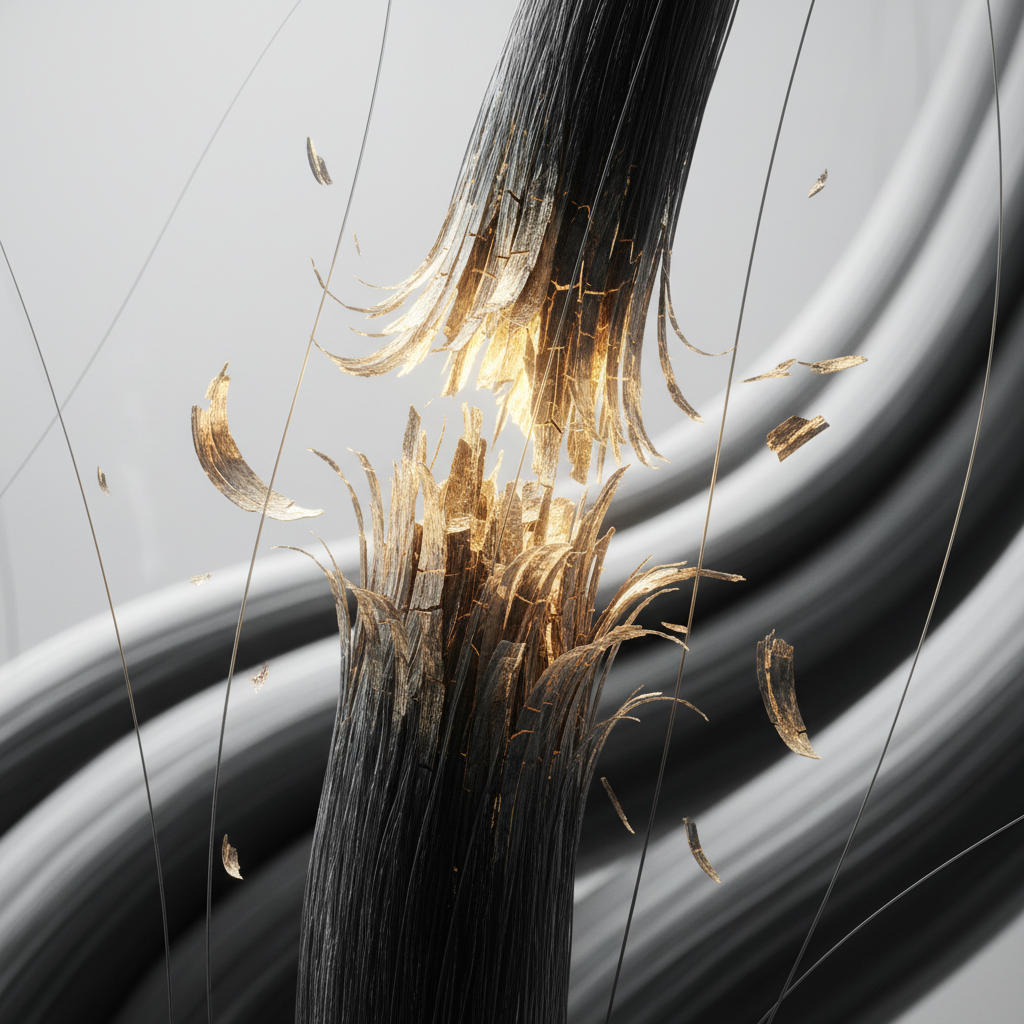
When exposed to alkaline solutions, such as bleaching powders (pH 9.0 to 11.0) or permanent hair colours, the water enters the low-sulphur endocuticle and CMC. This causes internal swelling, forcing the scale edges to flare outward. This lifting allows active chemicals to reach the cortex, but it also strips the protective 18-MEA fatty acid layer. Once 18-MEA is lost, hair becomes hydrophilic, absorbing water rapidly and drying slowly.
Thermal tools present a different challenge. Rapid heating of damp hair can vaporise trapped water within the endocuticle faster than it can escape through the epicuticle. This creates microscopic steam cavities within the scale, leading to blistering, edge chipping, and eventual scale loss.
Mechanical friction, such as rough towel drying, backcombing, or detangling unconditioned hair, exerts physical shear forces against the scale margins. Because scales overlap from root to tip, friction applied against the grain readily lifts, bends, and snaps the brittle exocuticle, eventually exposing the fibrous cortex beneath.
Signs of compromised Cuticle Layer Architecture
Because hair fibres are non-living tissue, cuticle damage cannot heal biologically. You can identify cuticle degradation through clear sensory and visual markers:
- High wet friction and tangling: Without 18-MEA and flat scale alignment, wet hair strands catch against each other instead of gliding, forming persistent fairy knots and tangles.
- Loss of natural lustre: A smooth cuticle layer acts as a specular mirror, reflecting light in a unified direction. When scales lift or break away, light scatters diffusely, making hair appear dull and matte.
- Rapid wetting and drying: Hydrophilic, cuticle-compromised hair sinks quickly in water and feels spongy when saturated, yet becomes excessively brittle once dry.
- Porosity variations: The ends of long hair show far fewer intact cuticle layers than the roots, often dropping from 8 layers near the scalp to 1 or 2 layers at the ends due to cumulative environmental weathering.
What you can do to preserve cuticle integrity
Protecting the cuticle relies on minimising physical stress, maintaining an optimal pH environment, and replenishing surface lubricity.
- Respect the isoelectric point: Hair fibres have an isoelectric point around pH 3.67, with salon-grade hair products performing best between pH 4.5 and 5.5. Formulations in this slightly acidic range prevent excessive swelling of the endocuticle, keeping scales seated firmly against the shaft.
- Use cationic conditioning agents: Quaternary ammonium compounds, cationic polymers, and silicones carry positive charges that bind electrostatically to the negative charges exposed on damaged cuticle surfaces. These agents smooth scale edges, lower dynamic friction, and mimic the missing 18-MEA layer.
- Detangle with slip: Never detangle dry, weathered hair or completely unconditioned wet hair. Apply water and a slippery conditioner first to reduce the shear stress that snaps exocuticle borders.
- Manage heat exposure: Never use flat irons on damp hair. Ensure fibres are completely dry, and apply a heat-protective barrier that distributes thermal energy evenly across the cuticle surface without causing steam blistering.
When breakage is mistaken for hair loss
A common misconception occurs when people notice short, ragged hair fragments on their pillowcases, clothes, or bathroom sink and assume their hair is falling out from the root.
True hair shedding (telogen effluvium) or follicular thinning (androgenetic alopecia) originates within the hair follicle in the scalp. Shed hairs display a tiny, white, bulb-shaped root at one end. In contrast, broken strands resulting from a failure in the Cuticle Layer Architecture snap along the mid-shaft or ends and have no bulb. When the protective cuticle completely erodes, the exposed cortical fibres split into individual protofibrils, creating trichoptilosis (split ends) and widespread fibre snapping. Treating breakage requires structural protection along the fibre, not scalp stimulants.
The Watermans perspective on hair integrity
While Watermans formulations are famous for invigorating the scalp environment to support fuller-looking hair growth, caring for the structural fibre itself is equally vital. The Watermans approach recognises that new growth achieved at the follicle must be safeguarded along its length. By using balanced, gentle cleansing systems and complementary conditioning rinses designed to maintain an optimal acidic mantle, Watermans products help keep external cuticle scales aligned. This cuts down on friction-induced snapping, preserves surface shine, and ensures every centimetre of hair retains its natural resilience.
Frequently asked questions about Cuticle Layer Architecture
How many layers make up the Cuticle Layer Architecture?
In human terminal scalp hair, the Cuticle Layer Architecture typically consists of 5 to 10 overlapping cellular layers. This number varies according to genetics, hair diameter, and ethnic background. Thick Asian hair often possesses up to 10 to 12 dense layers, whereas fine Caucasian hair may only have 4 to 6 layers, making it naturally more delicate.
Can damaged cuticle scales ever grow back or repair themselves?
No, cuticle scales cannot grow back or regenerate. Because the hair shaft outside the scalp is dead biological material without living cells or a blood supply, lost scales cannot heal. Cosmetic treatments, oils, and conditioners can temporarily smooth down lifted scales or fill microscopic gaps, but they wash away over time, leaving prevention as your best defence.
What is the purpose of 18-MEA on the hair cuticle?
The lipid 18-methyleicosanoic acid (18-MEA) is a specialised branched fatty acid that bonds covalently to the surface of the epicuticle. It serves as hair's primary water-repellent layer, preventing moisture absorption that causes fibre swelling. It also significantly lowers friction between adjacent hair strands, preventing tangles, snags, and daily grooming damage.
How does hair dyeing alter cuticle architecture?
Permanent hair dyeing relies on alkaline chemicals, typically ammonia or ethanolamine, to raise the pH above 9.0. This alkalinity forces the endocuticle to swell and lifts the cuticle scales like an open pinecone, allowing artificial dye precursors to enter the cortex. This process permanently depletes surface 18-MEA lipids and weakens the exocuticle cross-links.
Protecting your hair's outer shield
The Cuticle Layer Architecture is your hair's primary line of defence against the stresses of modern styling, sunlight, and cleansing. Its complex, multi-layered sandwich of cystine-rich proteins and water-repellent lipids ensures hair stays strong, flexible, and radiant throughout its multi-year lifespan. Because lost cuticle cells cannot regenerate, adapting your wash routine to respect hair's acidic pH, handling wet hair gently, and using protective conditioning agents will preserve your hair's natural shield for years to come.
Sources and references
- Robbins, C. R. (2012). Chemical and Physical Behavior of Human Hair. 5th ed. Springer-Verlag New York.
- Swift, J. A. (1999). Human hair cuticle: biologically conspired to the owner's disadvantage. Journal of Cosmetic Science, 50(1), 23-47.
- Breakspear, S., et al. (2022). The role of the cuticle in the mechanical properties of human hair fibres. International Journal of Cosmetic Science, 44(4), 382-393.
- D'Souza, P., & Rathi, S. K. (2015). Shampoo and conditioners: What a dermatologist should know? Indian Journal of Dermatology, 60(3), 248-254.
- Gavazzoni Dias, M. F. (2015). Hair cosmetics: An overview. International Journal of Trichology, 7(1), 2-15.