A Guide to Cortex Tensile Strength: Science, Structure, and Breakage Prevention
8 min read ·
Cortex Tensile Strength determines your hair fibre's resistance to snapping. Learn the science of cortical bonds, signs of damage, and how to reduce breakage.
Quick answer: Cortex Tensile Strength refers to the mechanical resistance of the hair fibre's central cortex against stretching and snapping under longitudinal force. Generating roughly 85 to 90 percent of a hair shaft's overall structural integrity, the cortex relies on alpha-keratin intermediate filaments bound within a high-sulphur protein matrix. The main limitation is that the cortex cannot regenerate living cells once damaged; physical stressors, chemical processing, and heat degrade disulphide bonds permanently, meaning lost tensile strength can only be cosmetically managed, not biologically repaired.
Key takeaways
- The cortex accounts for up to 90 percent of the hair's bulk and dictates the fibre's mechanical resilience, elasticity, and colour.
- Cortex Tensile Strength relies directly on cross-linked cystine disulphide bonds bridging intermediate keratin filaments.
- Virgin, undamaged hair can stretch between 20 and 30 percent of its dry length before breaking, and up to 50 percent when wet.
- Bleaching, chemical relaxers, permanent waving, and heat above 180°C cleave disulphide bonds into cysteic acid, permanently lowering tensile resistance.
- Hair snapping along the shaft represents mechanical breakage rather than follicular shedding or alopecia, demanding structural support rather than follicular treatments.
Cortex Tensile Strength: what the evidence shows
Cortex Tensile Strength determines how much physical tension a single hair fibre can tolerate before reaching its yield point and snapping. Peer-reviewed investigations in cosmetic chemistry and biophysics demonstrate that the hair shaft consists of three zones: the outer protective cuticle, the central cortex, and the central medulla. While the cuticle controls surface friction, porosity, and shine, the cortex dictates mechanical load-bearing capacity.

Within the cortex, cortical cells house macrofibrils, which are dense bundles of intermediate microfibrils embedded in an amorphous, cystine-rich matrix. The microfibrils provide high tensile stiffness through an alpha-helical protein architecture, while the matrix absorbs torsional and compressive stress. When you pull a dry hair, the alpha-helical keratin chains uncoil into a beta-pleated conformation. In healthy fibres, this transition is reversible up to roughly a 25 to 30 percent extension. Beyond that yield point, cross-links rupture, and the fibre breaks.
Wet hair behaves differently. Water molecules readily penetrate the cortex, disrupting weak hydrogen bonds and salt linkages. Consequently, the wet fibre requires significantly less force to stretch (demonstrating lower elastic modulus) yet stretches further (up to 50 percent) before complete tensile failure occurs.
What happens when the cortex degrades
When external aggressors strip away the cuticle, the cortex faces direct exposure to ambient friction, UV radiation, and environmental stress. Tensile decline follows specific chemical changes:
- Cleavage of disulphide bonds: Strong chemical processes, such as peroxide bleaching or alkaline perm solutions, oxidise cystine. This breaks the covalent disulphide bonds (-S-S-) that cross-link keratin chains, converting them into non-functional cysteic acid groups.
- Matrix erosion: Frequent lifting of the cuticles leaches soluble proteins from the interfilamentous matrix. As the matrix empties, microfibrils lose their supportive cushion, making the fibre brittle.
- Thermal denaturation: Exposing hair to dry heat above 180°C alters the helical geometry of cortical keratin. Above 230°C, the protein matrix melts, causing structural bubbling, irreversible stiffness, and complete tensile collapse.
The loss of internal strength causes mechanical breakage. Breakage happens when the tensile strain applied by a comb, brush, or styling tool exceeds the compromised tensile resistance of the hair shaft. This process must not be confused with telogen shedding or alopecia, which occur at the level of the hair follicle.
| Condition / State of Fibre | Typical Dry Elastic Extension | Primary Bond Responsible | Susceptibility to Breakage |
|---|---|---|---|
| Virgin, Undamaged Hair | 25 to 30 percent | Intact cystine disulphide bonds | Low; requires high load to snap |
| Bleached / Chemically Treated | 10 to 18 percent | Depleted disulphide bonds, elevated cysteic acid | Very high; low yield point |
| Thermally Damaged (>200°C) | 5 to 12 percent | Denatured alpha-keratin helices | High; brittle fractures along shaft |
| Fully Saturated (Wet Virgin) | 40 to 50 percent | Disrupted hydrogen bonds; intact disulphide | Moderate; vulnerable to over-stretching |
How to assess internal hair damage
Stylists and dermatologists evaluate hair integrity through distinct tactile and visual markers:
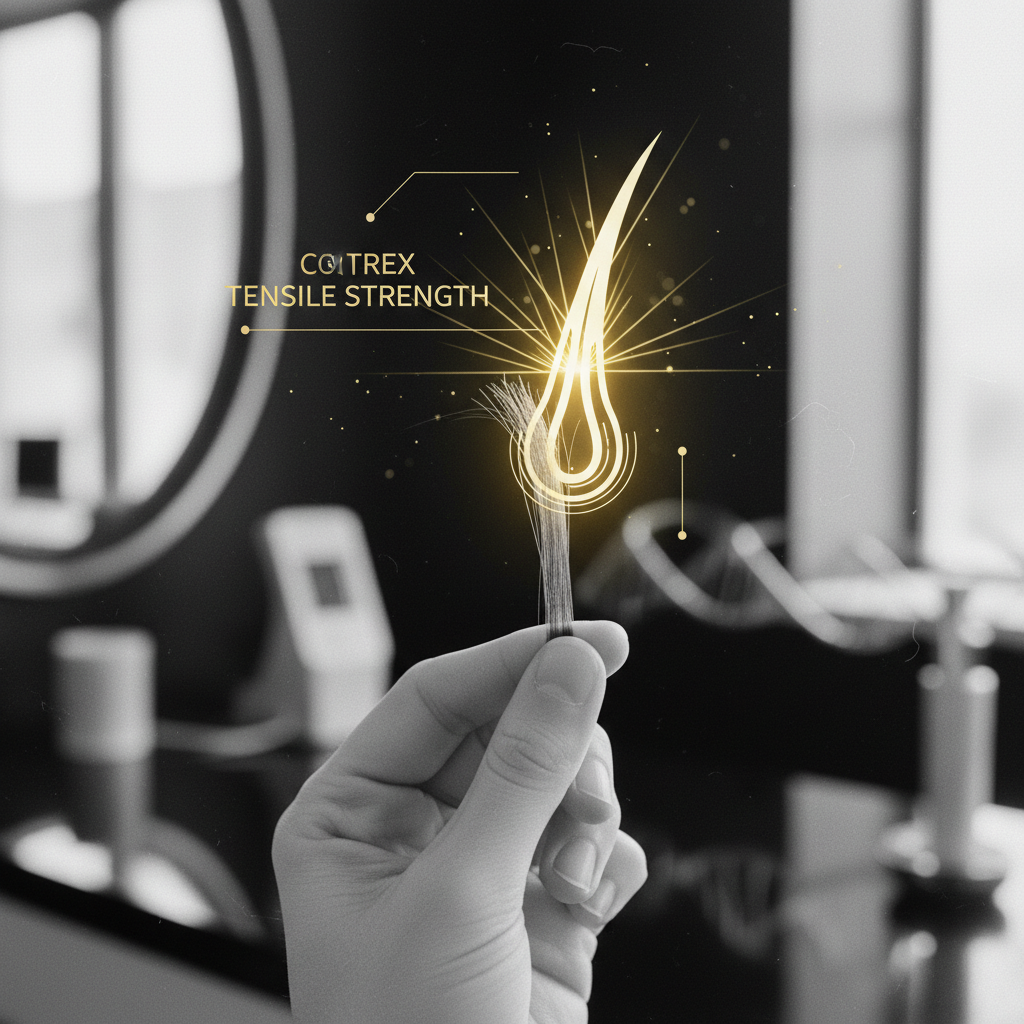
- The wet stretch assessment: Take a single wet strand of hair shed naturally from the head. Hold it securely between thumb and forefinger on both ends, and pull gently. Healthy hair stretches and bounces back to its initial length. Hair with low Cortex Tensile Strength stretches with little resistance and fails to return, remaining crinkled, or snaps immediately.
- Trichoptilosis and trichorrhexis nodosa: Under magnification, fibres exhibiting cortex degradation show split ends (trichoptilosis) or tiny, white node-like swellings (trichorrhexis nodosa). These nodes represent sites where cortical fibres have splayed open, resembling two paintbrushes pressed together.
- Short, blunt-ended fragments: Shed hair leaves the scalp with a small white bulb (the telogen bulb) at one end. If short strands collect on your clothes, shoulders, or sink without bulbs, they are broken shaft segments, signaling severely reduced tensile strength.
What you can do to preserve and reinforce tensile resilience
Hair is biologically non-living tissue above the skin surface. It cannot repair broken covalent bonds through natural cellular regeneration. However, you can prevent structural deterioration and reinforce fragile fibres using targeted cosmetic methods.
1. Minimise covalent bond destruction
Space out chemical bleaching, relaxer treatments, and oxidative colour applications. Avoid overlapping lighteners onto previously processed lengths. When lifting colour, keep alkaline exposure to the minimum effective time and concentration.
2. Guard against thermal breakdown
Never apply flat irons or curling tools to damp or wet hair; trapped moisture boils instantly, creating interior vapour cavities ("bubble hair") that destroy cortical strength. Always keep heated styling tools below 180°C and use a silicone or polymer heat protectant to slow heat transfer.
3. Use hydrolysed proteins and biomimetic bonding agents
Small-molecule hydrolysed vegetable, wheat, or keratin proteins (molecular weight under 1,500 Daltons) can penetrate past damaged cuticles into the outer layers of the cortex. Here, they temporarily bind to exposed polar sites, helping the fibre resist mechanical stress. Similarly, dicarboxylic and organic acid complexes can deposit within the matrix, helping to stabilise compromised structural chains.
4. Reduce wet-state friction
Because water lowers the mechanical force required to deform cortical keratin, hair is uniquely fragile when wet. Comb damp hair gently using a wide-tooth comb or flexible-bristle detangler, beginning at the tips and working upward to avoid concentrating mechanical load along a single point on the shaft.
The Watermans perspective: supporting fibre longevity
At Watermans, we focus on a complete approach to hair health. Scalp care underpins the production of a dense, well-formed hair fibre at the follicle stage. However, keeping hair on your head requires protecting the lengths from daily wear and tear.
While cosmetic shampoos cannot reconnect disulphide bonds within the cortex, formulas designed without harsh sulphates cleanse without stripping essential surface lipids. Pairing gentle cleansing with hydrolysed proteins, conditioning agents, and antioxidants helps safeguard the cuticle scales. When the cuticle remains closed and lubricated, the underlying cortex stays shielded from mechanical abrasion, supporting fibre strength against daily styling.
Frequently asked questions about Cortex Tensile Strength
What is Cortex Tensile Strength?
Cortex Tensile Strength is the measure of physical pull or force a hair fibre can withstand before snapping. It originates in the hair's cortex, which contains cross-linked keratin chains and accounts for up to 90 percent of the strand's structural resistance.
Can products permanently rebuild Cortex Tensile Strength?
No cosmetic treatment can permanently restore original Cortex Tensile Strength once the disulphide framework is broken. Certain salon bonding complexes and hydrolysed proteins temporarily cross-link or fill interior voids to improve resilience, but these wash out over time and require ongoing maintenance.
Does low tensile strength mean my hair is falling out?
No. Low tensile strength causes hair breakage along the shaft, not hair shedding from the follicle. If broken pieces lack a white bulb at the root, the issue is mechanical damage, not telogen effluvium or pattern hair loss.
Why does hair stretch more when it is wet?
Water breaks the weak hydrogen bonds and salt linkages between cortical keratin proteins. This allows the alpha-keratin helices to slide and uncoil under less pull, increasing elasticity while reducing overall resistance to mechanical damage.
How does bleach damage the cortex?
Bleaching agents use alkaline peroxide to dissolve melanin pigments located in the cortex. This chemical reaction inadvertently oxidises cystine, breaking structural disulphide bonds and turning them into cysteic acid, which permanently weakens the hair fibre.
Preserving your hair's structural integrity
Cortex Tensile Strength represents the hidden engine of healthy, resilient hair. While shine and smoothness stem from the outer cuticle, your hair's capacity to withstand brushing, washing, and heat relies entirely on the cross-linked proteins within the inner cortex. Because the hair shaft cannot biologically heal itself, preventing mechanical, thermal, and chemical stress is the single most reliable way to protect your fibres from snapping. By handling hair gently, applying thermal protection, and reinforcing damaged strands with hydrolysed proteins, you can maintain Cortex Tensile Strength and enjoy longer, fuller-looking hair over time.
Sources and references
- Robbins, C. R. (2012). Chemical and Physical Behavior of Human Hair (5th ed.). Springer-Verlag.
- Wolfram, L. J. (2003). Human hair: A unique physicochemical composite. Journal of the American Academy of Dermatology, 48(6), S106-S114.
- Swift, J. A. (1999). The mechanics of human hair. International Journal of Cosmetic Science, 21(4), 227-239.
- Dawber, R. (1996). Hair: Its structure and response to cosmetic preparations. Clinics in Dermatology, 14(1), 105-112.
- Cruz, C. F., et al. (2016). Human hair characteristics and methods of evaluation: A review. International Journal of Cosmetic Science, 38(5), 443-460.