Colour-Treated Hair Care: Evidence-Based Science and Maintenance
9 min read ·
Master colour-treated hair care with evidence-based tips on pH balance, preventing dye fade, restoring lipids, and protecting fragile strands against breakage.
Quick answer: Effective colour-treated hair care centres on repairing cuticle integrity, maintaining the hair's natural acidic pH (4.5 to 5.5), and slowing the oxidation and leaching of artificial dye molecules. Colour-treated hair care requires gentle, sulphate-free cleansing, routine conditioning with cationic surfactants, and thermal protection against ultraviolet rays and heat styling. However, cosmetic care cannot rebuild permanently broken disulphide bonds within the cortex; it can only seal the cuticle, slow colour loss, and shield against mechanical and environmental wear.
Key takeaways
- Chemical dyes lift the cuticle with alkalising agents (such as ammonia or ethanolamine) to deposit pigment into the cortex, permanently increasing hair porosity.
- Washing with hot water or harsh anionic surfactants accelerates dye leaching, as water-soluble colour molecules slip out through open cuticles.
- The optimal pH for colour-treated hair care products sits between 4.5 and 5.5, which helps close the cuticle scales and prevent swelling.
- True hair shedding happens at the follicle, but colour-treated strands are vulnerable to mid-shaft breakage caused by chemical degradation and protein loss.
- Heat tools above 185°C and ultraviolet radiation oxidise colour pigments, transforming rich shades into brassy or faded tones.
Colour-Treated Hair Care: what the evidence shows
Colour-Treated Hair Care begins with understanding how chemical processing alters the biological architecture of the hair fibre. Virgin hair is protected by the F-layer, a microscopic lipid coating consisting primarily of 18-methyleicosanoic acid (18-MEA). This layer makes the cuticle naturally hydrophobic, repelling water and environmental moisture.
When you apply permanent hair dye or bleach, alkaline agents raise the hair's natural pH from its resting state of 4.5 to 5.5 up to 9.0 or higher. This dramatic alkaline shift forces the protective cuticle scales to flare open. Hydrogen peroxide then oxidises natural melanin while opening the pathways for synthetic pigment precursors to enter the cortex and polymerise into larger colour molecules.
Research published in the International Journal of Cosmetic Science confirms that this alkaline oxidation strips away the protective 18-MEA lipid layer. Without this barrier, the hair fibre becomes hydrophilic (water-loving) and highly porous. Water penetrates the exposed cortex easily, causing repeated swelling and contracting known as hygral fatigue. As the cortex swells during washing, artificial dye molecules dissolve and wash away, leading to premature fading.
Effective colour-treated hair care relies on synthetic conditioning agents, such as amodimethicone, behentrimonium chloride, and hydrolysed plant proteins, to mimic the lost 18-MEA layer. These ingredients smooth the lifted cuticles, reduce friction during combing, and establish an artificial hydrophobic shield that locks colour pigments in place.
| Factor | Virgin Hair | Colour-Treated Hair | Recommended Care Strategy |
|---|---|---|---|
| Surface Layer (18-MEA) | Intact, hydrophobic (water-repelling) | Stripped, hydrophilic (water-absorbing) | Apply lipid-rich leave-ins and cationic conditioning agents |
| Cuticle Condition | Flat, smooth, compact | Lifted, chipped, porous | Use acidic formulations (pH 4.5 to 5.5) to flatten cuticles |
| Tensile Strength | High elasticity and resistance | Reduced; prone to mid-shaft breakage | Incorporate hydrolysed proteins to reinforce weak structural points |
| Water Sensitivity | Minimal swelling during cleansing | Significant swelling; dye molecules leach | Wash with lukewarm water and gentle, sulphate-free cleansers |
| UV Vulnerability | Melanin offers moderate natural protection | Pigments oxidise quickly into brassy tones | Apply antioxidant leave-in treatments and UV filters |
What the evidence does not show
Popular hair forums often claim that specific cosmetic oils or conditioning masks can fully reverse dye damage and permanently seal cuticles shut. The scientific evidence does not show this.
Once the covalent bonds of the F-layer are chemically severed, the hair shaft cannot regenerate living tissue. Hair is biologically dead matter. Conditioners, bonding builders, and plant oils provide temporary cosmetic cohesion. They deposit a protective film over gaps in the cuticle and cross-link temporary bonds, but these wash away over time and require consistent reapplication.
Furthermore, controlled research has not found that cosmetic hair dye causes follicular hair loss (alopecia). Dye-induced damage occurs along the shaft in the form of mechanical breakage. While severe chemical burns from misapplied bleach can scar follicles, normal colour application does not disrupt the internal follicular growth cycle. Confusing mid-shaft snapping with true follicular shedding leads to ineffective treatments.
Signs of dye damage versus typical shedding
Understanding the difference between structural fibre breakage and follicular shedding is vital for adjusting your routine.
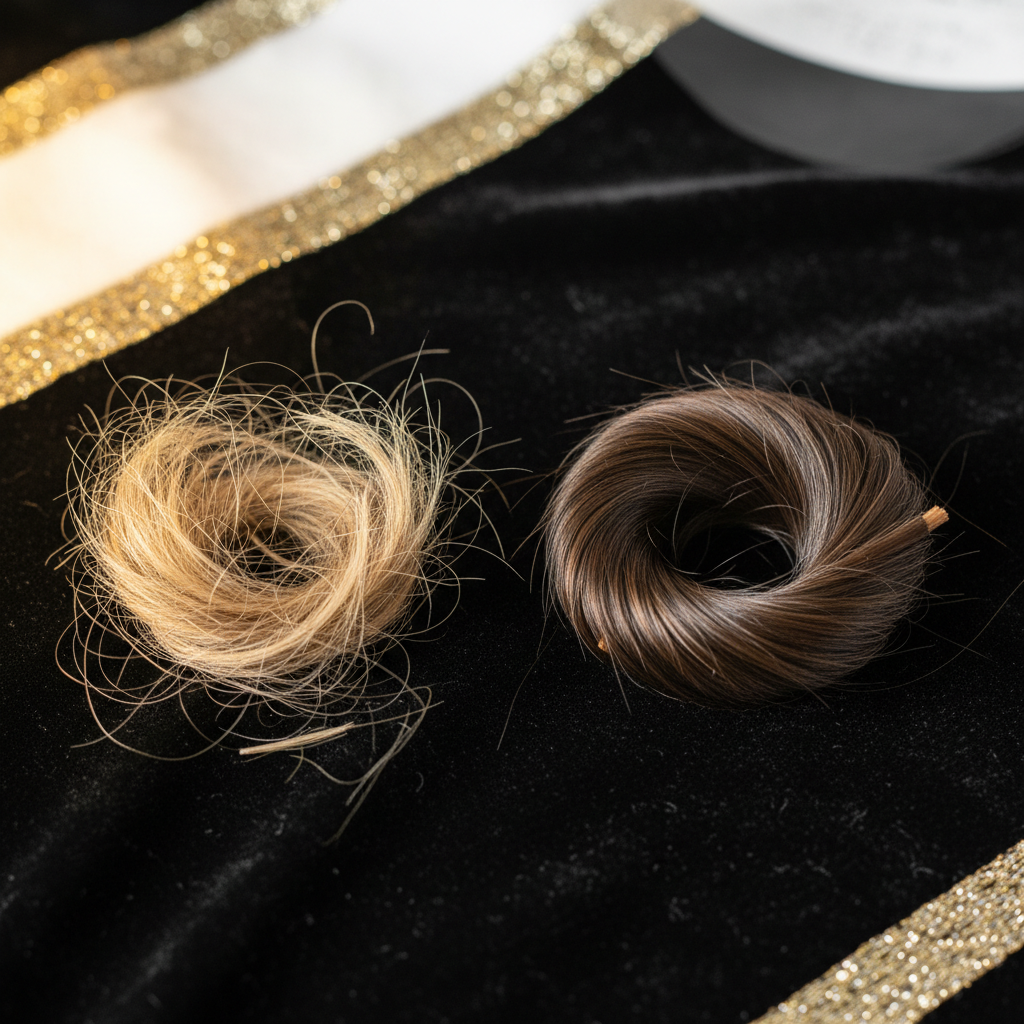
- Mid-shaft breakage: Snapped hair strands are noticeably shorter than your natural length and lack a white bulb at the root. They feel rough, tangle easily when wet, and snap under light tension. This indicates compromised protein bonds from bleaching or high-lift colouring.
- Follicular shedding: Shed hairs show a small, white keratin bulb at the root and match your full strand length. The scalp sheds between 50 and 100 of these hairs every day as part of the natural telogen phase.
- Surface porosity: Damaged colour-treated hair absorbs water almost instantly when wet, but takes an unusually long time to dry because the spongy cortex traps excess moisture.
- Dullness and brassiness: When the cuticle cannot lie flat, light scatters unevenly across the surface instead of reflecting cleanly, leaving hair looking matte, dry, and off-tone.
Practical steps for colour maintenance
Protecting chemically treated strands requires small adjustments to your daily routine that minimise mechanical friction, chemical leaching, and thermal stress.
- Lower your wash temperature: Hot water causes the hair shaft to expand, allowing dye pigments to escape into the water stream. Wash and rinse with lukewarm or cool water to keep the cuticle as tight as possible.
- Choose low-pH, sulphate-free cleansers: Harsh anionic surfactants like sodium lauryl sulphate strip natural surface sebum and speed up dye wash-out. Look for mild, amphoteric or non-ionic cleansers formulated at an acidic pH of 4.5 to 5.5.
- Space out your wash days: Water exposure is the primary driver of artificial pigment loss. Using dry shampoo between washes reduces the frequency of hygral expansion cycles.
- Cap heat styling at 180°C: High heat rapidly degrades both natural keratin and synthetic colour molecules. Keep styling tools below 180°C, and never skip a silicone- or polymer-based thermal protectant.
- Neutralise hard water minerals: Hard water contains dissolved calcium and magnesium (often exceeding 180 mg/L in hard-water zones) alongside trace copper. These minerals bind to porous hair, turning blonde hair green and brunette hair brassy. A chelating treatment once a month removes these deposits without stripping base tones.
When the cause may be something else
If you notice rapid thinning, widening part lines, or sudden clumps of hair coming out in the shower, the underlying cause is rarely your colour service.
Diffuse thinning across the entire scalp often points to telogen effluvium, triggered by acute physiological stress, high fevers, thyroid imbalances, rapid weight loss, or iron deficiency (ferritin levels below 30 ng/mL). Gradual thinning concentrated at the crown, temples, or parting line usually reflects androgenetic alopecia, which is driven by genetics and sensitivity to dihydrotestosterone (DHT).
Always examine the root of shed fibres. If the white root bulb is present on most fallen strands, look into systemic or metabolic health factors rather than your dye technique.
When to seek professional advice
Schedule an appointment with a dermatologist or an accredited trichologist if you notice signs of contact dermatitis after colouring, such as persistent scalp burning, redness, flaking, or blistering. Paraphenylenediamine (PPD) and related coal-tar derivatives found in permanent dark dyes can trigger acquired contact allergies that worsen with every exposure.
You should also consult an experienced colourist if your hair shows signs of extreme chemical compromise, such as a gummy, stretchy texture when wet (indicating complete loss of cortex elasticity). At this stage, at-home treatments cannot stabilise the strand, and continuing to bleach or dye over processed hair risks widespread breakage.
Supporting colour-treated hair with Watermans
Maintaining high-porosity, colour-treated hair requires gentle cleansing combined with scalp-friendly nourishment. The Watermans collection offers balanced care designed to protect fragile strands without stripping cosmetic colour. Watermans GrowMe Shampoo delivers a sulphate-free wash that cleanses without lifting the cuticle, helping preserve artificial pigment. Packed with rosemary extract, biotin, hydrolysed lupin protein, and niacinamide, it reinforces brittle, chemically processed fibres to reduce daily breakage. Paired with Watermans ConditionMe Conditioner, which uses cholesterol, caffeine, and softening emollients, it smooths the cuticle layer and restores healthy slip, keeping colour-treated strands glossy, supple, and resilient.
Frequently asked questions about Colour-Treated Hair Care
How soon should you wash your hair after a colour service?
Wait at least 48 to 72 hours before washing hair after a permanent colour service. It takes up to two days for the hair cuticle to fully contract and for synthetic colour pigments to trap securely within the cortex. Washing too soon, especially with warm water, opens the vulnerable cuticle and causes immediate pigment loss.
Can Colour-Treated Hair Care products restore split ends?
No cosmetic product can permanently mend a split end. Colour-Treated Hair Care products containing hydrolysed proteins and silicones can temporarily stick split ends together and smooth the outer cuticle layer. However, this is purely a cosmetic fix that washes away with your next shampoo. The only permanent solution for split ends is trimming the damaged tips.
Why does colour-treated hair become brassy over time?
Hair turns brassy due to oxidation from ultraviolet light, mineral deposits from tap water, and heat styling tools. When you lighten hair, natural underlying warm pigments (red, orange, and yellow) are revealed before toner is applied. As the cool-toned toner fades and environmental exposure oxidises remaining melanin, those warm undertones reappear on the surface.
Does sulphate-free shampoo actually protect hair colour?
Yes. Strong sulphate surfactants, such as sodium lauryl sulphate, are potent detergents that strip the lipid barrier and lift the cuticle scales, allowing water to wash away cortical dye molecules. Gentle, sulphate-free cleansers clean the scalp using mild surfactants that do not swell the cuticle, keeping colour vibrant for significantly longer.
What is the ideal product pH for colour-treated hair?
The ideal pH for colour-treated hair products falls between 4.5 and 5.5. Because chemical dyes use high-pH alkaline solutions to swell the hair shaft, using an acidic shampoo, conditioner, or rinse helps bring the hair back to its natural isoelectric point, sealing the cuticles flat and locking in moisture.
Summary
Successful Colour-Treated Hair Care requires balancing aesthetic goals with the biological needs of chemically altered hair. Because permanent dyes strip the protective lipid layer and leave the cuticle open, colour-treated strands demand a thoughtful routine focused on low-pH products, gentle cleansing, lipid restoration, and heat protection. While cosmetic products cannot rebuild broken bonds forever, consistent colour-treated hair care preserves cuticle health, guards against mid-shaft breakage, and keeps your colour looking rich, radiant, and salon-fresh.
Sources and references
- International Journal of Cosmetic Science: "The chemical and physical properties of colour-treated hair fibres" (2018)
- Journal of the Society of Cosmetic Chemists: "Effect of chemical treatments on the hydrophobic properties of human hair" (2014)
- British Association of Dermatologists: "Hair dye reactions and paraphenylenediamine (PPD) guidance" (2021)
- Cosmetic Science and Technology: "Hair Care Formulations and the Role of pH" (2020)
Find these ingredients in Watermans products
- Copper: you will find this ingredient in our Hair Vitamins.
- Niacinamide: you will find this ingredient in our Hair Mask.