Clarifying vs Chelating Shampoo: What the Evidence Shows
10 min read ·
Understand the science of clarifying vs chelating shampoo: discover which formula removes product buildup, which strips hard water minerals, and how to use them safely.
Quick answer: The debate over clarifying vs chelating shampoo comes down to the chemical nature of the buildup on your hair. A clarifying shampoo uses high-cleansing surfactants to remove surface residues like sebum, styling polymers, and silicones. A chelating shampoo contains specialised binding agents, such as tetrasodium EDTA, designed to bind and dissolve deep mineral deposits, hard water ions, and heavy metals. However, neither formula repairs existing structural damage, and overuse of either can strip essential lipids and lead to brittle hair breakage.
Understanding the difference between clarifying vs chelating shampoo is essential for anyone dealing with dull, lifeless, or unresponsive hair strands. While both categories offer a deeper reset than regular daily cleansers, they target entirely different types of residue at a molecular level.
Key takeaways
- Clarifying shampoos target organic surface buildup, such as cosmetic styling products, excess sebum, and heavy conditioners.
- Chelating shampoos target inorganic mineral buildup, including calcium, magnesium, iron, copper, and chlorine compounds.
- Chelating agents use chemical ligands that form stable, water-soluble ring complexes with metal ions, allowing them to rinse away cleanly.
- Using a clarifying formula when you have hard water mineral buildup often leaves hair feeling coated, stiff, and unmanageable.
- Overusing either formula can strip the protective epicuticle lipid layer (18-MEA), causing mechanical friction, cuticle weathering, and fibre breakage.
- Neither formula prevents genetic hair loss or hormonal shedding; their function is strictly cosmetic and fibre-focused.
Clarifying vs chelating shampoo: what the evidence shows
The distinction between clarifying vs chelating shampoo rests on the physical chemistry of adhesion. Cosmetic science research shows that everyday shampoos rely on balanced surfactant systems with a typical pH of 5.0 to 6.5. These maintain the hair fibre while providing mild cleansing.
Over time, two distinct types of residue accumulate on the hair shaft:
- Organic residues: Non-polar substances such as dimethicone, petrolatum, waxes, polyquaterniums, and sebum.
- Inorganic residues: Divalent and trivalent metal ions deposited from domestic tap water, swimming pools, or environmental pollution. These include calcium carbonate, magnesium salts, copper, and iron.
Standard clarifying shampoos rely on stronger anionic surfactants, such as sodium laureth sulfate or ammonium laureth sulfate, combined with amphoteric secondary surfactants. These formulas have a slightly higher pH (typically 6.0 to 7.5) to loosen and solubilise stubborn hydrophobic films. They strip away surface polymers effectively. Yet, studies published in the International Journal of Cosmetic Science demonstrate that standard surfactant cleansing removes less than 15 percent of hard water minerals bound within the cuticular layers.
Chelating shampoos go further by incorporating active sequestering agents. These chelants (from the Greek word chele, meaning claw) encircle positively charged polyvalent metal ions, neutralising their charge and converting them into water-soluble complexes. If your hair is coated with calcium carbonate from hard water, a regular clarifying wash simply washes over the calcified shell. You need a dedicated chelating agent to break that bond.
| Feature | Clarifying Shampoo | Chelating Shampoo |
|---|---|---|
| Primary Target | Organic styling buildup, silicones, waxes, sebum | Inorganic minerals, hard water deposits, chlorine, heavy metals |
| Key Active Ingredients | High-strength anionic surfactants (e.g., SLES, ALS, olefin sulfonates) | Chelating agents (e.g., Tetrasodium EDTA, Disodium EDTA, Phytic Acid, Sodium Gluconate) |
| Mechanism of Action | Emulsification and solubilisation of surface lipids | Molecular coordination and sequestering of metallic ions |
| Penetration Depth | Primarily surface cuticular layer | Outer cuticles and sub-cuticular mineral binding sites |
| Typical Frequency | Once every 1 to 2 weeks | Once every 2 to 4 weeks (or post-swimming) |
| Best For | Product junkies, heavy silicone users, oily scalps | Hard water areas, regular swimmers, pre-chemical service prep |
What the evidence does not show
There is no scientific evidence that clarifies or chelates hair to promote follicle growth, cure pattern baldness (androgenetic alopecia), or stop telogen effluvium. It is vital to separate hair breakage along the shaft from medical hair shedding at the follicle level.
Mineral buildup and product accumulation make the hair fibre stiff, coarse, and prone to tangling. The mechanical tension from brushing through this rigid hair can cause significant fibre breakage. When people use a clarifying or chelating formula and see fewer snapped hairs in their brush, they often assume they have cured their hair loss. In reality, they have simply restored fibre flexibility and reduced friction-induced snapping.
Furthermore, evidence does not show that chelating shampoos are suitable for daily use. Repeated exposure to strong chelants and high-detergency surfactants dissolves the 18-methyl eicosanoic acid (18-MEA) monolayer, which is the hair cuticles' primary natural moisture barrier. Stripping this layer leaves the cortex vulnerable to hygroscopic stress, moisture loss, and split ends.
How chelating works at the molecular level
The chemical mechanism of chelation involves coordination chemistry. When you wash your hair in hard water (defined as water containing more than 120 mg/L of dissolved calcium carbonate), metal ions attach themselves to the negatively charged keratin protein.
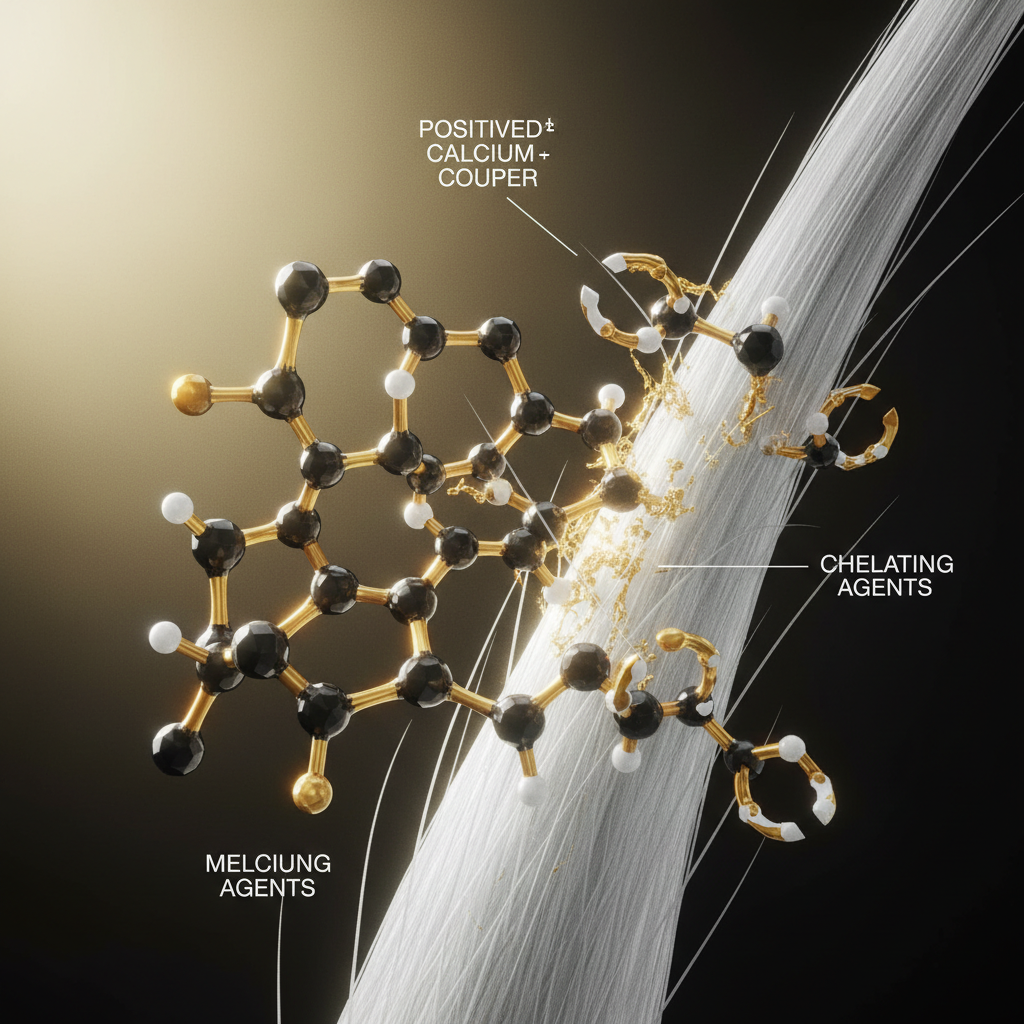
Hair contains high levels of cysteic acid and carboxyl groups, particularly if the cuticle has suffered previous oxidative damage from bleaching or sun exposure. These sites carry a negative electrical charge, acting as an electrostatic magnet for positively charged ions like Ca²⁺ (calcium), Mg²⁺ (magnesium), and Cu²⁺ (copper).
[Keratin Surface]- (Negative) + Ca²⁺ (Hard Water) --> [Bound Mineral Scale] (Stiff, brittle fibre)
[Bound Mineral Scale] + EDTA⁴⁻ (Chelant) --> [Keratin Surface] + [Ca-EDTA]²⁻ (Washes down drain)
Chelating agents like ethylenediaminetetraacetic acid (EDTA) possess multiple electron-donor atoms (typically nitrogen and oxygen). When introduced to wet hair, the chelant coordinates around the metal ion, outcompeting the keratin's binding affinity. It forms a stable, multi-ring coordination complex. The newly encapsulated mineral is water-soluble and rinses straight down the drain, leaving the keratin surface free of mineral scale.
Signs that tell you which shampoo you need
Recognising how your hair behaves helps you choose the right corrective wash without trial and error.
Signs you need a clarifying shampoo:
- Hair feels limp, slippery-greasy, or heavy within hours of washing.
- You use leave-in styling products containing dimethicone, trimethicone, polyquaternium-55, or microcrystalline waxes daily.
- Dry shampoo, hairsprays, or styling creams have created visible white powdery flaking near the roots.
- Your usual moisturising shampoo and conditioner seem to sit on the surface without hydrating the strand.
Signs you need a chelating shampoo:
- You live in a designated hard water geographical region (typically areas with chalky or limestone bedrock).
- Hair feels persistently rough, crunchy, straw-like, or "coated", even immediately after deep conditioning.
- Blonde, grey, or lightened hair takes on a brassy, muddy, or greenish cast (copper oxidation, often accelerated by swimming pool chlorine).
- Chemical treatments, such as salon bleach, highlights, or perms, lift unevenly or cause unexpected heat reactions on the hair.
- Your hair takes an abnormally long time to get wet under the shower stream, as if water is beading off it.
Best practice: how to clarify and chelate safely
To prevent lipid depletion and maintain fibre integrity, use these deep-cleansing formulas methodically:
- Assess the timeline: If you have mineral issues, use a chelating shampoo once every two to three weeks. If you only deal with styling waxes or polyquat buildup, a clarifying wash once a fortnight is usually sufficient.
- Focus your application: Apply the product directly to damp roots and mid-lengths. Work the lather thoroughly to ensure even surfactant contact.
- Allow contact time (chelating only): Surfactants work quickly, but chelating agents require dwell time to break coordination bonds with minerals. Let a chelating shampoo sit on the hair fibre for two to three minutes before rinsing.
- Rinse thoroughly with lukewarm water: Ensure all dissolved residues and loosened complexes wash away completely.
- Replenish lost lipids immediately: Because both shampoos strip away natural sebum alongside product residues, follow immediately with a rich, acidic conditioner or deep conditioning mask (pH 4.0 to 5.0). This re-aligns the cuticles and replenishes fatty alcohols.
When the issue is something else
If your hair remains brittle, dry, or unresponsive after using a clarifying or chelating shampoo, the underlying cause may not be external buildup.
- High hair porosity: Chemically bleached or heat-damaged hair has missing cuticle scales. The porous cortex absorbs water rapidly but loses it just as fast, mimicking the rough feel of mineral buildup. Cleansing will not fix this; structural protein treatments and bond builders are required.
- Seborrheic dermatitis: If you are using a clarifying wash to combat persistent scalp flakes, an overgrowth of Malassezia yeast might be the true culprit. Clarifying shampoos do not contain targeted antifungal agents like ketoconazole or piroctone olamine.
- Underlying medical shedding: If your hair feels thinner across the scalp, check for telogen effluvium or pattern loss with a qualified trichologist or dermatologist. Stripping the hair fibre with deep cleansers will not resolve follicular conditions.
A supportive approach to hair maintenance
Keeping the hair fibre free from environmental buildup creates the ideal foundation for healthy hair growth. When the scalp is clear of heavy cosmetic debris and excess sebum, topical treatments perform much more effectively. Watermans offers products designed to invigorate the scalp and strengthen the look and feel of the hair fibre without harsh stripping agents. Products like Watermans Grow Me Shampoo incorporate nourishing components such as biotin, rosemary, caffeine, and argan oil, making it an exceptional daily or alternate-wash option alongside your periodic clarifying or chelating routine.
Frequently asked questions about Clarifying vs Chelating Shampoo
What is the primary difference in clarifying vs chelating shampoo?
The key difference between clarifying vs chelating shampoo is the residue they remove. A clarifying shampoo breaks down surface oils, styling silicones, and cosmetic waxes using strong surfactants. A chelating shampoo uses specialised sequestering agents (like EDTA) to dissolve inorganic minerals, hard water scale, and heavy metal deposits locked within the hair cuticle.
Can a clarifying shampoo remove hard water mineral buildup?
No, standard clarifying shampoos cannot effectively eliminate hard water buildup. While they may strip surface grease, they lack the specific chelating ligands needed to unbind calcium, magnesium, and copper from keratin proteins. To remove hard water minerals, you need a formula containing dedicated chelating agents.
Will using a chelating shampoo fade my hair colour?
Yes, chelating formulas can cause cosmetic hair dye to fade if used too frequently. By opening the cuticle slightly and lifting surface deposits, artificial pigment molecules can escape. However, stylists often recommend a gentle chelating treatment immediately before colouring to remove minerals that would otherwise distort the dye results.
How often should I use clarifying vs chelating shampoo?
Most people should use a clarifying shampoo once every one to two weeks, depending on styling product use. A chelating shampoo should typically be used once every three to four weeks, or once weekly if you swim regularly in chlorinated pools or wash daily with very hard water.
Can clarifying or chelating shampoos stop hair loss?
No, neither shampoo treats genetic hair loss, hormonal shedding, or alopecia. They only address external fibre health. By removing mineral scale and product buildup, they reduce tangling and mechanical hair breakage along the shaft, which can make hair look and feel fuller, but they do not alter follicular growth cycles.
Choosing the right reset for your hair
Understanding the functional boundaries of clarifying vs chelating shampoo removes the guesswork from your haircare routine. If your hair is bogged down by styling pastes, silicones, and natural oils, an occasional clarifying wash provides the perfect clean slate. If your strands feel crunchy, dull, and unresponsive due to limestone-heavy tap water or pool chemicals, only a chelating shampoo has the molecular capability to dissolve those stubborn mineral bonds. Match the chemistry of your cleanser to the chemistry of your buildup, follow with rich conditioning, and your hair will retain its natural movement, shine, and structural resilience.
Sources and references
- International Journal of Cosmetic Science, "Investigation of the effects of hard water on hair properties", 2018.
- Journal of the Society of Cosmetic Chemists, "The interaction of metal ions with human hair keratin", 1999.
- Robbins, C. R., Chemical and Physical Behavior of Human Hair, 5th Edition, Springer, 2012.
- American Academy of Dermatology (AAD), "Hair Care Basics: How to wash your hair", aad.org.
- Cosmetic Ingredient Review (CIR), "Safety Assessment of EDTA and Its Salts as Used in Cosmetics", 2019.
Find these ingredients in Watermans products
- Copper: you will find this ingredient in our Hair Vitamins.