Clarifying Shampoos and Residue: The Science of Build-Up and Cleansing
8 min read ·
Clarifying Shampoos and Residue explained: discover how build-up forms, how clarifying formulas strip polymers and minerals, and how to protect hair health.

Quick answer: Understanding Clarifying Shampoos and Residue is vital for restoring hair vitality, as daily styling products, conditioning agents, and hard water minerals leave stubborn coatings on the hair shaft over time. Clarifying shampoos use higher concentrations of anionic surfactants with minimal conditioning agents to strip these deposits away. However, their primary limitation is that overuse can strip natural lipids, lift the cuticle, and leave hair dry or prone to mechanical breakage if not followed by proper hydration.
Key takeaways
- Residue builds up from three main sources: styling polymers, heavy conditioning silicones or quats, and dissolved tap water minerals such as calcium and magnesium.
- Clarifying shampoos feature stronger surfactant systems and a slightly higher pH (typically 5.5 to 6.5) than daily shampoos, allowing them to solubilise stubborn build-up.
- They are cleansing tools designed to break surface adhesion, not treatments for genetic or hormonal hair loss.
- Over-clarifying strips the hair's protective 18-methyleicosanoic acid (18-MEA) lipid layer, leading to friction and fibre snapping.
- Most individuals only require clarification once every one to four weeks, depending on hair texture, styling habits, and local water hardness.
Clarifying Shampoos and Residue: what the evidence shows
Research into cosmetic chemistry demonstrates that normal cleansing formulas leave intentional deposits to make hair feel smooth. Daily shampoos and conditioners often contain polyquaterniums, non-volatile silicones (such as dimethicone), and fatty alcohols. While these ingredients temporarily reduce combing friction, repeated applications without periodic deep cleansing lead to product accumulation.
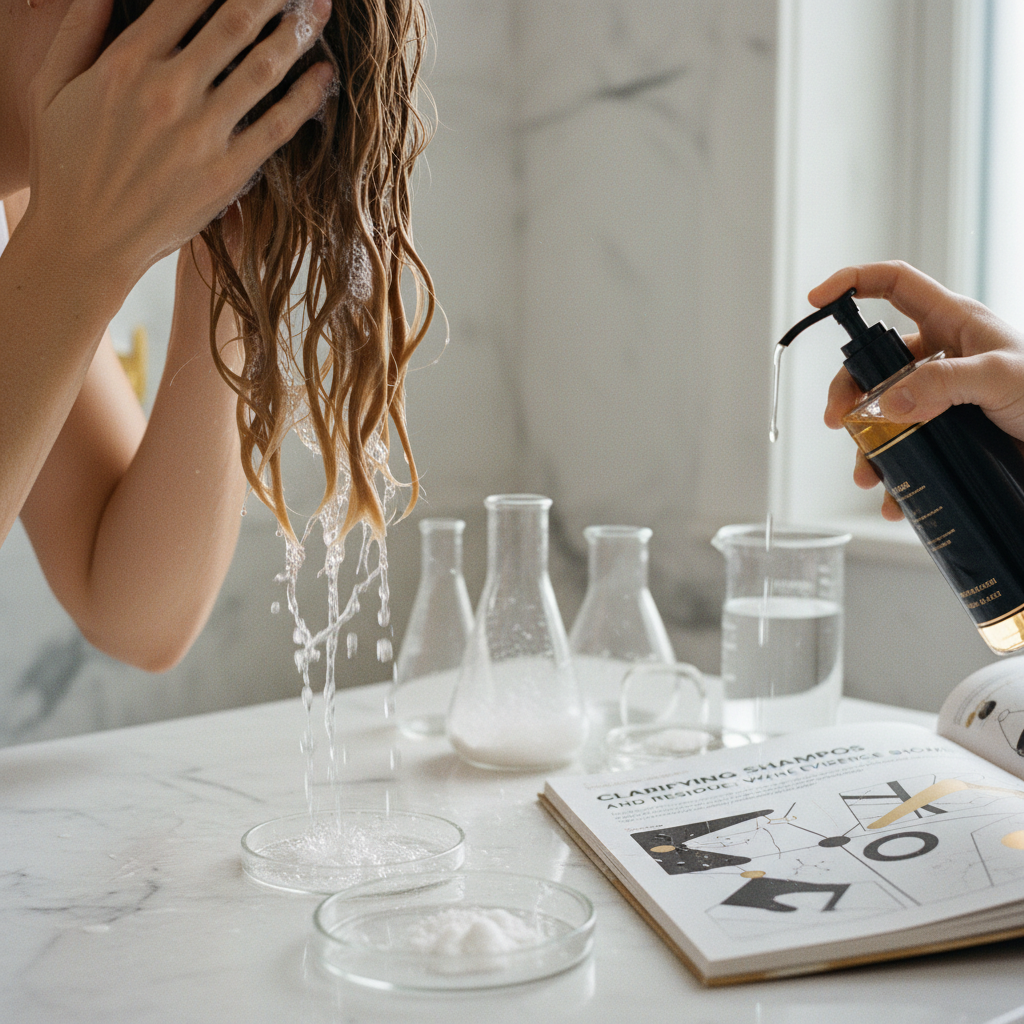
Studies in cosmetic dermatology show that mineral residues from hard water compounds (specifically calcium and magnesium salts) bind electrostatically to anionic sites on the keratin protein matrix. When hair fibres carry this dual burden of polymer build-up and mineral scale, they become hydrophobic, stiff, and prone to dullness.
When evaluating Clarifying Shampoos and Residue, the evidence shows that targeted surfactant formulations effectively strip away these films. By employing primary anionic cleansers (such as ammonium laureth sulphate, sodium C14-16 olefin sulfonate, or sodium lauryl sulfoacetate) without adding back heavy lubricating oils, clarifying cleansers leave the hair shaft clean and reset.
+------------------------+-----------------------------------+----------------------------------+
| Feature | Daily / Moisturising Shampoo | Clarifying Shampoo |
+------------------------+-----------------------------------+----------------------------------+
| Primary Surfactants | Mild amphoteric or gentle anionics| Strong anionic surfactant blends |
| Conditioning Agents | High (silicones, polyquats, oils) | Minimal to none |
| Typical pH Level | 4.5 to 5.5 | 5.5 to 6.5 |
| Primary Purpose | Gentle sebum removal, smoothing | Stripping stubborn build-up |
| Recommended Frequency | Daily to 3 times per week | Once every 1 to 4 weeks |
| Scalp & Fibre Impact | Preserves surface lubrication | Maximises cleansing; can dry |
+------------------------+-----------------------------------+----------------------------------+
What the evidence does not show
There is no scientific evidence showing that product residue directly suffocates follicles or triggers follicular hair loss conditions such as androgenetic alopecia. Hair growth occurs deep within the dermal papilla beneath the scalp surface. While heavy sebum and polymer build-up can aggregate around the follicular ostium and exacerbate inflammatory scalp conditions like seborrhoeic dermatitis, residue does not turn off hair production.
Similarly, the evidence does not support using clarifying shampoo as an anti-dandruff therapy. While a clarifying wash can temporarily dislodge loose scales, true dandruff stems from a physiological response to Malassezia yeast metabolising sebum, requiring specific antifungal actives rather than pure stripping surfactants.
The mechanism: how residue forms and how cleansers remove it
Residue binds to the hair fibre through hydrophobic interactions, covalent bonding, and electrostatic attraction. The hair fibre possesses an overall negative electrical charge, especially along damaged cuticles where internal cysteic acid is exposed.

Many conditioning agents and styling polymers carry a positive charge (cationic). Opposites attract, causing ingredients like polyquaternium-10, cetrimonium chloride, and guar hydroxypropyltrimonium chloride to anchor firmly to the cuticle surface. In tandem, insoluble silicones form a waterproof shield, while mineral ions from domestic water supplies (calcium carbonate, magnesium sulphate) precipitate into the gaps under raised cuticle scales.
Clarifying shampoos overcome these strong bonds through specific chemical actions:
- Micellar solubilisation: High-potency anionic surfactants form spherical micelle structures that surround non-polar product polymers, lifting them into the water rinse.
- Cuticle swelling: Formulated at a slightly higher pH than standard acid-balanced shampoos, clarifying cleansers gently relax the outer layers of the hair cuticle, exposing entrapped deposits.
- Chelation: High-grade clarifying products frequently incorporate chelating agents (such as tetrasodium EDTA or citric acid). These molecules act like molecular claws, binding tightly to calcium, iron, and magnesium ions and converting them into water-soluble complexes that rinse away easily.
Signs your hair has residue build-up
Recognising when hair fibre requires deep cleansing prevents both under-washing and unnecessary stripping:
- Persistent limpness and loss of volume: Hair feels heavy, greasy, or coated even immediately after being washed and blow-dried.
- Flaking without inflammation: You observe small, dry, white flakes along the hair shaft rather than on the scalp, which often indicates polymer product shedding.
- Dull, matte appearance: Light reflects unevenly off the hair shaft because microscopic coats of silicone and mineral deposits diffuse the reflection.
- Poor response to conditioning: Hydrating masks and conditioners appear to sit on the outside of the hair fibre without improving softness or flexibility.
- Colour resistance: Fresh hair colour or toner takes unevenly because barrier films stop pigments from penetrating the cortex consistently.
What you can do to manage build-up
Managing build-up requires a balanced routine that cleanses deeply without compromising the hair's structural integrity.
Start by auditing your wash frequency. If you live in a soft water area and use water-soluble styling products, clarifying once every three to four weeks is usually plenty. If you swim regularly, live in a hard water area (above 180 mg/L calcium carbonate), or rely on daily dry shampoos and heavy styling waxes, a fortnightly clarifying wash is more appropriate.
Apply the clarifying shampoo predominantly to wet roots and mid-lengths, working it into a rich lather. Allow the foam to sit for two to three minutes so the surfactants and chelating agents have adequate dwell time to break surface bonds. Rinse thoroughly with lukewarm water.
Because clarifying removes the protective surface lipids alongside the unwanted build-up, always follow with an intensive, acid-balanced conditioner or mask (pH 4.0 to 5.0). This recloses the cuticle scale, restores moisture, and re-establishes healthy fibre slip.
When the cause may be something else
If your hair remains dull, brittle, or greasy despite clarifying, the underlying issue might not be cosmetic build-up:
- Seborrhoeic dermatitis: Thick, yellowish, oily scales that adhere to an itchy, red scalp are caused by an inflammatory reaction to yeast, not styling product build-up.
- Hygral fatigue and internal dryness: Hair that feels stiff or rough may be suffering from protein imbalance or excessive moisture loss due to past chemical bleaching, rather than a coating of residue.
- Hard water mineral staining: If hair takes on an orange, green, or brassy tint, domestic copper or iron deposits are present. Standard clarifying shampoos may not have enough chelating power to remove heavy metal staining, requiring a dedicated salon demineralising treatment.
- Follicular shedding: If you are noticing increased shedding in the shower, look to telogen effluvium, nutritional shifts, or hormonal changes rather than your shampoo routine.
When to seek professional advice
Consult a registered trichologist or a consultant dermatologist if your scalp exhibits persistent redness, burning, tenderness, crusting, or hair loss patches. Strong clarifying shampoos can irritate active eczema, psoriasis, or compromised epidermal barriers.
Similarly, if your hair snaps along the shaft whenever you touch it, visit a professional colourist or hair stylist before using strong clarifying washes. Compromised, over-processed hair cuticles can become further fractured by high-surfactant products.
Balancing scalp health with Watermans
Maintaining a clean scalp environment is an essential part of an effective haircare routine. Watermans focuses on providing formulas that support the feel and appearance of natural hair vitality. Products like Watermans Grow Me Shampoo clean the hair and scalp while delivering beneficial ingredients such as biotin, caffeine, rosemary extract, and argan oil.
Using an effective regular cleanser ensures that your scalp stays fresh and unclogged without stripping the delicate moisture balance needed to resist daily mechanical breakage.
Frequently asked questions about Clarifying Shampoos and Residue
Can clarifying shampoo cause hair breakage?
Yes, if used incorrectly. Clarifying shampoos thoroughly strip surface oils and raise the cuticle. If you clarify too frequently, or fail to follow with a rich, moisturising conditioner, the exposed cuticle scales will rub together. This increased inter-fibre friction weakens the shaft, leading to mechanical breakage over time.
How often should you use clarifying shampoos for residue removal?
For most hair types, once every two to four weeks is ideal. If you swim in chlorinated pools, use heavy waxes, or live in a known hard-water region, you may benefit from clarifying once a week. Those with dry, coarse, or chemically relaxed hair should limit use to once a month.
Will a clarifying shampoo strip artificial hair colour?
Yes. The higher surfactant levels and slightly elevated pH of clarifying formulas open the cuticle layer, which allows artificial colour molecules to leach out quickly. Avoid clarifying within the first week after permanent colouring, and stick to colour-safe cleansers unless intentionally fading a shade.
What is the difference between clarifying and chelating shampoos?
Clarifying shampoos target surface cosmetic residues like silicones, styling polymers, and excess sebum. Chelating shampoos contain much higher concentrations of active agents (like EDTA) formulated specifically to dissolve deep mineral bonds, such as copper, iron, and calcium scale from hard water or swimming pools.
Do Clarifying Shampoos and Residue build-up affect scalp health?
Yes. When cosmetic polymers and oils mix with natural sebum, they can form an occlusive film that traps dead skin cells. Using clarifying shampoos to eliminate this residue helps maintain an airy, clean scalp surface, discouraging irritation and flakes caused by trapped grime.
Summary: mastering clarifying shampoos and residue
Navigating Clarifying Shampoos and Residue successfully comes down to knowing your hair's environment, styling habits, and unique porosity. Clarifiers serve as exceptional periodic reset buttons, clearing the way for conditioning treatments to work properly and giving hair clean movement. By pairing a well-timed clarifying session with consistent hydration, you can keep your scalp fresh, protect the cuticle layer, and enjoy clean, healthy-looking hair.
Sources and references
- British Association of Dermatologists. Scalp Care and Hair Cleansing Clinical Standards, 2022.
- D'Souza, P., & Rathi, S. K. "Shampoo and Conditioners: What a Dermatologist Should Know?" Indian Journal of Dermatology, 2015.
- Robbins, C. R. Chemical and Physical Behavior of Human Hair. 5th ed., Springer, 2012.
- Gavazzoni Dias, M. F. "Hair Cosmetics: An Overview." International Journal of Trichology, 2015.
- Cruz, C. F., et al. "Human Hair Characteristics and Methods for Evaluating Hair Care Products." Cosmetics, 2016.
Find these ingredients in Watermans products
- Copper: you will find this ingredient in our Hair Vitamins.