Chronic Telogen Effluvium vs Pattern Baldness: Evidence and Differences
9 min read ·
Understand the core differences in Chronic Telogen Effluvium vs Pattern Baldness, from follicle miniaturisation to shedding patterns and clinical diagnosis.

Quick answer: Comparing Chronic Telogen Effluvium vs Pattern Baldness comes down to shedding versus miniaturisation. Chronic telogen effluvium causes excessive, diffuse hair shedding across the entire scalp lasting over six months without altering hair follicle width. Pattern baldness (androgenetic alopecia) is a genetic process where dihydrotestosterone (DHT) progressively shrinks specific follicles, causing hair to grow back finer until it disappears. The main limitation in distinguishing them is that both can occur simultaneously, requiring trichoscopy or a scalp biopsy for definitive clinical diagnosis.
Distinguishing between Chronic Telogen Effluvium vs Pattern Baldness can be difficult in the early stages because both conditions thin the visible density of your hair. However, their underlying biological mechanisms, timelines, shedding patterns, and long-term outcomes are entirely different.
Key takeaways
- Chronic telogen effluvium (CTE) involves prolonged, diffuse shedding across the entire scalp, typically lasting longer than six months.
- Pattern baldness (androgenetic alopecia, or AGA) involves progressive follicular miniaturisation driven by genetic sensitivity to androgens like DHT.
- Shedding volume is dramatically higher in CTE, often exceeding 100 to 300 hairs daily, whereas early pattern baldness may produce minimal extra shedding.
- Follicle thickness remains uniform in pure CTE, whereas pattern baldness displays marked hair diameter diversity (anisotrichosis) under magnification.
- The two conditions are not mutually exclusive; chronic telogen effluvium can trigger or unmask underlying androgenetic alopecia in genetically susceptible individuals.
Chronic Telogen Effluvium vs Pattern Baldness: what the evidence shows
Dermatological literature treats chronic telogen effluvium and pattern baldness as distinct clinical entities with completely different microscopic features. First described in medical literature by Whiting in 1996, CTE predominantly affects women aged 30 to 60 who present with sudden, persistent, diffuse hair shedding. Crucially, research shows that CTE does not lead to complete baldness. The follicles remain intact and full-sized; they simply cycle through the growth phases too quickly.
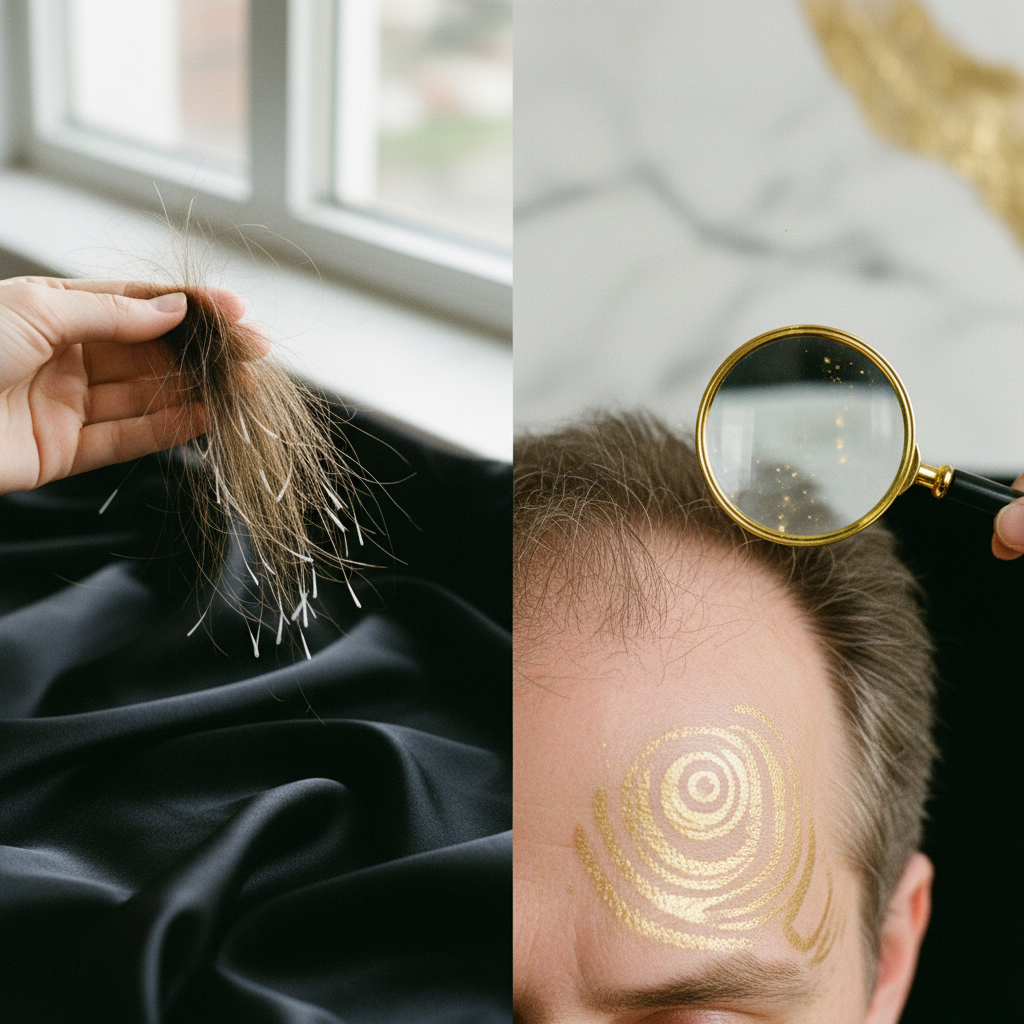
In contrast, pattern baldness is a progressive, patterned thinning seen in both men and women. In men, it typically follows the Hamilton-Norwood scale, affecting the temples, hairline, and vertex. In women, it generally follows the Ludwig pattern, presenting as widening along the central parting while preserving the frontal hairline.
The primary distinction under a dermatoscope is hair shaft thickness. In pattern baldness, studies confirm that more than 20 percent of hairs in the affected zone show diameter variation because DHT gradually constricts the dermal papilla. In chronic telogen effluvium, hair shaft thickness remains uniform across the entire scalp, and the percentage of miniaturised hairs stays well below normal clinical thresholds (typically under 10 percent).
| Feature | Chronic Telogen Effluvium (CTE) | Pattern Baldness (Androgenetic Alopecia) |
|---|---|---|
| Primary Mechanism | Disrupted hair cycle; premature shift from anagen to telogen | Follicular miniaturisation driven by genetic sensitivity to DHT |
| Onset | Abrupt or insidious; chronic shedding lasting over 6 months | Gradual, slow progression over years |
| Shedding Volume | High (often 100 to 400+ hairs daily) | Normal to slightly elevated (usually 50 to 100 hairs daily) |
| Pattern of Loss | Diffuse across the entire scalp, including sides and back | Localised to crown, temples, and vertex (men) or central part (women) |
| Hair Shaft Calibre | Uniform thickness across all shed hairs | Marked variability in hair thickness (anisotrichosis) |
| Bitemporal Recession | Absent; hairline remains intact | Frequent in men; occasionally seen in women |
| Risk of Total Baldness | Zero; follicles do not atrophy | High in untreated male patterns; rare in female patterns |
Biological mechanisms: shedding vs miniaturisation
To understand why these conditions behave differently, you have to look at the hair follicle lifecycle.
A healthy human scalp holds roughly 100,000 hair follicles. At any given moment, 85 to 90 percent sit in the anagen (active growth) phase, which lasts between two and seven years. Around 1 percent rest in catagen (transition), and roughly 10 to 15 percent reside in telogen (resting), which lasts about 100 days before the hair sheds (exogen).
In chronic telogen effluvium, a systemic trigger shortens the anagen phase or forces large waves of follicles prematurely into telogen. Instead of shedding 50 to 100 club hairs per day, you may shed hundreds. Because this process repeats or fails to resolve after six months, overall hair volume drops noticeably, but the hair-producing machinery within the follicle remains completely healthy and unscarred.
In pattern baldness, the anagen phase also shortens, but the primary pathology is morphological. The enzyme 5-alpha reductase converts circulating testosterone into dihydrotestosterone (DHT) inside scalp tissue. In genetically susceptible follicles, DHT binds to androgen receptors in the dermal papilla. This triggers signalling pathways (including TGF-beta) that reduce the blood supply and physically shrink the follicle over successive cycles. Each new cycle produces a shorter, finer, less pigmented terminal hair, eventually producing tiny vellus hair that is barely visible to the naked eye.
What the evidence does not show
There is no clinical evidence that chronic telogen effluvium destroys hair follicles or causes permanent, irreversible baldness. Patients often fear that shedding several hundred hairs a day will inevitably leave them completely bald, but CTE preserves follicular stem cells.

Conversely, clinical evidence does not support the idea that pattern baldness is caused by poor scalp blood flow, clogged pores, or stress alone. While chronic stress and inflammation can exacerbate miniaturisation, pattern baldness requires genetic susceptibility and androgen activity. Massaging your scalp or washing away sebum will not alter the genetic sensitivity of your androgen receptors.
Finally, evidence does not show that using harsh shampoos or styling products causes either condition. External styling habits cause hair shaft breakage, not systemic shedding from the follicle.
Clinical signs to look for
Telling the two conditions apart at home requires observing where and how your hair falls:
- Examine the shed hairs: In CTE, the shed hairs are almost exclusively thick, fully grown terminal hairs with a white bulb at the root (club hairs). In pattern baldness, hairs shed from affected areas are often short, thin, wispy, and uneven in diameter.
- Check the ponytail circumference: CTE causes a rapid, noticeable reduction in total ponytail thickness because hairs are lost evenly from the sides, back, and top. Pattern baldness reduces density primarily on the top and crown while sparing the occipital donor zone at the back of your head.
- Assess the hairline: If your frontal hairline or temples are steadily creeping backward, pattern baldness is almost certainly present. CTE rarely alters the front hairline contour.
- Scalp sensations: Patients with CTE frequently report trichodynia, a painful, burning, or tingling sensation across the scalp that mirrors inflammatory neuropeptide release during sudden hair cycling shifts. Trichodynia is less common in uncomplicated pattern baldness.
Potential overlapping causes
Diagnosing hair thinning is rarely black and white because several internal and external factors can mimic or compound these conditions.
- Nutritional deficiencies: Low ferritin (stored iron), vitamin D deficiency, and zinc imbalances can directly trigger chronic shedding and exacerbate pattern thinning.
- Thyroid dysfunction: Both hypothyroidism and hyperthyroidism disrupt the metabolic activity of follicular matrix cells, leading to diffuse telogen shedding.
- Post-febrile or postpartum triggers: Acute telogen effluvium from childbirth, severe infection, or rapid weight loss typically resolves within six months. If shedding continues past that window, it may have transitioned into CTE or unmasked latent pattern baldness.
- Traction and styling strain: Tight hairstyles cause traction alopecia, which pulls out hairs along the margins, while chemical treatments cause fibre breakage along the shaft. Neither should be confused with systemic shedding.
Everyday care and cosmetic support
When managing chronic shedding or thinning, your primary goal is to maintain a healthy scalp environment while avoiding mechanical stress on vulnerable fibres.
Wash your scalp regularly with gentle, balanced cleansers. Restricting washing because you fear seeing hair fall in the drain is counterproductive. Hair that is ready to shed will fall regardless; delaying washing allows sebum, microorganisms, and environmental debris to accumulate, increasing the risk of scalp irritation.
For individuals experiencing thinning hair, incorporating supportive cosmetic care can help improve hair appearance and strand resilience. Watermans GrowMe Shampoo is formulated with ingredients such as biotin, caffeine, rosemary extract, niacinamide, and argan oil. While cosmetic shampoos cannot alter your genetics or cure medical conditions like pattern baldness, this targeted blend helps nourish the scalp, supports an optimal environment for hair growth, and strengthens existing fibres to reduce daily mechanical breakage.
Alongside topical care, focus on a balanced diet containing adequate protein (around 0.8 to 1.0 grams per kilogram of body weight minimum) to ensure your hair follicles have the building blocks needed to sustain active anagen growth.
When to seek professional advice
You should book an appointment with a dermatologist or certified trichologist if:
- Your hair shedding exceeds 100 to 150 hairs daily for more than three consecutive months.
- You notice distinct patchy hair loss, red plaques, scaling, or scarring on the scalp.
- Your scalp burns, itches, or hurts persistently.
- You are unsure whether your thinning is patterned or diffuse.
A professional will perform a pull test, examine your scalp using a dermatoscope (trichoscopy), review relevant blood panels (ferritin, thyroid-stimulating hormone, full blood count, vitamin D), and, if necessary, take a 4 mm punch biopsy to evaluate horizontal sections of the follicles.
Frequently asked questions about Chronic Telogen Effluvium vs Pattern Baldness
Can you have both conditions at the same time?
Yes, it is common to experience both simultaneously. In many cases, an episode of chronic telogen effluvium unmasks underlying pattern baldness. If your hair sheds diffusely from a systemic trigger, the follicles with genetic sensitivity to DHT may fail to recover their original thickness, accelerating visible pattern thinning.
Does Chronic Telogen Effluvium eventually turn into Pattern Baldness?
No, Chronic Telogen Effluvium vs Pattern Baldness involves two completely different biological pathways. CTE cannot transform into pattern baldness. However, if you already carry the genetic predisposition for androgenetic alopecia, prolonged shedding can speed up the visibility of your patterned hair thinning.
How do dermatologists tell them apart during an exam?
Dermatologists use dermatoscopy to inspect the scalp under high magnification. Pattern baldness displays significant hair shaft diameter diversity (anisotrichosis), yellow dots, and peripilar signs around follicles. In contrast, chronic telogen effluvium shows uniform hair shaft thickness, normal follicular units, and empty hair follicles without miniaturisation.
How long does chronic telogen effluvium last?
By clinical definition, chronic telogen effluvium lasts longer than six months. It can fluctuate for several years, alternating between periods of heavy shedding and relative stability. Fortunately, because the hair follicles do not undergo miniaturisation or permanent scarring, full recovery of density remains biologically possible once the underlying trigger resolves.
Summary of Chronic Telogen Effluvium vs Pattern Baldness
Navigating the differences between Chronic Telogen Effluvium vs Pattern Baldness starts with identifying whether your hair is shedding diffusely from the root or shrinking gradually in a specific zone. Chronic telogen effluvium is an exhausting, high-shed condition that leaves follicles healthy and intact. Pattern baldness is a progressive, hormone-mediated process that requires early intervention to preserve follicle size. By getting an accurate diagnosis through trichoscopy and supporting your scalp with gentle, nourishing care, you can choose the right management path for your hair.
Sources and references
- Whiting, D. A. (1996). Chronic telogen effluvium: increased scalp hair shedding in middle-aged women. Journal of the American Academy of Dermatology, 35(6), 899-906.
- Sinclair, R. (1999). Chronic telogen effluvium: a study of 5 cases. British Journal of Dermatology, 140(1), 84-88.
- Camacho, F. M., & Garcia-Hernandez, M. J. (2002). Telogen effluvium. Seminars in Cutaneous Medicine and Surgery, 21(1), 48-52.
- British Association of Dermatologists. (2020). Telogen Effluvium and Androgenetic Alopecia Clinical Guidelines.
- National Institute for Health and Care Excellence (NICE). (2021). Alopecia androgenetica: Clinical Knowledge Summaries.
Find these ingredients in Watermans products
- Zinc: you will find this ingredient in our Hair Vitamins.
- Niacinamide: you will find this ingredient in our Hair Mask.