The Cell Membrane Complex in Hair: Architecture, Damage, and Care
8 min read ·
The Cell Membrane Complex in Hair acts as the vital lipid mortar binding your cuticles and cortex. Learn how it degrades and how to protect hair elasticity.
Quick answer: The Cell Membrane Complex in Hair acts as the biological intercellular cement holding cuticle scales and cortical cells together. Making up roughly 2 to 3 percent of total fibre weight, this lipid-protein matrix governs moisture diffusion, elasticity, and internal cohesion. When chemical processing or thermal tools degrade it, hair becomes porous, fragile, and prone to breakage. While topical treatments cannot livingly regenerate damaged intercellular layers, lipid-replenishing conditioners and pH-balanced formulations can temporarily reinforce fibre integrity and seal moisture pathways.
Key takeaways
- The Cell Membrane Complex (CMC) glues cuticle layers together and binds cortical spindle cells within the hair shaft.
- It comprises three distinct sub-layers: a central protein-rich beta-layer flanked by two lipid-rich delta-layers.
- Chemical treatments like bleaching, permanent waving, and alkaline colouring strip the 18-methyleicosanoic acid (18-MEA) lipid layer, compromising the CMC.
- Damage to the CMC increases cuticle uplift, accelerates moisture loss, and causes structural fibre breakage rather than follicular hair loss.
- Cosmetic treatments can replenish lost surface and intercellular lipids temporarily, but they cannot biologically regenerate the non-living keratin fibre.
The Cell Membrane Complex in Hair: what the evidence shows
The Cell Membrane Complex in Hair is an intercellular network roughly 25 to 30 nanometres thick that binds adjacent cells throughout the fibre. Electron microscopy studies published in cosmetic science confirm that hair is not a solid block of keratin. Instead, it consists of individual cells cemented together by this continuous lipid-protein matrix.
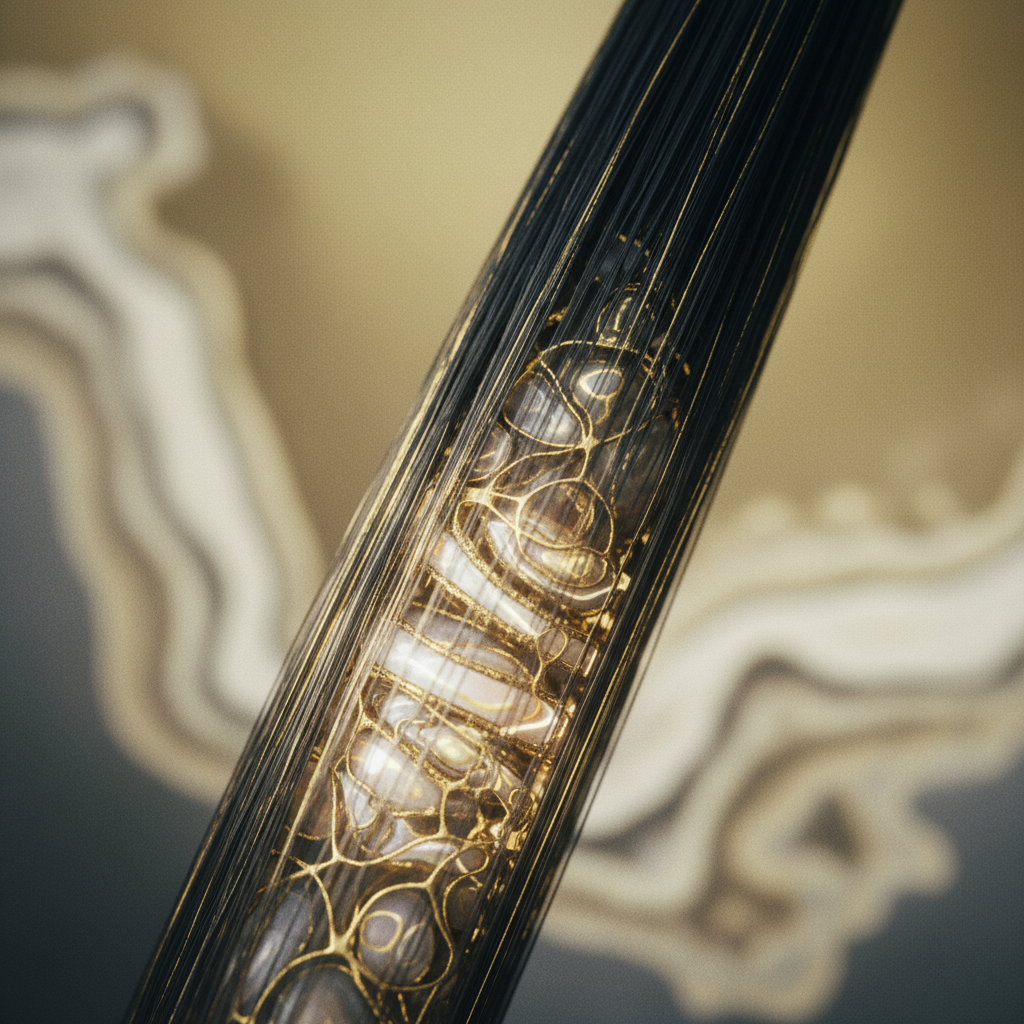
The structure extends from the outer epicuticle right into the central cortex. Researchers divide the CMC into three distinct regions:
- The Cuticular CMC: Located between the overlapping shingle-like cuticle cells. It features a central beta-layer (dense protein) surrounded by two delta-layers (composed of lipids and non-keratinous proteins).
- The Cortical CMC: Located deep within the cortex, where it binds the elongated cortical spindle cells that give hair its tensile strength and elasticity.
- The Cuticle-Cortex Junction: The boundary layer anchoring the protective outer cuticle sheath to the inner structural core.
Chemically, the lipid fraction accounts for only about 2 to 3 percent of the hair's overall dry weight. Yet this tiny fraction controls fundamental physical characteristics. The primary structural lipid is 18-methyleicosanoic acid (18-MEA), a branched fatty acid covalently bound via thioester bonds to the cysteine-rich outer protein membrane. Free fatty acids, ceramides, cholesterol, and cholesteryl esters make up the remainder of the intercellular lipid blend.
When the CMC remains intact, it creates a hydrophobic barrier. This barrier prevents excessive water absorption, limits nutrient leaching, and keeps cuticle scales lying flat against each other.
| CMC Component | Primary Location | Chemical Composition | Main Function |
|---|---|---|---|
| Beta-layer | Centre of cuticular and cortical CMC | Structural proteins, low cysteine content | Provides mechanical adhesion between adjacent cell walls |
| Delta-layers | Flanking the beta-layer on both sides | Sphingolipids, ceramides, cholesterol, fatty acids | Regulates moisture diffusion and provides internal flexibility |
| 18-MEA Layer | Outer surface of epicuticle and upper cuticle CMC | Branched-chain fatty acid (thioester-bonded) | Imparts hydrophobicity and reduces inter-fibre friction |
| Cortical Matrix CMC | Interspersed between macrofibrils in cortex | Non-keratin proteins and polar lipids | Facilitates fibre bending without internal structural fracturing |
What the evidence does not show
Scientific evidence does not show that any cosmetic ingredient, salon treatment, or supplement can biologically regenerate the Cell Membrane Complex in Hair. Hair fibres outside the scalp are non-living, fully keratinised tissue. Once a chemical treatment cleaves the covalent thioester bonds holding 18-MEA, or solvent action dissolves internal ceramides, the body cannot manufacture new intercellular lipids to replace them inside the existing hair shaft.
Controlled research also refutes the claim that CMC degradation causes follicular hair loss or hair shedding. The CMC is an architectural feature of the hair shaft, not the follicle. Degradation of this intercellular glue causes hair breakage along the strand, frayed ends, and split fibres. It does not induce telogen effluvium or pattern hair thinning, which originate deep within the dermal papilla.
The mechanism: how CMC breakdown occurs
Damage to the CMC follows predictable chemical and physical pathways. Alkaline chemical processing represents the most destructive route. When hair undergoes bleaching or permanent colouring, ammonia or ethanolamine raises the fibre pH to 9.0 or higher. This alkaline swelling forces the cuticle scales apart.
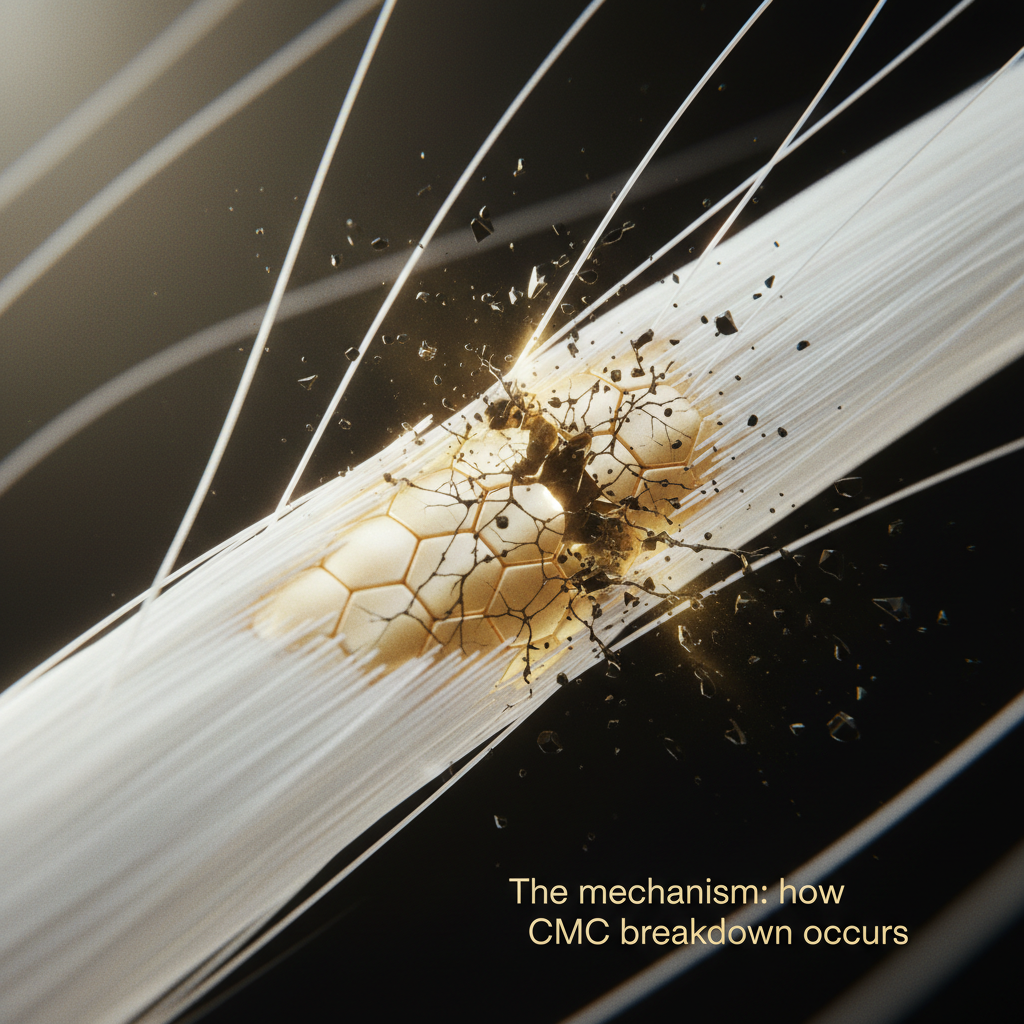
During this process, hydrogen peroxide cleaves the thioester linkages that bind 18-MEA to the outer protein membrane. Studies indicate that a single standard bleaching session can strip up to 80 percent of surface 18-MEA.
Once this hydrophobic shield disappears, polar solvents and water penetrate the cuticular delta-layers directly. Further chemical processing extracts soluble ceramides, cholesterol, and non-keratin proteins from between the cell walls.
Thermal stress accelerates this breakdown. Heat tools operating above 185 degrees Celsius denature the inter-scale proteins and liquify non-polar lipids, allowing them to vaporise or leach out during subsequent washing.
Without this intercellular cement, the individual cuticle scales lift permanently. They chip, split, and detach from the cortex, leaving the inner cortical CMC exposed to atmospheric humidity and friction.
Signs of CMC degradation
When the intercellular cement erodes, the hair shaft displays distinct physical symptoms:
- Persistent hydrophilicity: Wet hair absorbs excessive water rapidly, taking noticeably longer to dry because the hydrophobic lipid seal is missing.
- Micro-tangling and friction: Hair feels rough, velcro-like, or raspy when slid between fingers, caused by uplifted, unglued cuticle scales rubbing together.
- Spontaneous mid-shaft breakage: Strands snap under light tension (such as gentle brushing or towel drying) due to cortical cell separation.
- Porosity fluctuations: Hair absorbs styling products or dye unevenly, often turning muddy or over-processing rapidly at the ends.
- Dull appearance: Light scatters irregularly across jagged, unglued cuticle edges instead of reflecting smoothly.
What you can do to support hair structure
While the living follicle cannot repair the non-living hair shaft, targeted cosmetic strategies can mimic and mechanically reinforce the CMC.
- Topical lipid replacement: Formulations containing biomimetic ceramides, free fatty acids, and phytosterols can penetrate into the microscopic gaps left by extracted intercellular lipids. While these ingredients do not covalently bond like virgin 18-MEA, they temporarily reduce cuticle friction and slow moisture loss.
- pH management: Shampoos and conditioners formulated at a mildly acidic pH (between 4.5 and 5.5) prevent unnecessary fibre swelling. Acidic environments help contract the outer cuticle layers, keeping remaining CMC components compacted between the cell walls.
- Minimise thermal exposure: Keep heated styling tools below 180 degrees Celsius and always use heat protectants containing heat-stable polymers. These polymers form a sacrificial film that absorbs thermal energy before it melts internal lipids.
- Gentle cleansing surfactants: Strong anionic detergents, particularly when used in high-pH formulations, strip away polar lipids. Switching to gentle, amphoteric, or non-ionic surfactant blends preserves the existing lipid envelope.
- Hydrolysed protein support: Small-molecular-weight peptides (under 1,000 Daltons) can migrate into internal cortical voids created when non-keratin proteins leach out, temporarily fortifying structural tensile strength.
When the cause may be something else
If your hair appears thin, sparse, or lacks density, the underlying cause is rarely isolated CMC erosion. Intercellular lipid loss produces hair breakage, which manifests as short, snapped hairs of varying lengths across your clothing or pillow.
In contrast, if you notice an widening parting, diffuse shedding across the scalp, or clumps of hairs coming out with white bulb roots attached, you are experiencing follicular shedding (such as telogen effluvium) or genetic hair thinning (androgenetic alopecia). These conditions require dermatological assessment rather than lipid-focused cosmetic conditioning.
Supporting overall hair vitality with Watermans
When managing hair that suffers from mechanical and environmental fatigue, a holistic approach yields the best cosmetic outcomes. Maintaining a balanced scalp environment gives emerging fibres the best starting point before external wear-and-tear begins.
Watermans products, including the GrowMe Shampoo and ConditionMe Conditioner, are crafted to support cosmetic hair resilience. Watermans ConditionMe incorporates nourishing conditioning agents, cholesterol, and natural emollients that coat stressed fibres, smoothing down rough cuticle edges and improving strand flexibility. By softening mechanical friction, these blends reduce the mechanical tension that causes structurally compromised, CMC-depleted fibres to snap.
Frequently asked questions about The Cell Membrane Complex in Hair
What is the primary role of the Cell Membrane Complex in Hair?
The primary role of the Cell Membrane Complex in Hair is to act as an intercellular adhesive. It cements cuticle scales together on the outside and binds cortical cells internally, controlling moisture diffusion, flexibility, and physical resistance to external friction.
Can salon treatments permanently rebuild damaged hair CMC?
No, salon treatments cannot permanently rebuild the CMC. Hair outside the scalp is non-living tissue. Bond-building and deep-conditioning treatments temporarily fill gaps and lubricate cuticles, but they wash out over time and cannot biologically reform native covalent lipid bonds.
How does bleaching damage the Cell Membrane Complex?
Bleaching degrades the CMC through alkaline swelling and oxidation. Alkaline agents lift cuticle cells, while peroxide cleaves the thioester bonds anchoring surface 18-MEA, allowing crucial intercellular lipids and non-keratin proteins to leach out into the wash water.
What is the difference between cuticle damage and CMC damage?
Cuticle damage refers broadly to the lifting, cracking, or loss of the outer protective scales themselves. CMC damage specifically describes the breakdown of the underlying lipid-protein cement that glues those scales together and anchors them to the cortex.
Can dietary fatty acids restore the lipid layer in existing hair?
Dietary fatty acids cannot restore the lipid layer of hair that has already emerged from the scalp. Good nutrition supports the synthesis of healthy lipids at the follicle stage, but once the fibre grows out, dietary changes cannot replenish stripped hair lipids.
Final perspectives on hair fibre integrity
The Cell Membrane Complex in Hair serves as the critical biological mortar that maintains the fibre's architectural strength, shine, and moisture balance. While everyday chemical processing and heat styling strip its precious lipid pathways and provoke fibre breakage, consistent use of pH-balanced care and lipid-rich conditioners can artificially cushion the strand against mechanical wear. Protecting this delicate matrix from early damage remains the most effective strategy for preserving smooth, resilient, and manageable hair.
Sources and references
- Robbins, C. R. (2012). Chemical and Physical Behavior of Human Hair (5th ed.). Springer Science & Business Media.
- Swift, J. A. (1999). "The hair surface and its significance." International Journal of Cosmetic Science, 21(3), 169-180.
- Masukawa, Y., Narita, H., & Imokawa, G. (2005). "Characterization of the lipid composition at the proximal root and distal tip ends of human hair." Journal of Cosmetic Science, 56(1), 1-16.
- Society of Cosmetic Chemists (SCC). Monograph: Hair Shaft Architecture and Intercellular Lipids.