The Cell Membrane Complex in Hair Care: The Science of Hair's Intercellular Glue
9 min read ·
Understand the cell membrane complex in hair care: how this lipid-rich mortar holds cuticle and cortex cells together, and how to protect hair against breakage.
Quick answer: Understanding The Cell Membrane Complex in Hair Care reveals how individual hair cells bind together. The cell membrane complex (CMC) acts as the biological mortar between cuticle scales and cortical cells, composed of lipids, structural proteins, and 18-methyleicosanoic acid (18-MEA). While the CMC provides essential elasticity, moisture retention, and mechanical strength, its primary limitation is that once damaged by chemical processing or extreme heat, it cannot biologically regenerate, requiring targeted topical cosmetic conditioning to mimic its structural function.
Key takeaways
- The cell membrane complex functions as the structural adhesive holding the cuticle layers and cortical cells together within the hair shaft.
- It consists of roughly 55 to 65 percent protein, 35 to 45 percent lipids (including ceramides, free fatty acids, and cholesterol), and key components like 18-MEA.
- Chemical treatments such as alkaline bleaching and permanent straightening deplete the lipid-rich beta layers, causing porous, brittle fibres.
- While hair cannot biologically regrow or synthesize a lost cell membrane complex, lipid-replenishing conditioners and pH-balanced formulations protect and reinforce remaining structures.
- CMC breakdown leads directly to mechanical breakage, split ends, and moisture loss, but it does not cause biological hair shedding from the follicle.
The Cell Membrane Complex in Hair Care: what the evidence shows
Research in cosmetic trichology and fibre biophysics demonstrates that the cell membrane complex is vital for hair resilience. In the context of The Cell Membrane Complex in Hair Care, scientific studies show that this intercellular pathway occupies roughly 3 to 5 percent of the total hair volume, yet it exerts disproportionate control over hair swelling, chemical diffusion, and shear resistance.

Transmission electron microscopy (TEM) reveals that the CMC separates every single cellular unit of the fibre. It consists of three distinct sub-layers:
- A central protein-rich delta layer (approx 15 to 20 nanometres wide).
- Two flanking lipid-rich beta layers (each approx 5 nanometres wide).
The lipid component contains 18-methyleicosanoic acid (18-MEA), a branched-chain fatty acid covalently bonded to the outer protein layers of the hair cuticle. This gives undamaged hair its natural hydrophobicity, causing water droplets to bead up on the surface rather than soaking in instantly. When hair undergoes alkaline chemical processing, such as bleaching (which typically runs at a pH of 9.5 to 11.0), the thioester linkages anchoring 18-MEA are cleaved. Studies show that a single bleaching session can strip away more than 50 percent of virgin hair surface 18-MEA, converting a hydrophobic, low-friction fibre into a hydrophilic, high-friction, tangle-prone one.
Beyond the cuticle, the internal cell membrane complex cements the macrofibrils inside the hair cortex. When internal CMC lipids deplete, shear forces from brushing or styling cause cortical cells to slide past one another and split along the longitudinal axis, producing classic split ends (trichoptilosis).
What the evidence does not show
Cosmetic science has made rapid progress in lipid chemistry, but marketing claims often outpace biological reality:
- The CMC cannot self-repair. Hair is biologically non-living tissue (keratinised). Once the delta layer breaks down or the beta-layer lipids dissolve, the scalp cannot pump replacement lipids down the length of the shaft to repair the fibre from the inside.
- Topical lipids do not bond permanently. While treatments containing ceramides, biomimetic lipids, or fatty alcohols coat the hair and deposit within the voids of the CMC, these bonds are physical and electrostatic, not permanent covalent bonds. They wash out over successive shampoo cycles.
- CMC damage does not cause follicular hair loss. A compromised cell membrane complex causes the shaft to break, fray, or snap. It has no physical mechanism to trigger alopecia, telogen effluvium, or hormonal thinning, as it exists purely outside the living scalp follicle.
The mechanism: how the CMC works inside the hair
To picture the cell membrane complex, imagine a brick wall. The flattened cuticle cells on the outside and the spindle-shaped cortical cells on the inside are the bricks. The cell membrane complex is the mortar holding every row firmly together.
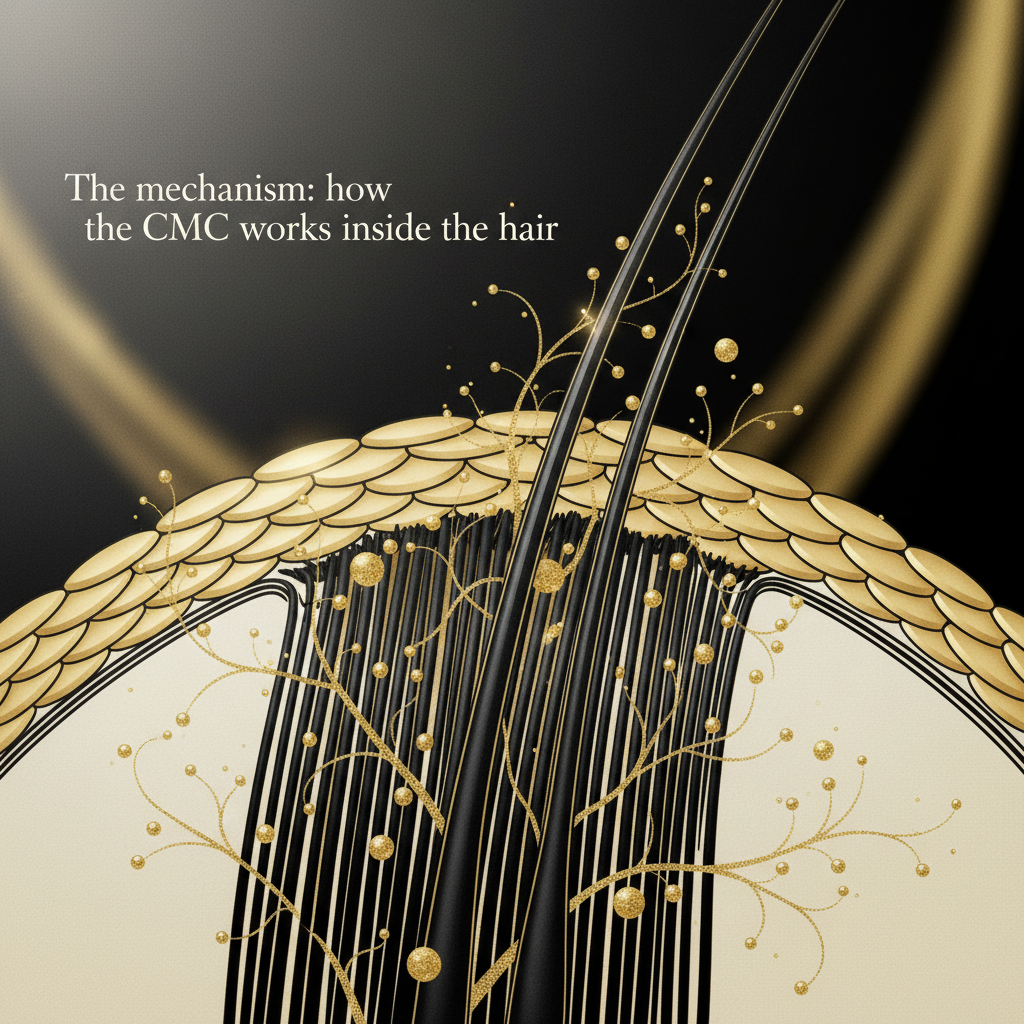
+-----------------------------------------------------------+
| Cuticle Cell |
+-----------------------------------------------------------+
 Beta Layer (Lipids: ceramides, fatty acids, 18-MEA) ~5 nm
 Delta Layer (Structural proteins, low-sulphur content) ~15 nm
 Beta Layer (Lipids: ceramides, fatty acids, 18-MEA) ~5 nm
+-----------------------------------------------------------+
| Underlying Cuticle or Cortical Cell |
+-----------------------------------------------------------+
Water enters hair primarily through the intercellular diffusion pathway provided by the cell membrane complex. Because the delta layer contains polar amino acids and structural proteins with relatively low sulphur content compared to the surrounding matrix, it permits moisture and low-molecular-weight molecules to travel into the cortex.
When the protective beta lipid layers remain intact, water moves in and out at a controlled, measured rate. When those lipid boundaries vanish through chemical or UV degradation, the fibre swells drastically when wet (hygral fatigue) and contracts rapidly when dry. This repeated expansion and contraction breaks the delicate protein bonds within the delta layer, eventually causing the cuticle scales to lift, crack, and flake away.
Signs of cell membrane complex degradation
Recognising damage to the intercellular structure helps you identify the correct restorative routine before mechanical breakage occurs:
- Loss of water-repellency: Healthy hair resists immediate saturation. If hair absorbs water instantly upon contact and feels sodden within seconds, the hydrophobic lipid layer has eroded.
- Extreme wet friction and snagging: A depleted CMC increases inter-fibre friction. When wet, strands grip each other aggressively, leading to severe matting during washing.
- Accelerated dry-out: Hair loses retained internal moisture quickly after washing, leaving it feeling stiff, hollow, and papery within minutes of blow-drying.
- Mid-shaft snapping: Rather than finding full-length shed hairs with a white bulb on your brush, you notice tiny, jagged pieces of broken hair across your sink or clothing.
Comparison: Healthy CMC vs Damaged CMC
| Attribute | Intact Cell Membrane Complex | Damaged Cell Membrane Complex |
|---|---|---|
| Water interaction | Hydrophobic (repels water; droplets bead) | Hydrophilic (absorbs water instantly) |
| Surface lipid layer | Rich in bound 18-MEA | Cleaved 18-MEA, exposing polar proteins |
| Inter-fibre friction | Low; smooth glide between strands | High; strands cling, catch, and knot |
| Elasticity | Resilient; returns to baseline stretch | Poor; stretches excessively then snaps |
| Internal structure | Compact cortical adhesion | Delaminated cortex; high risk of split ends |
| Porosity | Normal (low to medium) | High porosity (rapid swelling, rapid drying) |
What you can do to protect and support the CMC
Because the body cannot biologically replace lost CMC components, hair management requires preventive styling and cosmetic reinforcement.
Maintain an optimal acidic pH
Hair fibres are strongest and most compact at a slightly acidic pH between 4.5 and 5.5. Highly alkaline products (such as harsh clarifying shampoos or relaxers) force the cuticle scales open, dissolving beta-layer lipids and leaching out protein fragments from the delta layer. Using balanced shampoos and acidic post-chemical rinses keeps the cuticle flat and seals the cell membrane complex against mechanical erosion.
Incorporate biomimetic lipids
Conditioners, masks, and serums formulated with ceramides, cholesterol, and natural plant-derived fatty acids help simulate the missing beta layer. While they cannot re-form covalent 18-MEA bonds, they fill the microscopic gaps between lifted cuticle cells, restoring softness, reducing wet friction, and slowing water loss.
Minimize thermal and UV lipid peroxidation
Direct heat over 180 degrees Celsius oxidises and degrades natural hair lipids. Always use a dedicated thermal protectant containing film-forming polymers before blow-drying or flat-ironing. Similarly, ultraviolet radiation (especially UVA) degrades lipid structures through oxidative stress, making UV-filtering leave-in sprays practical for extended outdoor exposure.
Reduce mechanical tension when wet
Because wet hair with a compromised cell membrane complex swells excessively, the internal bonds are under massive hydrostatic pressure. Never brush wet, high-porosity hair aggressively with rigid bristles. Instead, apply a slippery leave-in detangler and use a wide-tooth comb or flexible wet brush, starting at the tips and working upward toward the scalp.
When the cause may be something else
It is vital to distinguish between cosmetic fibre damage and physiological scalp conditions. If you notice a sudden increase in hairs shedding with the bulb attached, your issue is not cell membrane complex wear; it is an internal hair cycle disruption such as telogen effluvium or androgenetic alopecia.
Similarly, coarse or uneven textures can sometimes be genetic rather than the result of stripped lipids. When you run your fingers down a strand and feel regular, knot-like beads, this may indicate trichorrhexis nodosa, a structural defect that can be congenital or triggered by severe physical trauma, not simple lipid loss.
When to get professional advice
Consult a qualified trichologist or dermatologist if you experience:
- Sudden, excessive hair shedding (over 100 to 150 hairs daily) from the scalp.
- Scalp redness, itching, burning, flaking, or pain.
- Thinning patches or widening of the hair part line.
- Complete failure of conditioning treatments to stop snapping, which may require structural microscopic analysis to rule out systemic or genetic fibre anomalies.
Watermans: holistic care for the hair ecosystem
While managing The Cell Membrane Complex in Hair Care demands external moisture control and friction reduction along the lengths, healthy hair begins with the scalp microenvironment. Watermans focuses on providing balanced, nutrient-dense haircare that supports the hair follicle and maintains clean, comfortable conditions at the root. Formulations that avoid unnecessary harshness allow the natural lipid equilibrium of the hair shaft to remain intact from the moment it emerges from the follicle, setting the stage for resilient, manageable lengths throughout their entire growth cycle.
Frequently asked questions about The Cell Membrane Complex in Hair Care
What is the exact role of The Cell Membrane Complex in Hair Care?
The cell membrane complex acts as an adhesive layer that joins the cuticle scales and cortical cells together. In haircare, protecting this complex is crucial because it governs how moisture diffuses through the strand, prevents premature breakage, and keeps the cuticle smooth and reflective.
Can a salon treatment permanently rebuild a broken cell membrane complex?
No salon treatment can permanently regenerate the original cell membrane complex. While professional bond builders and deep lipid masks temporarily bridge broken protein bonds and fill lipid gaps, these benefits gradually diminish with routine washing and mechanical wear, requiring regular at-home maintenance.
How does hair bleach affect the cell membrane complex?
Bleaching agents use strong alkaline chemicals (usually ammonium hydroxide or monoethanolamine) and high-volume hydrogen peroxide. This process aggressively oxidises and breaks the covalent thioester bonds securing 18-MEA, stripping the hair of its primary hydrophobic shield and dissolving internal cortical lipids.
Does shampooing wash away the cell membrane complex?
Harsh, high-pH, or overused sulphate shampoos can gradually strip the unbound surface lipids of the CMC over time. However, gentle, pH-balanced shampoos cleanse the scalp and hair surface without leaching out the deeper structural lipids, preserving the hair's natural intercellular integrity.
Preserving your hair's intercellular foundation
Mastering The Cell Membrane Complex in Hair Care shifts your routine from superficial styling to structural maintenance. By recognising that your hair's internal mortar cannot regrow, you can prioritise preventive care: avoiding unnecessary chemical insults, using pH-appropriate cleansers, replenishing lost surface lipids, and handling wet hair with care. Respecting this microscopic boundary keeps your hair supple, strong, and shielded against daily environmental wear.
Sources and references
- Journal of Cosmetic Science: "The Cell Membrane Complex of Hair: Its Structure, Function, and Role in Hair Care" (2011)
- Robbins, C. R., Chemical and Physical Behavior of Human Hair, 5th Edition, Springer (2012)
- International Journal of Trichology: "Hair Cosmetics: An Overview" (2015)
- Society of Cosmetic Chemists: "The Effect of Bleaching on the Hair Lipid Composition and Cell Membrane Complex" (2018)
- British Association of Dermatologists: "Hair Structure and Common Shaft Disorders" (2021)