The Cell Membrane Complex in Hair: Structure, Function, and Protection
9 min read ·
The Cell Membrane Complex in Hair acts as the lipid cement binding cuticle and cortex cells together. Learn its structure, causes of damage, and how to protect it.
Quick answer: The Cell Membrane Complex in Hair (CMC) is the intercellular lipid-protein cement that binds cuticle scales and cortical cells together throughout the hair shaft. Accounting for roughly 3 to 5 percent of total hair mass, it maintains fibre cohesion, regulates moisture entry, and gives hair its natural flexibility. The main limitation is that the CMC cannot biologically self-repair once damaged, because hair fibre is non-living tissue; lost lipids can only be temporarily reinforced or simulated through targeted topical care.
Key takeaways
- The Cell Membrane Complex in Hair acts as the biological mortar holding cuticle scales and cortex cells together.
- It consists of three structural layers: a central lipid-rich delta layer sandwiched between two protein-dense beta layers.
- Lipids within the CMC, including 18-methyleicosanoic acid (18-MEA), ceramides, and free fatty acids, govern hair hydrophobicity and moisture resistance.
- Chemical processing (such as bleaching or permanent waving), excessive heat, and UV radiation deplete CMC lipids, leading to cuticle lifting and mechanical breakage.
- Topical lipid treatments and pH-balanced formulations can replenish surface smoothness and slow down moisture loss, but they cannot permanently regenerate the original biological structure.
Cell Membrane Complex in Hair: what the evidence shows
Research published in textile, cosmetic, and dermatological literature demonstrates that the Cell Membrane Complex in Hair (CMC) serves as the primary continuous pathway across the entire hair shaft. While keratin proteins form the bulk of the hair's structural matrix (roughly 85 to 90 percent of its dry weight), the CMC accounts for approximately 3 to 5 percent. Despite its relatively small proportion, this multi-layered network determines how the fibre flexes, how water diffuses into the shaft, and how securely outer cuticle scales adhere to each other.
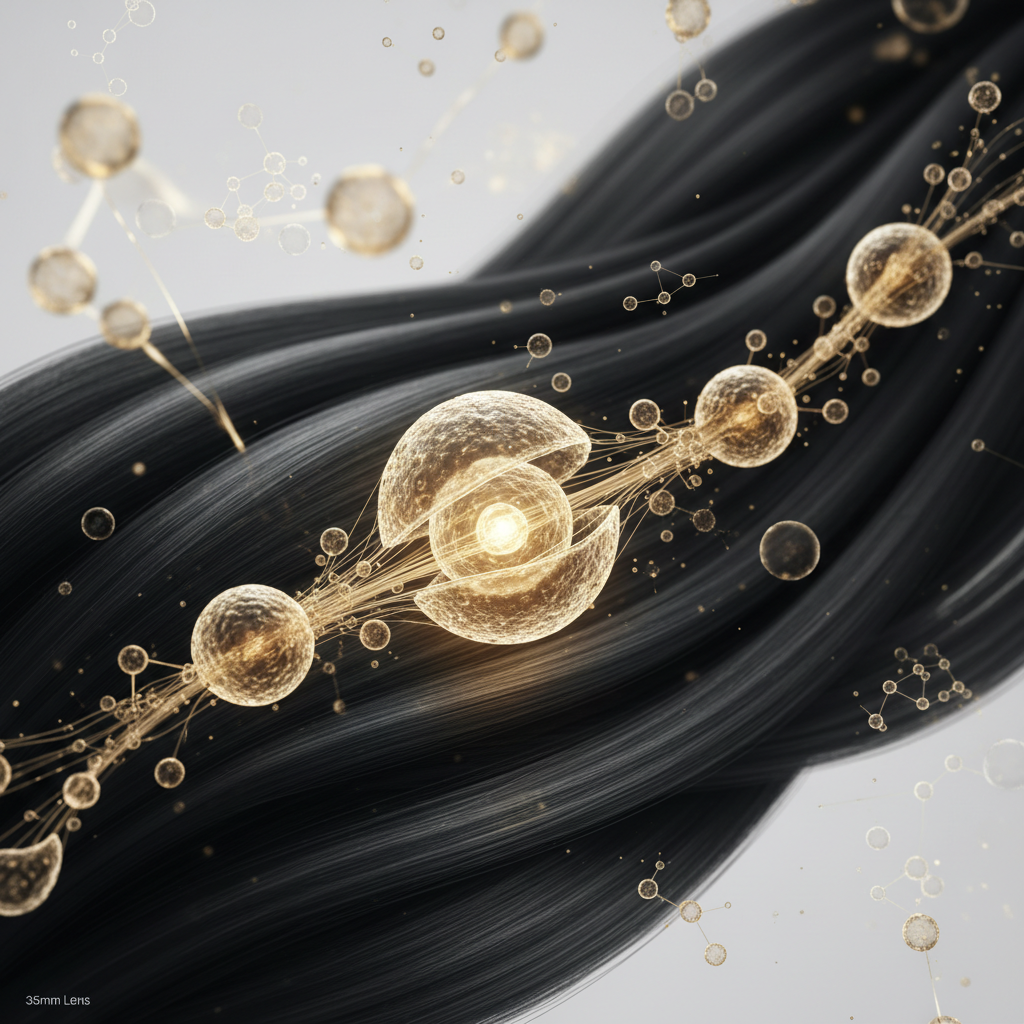
Electron microscopy reveals that the CMC separates every single cellular unit in hair. It exists between overlapping cuticle cells (cuticle-cuticle CMC), between cortex cells (cortex-cortex CMC), and at the boundary where the innermost cuticle layer meets the outer cortex (cuticle-cortex CMC).
The composition of the CMC differs slightly depending on its location within the fibre:
- Cuticle-cuticle CMC: High in specialised lipids, particularly 18-methyleicosanoic acid (18-MEA), which covalently binds to the outer epicuticle to create a hydrophobic, water-repelling barrier.
- Cortex-cortex CMC: Contains a higher concentration of non-keratinous, globular proteins alongside polar lipids like ceramides, cholesterol, and free fatty acids. It provides flexibility, allowing cortical cells to slide slightly against one another under mechanical tension without snapping.
When the CMC is intact, hair resists excessive swelling in water, retains its natural tensile strength, and reflects light smoothly. When the CMC is extracted or oxidised, the fibre becomes fragile, porous, and prone to splitting.
 Cuticle Layer A
+-----------------------------+
| Beta Layer (Protein) |
+-----------------------------+
| Delta Layer (Lipids) | <--- Central lipid cement (ceramides, fatty acids)
+-----------------------------+
| Beta Layer (Protein) |
+-----------------------------+
 Cuticle Layer B
The structural mechanism of the CMC
The architecture of the Cell Membrane Complex in Hair follows a sandwich model, typically measuring between 25 and 30 nanometres in total thickness. It consists of three distinct sub-layers:
- The central delta layer: Measuring roughly 10 to 15 nanometres thick, this middle zone consists of structural lipids, water-soluble proteins, and polysaccharides. It functions as the adhesive core. Ceramides, cholesterol, cholesterol esters, and free fatty acids reside primarily in this zone.
- The two beta layers: Flanking the delta layer on either side are two protein-dense bands, each about 5 nanometres thick. These layers contain high concentrations of cystine-poor proteins that link directly to the cell membranes of neighbouring keratinised cells via thioester and peptide bonds.
The delta layer is the primary route for chemical diffusion. Because the highly cross-linked keratin of the cortex is dense and crystalline, cosmetic chemicals (such as dye precursors, bleaching agents, and perm lotions) travel primarily through the softer delta layer of the CMC to penetrate the hair shaft. This pathway makes the CMC vulnerable during salon chemical services.
| Feature | Cuticle-Cuticle CMC | Cortex-Cortex CMC |
|---|---|---|
| Primary role | Surface protection, water repellence, cuticle adhesion | Internal elasticity, cell cohesion, flexibility |
| Dominant lipids | 18-MEA, free fatty acids | Ceramides, cholesterol, polar lipids |
| Protein nature | Thin beta layers, highly cross-linked boundary | Thicker globular non-keratinous matrix |
| Susceptibility | High vulnerability to alkaline stripping and UV oxidation | Susceptible to deep chemical swelling and cystine cleavage |
| Visible damage sign | Cuticle lifting, surface roughness, frizz, dullness | Internal fibre fatigue, split ends, mid-shaft breakage |
What the evidence does not show
It is vital to distinguish between cosmetic conditioning and structural regeneration. Commercial marketing often claims that deep treatments can "rebuild" or "restore" the cell membrane complex. The evidence does not support this claim.
- No cellular regeneration: Hair fibre is non-vital, meaning it consists of dead, fully keratinised cells without blood supply, cellular metabolism, or DNA replication. Once the covalent bonds linking 18-MEA to the epicuticle are broken by alkaline peroxide, the follicle cannot reattach them down the hair length.
- Breakage is not hair loss: Damage to the CMC causes hair breakage along the shaft. It does not cause follicular hair loss (such as androgenetic alopecia) or telogen effluvium shedding. The CMC is a structural fibre component, not a follicular cycling mechanism.
- Temporary deposition versus permanent replacement: While synthetic ceramides, biomimetic lipids, and fatty alcohols can fill physical voids within the delta layer, washing and environmental exposure gradually remove these ingredients. They do not permanently integrate into the native biological scaffold.
Signs of CMC depletion and damage
When the Cell Membrane Complex in Hair degrades, the physical properties of the fibre change predictably. Key warning signs include:
- Rapid water absorption: Hair soaks up water almost instantly when wet and takes an abnormally long time to dry. This happens because the protective lipid barrier that normally prevents excessive water penetration has degraded.
- Extreme hygral fatigue: Without the hydrophobic protection of the CMC, hair shafts swell excessively when wet and contract violently when dry, weakening the internal keratin bonds over repeated cycles.
- Loss of natural slip: Hair tangles easily, even after conditioning, because lifted cuticle scales snag against adjacent fibres.
- Loss of elasticity: When stretched gently, the hair snaps abruptly rather than stretching and returning to its original length, indicating that the cortex-cortex CMC can no longer cushion cortical cell movement.
- Trichoptilosis (split ends): When cortex-cortex adhesion fails completely at the tips, cortical cells separate longitudinally, creating splits.
Causes of damage to the Cell Membrane Complex
Multiple everyday habits and salon procedures compromise the integrity of the CMC:
- Alkaline chemical services: Bleaching agents, permanent hair dyes, and relaxers require an elevated pH (often pH 9.0 to 11.0) to swell the fibre. This alkaline environment hydrolyses the ester bonds anchoring 18-MEA and dissolves soluble lipids within the delta layer.
- Thermal styling: Flat irons and curling wands operating above 180°C can melt and oxidise free fatty acids and ceramides within the CMC, turning a flexible matrix into brittle, crystalised residue.
- Ultraviolet (UV) radiation: Sunlight generates free radicals that oxidise unsaturated lipids in the CMC, stripping the hair's natural colour and degrading the adhesive capacity of the delta layer.
- Aggressive surfactants: Repeated exposure to harsh, high-pH cleansing agents strips non-polar surface lipids faster than they can be protected, leaving the beta layers exposed to mechanical friction.
What you can do: protecting and supporting the CMC
Because the CMC cannot biologically heal, practical hair care focuses on preventing unnecessary lipid stripping and topically mimicking lost components:
- Cleanse at the right pH: Hair has an isoelectric point around pH 3.67, while a balanced hair shaft thrives between pH 4.5 and 5.5. Cleansing with low-pH, sulphate-free formulations minimises cuticular swelling, keeping the delicate delta layer protected.
- Use biomimetic lipids: Look for products containing ceramides, cholesterol, phytosterols, and natural fatty acids (such as palmitic, stearic, and oleic acids). These molecules fit into microscopic gaps in the delta layer, temporarily restoring hydrophobic protection.
- Thermal defence: Always apply a heat protectant containing polymers before using hot tools. These polymers form an external sacrificial film, absorbing the brunt of thermal energy so internal CMC lipids stay intact.
- Pre-wash oil treatments: Applying penetrating plant oils (such as coconut or argan oil) prior to washing can reduce water uptake. By occupying spaces within the hair shaft, these oils limit the rapid swelling and contraction that tears the delta layer.
- Seal with acidity: Post-colour treatments and conditioning rinses formulated at an acidic pH (3.5 to 4.5) help contract the cuticle layers, mechanically pressing the CMC layers together and reducing lipid loss.
The Watermans approach to fibre maintenance
While the Cell Membrane Complex in Hair is an anatomical structure of the fibre shaft, maintaining overall hair density and fibre strength requires attention from root to tip. Watermans focuses on providing balanced, nutrient-rich formulations designed to support the scalp environment while maintaining cosmetic fibre integrity.
By avoiding overly harsh stripping agents and including gentle cleansing bases, Watermans products help ensure that the natural moisture barrier and protective lipids along the hair shaft are respected during regular washing. Supporting healthy scalp conditions allows newly emerging fibres to develop with an intact, robust cuticle and undamaged cellular cohesion from the very start.
Frequently asked questions about Cell Membrane Complex in Hair
What is the exact role of the Cell Membrane Complex in Hair?
The Cell Membrane Complex in Hair acts as the structural adhesive holding the individual cells of both the cuticle and cortex together. It accounts for 3 to 5 percent of the hair's mass and regulates lipid distribution, moisture absorption, fibre flexibility, and surface hydrophobicity.
Can a damaged Cell Membrane Complex in Hair be repaired permanently?
No, the Cell Membrane Complex in Hair cannot be permanently repaired. Hair fibres consist of non-living, keratinised tissue. Once internal lipids like 18-MEA or ceramides are stripped by chemical processing or heat, they can only be temporarily supplemented with topical lipid-rich conditioners and biomimetic treatments.
How does bleaching affect the Cell Membrane Complex?
Bleaching uses strong oxidising agents in an alkaline medium, which dissolves and extracts the lipids of the delta layer. Crucially, it cleaves the covalent thioester bonds holding 18-MEA to the outer cuticle, transforming hair from hydrophobic (water-repelling) to hydrophilic (water-absorbing), causing porosity and breakage.
What is the difference between the CMC and keratin?
Keratin is a fibrous, insoluble protein that forms the physical bulk of the cortex and cuticle (85 to 90 percent of hair). The CMC is the intercellular lipid-protein cement (3 to 5 percent) that surrounds and binds those keratinised cells together.
How do ceramides help the Cell Membrane Complex?
Ceramides are natural polar lipids found within the delta layer of the cortex-cortex and cuticle-cuticle CMC. When applied topically in conditioners, synthetic or plant-derived ceramides temporarily slip into the eroded spaces of the delta layer, helping to reduce porosity and increase fibre flexibility.
Preserving fibre integrity
Understanding the Cell Membrane Complex in Hair changes the way you approach everyday hair care. Far from being a uniform stick of protein, every hair strand is a complex, composite material held together by delicate lipid-rich pathways. Because the CMC cannot biologically heal once damaged, safeguarding its lipid content against excessive heat, harsh chemical processes, and high-pH cleansing remains the most effective strategy for preventing premature hair breakage and maintaining strong, resilient strands.
Sources and references
- Journal of Cosmetic Science: "The Cell Membrane Complex of Hair: Structure, Function, and Influence on Hair Properties" (2012)
- Robbins, C. R., Chemical and Physical Behavior of Human Hair, 5th ed., Springer-Verlag, New York (2012)
- International Journal of Trichology: "Hair Cosmetics: An Overview" (2015)
- Society of Cosmetic Chemists: "The structural lipids of human hair and their role in fibre performance" (2017)
- Dermatology Research and Practice: "Lipids of the Hair Shaft: Structure and Function" (2019)
Find these ingredients in Watermans products
- Argan Oil: you will find this ingredient in our Hair Growth Shampoo.