Caring for Coloured Hair: The Definitive Science-Backed Guide
9 min read ·
Evidence-based guide to Caring for Coloured Hair: protect the 18-MEA lipid barrier, prevent colour fade from water and heat, and stop hair breakage.
Quick answer: Caring for Coloured Hair requires protecting an artificially altered fibre structure from moisture loss, mechanical friction, and oxidative fading. Chemical processing lifts the protective cuticle layer and degrades the hair's natural 18-methyleicosanoic acid (18-MEA) lipid barrier, leaving hair porous and susceptible to water-induced colour leaching. An effective regimen uses low-pH, sulphate-free cleansers, targeted conditioning proteins, lukewarm water, and thermal protection. However, topical care cannot physically rejoin severed disulphide bonds; it primarily seals the cuticle and slows external colour degradation.
Key takeaways
- Chemical tinting and bleaching strip the hydrophobic 18-MEA lipid layer from the cuticle, making hair hydrophilic and prone to rapid moisture swelling.
- Water exposure is responsible for substantial colour fade because water causes the cortex to swell, allowing synthetic colour pigments to wash out.
- Maintaining an acidic surface pH (between 4.5 and 5.5) helps contract the cuticle scales, locking in artificial dye molecules and improving shine.
- Hair snapping along the shaft is chemical fibre breakage, not root hair loss; true follicular shedding happens at the scalp level.
- Heat tools accelerate thermal oxidation and pigment degradation, making daily thermal barrier protection essential for shade longevity.
Caring for Coloured Hair: what the evidence shows
Caring for Coloured Hair centres on counteracting the permanent physical and chemical alterations caused by cosmetic dyes. When you colour your hair, an alkaline agent such as ammonia or monoethanolamine (MEA) elevates the fibre's pH, which typically rests between 4.5 and 5.5. This alkaline shift forces the overlapping shingles of the cuticle layer to lift outward.
Once open, oxidising agents penetrate into the internal cortex to either bleach natural melanin or deposit synthetic dye precursors that polymerise into larger colour molecules. While this chemical pathway yields rich shades, peer-reviewed cosmetic dermatology studies demonstrate that the process permanently strips the hair of its native protective lipid layer, known as 18-methyleicosanoic acid (18-MEA).
Without this covalently bound lipid barrier, the hair transitions from naturally hydrophobic (water-repelling) to hydrophilic (water-attracting). This structural change means the cortex absorbs water rapidly during washing. The resulting swelling and contraction cycle, called hygral fatigue, physically displaces artificial dye molecules, causing visible fading.
Evidence shows that washing frequency, water temperature, and shampoo surfactant chemistry are the primary drivers of colour loss. Gentle, sulphate-free surfactants clean without excessively stripping surface lipids, helping colour stay vibrant for longer.
What the evidence does not show
Topical cosmetic formulations cannot reverse internal chemical alteration. While marketing terms often suggest products can rebuild broken hair, cosmetic science indicates that severed cystine disulphide bonds do not naturally re-fuse simply through the application of standard conditioning agents.
Furthermore, evidence does not show that using cold water completely stops colour wash-out. Lukewarm water is preferable to very hot water because heat increases fibre swelling, but cold water cannot fully seal open cuticles if the underlying structural chemistry remains disrupted.
Finally, poor hair condition after colouring should not be conflated with medical hair loss. Chemical processing affects the non-living keratin shaft outside the skin; it does not shut down the follicle unless an intense chemical burn occurs directly on the scalp.
The mechanism: why colour fades and hair breaks
Understanding why dyed hair behaves differently requires examining the architecture of the hair fibre:
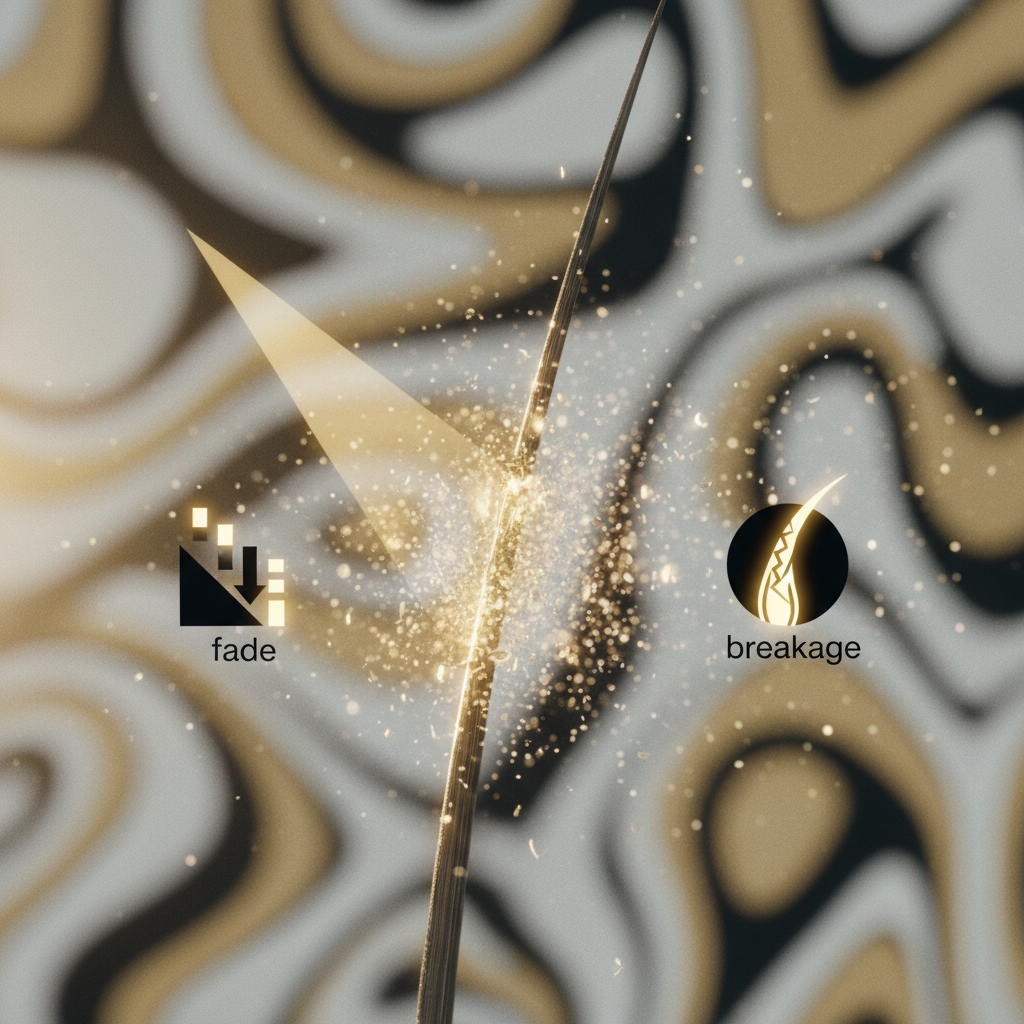
[ Natural Fibre ] -> Intact Cuticle + Hydrophobic 18-MEA Shield -> Retains Moisture & Pigment
[ Chemical Dye Process ] -> Alkaline Swelling -> Cuticle Lifts -> 18-MEA Stripped
[ Treated Fibre ] -> High Porosity -> Water Enters Easily -> Pigments Leach -> Fibre Weakens
When 18-MEA is degraded, hair loses its natural lubrication. Friction between neighbouring strands rises dramatically, leading to cuticle chipping, jagged edges, and split ends.
Simultaneously, oxidation breaks the internal disulphide cross-links that provide hair its tensile strength and elasticity. When stretched during detangling or styling, colour-treated hair hits its yield point far sooner than virgin hair, snapping mid-shaft.
Coloured hair also oxidises under ambient ultraviolet (UV) radiation. Sunlight breaks down both synthetic dye complexes and natural keratin proteins, generating free radicals that turn brunette shades brassy and cause vibrant reds to degrade quickly.
Signs your colour-treated hair needs targeted care
Damaged or fading coloured hair exhibits specific physical symptoms:
- High wet porosity: Strands feel spongy, gummy, or excessively heavy when wet, taking an unusually long time to dry naturally.
- Rapid shade shifting: Rich tones turn dull, warm, or brassy within two to three weeks of salon application.
- Tangles and friction: Strands catch on each other easily, producing a rough, straw-like sensation when running fingers from mid-lengths to ends.
- Short white bulbs absent on fallen strands: Short broken pieces appear on clothes or styling brushes without the white keratin sheath that marks a naturally shed root hair.
- Dull light reflection: The hair appears matte because lifted, jagged cuticle scales scatter light rather than reflecting it evenly.
Comparison: virgin hair vs coloured hair behaviour
| Characteristic | Virgin Hair | Coloured or Bleached Hair | Daily Management Implication |
|---|---|---|---|
| Surface Nature | Hydrophobic (repels excess water) | Hydrophilic (readily absorbs water) | Use protective leave-in sealants before wetting |
| Cuticle Position | Tightly closed and smooth | Raised, fragmented, or porous | Needs low-pH (4.5 to 5.5) conditioning rinses |
| Tensile Strength | High structural elasticity | Reduced due to disulphide bond cleavage | Comb gently with wide teeth; avoid high-tension brushing |
| Lipid Barrier | Intact 18-MEA layer present | Largely depleted or removed | Apply fatty alcohols, plant oils, and biomimetic lipids |
| Thermal Vulnerability | Tolerates moderate heat | Burns and oxidises easily | Use heat protectants up to 230°C on every heat cycle |
What you can do: evidence-based care strategies
Adopting a practical, protective routine preserves both hair fibre integrity and pigment saturation:
- Optimise wash chemistry: Choose sulphate-free, mild surfactant cleansers that operate at an acidic pH. This limits cuticle expansion and reduces pigment run-off.
- Regulate water temperature: Wash and rinse with lukewarm or cool water. High-temperature water accelerates cortex swelling and strips surface treatments prematurely.
- Incorporate hydrolysed proteins: Formulations containing hydrolysed keratin, wheat protein, or silk amino acids temporarily deposit inside cuticle gaps, reinforcing structural tensile strength and reducing breakage.
- Replenish lost lipids: Look for products containing ceramides, fatty acids, and natural oils like argan, jojoba, or abyssinian oil to recreate the missing hydrophobic surface coating.
- Shield against thermal tools: Always apply a leave-in spray containing heat-distributing polymers such as polyquaternium or silicone derivatives before using blow-dryers, straighteners, or curling wands.
- Filter hard water: If you live in an area with hard municipal water, dissolved calcium and magnesium ions can bind to damaged cuticle sites, creating a brittle coating and distorting blonde shades. A chelating shampoo used every few weeks clears mineral build-up without stripping colour.
When the cause may be something else
If you notice widespread thinning, a widening parting line, or hair detaching with its white root bulb intact, the underlying cause is not chemical colouring. These are symptoms of follicular hair shedding or loss:
- Telogen effluvium: A temporary condition where physiological stress, nutritional deficiencies, illness, or hormonal fluctuations push an unusually high percentage of follicles into the resting phase.
- Androgenetic alopecia: Genetic thinning driven by dihydrotestosterone (DHT) sensitivity, which miniaturises follicles at the crown and hairline over time.
- Traction alopecia: Persistent mechanical pulling from tight ponytails, extensions, or braids that physically damages the root structure.
Distinguishing between hair breakage (snapping shafts from bleach and dye damage) and follicular shedding ensures you apply the correct care strategy.
Supporting colour-treated hair with Watermans
When managing coloured hair, keeping the scalp balanced while caring for fragile strands is crucial. Watermans Grow Me Shampoo provides a gentle, sulphate-free wash base that cleanses without aggressively stripping the hair shaft.
Enriched with biotin, rosemary extract, caffeine, and argan oil, it fosters an ideal scalp environment while leaving colour-treated hair feeling refreshed and resilient. Pairing it with a deeply moisturising, lipid-replenishing conditioner like Watermans Condition Me helps detangle, smooth raised cuticles, and reduce mechanical styling breakage.
When to get professional advice
Consult a registered trichologist or a consultant dermatologist if you experience persistent scalp irritation, burning, scabbing, or widespread diffuse shedding from the root after a colouring appointment. Contact allergies to paraphenylenediamine (PPD) and related dye compounds can develop suddenly, requiring medical assessment and patch testing.
For severe chemical damage such as extreme brittleness or extensive fibre melting, consult an experienced professional colourist who can apply in-salon corrective treatments and adjust chemical formulas to preserve your remaining hair integrity.
Frequently asked questions about Caring for Coloured Hair
How soon after salon colouring should I wash my hair?
Waiting 48 to 72 hours before shampooing gives the hair fibre time to stabilise after chemical processing. It also allows natural scalp sebum to begin lightly recoating the dry cuticle layer. When you do wash, use lukewarm water and a gentle, sulphate-free formula.
Does Caring for Coloured Hair require special sulphate-free shampoos?
Yes. Sulphate surfactants, such as sodium lauryl sulphate, have high cleansing efficiency that can lift the cuticle and strip artificial colour molecules rapidly. Sulphate-free shampoos use gentler cleansing agents that clean effectively while helping to preserve your colour investment.
Can coloured hair ever fully regain its natural virgin strength?
No. Once chemical processing removes the 18-MEA lipid layer and oxidises internal disulphide bonds, the biological structure is permanently altered. However, dedicated cosmetic conditioning, protein treatments, and lipid sealants can closely replicate natural smoothness and significantly reduce fibre snapping.
Why does dyed red hair fade faster than brunette shades?
Synthetic red dye molecules are chemically smaller than natural eumelanin or brown dye molecules. Because coloured hair is porous, these smaller red pigments leach out through lifted cuticle scales far more rapidly during normal washing and water exposure.
Does hard water ruin colour-treated hair?
Hard water contains dissolved minerals, particularly calcium, magnesium, and copper. In porous, colour-treated hair, these minerals readily adhere to the hair shaft, leading to brassiness, green tints in blonde hair, and an unpleasantly stiff, brittle texture.
Summary
Successful Caring for Coloured Hair requires a proactive approach focused on moisture retention, gentle cleansing, and structural protection. While chemical colouring alters the natural keratin framework and strips vital protective lipids, a balanced routine can preserve vibrant tones and strong strands. By washing with low-pH, sulphate-free cleansers, minimising excessive heat, and replenishing the hair's surface barrier with quality lipids and proteins, you can keep your colour luminous and protect your hair from breakage.
Sources and references
- American Academy of Dermatology Association. "Dermatologists' alternative to common hair care habits that damage hair." (2022).
- Robbins, C. R. Chemical and Physical Behavior of Human Hair. 5th ed., Springer-Verlag, (2012).
- Cruz, C. F., et al. "Human hair characteristics, chemistry, and cosmetic treatments: an overview." International Journal of Cosmetic Science (2016). DOI: 10.1111/ics.12327.
- Evans, A., & Wickett, R. R. Practical Modern Hair Science. Allured Business Media, (2012).
- Masukawa, Y., et al. "Characterization of the lipid layer on the human hair surface and its role in hair surface properties." International Journal of Cosmetic Science (2005). DOI: 10.1111/j.1467-2494.2005.00255.x.
Find these ingredients in Watermans products
- Copper: you will find this ingredient in our Hair Vitamins.