Caffeine and Follicle Stimulation: Mechanisms, Evidence, and Scalp Health
9 min read ·
Learn the science of Caffeine and Follicle Stimulation, including how topical caffeine penetrates the scalp, blocks DHT, and boosts hair vitality.
Quick answer: The relationship between Caffeine and Follicle Stimulation centres on topical caffeine's ability to penetrate the scalp barrier, counteract dihydrotestosterone (DHT) activity, and stimulate cellular metabolism in hair matrix cells. Laboratory and clinical trials indicate topical caffeine prolongs the anagen (growth) phase and improves hair shaft elongation. However, its main limitation is that cosmetic topical formulations cannot cure genetic hair loss or replace prescription medical therapies for advanced androgenetic alopecia.
Key takeaways
- Topical caffeine reaches the hair follicle within minutes of application, penetrating through both follicular pathways and the stratum corneum.
- Laboratory research demonstrates that caffeine counteracts the suppressive effects of testosterone and DHT on keratinocyte proliferation.
- Caffeine acts as a phosphodiesterase inhibitor, raising intracellular cyclic adenosine monophosphate (cAMP) levels to encourage cellular division in the hair bulb.
- Drinking coffee will not deliver adequate caffeine concentrations to the scalp; effective follicle stimulation requires topical delivery.
- Cosmetic caffeine shampoos and scalp serums support hair density and reduce shedding, but established pattern baldness requires clinical dermatological oversight.
Caffeine and Follicle Stimulation: what the evidence shows
Research into Caffeine and Follicle Stimulation gained international prominence following pioneering in vitro studies led by dermatological researchers at the University of Jena in Germany. In 2007, a landmark study published in the International Journal of Dermatology demonstrated that caffeine concentrations between 0.001% and 0.005% stimulated the growth of human hair follicles cultivated in laboratory conditions.
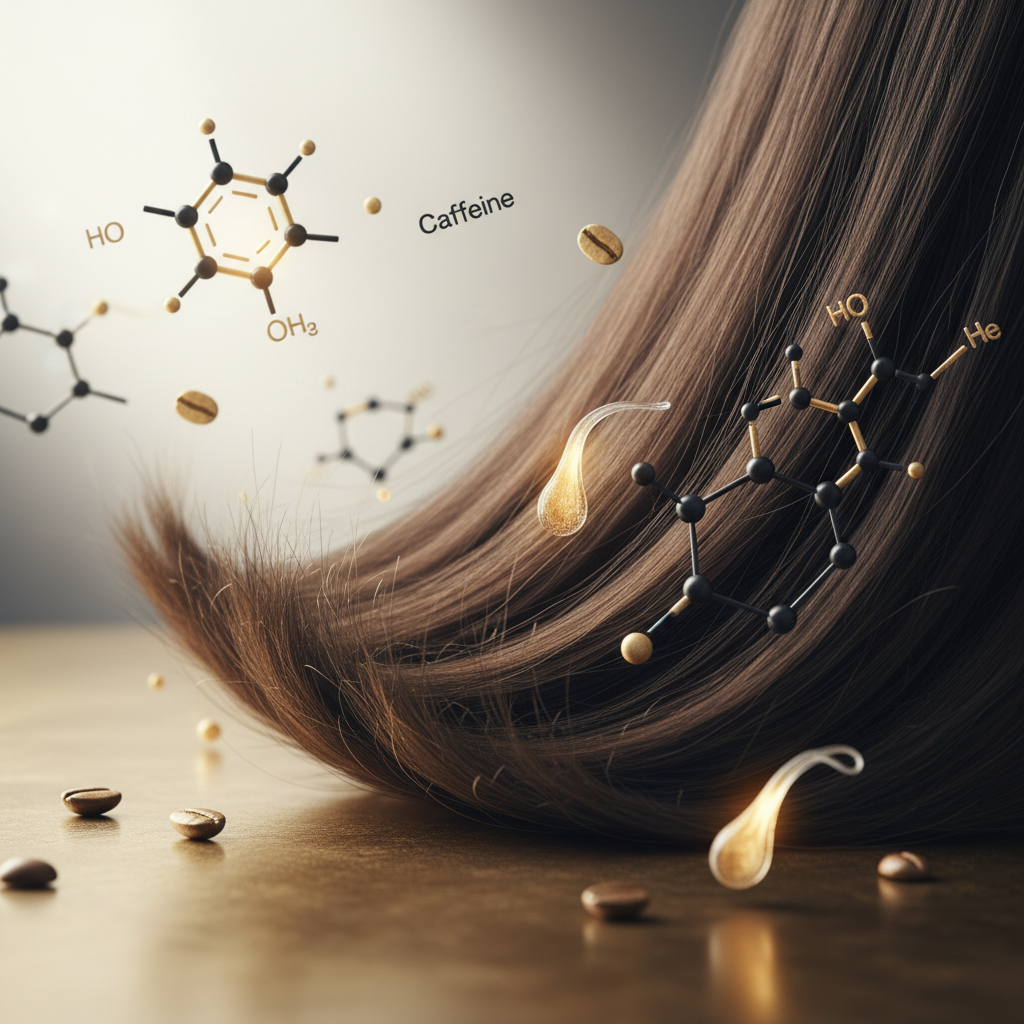
When follicles were exposed to testosterone, their growth was significantly suppressed, mimicking the biology of androgenetic alopecia. However, when caffeine was introduced alongside testosterone, it neutralised this suppressive effect, producing shaft elongation and prolonging the anagen duration.
Subsequent investigations focused on human in vivo penetration. A 2007 study conducted at the Charité University Hospital in Berlin examined how quickly caffeine penetrates the human scalp. Using a shampoo formulation left on the scalp for just two minutes, researchers detected caffeine in the hair follicles after only two minutes, with systemic transdermal absorption occurring after twenty minutes. This confirmed that the hair follicle acts as an efficient reservoir for topical caffeine, allowing the active molecule to reach the dermal papilla.
Clinical trials comparing topical caffeine solutions to standard treatments have yielded promising results. A 2017 six-month, open-label, non-inferiority clinical trial published in Skin Pharmacology and Physiology evaluated a 0.2% topical caffeine liquid against 5% minoxidil in men with androgenetic alopecia. The study found that topical caffeine showed non-inferior efficacy to 5% minoxidil in increasing the anagen hair ratio, offering a well-tolerated cosmetic alternative for people experiencing early-stage follicular miniaturisation.
| Delivery or Evaluation Method | Mechanism or Pathway | Observed Effect on Follicle | Clinical Limitation |
|---|---|---|---|
| Topical Rinse-Off (Shampoo) | Follicular infundibulum uptake within 2 minutes | Mild cellular stimulation, supports hair strand retention | Short contact time limits maximum absorption depth |
| Topical Leave-On (Serum / Tonic) | Follicular and interfollicular penetration over 24 hours | Sustained cAMP elevation and metabolic stimulation | Requires daily, consistent application to maintain benefit |
| Oral Ingestion (Beverages) | Systemic circulation via bloodstream | Negligible; systemic toxicity occurs before follicular threshold is reached | Oral doses cannot safely achieve therapeutic follicular levels |
| Prescription Topicals (Minoxidil) | Potassium channel opening, vasodilation | Proven clinical hair regrowth across diverse populations | Potential scalp irritation, hypertrichosis, and shedding upon cessation |
The biological mechanism of action
To understand how caffeine supports the hair follicle, you have to look at the cellular machinery inside the hair bulb. The dermal papilla regulates the follicular cycle, dictating when an individual strand moves from anagen (growth) to catagen (regression) and telogen (rest).
Caffeine functions primarily as a non-specific phosphodiesterase (PDE) inhibitor. Within the cell, phosphodiesterase enzymes break down cyclic adenosine monophosphate (cAMP), a vital secondary messenger responsible for signalling cellular proliferation and active metabolism. By inhibiting phosphodiesterase, caffeine allows intracellular cAMP levels to rise. This surge in cAMP triggers cellular division among matrix keratinocytes, accelerating the construction of new hair fibre.
At the same time, caffeine exerts a protective influence against androgen-mediated signalling. In individuals genetically predisposed to androgenetic alopecia, hair follicles on the crown and temples are sensitive to dihydrotestosterone (DHT). DHT binds to androgen receptors in the dermal papilla, triggering the release of transforming growth factor beta (TGF-beta), a signalling protein that forces the follicle into premature catagen.
Caffeine downregulates TGF-beta expression while promoting insulin-like growth factor 1 (IGF-1), a protein that maintains the anagen phase and encourages healthy shaft expansion.
What the evidence does not show
While laboratory and clinical data confirm biological activity, it is vital to distinguish between cosmetic follicle stimulation and medical treatment.
The evidence does not show that caffeine can:
- Revive dead or completely fibrosed hair follicles where scarring or long-term smooth baldness has occurred.
- Permanently alter your genetic sensitivity to DHT once you stop using the topical formulation.
- Work through dietary intake. To achieve the concentration used in laboratory follicle cultures, you would need to consume between 50 and 100 cups of coffee a day, a dosage that is toxic to the human body.
- Treat autoimmune forms of hair loss, such as alopecia areata or frontal fibrosing alopecia, which involve T-cell mediated follicular destruction rather than metabolic slowdown.
Hair shedding (telogen effluvium) and hair breakage are also frequently confused with permanent hair loss. Caffeine does not repair broken disulfide bonds along damaged hair shafts; that is a structural fibre issue addressed by conditioning agents and protein treatments, not follicle stimulation.
How to integrate caffeine into your haircare routine
If you want to harness topical caffeine for hair retention and density, consistency and contact time are the critical factors:
- Prioritise direct scalp exposure: Whether using a shampoo, conditioner, or leave-on scalp treatment, the product must make physical contact with the skin. Part your hair into sections to ensure the liquid reaches the scalp rather than sitting exclusively on the hair strands.
- Respect the contact window: If using a wash-off product like a caffeine shampoo, leave it on the scalp for at least two minutes before rinsing. This provides the minimum window required for follicular penetration.
- Combine with scalp massage: Gentle mechanical massage using the pads of your fingers increases local superficial blood flow, aiding product distribution across the infundibulum.
- Maintain regular use: Because caffeine is metabolised and cleared by the scalp within 24 to 48 hours, benefits require steady, ongoing application.
Formulations that support follicle vitality: Watermans
When formulating products for thinning or sluggish hair, ingredient synergy makes a substantial difference. Caffeine performs best when combined with complementary active compounds that support scalp health and barrier resilience.
Watermans incorporates high-grade caffeine alongside biotin, argan oil, rosemary, allantoin, and lupin protein in its Grow Me Shampoo and Condition Me Conditioner. This formulation focuses on delivering nutrients directly to the scalp environment while reinforcing the exterior fibre against daily mechanical breakage. By combining topical caffeine with botanical extracts that soothe the scalp and condition the cuticle, it creates an optimal ecosystem for fuller-looking, resilient hair.
When hair loss signals something else
Not all hair loss stems from hormonal miniaturisation or sluggish follicular division. If you notice rapid shedding, patchy circular bare spots, or scalp inflammation, caffeine will not solve the underlying issue.
Consider these potential alternative causes:
- Nutritional deficiencies: Low serum ferritin (stored iron), vitamin D3 insufficiency, and zinc deficits frequently cause telogen effluvium.
- Thyroid dysfunction: Both hypothyroidism and hyperthyroidism disrupt the metabolic clock of the follicle, leading to diffuse hair shedding.
- Physical or emotional shock: High fever, surgery, severe illness, or major psychological distress can push large populations of anagen hairs into telogen roughly three months after the triggering event.
- Scalp disorders: Severe seborrhoeic dermatitis, psoriasis, or fungal infections cause inflammation that impairs hair anchoring.
When to seek professional advice
You should consult a GP, registered trichologist, or dermatologist if you experience:
- Sudden, patchy, or coin-shaped areas of total hair loss.
- Scalp itching accompanied by severe redness, burning, pain, scaling, or pustules.
- Shedding that exceeds 100 to 150 hairs daily for longer than six consecutive weeks.
- Significant thinning accompanied by changes in your menstrual cycle, acne, or unexplained weight shifts.
A professional can perform dermoscopy, run blood panels, and determine whether you require prescription interventions such as topical minoxidil, oral anti-androgens, or anti-inflammatory treatments.
Frequently asked questions about Caffeine and Follicle Stimulation
Can drinking more coffee stimulate my hair follicles?
No. Ingesting caffeinated drinks does not deliver therapeutic concentrations to your scalp. The liver metabolises ingested caffeine, distributing tiny fractions throughout the entire body. Achieving follicular stimulation through consumption would require dangerously toxic intake levels. Effective follicle stimulation demands direct topical application.
How quickly does caffeine penetrate down to the hair follicle?
Research from the Charité University Hospital in Berlin demonstrates that caffeine in a topical rinse-off shampoo penetrates the hair follicle within two minutes of application. When left on the scalp, it continues to diffuse into deeper surrounding tissue for several hours.
Is Caffeine and Follicle Stimulation effective for everyone?
Caffeine supports follicular activity primarily in hair experiencing sluggish growth or early stages of androgenetic thinning. It cannot stimulate follicles that have completely atrophied or closed due to long-term baldness or scarring alopecias.
Does topical caffeine cause any side effects on the scalp?
Topical caffeine is generally well-tolerated. Rare side effects are typically related to the vehicle base rather than the caffeine itself, including mild contact redness or dryness. Unlike oral caffeine, topical application does not cause jitteriness, insomnia, or elevated heart rates when used as directed.
Can I stop using caffeine shampoo once my hair feels thicker?
If your hair fullness improves from topical caffeine, maintaining those results requires ongoing use. Caffeine does not permanently rewrite the genetics of your hair follicles. Discontinuing use allows the follicles to return gradually to their natural biological pace.
Balancing expectations and science
Understanding the realistic potential of Caffeine and Follicle Stimulation empowers you to make informed decisions about your daily regimen. While cosmetic caffeine products cannot match the pharmacological potency of prescription hair-loss drugs, the peer-reviewed evidence confirms that topical caffeine penetrates quickly, boosts intracellular energy, and shields the hair bulb from androgenic stress. Combined with a balanced diet, proper scalp hygiene, and realistic expectations, caffeine represents one of the most reliable and accessible cosmetic tools for supporting fuller, stronger-feeling hair.
Sources and references
- Fischer, T. W., Hipler, U. C., & Elsner, P. (2007). Effect of caffeine and testosterone on the proliferation of human hair follicles in vitro. International Journal of Dermatology, 46(1), 27-35.
- Otberg, N., Teichmann, A., Rasuljev, U., Sinkgraven, R., Sterry, W., & Lademann, J. (2007). Follicular penetration of topically applied caffeine via a shampoo formulation. Skin Pharmacology and Physiology, 20(4), 195-198.
- Dhurat, R., Chitallia, J., May, T. W., Jayaraaman, A. M., Madhukara, J., Maitryan, S.... & Schürer, N. (2017). An open-label randomized multicenter study assessing the noninferiority of a caffeine-based topical liquid 0.2% versus minoxidil 5% solution in male androgenetic alopecia. Skin Pharmacology and Physiology, 30(6), 298-305.
- Fischer, T. W., Herczeg-Lisztes, E., Funk, W., Zillikens, D., Bíró, T., & Paus, R. (2014). Differential effects of caffeine on hair shaft elongation, matrix and outer root sheath keratinocyte proliferation, and transforming growth factor-β2/insulin-like growth factor-1-mediated regulation of the hair cycle in male and female human hair follicles in vitro. British Journal of Dermatology, 171(5), 1031-1043.
- National Institute for Health and Care Excellence (NICE). (2022). Alopecia androgenetica: Scenario: Management of androgenetic alopecia. NICE Clinical Knowledge Summaries.
Find these ingredients in Watermans products
- Zinc: you will find this ingredient in our Hair Vitamins.