Bleached Hair Care and Protein Balance: A Scientific Guide
9 min read ·
Bleached Hair Care and Protein Balance requires managing peptide reinforcement and moisture elasticity to prevent brittle breakage and restore chemically damaged hair.
Quick answer: Bleached Hair Care and Protein Balance requires managing two competing physical states: replenishing lost structural peptides without creating brittle fibre stiffness. Chemical bleaching oxidises melanin by stripping the protective 18-methyleicosanoic acid (18-MEA) lipid layer and degrading internal keratin polypeptide chains. Restoring integrity involves applying hydrolysed proteins to patch cortical voids, balanced equally with emollients and humectants to preserve fibre elasticity. However, topical protein treatments cannot permanently rebuild broken covalent disulphide bonds; they provide temporary reinforcement that washes out over time.
Key takeaways
- Bleaching oxidises and dissolves up to 15 to 20 percent of hair's internal keratin mass while stripping the protective surface lipid layer.
- Hydrolysed proteins deposit inside cuticular voids, temporarily restoring tensile strength and reducing wet fibre elongation.
- Too much protein without sufficient moisture causes fibre stiffness, making bleached strands snap under low mechanical stress.
- The wet stretch test helps diagnose whether bleached fibre lacks structural protein, moisture, or both.
- Topical cosmetic treatments cannot permanently reform severed cystine disulphide bonds, meaning maintenance must be consistent and ongoing.
Bleached Hair Care and Protein Balance: what the evidence shows
Bleaching relies on an alkaline persulphate and hydrogen peroxide mixture that swells the hair cuticle and oxidises natural melanin pigment. During this process, the chemical reaction non-selectively degrades the protein matrix of the hair cortex. Research published in the Journal of Cosmetic Science shows that repeated bleaching significantly reduces cystine content, converting it into cysteic acid through oxidation. This irreversible cleavage of disulphide bonds weakens the keratin backbone, creating a porous, mechanically fragile fibre that absorbs water rapidly yet cannot retain internal hydration.

Bleached Hair Care and Protein Balance is the systematic equilibrium between structural reinforcement and mechanical flexibility. Hydrolysed proteins, such as low-molecular-weight wheat, keratin, or silk proteins (typically under 1,500 Daltons), can penetrate the lifted cuticle layers and diffuse into the outer cortex. These peptides form temporary hydrogen and ionic bonds with the damaged keratin chains. Controlled mechanical testing demonstrates that hair treated with appropriate concentrations of hydrolysed protein exhibits increased resistance to breaking under tension.
The balance breaks down when users mistake structural rigidity for health. Cosmetic scientists have long observed that over-accumulating high-molecular-weight proteins on highly porous bleached hair produces a hard, inflexible shell. When hair lacks moisture and plasticity, normal brushing or styling generates brittle mechanical fracture, causing the fibre to snap clean along the shaft. True equilibrium pairs penetrative peptides with fatty alcohols, conditioning lipids, and humectants to maintain pliability.
The biological mechanism: why bleached hair loses structural integrity
Natural, unbleached hair possesses an intact outer epicuticle coated in 18-methyleicosanoic acid (18-MEA), a covalently bound fatty acid that repels water and keeps the surface hydrophobic. The interior cortex contains tightly bundled keratin intermediate filaments rich in the amino acid cystine. These filaments give hair its elasticity and mechanical resilience.
Bleaching strips 18-MEA within minutes of application, turning the hair surface hydrophilic. Water penetrates freely, causing rapid cortical swelling followed by rapid desiccation when drying. More critically, the alkaline bleach oxidises cystine linkages:
- Disulphide bond cleavage: Peroxide oxidises the sulphur atoms in cystine, yielding soluble cysteic acid residues.
- Protein leaching: As the structural cross-links degrade, fragmented keratin peptides leach out of the cortex into the chemical wash bath.
- Pore formation: The loss of cortical mass leaves microscopic voids within the macrofibril structure, drastically reducing the tensile load the strand can support before snapping.
Because severed disulphide bonds cannot spontaneously reconnect, external peptide fragments must be introduced to occupy these physical gaps and temporarily support the matrix.
Recognising the signs: protein deficiency versus protein overload
Bleached hair displays distinct physical cues depending on whether it requires structural reinforcement, lipid-rich moisture, or a reduction in treatment frequency.
| Hair Characteristic | Protein-Deficient Bleached Hair | Balanced Bleached Hair | Protein-Overloaded Bleached Hair |
|---|---|---|---|
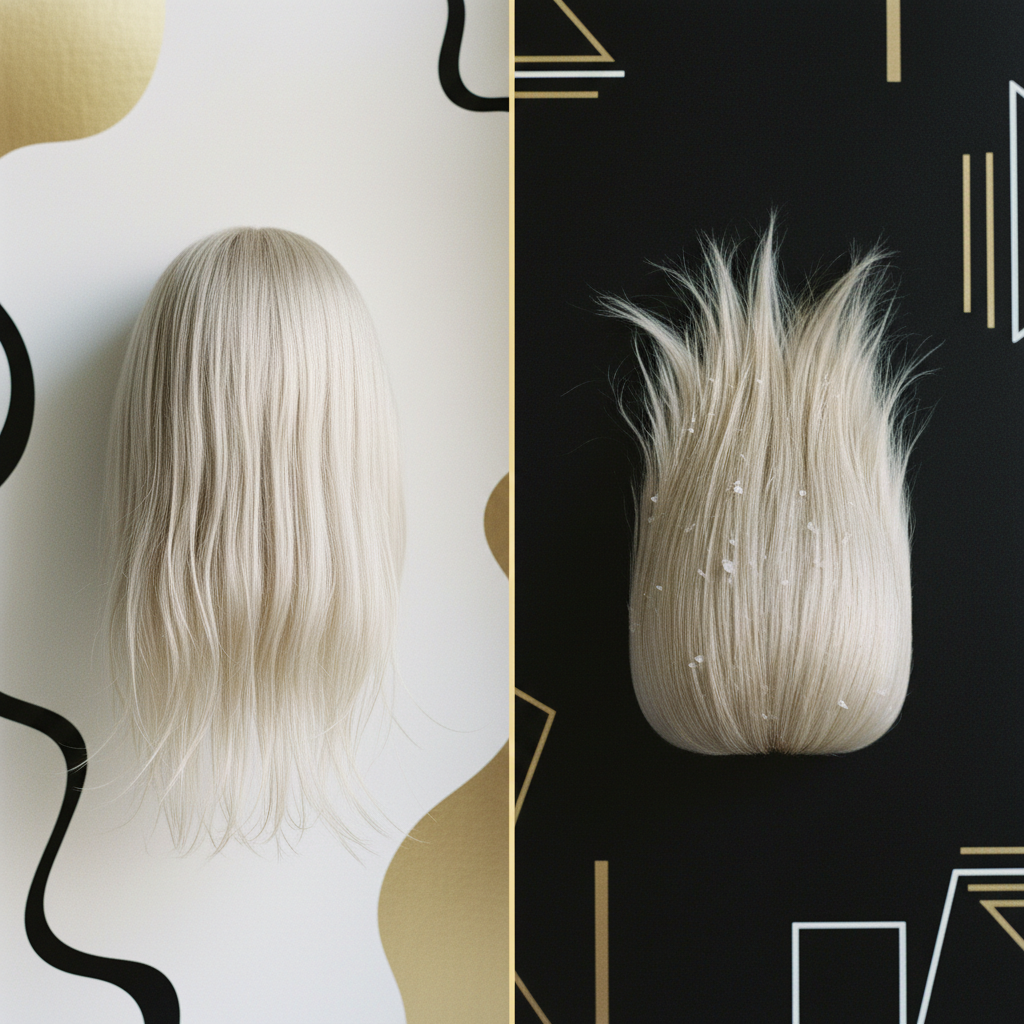
| Wet stretch behaviour | Stretches excessively, feels gummy, does not return to length | Stretches roughly 20 to 30 percent, snaps back smoothly | Little to no stretch, snaps immediately under low tension |
| Dry texture | Mushy when damp, lifeless and limp when dry | Soft, pliable, smooth cuticular surface | Coarse, straw-like, raspy, tangled at ends |
| Breakage pattern | Stretches thin before tearing or tearing off in clumps | Minimal breakage during routine detangling | Snaps cleanly into short, rigid shards when combed |
| Porosity & water uptake | Absorbs water instantly, takes hours to dry | Absorbs and releases moisture at moderate rates | Repels topical conditioners, feels coated and stiff |
To perform an accurate wet stretch test at home or in the salon: Take a single strand of wet, clean hair. Hold it firmly between your thumb and forefinger on both hands, leaving roughly two inches of exposed strand in the middle. Gently pull outwards.
- If it stretches continuously like chewing gum and curls up into a limp knot, it is protein-deficient.
- If it yields slightly, exhibits natural spring, and returns to its original dimension without deforming, it is balanced.
- If there is no give and the fibre snaps instantly under minimal tension, it is suffering from protein overload and requires intensive moisture and clarifying.
What the evidence does not show
Topical proteins do not reconstruct living tissue or permanently regenerate the cortex. Hair is non-living, biological keratin once it emerges past the follicular infundibulum. Peer-reviewed dermatological literature confirms that no shampoo, conditioning mask, or salon treatment can reverse cysteic acid back into cystine.
Furthermore, evidence does not show that all protein forms act identically. Large, unhydrolysed proteins (such as raw egg or whole milk proteins) possess molecular weights far exceeding 100,000 Daltons. These molecules are physically too large to penetrate the cuticle barrier, which generally permits ingress only to peptides under 1,500 to 3,000 Daltons. Applying food-grade proteins merely forms an uneven, sticky surface film that can worsen cuticular friction without restoring internal tensile strength.
A routine to restore bleached hair stability
Managing bleached fibre requires alternating between structural peptide reinforcement and lipid restoration.
Step 1: Gentle, low-friction cleansing
Bleached cuticle scales remain permanently propped open. Use a sulphate-free, pH-balanced shampoo (pH 4.5 to 5.5) to cleanse the scalp without forcing cuticular swelling. Avoid scrubbing lengths vigorously, which induces mechanical friction and cuticular shearing.
Step 2: Targeted hydrolysed protein application
Apply a targeted reconstructive treatment containing hydrolysed keratin, wheat protein, or amino acids every 2 to 4 washes, depending on the severity of chemical processing. Work the product into damp mid-lengths and ends where chemical porosity is highest. Observe contact time strictly according to the formulation; leaving protein treatments on indefinitely does not increase efficacy and accelerates brittle cuticle stiffening.
Step 3: Lipid and humectant replenishment
Always follow a protein step with a rich emollient conditioner or lipid mask containing cetyl alcohol, stearyl alcohol, or plant-derived triglycerides. These replenish surface lubricity, fill outer gaps, and seal water into the cortex, counterbalancing the rigidity introduced by the peptide treatment.
Step 4: Leave-in thermal and friction protection
Wet bleached hair exhibits a high coefficient of friction. Apply a leave-in detangler containing light silicones or low-weight plant oils before combing with a wide-tooth comb. Always apply a heat protectant prior to blow-drying; unbuffered heat on bleached hair oxidises the remaining keratin matrix at temperatures as low as 160 degrees Celsius.
When breakage is not a protein issue
It is critical to distinguish between structural breakage and follicular hair loss. Bleached hair frequently snaps along the mid-shaft or ends due to chemical degradation, which can give the appearance of thinning. However, this is fibre breakage, not alopecia.
If you are experiencing true hair shedding, where hairs fall out from the scalp with the tiny white bulb (keratinised root sheath) intact at the end, the underlying cause is not chemical bleaching or protein imbalance. Widespread shedding usually stems from telogen effluvium triggered by systemic stressors, hormonal fluctuations, nutritional deficiencies (such as low serum ferritin or zinc), or thyroid dysfunction. Similarly, gradual thinning at the parting or crown indicates androgenetic alopecia. Protein masks cannot resolve follicular shedding or pattern thinning.
Supporting hair density with Watermans
While cosmetic treatments reinforce damaged hair fibres, supporting the scalp environment is essential for maintaining natural hair vitality at the root. Watermans Grow Me shampoo is formulated with stimulating topical ingredients including biotin, caffeine, rosemary extract, niacinamide, and argan oil. It delivers gentle, sulphate-free cleansing suitable for chemically compromised hair, helping to maintain scalp health and nourish new growth without stripping vulnerable bleached lengths.
Frequently asked questions about Bleached Hair Care and Protein Balance
How often should I apply protein to bleached hair?
Most bleached hair benefits from a hydrolysed protein treatment once every 2 to 3 weeks. If hair has undergone multi-process lightening or high-lift tinting, a weekly low-molecular-weight amino acid treatment may be necessary initially. Always alternate with a deeply moisturising, protein-free mask to avoid stiffening the hair shaft.
Can Bleached Hair Care and Protein Balance reverse chemical damage?
No treatment can permanently reverse chemical damage or reform destroyed cystine bonds. Bleached Hair Care and Protein Balance works by temporarily lodging microscopic peptide fragments into cortical voids, restoring strength and elasticity through hydrogen and ionic bonding. This effect diminishes with successive washes, requiring ongoing maintenance.
What is the quickest way to fix protein overload in bleached hair?
To resolve protein overload, stop all products containing keratin, collagen, silk, or hydrolysed vegetable proteins. Wash with a gentle clarifying or chelating shampoo to remove surface polymer build-up, then apply a rich, protein-free deep conditioning treatment with heat (such as a warm towel) for 20 minutes to restore lipid flexibility.
Why does bleached hair stretch like elastic when wet?
Bleached hair loses structural disulphide bonds and cortical protein mass, destroying its internal cross-linking. Without these rigid structural anchors, the wet keratin chains slide past one another unchecked under tension, causing the hair to stretch excessively, feel gummy, and fail to snap back into its natural shape.
Does bleaching cause hair loss at the follicle?
Bleaching causes fibre breakage, not follicular hair loss, unless the chemical burns the scalp. Severe chemical burns from high-volume peroxide left on the skin can damage follicles and cause cicatricial scarring, but standard bleaching simply breaks hair strands along the shaft, giving the visual illusion of reduced density.
Finding equilibrium for chemically lightened hair
Bleached Hair Care and Protein Balance is not about saturating the hair with maximum keratin; it is an ongoing negotiation between structural support and physical pliability. Chemical bleaching inevitably compromises the cuticle and degrades the internal cortical matrix. By learning to read your hair's mechanical elasticity, applying targeted hydrolysed peptides sparingly, and consistently replenishing lost lipids, you can protect bleached strands from excessive breakage and keep your hair looking resilient, soft, and vibrant.
Sources and references
- Robbins, C. R. (2012). Chemical and Physical Behavior of Human Hair. 5th ed. Springer-Verlag.
- Journal of Cosmetic Science (2004). "The effect of chemical treatments on the mechanical properties and cystine content of human hair."
- British Association of Dermatologists. (2020). Hair breakage versus hair loss: clinical differentiation and patient management.
- International Journal of Trichology (2011). "Hair cosmetics: An overview."
- Cruz, C. F., et al. (2017). "Human hair: A review on its structure, properties, and the influence of cosmetic treatments." Cosmetics, MDPI.
Find these ingredients in Watermans products
- Zinc: you will find this ingredient in our Hair Vitamins.