How Bleach and Chemical Treatments Affect Hair Structure
8 min read ·
Discover how bleach and chemical treatments affect hair structure at a molecular level, impacting cuticle health, disulphide bonds, and overall hair strength.
Quick answer: Understanding how bleach and chemical treatments affect hair structure reveals that these processes fundamentally alter the hair's physical and chemical integrity. Bleaching agents, permanent dyes, relaxers, and perms raise the protective cuticle scales, degrade natural melanin, and break down vital cystine disulphide bonds within the cortex. While modern conditioning agents and bond builders can temporarily reinforce weak fibres and reduce breakage, they cannot completely rebuild the hair's native molecular matrix once these internal bonds are permanently broken.
Key takeaways
- Chemical processes rely on alkaline pH levels (typically 9.0 to 11.5) to swell the cuticle and penetrate the inner cortex.
- Bleaching dissolves melanin granules while oxidising cystine into cysteic acid, permanently weakening the hair shaft.
- Chemical relaxers convert disulphide bonds into lanthionine bonds, permanently reducing the tensile strength of the fibre.
- The protective outer f-layer (18-methyleicosanoic acid) is stripped away during chemical lightening, leaving hair porous and hydrophobic qualities lost.
- Cosmetic bond builders and protein treatments reinforce damaged fibres against mechanical snapping, but cannot fully reverse biological protein loss.
How Bleach and Chemical Treatments Affect Hair Structure: what the evidence shows
When assessing how bleach and chemical treatments affect hair structure, cosmetic scientists evaluate three distinct anatomical layers: the cuticle, the cortex, and the cell membrane complex. Hair is composed of roughly 65 to 90 percent protein (primarily keratin), along with water, lipids, trace elements, and melanin. Chemical alteration forces these tightly bound, hydrophobic structures open to create lasting changes in colour or shape.
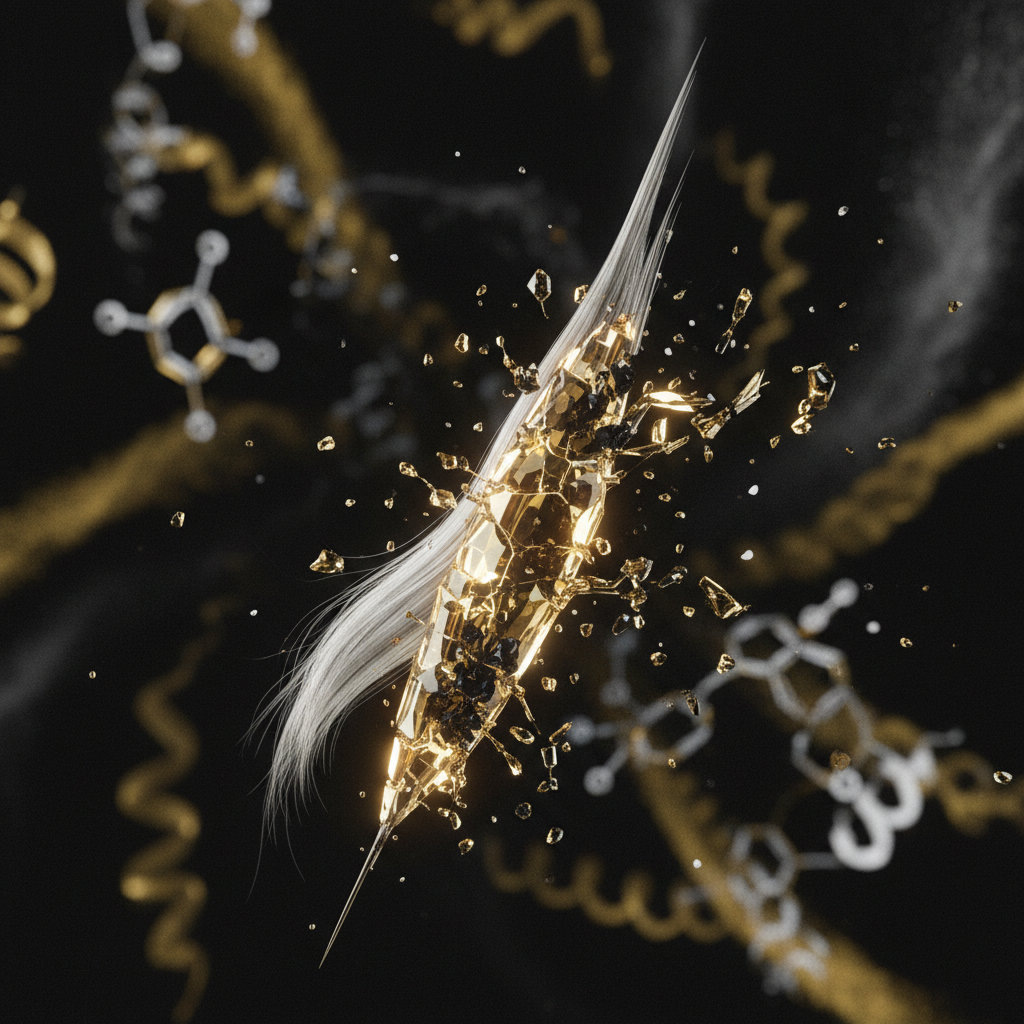
Permanent lightening agents rely on alkaline chemicals, such as ammonium hydroxide or ethanolamine, combined with hydrogen peroxide. Under a scanning electron microscope, virgin hair shows smooth, overlapping cuticle scales resembling roof tiles. Following bleaching, these scales swell, lift, crack, and frequently break away entirely.
Within the cortex, hydrogen peroxide oxidises natural melanin pigment, rendering it colourless. Concurrently, the peroxide indiscriminately attacks keratin proteins. It breaks the strong disulphide bonds that give hair its strength and elasticity, converting them into cysteic acid. Research published in cosmetic science literature indicates that a single high-lift bleaching session can destroy 15 to 45 percent of a hair fibre's cystine content, leaving the shaft brittle, highly porous, and prone to mechanical fracture.
Virgin Cuticle (Intact 18-MEA) ➔ Alkaline Swelling (pH 9-11) ➔ Disulphide Bond Cleavage ➔ Protein Leaching & Cysteic Acid
Relaxers and perms operate on a related mechanical pathway. Alkaline relaxers (such as sodium hydroxide or guanidine hydroxide) operate at a high pH (typically 12.0 to 14.0). They cleave roughly one-third of the hair's disulphide bonds, converting them into non-reconnectable lanthionine bonds. This permanently straightens the fibre but permanently lowers its tensile yield point. Perms, conversely, use reducing agents like ammonium thioglycolate to sever disulphide bonds, reshape the fibre around a rod, and re-oxidise them with hydrogen peroxide. Not all bonds reconnect, leaving permanent micro-structural deficits.
| Treatment Type | Mechanism of Action | Typical Working pH | Impact on Disulphide Bonds | Primary Structural Risk |
|---|---|---|---|---|
| Powder Lightener (Bleach) | Alkaline swelling; oxidises melanin and keratin matrix | 9.5 to 11.0 | Irreversible oxidation of cystine to cysteic acid | Extreme porosity, cuticle ablation, snapping |
| Permanent Hair Dye | Lifts cuticle, oxidises natural melanin, deposits synthetic dye | 9.0 to 10.5 | Moderate disulphide oxidation | Cuticle chipping, surface friction, moisture loss |
| Hydroxide Relaxer | Cleaves cystine to form lanthionine bonds | 12.0 to 14.0 | Irreversible bond conversion (lanthionisation) | Significant loss of tensile strength, mid-shaft breakage |
| Thioglycolate Perm | Reduces disulphide bonds; re-oxidises in new shape | 8.5 to 9.5 | Temporary cleavage; incomplete bond reformation | Structural weakness, curl fragmentation, frizz |
What the evidence does not show
There is no scientific evidence demonstrating that topical treatments, salon glosses, or bond-building additives can permanently repair or regenerate broken disulphide bonds back to their native, virgin state. Products containing bis-aminopropyl diglycol dimaleate, maleic acid, or hydrolysed vegetable proteins create cross-links or temporary ionic bridges between damaged keratin fragments. These treatments help preserve tensile strength during and after chemical processing, but they wash out or degrade over time.
Additionally, scientific consensus does not show that chemical processing causes genuine hair loss at the follicle, provided the chemicals do not cause severe chemical scalp burns. Chemical treatments cause hair breakage along the hair shaft. While extreme breakage can make hair appear dramatically thinner, the follicular root remains unaffected unless the chemical causes direct scalping or severe irritant contact dermatitis.
The molecular mechanism: from 18-MEA loss to porosity
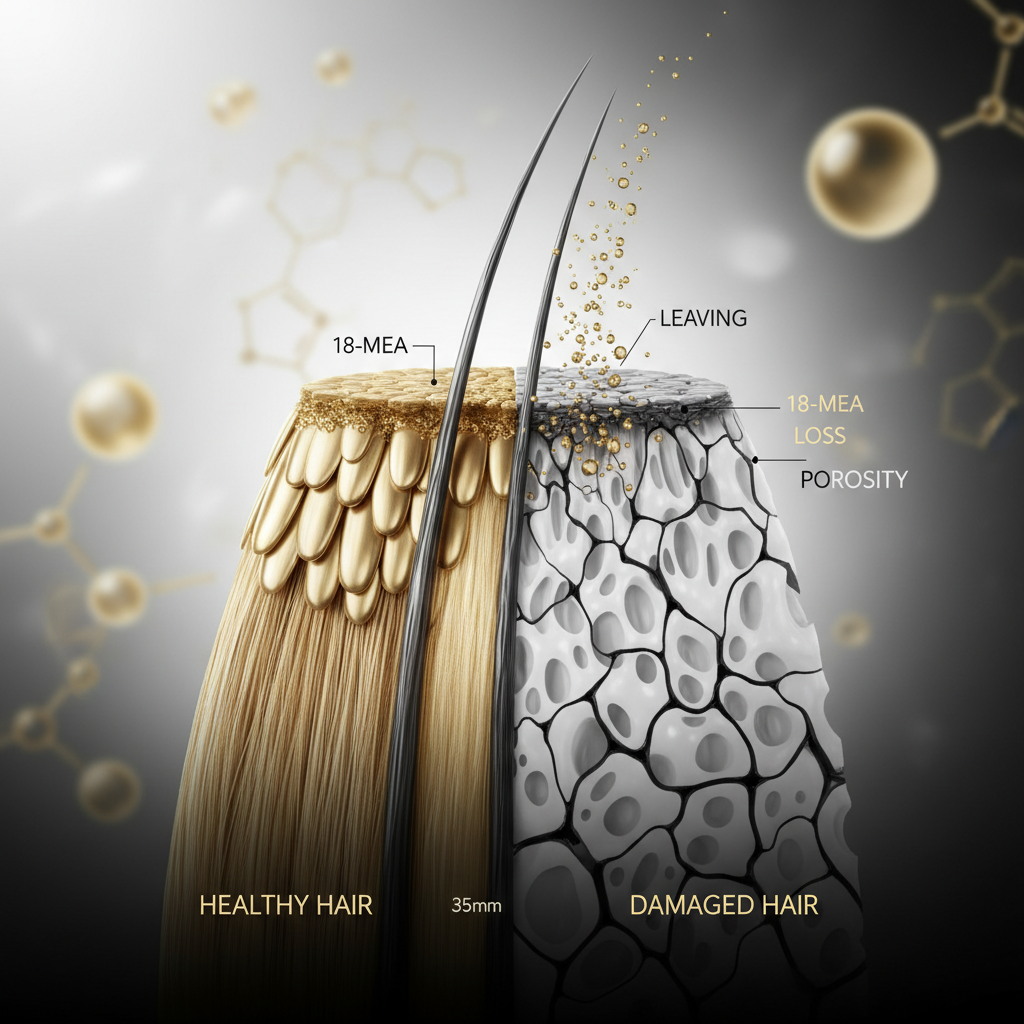
Hair fibre integrity depends on a microscopic lipid layer called 18-methyleicosanoic acid (18-MEA), chemically bound to the outermost cuticle surface. This lipid f-layer makes healthy hair naturally water-repellent (hydrophobic) and silky to the touch.
When you apply bleach or chemical processes:
- Lipid stripping: The alkaline environment instantly saponifies and strips the protective 18-MEA layer. Hair shifts from being hydrophobic to hydrophilic, meaning it readily absorbs environmental moisture, swells, and becomes vulnerable to mechanical stress.
- Cell membrane complex disruption: The chemical penetrates past the cuticle into the cell membrane complex (the intercellular cement holding cells together), leaching out natural ceramides and lipids.
- Cystine oxidation: Peroxide converts cystine into hydrophilic cysteic acid. Higher levels of cysteic acid create negative electrical charges along the hair shaft, increasing friction between strands and causing tangling.
- Protein leaching: Cavities and voids develop inside the cortex. When the hair is washed, micro-fragments of hydrolysed keratin protein leach out into the rinse water, leaving the hair fibre hollowed and limp.
Signs of chemical structural damage
Hair altered by excessive chemical exposure displays distinct physical symptoms:
- High wet elasticity with no recovery: Hair stretches out like wet chewing gum when pulled gently, then snaps without bouncing back.
- Rapid absorption and water logging: Strands absorb water immediately upon wetting, feel heavy and gummy in the shower, and take significantly longer to dry.
- Persistent surface roughness: Hair catches on fine combs and tangles constantly due to raised, jagged cuticle edges.
- Trichorrhexis nodosa: The presence of tiny white dots along the hair shaft where the cortex has completely collapsed, forming microscopic points of impending fracture.
What you can do to manage treated hair
While you cannot biologically regrow dead shaft tissue, you can protect the structural remnants of treated hair:
- Integrate bond-building formulations: Use bond-multiplying technologies during and after bleaching to create temporary cross-links across damaged protein chains.
- Restore surface lipids with low pH: Use conditioning formulations with a pH of 3.5 to 5.0. Mild acidity helps flatten remaining cuticle scales and neutralise residual alkalinity.
- Apply film-forming proteins: Hydrolysed keratin, wheat protein, and amino acids temporarily fill cortical voids, increasing the mechanical force required to break the fibre.
- Minimise thermal and friction stress: Reduce blow-drying heat below 150°C, sleep on smooth silk or satin pillowcases to reduce cuticle abrasion, and never brush hair while it is sopping wet.
- Track processing intervals: Avoid overlapping bleach or chemical relaxers over previously treated hair. New chemical applications should be strictly limited to virgin regrowth.
When the cause may be something else
If you are experiencing noticeable thinning, shedding, or density loss after a salon visit, the underlying mechanism might not simply be shaft breakage.
Excessive shedding where hairs fall out entirely with a small white bulb attached points to telogen effluvium or another follicular event, rather than chemical snapping. This can be triggered by systemic stress, nutritional deficiencies (such as ferritin or vitamin D deficiency), hormonal shifts, or an acute immune reaction to cosmetic dye ingredients (paraphenylenediamine allergy). If you notice patchy shedding, bald spots on the scalp, or burning sensations, see a dermatologist or qualified trichologist.
Supporting compromised hair: cosmetic care
For individuals with chemically lightened or chemically textured hair, maintaining tensile strength and cuticle cohesion is vital to prevent breakage. Watermans offers targeted, sulphate-free haircare formulations designed to cleanse gently without stripping delicate surface lipids. Formulated with hydrolysed lupin protein, biotin, and restorative botanical extracts, Watermans products support scalp health and coat fragile hair fibres, helping stressed strands look fuller, resist daily mechanical tension, and retain essential moisture between salon visits.
Frequently asked questions about How Bleach and Chemical Treatments Affect Hair Structure
Does bleaching permanently change how bleach and chemical treatments affect hair structure?
Yes. Bleaching permanently alters the hair shaft by oxidising melanin and breaking disulphide bonds within the cortex. The natural 18-MEA lipid layer is completely stripped away. While conditioning treatments, masks, and bond builders can temporarily coat the cuticle and reinforce weak fibres, the original internal protein architecture cannot be biologically restored to a virgin state.
What is the difference between hair breakage and follicular hair loss from bleach?
Bleach causes hair breakage, meaning the hair shaft fractures along its length due to degraded keratin and lost elasticity. The follicle beneath the scalp is unharmed unless bleach causes a severe chemical burn. True follicular hair loss involves the bulb shedding from beneath the skin, which is rarely caused by hair dye alone.
Can protein treatments fix chemically damaged hair?
Protein treatments offer temporary structural reinforcement rather than a permanent fix. Hydrolysed proteins penetrate the cuticle and adhere to gaps in the damaged cortex, creating temporary scaffolding that helps prevent snapping. However, these proteins gradually wash away and must be reapplied routinely alongside balanced moisturising treatments to prevent hair from becoming stiff.
Why does chemically treated hair turn gummy when wet?
Hair turns gummy when severe bleaching destroys the internal cystine bonds that give keratin its natural spring and resistance. Without intact disulphide links, the cortex loses its tensile recoil. When saturated with water, the damaged, porous protein chains stretch out excessively like rubber and snap easily under minimal tension.
Summary
Recognising how bleach and chemical treatments affect hair structure is the first step toward building a healthy chemical maintenance routine. Lighteners, relaxers, and texturisers penetrate deep into the hair shaft, fundamentally altering disulphide bonds and stripping the protective lipid cuticle. While modern chemistry provides tools to mitigate breakage and reinforce structural integrity, careful processing, strict avoidance of overlapping chemicals, and disciplined conditioning remain necessary to preserve treated hair over time.
Sources and references
- American Academy of Dermatology. Chemical Hair Treatments and Hair Health. 2022.
- Robbins, C. R. Chemical and Physical Behavior of Human Hair. Springer-Verlag, 5th Edition, 2012.
- Journal of Cosmetic Science. Effects of Bleaching and Perming on the Structure of Human Hair Keratin. 2017.
- International Journal of Trichology. Structural Changes in Hair Shaft Caused by Chemical Treatments: Electron Microscopy Studies. 2019.
- Society of Cosmetic Chemists. The Mechanism of Disulfide Bond Cleavage and Cystine Oxidation in Bleached Hair. 2021.
Find these ingredients in Watermans products
- Biotin: you will find this ingredient in our Hair Growth Shampoo.
- Vitamin D: you will find this ingredient in our Hair Vitamins.