Best Heat Styling Temperatures for Healthy, Undamaged Hair
8 min read ·
Discover the best heat styling temperatures to prevent hair damage. Learn how keratin responds to heat, signs of thermal stress, and tips for safe styling.
Quick answer: Determining the Best Heat Styling Temperatures depends on your hair fibre diameter, chemical history, and moisture level. Fine, fragile, or bleached hair should never exceed 150°C to 165°C, healthy medium hair responds well between 170°C and 185°C, and coarse or resistant hair requires 190°C to 200°C. Exceeding 210°C triggers irreversible thermal degradation across all hair types. The main limitation is that no thermal setting prevents damage entirely; lower heat simply slows down structural breakdown.
Key takeaways
- Hair keratin undergoes permanent structural denaturation above 155°C, with severe crystalline decomposition occurring beyond 215°C.
- Setting flat irons and curling wands between 150°C and 185°C delivers effective shape reformation for most hair textures without scorching the cortex.
- High temperatures degrade 18-methyleicosanoic acid (18-MEA), the protective lipid layer that keeps cuticles flat, hydrophobic, and smooth.
- Wet or damp hair styled with contact heat suffers "bubble hair" deformity due to steam expansion inside the cortex.
- Topical heat protectants containing silicones and polymers create a thermal buffer, raising the threshold of heat tolerance by several degrees.
Best Heat Styling Temperatures: what the evidence shows
Scientific testing shows that the Best Heat Styling Temperatures sit between 150°C and 185°C for the vast majority of human hair. Thermal styling relies on temporarily resetting the hydrogen bonds in hair keratin to mould the shaft into straight or curled configurations. While higher heat resets these bonds rapidly, research confirms that thermal degradation begins far earlier than tool manufacturers often suggest.
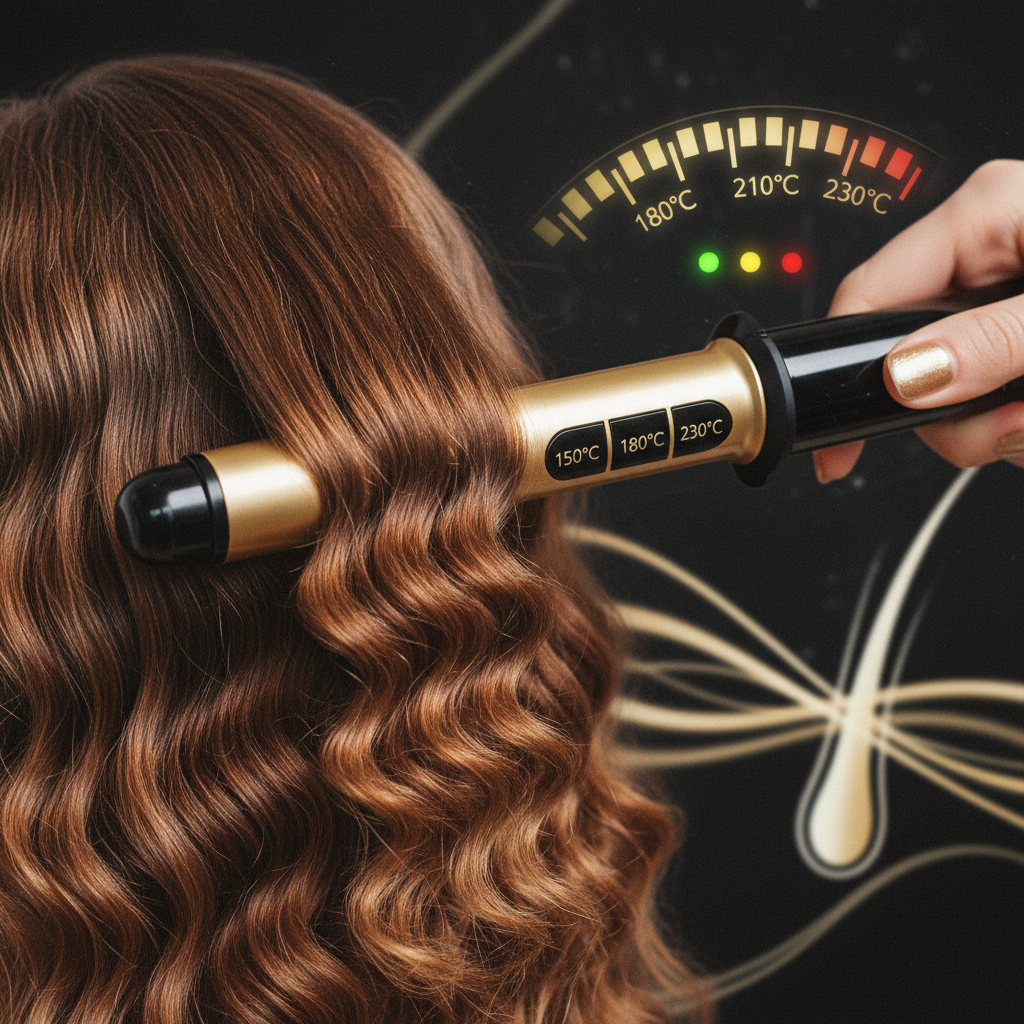
Thermal analysis using differential scanning calorimetry reveals that alpha-keratin transitions to disordered beta-sheet structures between 155°C and 160°C. When tools operate between 170°C and 185°C, hydrogen bonds soften sufficiently to allow styling within a single, deliberate pass of an iron. Pushing settings past 200°C accelerates the loss of cystine, an essential amino acid responsible for hair strength via disulphide cross-links.
For fine, chemically lightened, or colour-treated strands, the optimal thermal window drops to 130°C to 160°C. Bleaching strips protective cuticles and hydrolyses internal bonds, rendering the cortex vulnerable to heat-induced melting. Conversely, virgin, thick, and tightly coiled fibres contain greater cortex volume, requiring temperatures between 180°C and 200°C to allow thermal transfer through to the inner core.
| Hair Fibre Profile | Recommended Tool Temperature | Structural Vulnerability | Recommended Tool Passes |
|---|---|---|---|
| Bleached, relaxed, or heavily damaged | 120°C to 150°C | Severe cuticle absence; low tensile limit | 1 slow pass |
| Fine or colour-treated | 150°C to 165°C | Thin cortex; rapid heat penetration | 1 to 2 passes |
| Medium, virgin, or wavy | 170°C to 185°C | Balanced lipid and protein levels | 1 pass |
| Coarse, thick, or compact afro-textured | 185°C to 200°C | Dense cross-sectional area; slow heat intake | 1 to 2 passes |
| Any wet or damp hair | Never use direct contact heat | Extreme risk of cortex steam expansion | Zero |
What the evidence does not show
Controlled research does not support the claim that ceramic or tourmaline plates eliminate heat damage. While quality heating elements distribute surface warmth more evenly and eliminate hot spots, they do not alter the thermal physics of keratin breakdown. 190°C from a luxury flat iron degrades cuticles at the exact same rate as 190°C from a budget tool.
Furthermore, evidence does not show that thermal protectant sprays make hair immune to high temperatures. Formulations containing polyquaternium compounds, silicones, and hydrolysed proteins slow down heat conduction and preserve moisture. However, they reduce structural degradation by roughly 30% to 50%; they do not prevent damage when tools are held in one spot or cranked to maximum heat.
The biological mechanism of heat damage
Direct thermal contact compromises three distinct parts of the hair fibre: surface lipids, the cuticle sheath, and the internal cortex.
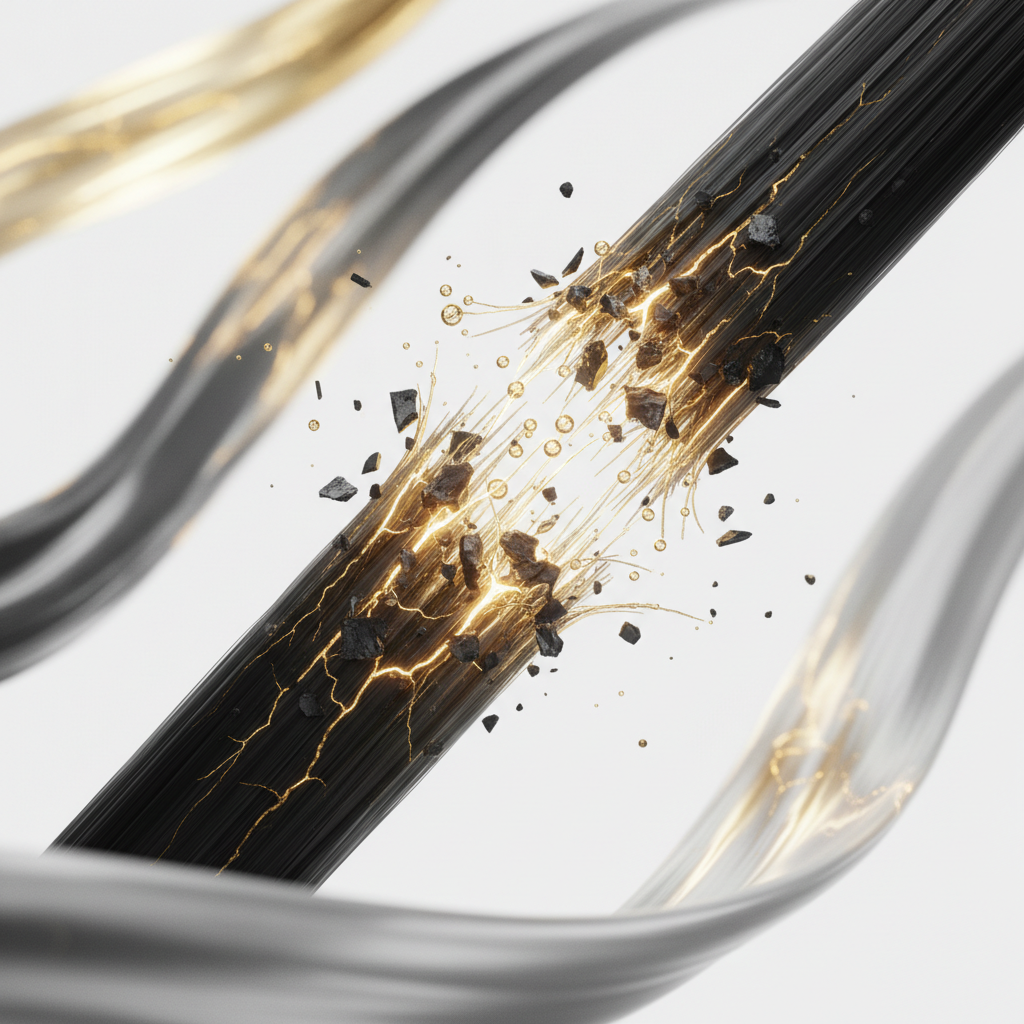
The outermost layer of the hair is coated in a monomolecular lipid layer called 18-methyleicosanoic acid (18-MEA). This fatty layer makes the hair hydrophobic, repelling unwanted atmospheric moisture while locking in internal hydration. Heat exceeding 140°C degrades 18-MEA rapidly. Once this layer is stripped, hair becomes porous, hydrophilic, rough, and prone to severe frizz.
At higher temperatures (160°C to 190°C), physical stress impacts the overlapping cuticle cells. Thermal stress causes the edges of cuticles to curl, buckle, and crack. This lift exposes the fragile cortex beneath.
Within the cortex, temperatures reaching 200°C to 230°C cause the moisture naturally bound inside the hair to flash into steam. If water expands faster than it can escape through the porous cuticle, it forces physical cavities into the shaft. This condition, medically recognised as bubble hair deformity, makes the fibre brittle, leading to severe breakage along the shaft.
Signs your styling temperature is too high
Heat-induced mechanical failure does not originate at the follicle. It represents fibre breakage rather than biological hair loss or shedding. Watch for these distinct signs:
- Trichorrhexis nodosa: Small white specks or swellings along the hair shaft where the cortex has shattered, causing the strand to snap under minimal tension.
- Loss of elastic recovery: Wet hair should stretch by roughly 30% of its original length and bounce back. Thermally degraded hair snaps immediately when gently pulled.
- Colour brassiness and fading: High heat oxidises artificial pigments and degrades natural melanin, leaving hair looking dull, faded, or distinctly orange.
- Chronic dryness and hydrophilicity: Strands absorb water like a sponge in the shower but feel parched, brittle, and stiff once dried.
- Heat-straightened curl patterns: Naturally curly or coiled hair that fails to spring back into its original wave pattern after washing has suffered thermal denaturation of its keratin matrix.
What you can do to protect your hair
Minimising heat degradation requires adjusting technique, tools, and prep routines.
First, invest in styling tools with variable, digital temperature controls. Avoid appliances that offer only simple low, medium, and high switches, as these frequently peak past 220°C.
Second, make sure hair is completely dry before touching it with hot plates or curling tongs. Rough blow-drying should be performed on a medium airflow setting with the nozzle held at least 15 centimetres away from the hair. Using contact heat on damp hair boils trapped water within the cortex.
Third, coat the hair thoroughly with a dedicated leave-in heat protectant containing film-forming ingredients. Work in small, clean sections. One slow, deliberate pass with a flat iron at 170°C smooths hair far more effectively and with less damage than three fast passes over the same section.
When breakage is mistaken for hair shedding
People often look at broken strands in their brush or sink and assume they are suffering from hair loss or telogen effluvium. It is vital to separate hair shedding from hair snapping.
Examine the shed fibres closely. True shedding involves the entire hair strand exiting the follicle, complete with a tiny, white keratinised bulb at the root end. Breakage caused by high heat shows blunt, splintered ends with no bulb present. If you notice uniform thinning across the scalp alongside distinct root bulbs, consult a trichologist or GP to explore nutritional, hormonal, or systemic causes rather than tool damage.
Supporting hair health from the roots
Thermal protection shields the external strand, but long-term resilience starts at the scalp and follicle. Maintaining robust hair requires balanced nutrition and healthy follicular activity.
Watermans offers scalp-care solutions formulated to nourish the hair-bearing skin, including their Grow Me Shampoo, Condition Me Conditioner, and Grow More Scalp Elixir. Formulated with ingredients such as biotin, rosemary, caffeine, and lupin protein, these topical blends promote a clean, invigorated scalp environment. Healthy new growth emerging from well-nourished follicles displays optimal tensile strength, making it better equipped to withstand daily environmental and styling wear.
Frequently asked questions about Best Heat Styling Temperatures
What are the Best Heat Styling Temperatures for fine hair?
The Best Heat Styling Temperatures for fine hair range between 130°C and 160°C. Because fine hair features a narrow cortex and fewer cuticle layers, heat penetrates the fibre instantly. Applying settings above 165°C rapidly degrades structural proteins, leading to cuticle blistering, loss of elasticity, and immediate fibre snapping along the mid-lengths.
Can hair recover from heat damage if I lower the temperature?
Hair is non-living tissue, meaning split ends and fractured cortices cannot biologically heal. Lowering your styling tool temperature prevents fresh damage from occurring, but existing structural breaks must be trimmed away. Using protein-rich conditioners and lipid-replenishing treatments helps temporarily patch porous cuticle gaps on previously heat-compromised strands.
At what temperature does hair burn?
Physical scorching and protein breakdown begin around 215°C to 230°C. At this threshold, the alpha-keratin crystals melt, cross-linked disulphide bonds disintegrate, and the fibre's natural moisture flashes into destructive steam. Prolonged contact at these settings causes permanent structural disintegration and leads to brittle, unravelling hair shafts.
Does a lower temperature setting mean I can pass the iron multiple times?
No, repeated passes at lower temperatures can cause just as much cumulative damage as a single hot pass. Friction from tool plates wears down fragile cuticle cells mechanically. One steady, uniform pass at 175°C causes less cuticle friction and lipid erosion than gliding an iron down the same section four times at 150°C.
Summary on heat styling temperatures
Mastering the Best Heat Styling Temperatures is essential for maintaining smooth, strong hair while achieving long-lasting styles. Dialling your styling tools down to the lowest effective threshold, usually between 150°C and 185°C, protects the delicate protein structure of the cortex and preserves surface lipids. Pair sensible heat settings with quality leave-in thermal barriers and a well-nourished scalp routine to keep your hair resilient, shiny, and full of natural movement.
Sources and references
- Journal of Cosmetic Science, "Thermal degradation of hair keratin," 2004.
- International Journal of Cosmetic Science, "The effect of thermal straightening on the properties of human hair," 2011.
- British Association of Dermatologists, "Acquired hair shaft disorders and weathering," 2018.
- Annals of Dermatology, "Hair shaft damage from heat and cosmetic treatments," 2011.
Find these ingredients in Watermans products
- Biotin: you will find this ingredient in our Hair Growth Shampoo.