The Science and Benefits of Hydrolysed Wheat Protein in Modern Haircare
9 min read ·
Discover the science-backed Benefits of Hydrolysed Wheat Protein. Learn how this peptide boosts tensile strength, prevents breakage, and improves hair moisture.
Quick answer: The core Benefits of Hydrolysed Wheat Protein centre on its ability to penetrate the hair cuticle, increase tensile strength, reduce mechanical breakage, and boost moisture retention. Because natural wheat proteins are chemically enzymatically broken down into low-molecular-weight peptides, they bind easily to keratin chains within damaged fibres. However, its primary limitation is that it acts strictly as a cosmetic repair agent for the hair shaft; it cannot reverse follicle-level hair loss or permanently alter natural hair genetics.
Key takeaways
- Penetrating molecular size: Hydrolysis reduces wheat protein molecules down to roughly 1,000 to 3,000 Daltons, allowing them to pass beneath the cuticle layer into the cortex.
- Breakage reduction: By reinforcing internal cystine bonds and filling surface micro-fissures, it significantly increases the tensile strength of porous or chemically processed hair.
- Moisture balancing: It acts as a conditioning humectant, drawing in atmospheric moisture and improving fibre elasticity without leaving a rigid cast.
- Cosmetic vs biological action: It treats structural fibre damage and snapping; it does not treat follicular conditions like alopecia or telogen effluvium.
- Universal compatibility: Suitable for straight, wavy, curly, and coily patterns, provided products balance protein with emollient conditioners to avoid protein overload.
Benefits of Hydrolysed Wheat Protein: what the evidence shows
Hydrolysed wheat protein (HWP) is an amber-coloured, water-soluble peptide mixture derived from wheat gluten via controlled acid, alkaline, or enzymatic hydrolysis. In cosmetic science, the Benefits of Hydrolysed Wheat Protein are well-documented across several peer-reviewed studies examining damaged hair substrates.
Deep cortex penetration
Intact wheat protein is too large to enter the hair fibre, with a molecular mass far exceeding 100,000 Daltons. Hydrolysis cleaves these peptide chains into smaller fragments, typically yielding average molecular weights between 1,000 and 3,000 Daltons. Because of this small size, low-molecular-weight fractions can slip past lifted cuticle scales and penetrate deep into the cortex. Once inside, they integrate with the hair's natural keratin matrix, reinforcing weak points created by bleaching, UV exposure, or mechanical heat styling.
Increased tensile strength and reduced breakage
When hair undergoes chemical treatments such as bleaching or permanent waving, disulphide bonds fracture, leaving the fibre fragile and prone to snapping. Research published in the Journal of Cosmetic Science shows that treatments containing hydrolysed proteins significantly increase the tensile strength (the force required to snap a wet or dry hair strand) of damaged hair. By bolstering internal tensile strength, HWP drastically curtails breakage along the shaft.
Humectancy and improved elasticity
Wheat protein is rich in amino acids such as glutamine and proline, which possess strong moisture-binding properties. These peptides act as hygroscopic agents within the shaft, attracting and holding ambient moisture. This moisture retention directly enhances elasticity, meaning the hair fibre can stretch under mechanical tension (such as detangling with a brush) and return to its original shape without snapping.
Cuticle smoothing and gloss
Higher-molecular-weight fractions within hydrolysed wheat protein settle along the hair surface. They form a micro-fine, uniform protective film over the cuticle scales. This layer fills microscopic gaps, seals ruffled edges, reflects light more evenly for enhanced shine, and reduces friction between adjacent strands, which minimises future mechanical wear.
What the evidence does not show
It is critical to separate structural fibre repair from follicle biology. Despite marketing claims frequently found across the beauty industry, cosmetic evidence does not support the following:
- It does not cure or reverse alopecia: Hydrolysed wheat protein works strictly on the non-living hair shaft. It has no biological interaction with the dermal papilla or androgen receptors. Conditions such as androgenetic alopecia (pattern baldness) or alopecia areata cannot be cured or arrested by topical protein washes.
- It does not halt telogen effluvium: Hair shedding (telogen effluvium) is an internal disruption of the hair growth cycle triggered by stress, illness, nutritional deficits, or hormonal shifts. Topical proteins cannot influence the hair cycle or stop hair shedding from the root.
- It is not a permanent structural fix: While HWP adheres to keratin via ionic and hydrogen bonding, these bonds are not covalent. Surfactants, washing, and friction gradually strip applied proteins over time. Regular maintenance is necessary to sustain its conditioning benefits.
Mechanism: how hydrolysed wheat protein works on the hair shaft
To understand how HWP functions, you must understand the architecture of hair. Each hair strand consists of three main layers: the outer protective cuticle, the structural cortex, and the central medulla.
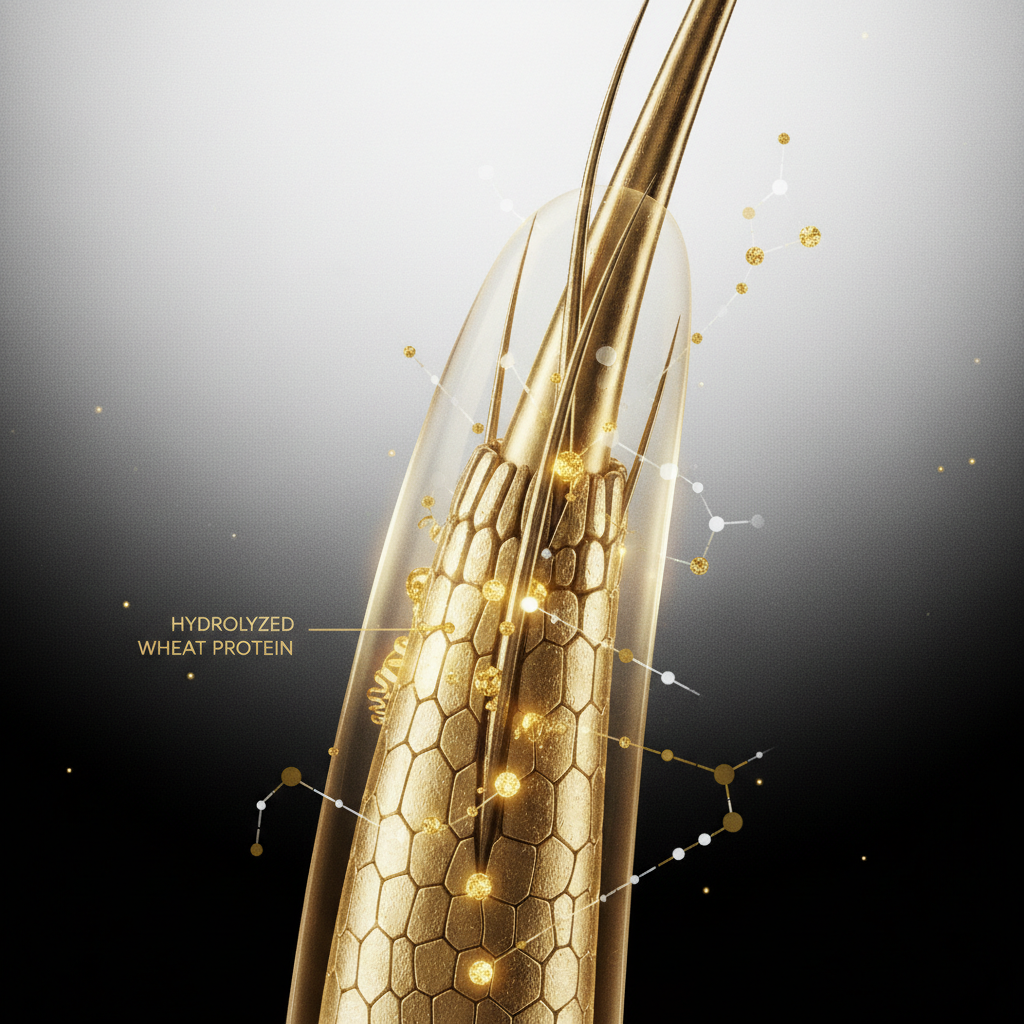
[ Outer Cuticle Layer ] <-- Film-forming wheat peptides smooth & seal gaps
 |
[ Structural Cortex ] <-- Low MW peptides (<1,500 Da) penetrate & bind keratin
 |
[ Central Medulla ] <-- Core of the fibre
- Electrostatic attraction: Damaged hair has a net negative charge because chemical treatments strip the protective 18-methyleicosanoic acid (18-MEA) lipid layer, oxidising disulphide bonds into cysteic acid groups. Hydrolysed wheat protein contains cationic (positively charged) amine groups under standard cosmetic pH formulations (pH 4.5 to 5.5). This causes the protein fragments to adhere electrostatically to the most damaged sites.
- Matrix integration: Once bound, low-molecular-weight peptides integrate into the porous cortical sponge. They replenish mass lost during chemical processing.
- Moisture regulation: As ambient humidity shifts, the hydrophilic amino acid residues inside the cortex buffer the fibre against rapid swelling and shrinking, which is a major cause of cuticle chipping and split ends.
Comparison: Hydrolysed wheat protein vs other cosmetic proteins
Different cosmetic proteins offer distinct molecular weights, amino acid profiles, and performance characteristics:
| Protein Type | Typical Molecular Weight (Daltons) | Primary Function | Best Suited For |
|---|---|---|---|
| Hydrolysed Wheat Protein | 1,000 to 3,000 | Deep penetration, moisture retention, tensile strength | Chemically processed, porous, or fine brittle hair |
| Hydrolysed Keratin | 1,000 to 2,500 | Rebuilding cortex structural mass, high elasticity | Heavily bleached, heat-damaged, or chemically relaxed hair |
| Hydrolysed Silk Protein | 500 to 2,000 | Intense surface shine, silky feel, light film coating | Dull, coarse hair needing external polish |
| Hydrolysed Soy Protein | 2,000 to 4,000 | Volume enhancement, mild penetration, moisture barrier | Fine, limp hair lacking body and fullness |
| Hydrolysed Collagen | 2,000 to 5,000 | Elastic film formation, external hydration | Dry, brittle ends requiring moisture sealing |
Signs your hair needs protein
Hair often signals an imbalance between moisture and structural protein. Look for these clear indications that your hair fibre could benefit from hydrolysed wheat protein:
- Mushy, gummy texture when wet: If wet strands stretch excessively and feel soft, gummy, or limp before breaking, the internal protein matrix is depleted.
- High porosity: Hair that absorbs water instantly in the shower but dries out within minutes typically suffers from lifted, perforated cuticles.
- Snapping during routine detangling: If small fragments of hair break off without root bulbs attached when combing, the tensile strength is compromised.
- Loss of curl definition: Naturally curly or wavy patterns that appear limp, stretched out, or frizzy often lack the internal rigidity needed to support their natural pattern.
What you can do: best practice application
To maximise the Benefits of Hydrolysed Wheat Protein without risking product build-up or fibre stiffness, use a balanced approach:
- Opt for leave-in or treatment formats: While shampoos containing HWP deposit small amounts of protein, rinse-off masks, deep conditioners, and leave-in sprays provide prolonged contact time, allowing peptides to penetrate the cortex.
- Mind the protein-moisture balance: Applying protein treatments daily without sufficient emollients (such as natural oils or fatty alcohols) can make hair feel stiff, dry, or brittle. Alternate protein-rich products with deeply hydrating, moisture-focused conditioners.
- Use gentle heat during deep conditioning: Applying gentle warmth (such as a warm towel or indirect heat cap) for 10 to 15 minutes helps open the cuticle scales slightly, facilitating deeper migration of wheat peptides into the cortex.
- Clarify periodically: Use an effective clarifying shampoo every two to four weeks to remove any residual polymer or film build-up from the cuticle surface.
When the cause may be something else
If you are experiencing noticeable hair density reduction, it is vital to distinguish between hair breakage and actual hair shedding or hair loss:
- Hair breakage: Short, snapped pieces with no white bulb at the end. This is a fibre integrity issue, for which hydrolysed wheat protein is an ideal cosmetic intervention.
- Hair shedding (Telogen Effluvium): Long strands coming out from the root in high numbers (often over 100 to 150 hairs daily), complete with a tiny white keratin bulb. This points to a biological shift, such as hormonal fluctuations, iron deficiency, thyroid imbalances, or post-febrile illness.
- Follicular hair loss (Alopecia): Progressive thinning along the crown, widening parting lines, or patchy bald areas. These conditions originate at the follicular level and require clinical diagnosis rather than cosmetic protein therapies.
When to seek professional guidance
Consult a trichologist, dermatologist, or GP if:
- You observe sudden, diffuse hair shedding exceeding normal daily levels that lasts longer than three months.
- You notice patchy, coin-sized areas of complete baldness on your scalp.
- Your scalp presents signs of inflammation, scaling, burning, redness, or tenderness.
- You have a diagnosed severe wheat allergy or celiac condition with contact sensitivity (though topical reactions to cosmetic hydrolysed wheat protein are rare, hypersensitive individuals should exercise caution and patch test).
Targeted haircare solutions
For individuals dealing with fine, limp, or mechanically stressed hair, high-performance cosmetic formulas balance bio-active peptides with scalp-nourishing botanical extracts. Watermans integrates hydrolysed wheat protein into targeted formulations designed to improve hair condition, visibly thicken the appearance of the fibre, and reinforce fragile strands against everyday environmental and thermal styling stress. Using products that unite peptide-based fibre reinforcement with botanical scalp conditioning ensures your hair maintains both tensile strength and cosmetic vitality.
Frequently asked questions about Benefits of Hydrolysed Wheat Protein
What are the main Benefits of Hydrolysed Wheat Protein for fine hair?
The primary Benefits of Hydrolysed Wheat Protein for fine hair include increased fibre diameter, improved body, and structural resilience without the heavy, flattening residue associated with thick plant butters. Because its low molecular weight allows it to penetrate the cortex, it strengthens the strand from within, helping fine hair hold volume and resist daily mechanical snapping.
Can hydrolysed wheat protein cause protein overload?
Yes, using concentrated protein treatments too frequently without balancing them with hydrating conditioners can lead to protein build-up. When peptides deposit excessively on the cuticle without sufficient moisture, hair can feel stiff, brittle, rough, and prone to snap. If this happens, clarify your hair and switch to purely moisturising conditioners for two weeks.
Is hydrolysed wheat protein safe for colour-treated hair?
Yes, it is especially beneficial for colour-treated hair. The process of colouring or bleaching strips natural lipids and oxidises structural bonds in the cortex. Hydrolysed wheat protein binds to these porous, negatively charged areas, helping to reinforce the weakened matrix, smooth the cuticle layer, and prolong colour vibrancy by preventing rapid pigment wash-out.
Can people with celiac disease use hydrolysed wheat protein?
Topical hydrolysed wheat protein generally cannot be absorbed through unbroken skin in quantities that trigger internal celiac responses, as gluten must be ingested to initiate an autoimmune response in the gut. However, individuals with severe wheat contact allergies or broken skin should exercise caution, review full ingredient labels, and conduct a patch test prior to full application.
Summary
Understanding the Benefits of Hydrolysed Wheat Protein allows you to make informed, scientifically sound decisions for your haircare routine. By breaking wheat protein down into small, bioavailable peptides, cosmetic science provides a proven mechanism to reinforce damaged hair fibres, enhance tensile strength, boost hydration, and smooth the cuticle. While it is not a cure for biological hair loss or shedding, it remains one of the most effective, versatile cosmetic tools available for restoring resilience and shine to fragile hair.
Sources and references
- Journal of Cosmetic Science, "The effect of hydrolysed wheat proteins on the mechanical and physical properties of human hair", 2004.
- International Journal of Cosmetic Science, "Protein-hair interactions: Penetration and binding characteristics of cosmetic peptides", 2012.
- Cosmetic Ingredient Review (CIR), "Safety Assessment of Hydrolysed Wheat Protein and Hydrolysed Wheat Gluten as Used in Cosmetics", 2018.
- British Journal of Dermatology, "Structural and biochemical changes in chemically treated human hair", 2016.
Find these ingredients in Watermans products
- Wheat Amino Acids: you will find this ingredient in our Heat Protection Spray.