Afro Hair Porosity Guide: The Evidence-Based Care Reference
10 min read ·
Master your wash day with our Afro Hair Porosity Guide. Learn how cuticle science affects type 4 coils, bust testing myths, and build an effective routine.
Quick answer: Hair porosity describes how easily moisture, water, and cosmetic oils pass through your cuticle into the cortex. This Afro Hair Porosity Guide explains how the unique elliptical geometry of type 4 coils influences cuticle alignment, liquid uptake, and moisture retention. Low porosity repels hydration due to tightly overlapping cuticles, whereas high porosity absorbs water rapidly but loses it just as quickly through lifted or missing scales. The main limitation is that porosity fluctuates along the same strand, meaning chemical or mechanical ends behave differently from virgin roots.
Key takeaways
- Hair porosity measures your hair fibre's capacity to absorb and retain water, dictated by the health and architecture of the outer cuticle layer.
- Afro hair features an elliptical cross-section and intermittent twists along the shaft, naturally creating points of cuticle vulnerability independent of heat or chemical processing.
- The widely popular "float test" in a glass of water is scientifically unreliable due to surface tension and natural sebum coats; wet-feel and dry-time assessments offer better practical insight.
- Low-porosity afro coils benefit from gentle warmth and lighter humectants to lift tightly bound scales, while high-porosity coils require slightly acidic rinses, proteins, and film-forming sealants.
- True chemical damage permanently alters cuticular integrity, so daily styling techniques must shift to mitigate mechanical breakage rather than aiming to permanently "cure" high porosity.
Afro Hair Porosity Guide: what the evidence shows
The purpose of this Afro Hair Porosity Guide is to cut through popular salon myths and ground your wash-day routine in cosmetic science and fibre biophysics. Hair porosity is not a permanent identity or a genetic trait fixed from root to tip. Instead, it reflects the physical state of your hair's protective casing: the cuticle.
The human hair cuticle consists of 5 to 10 overlapping layers of flattened, keratinised cells held together by a lipid-rich cell membrane complex. On the outermost layer lies the 18-methyleicosanoic acid (18-MEA) fatty acid layer, which renders healthy virgin hair naturally hydrophobic (water-repelling). In afro hair (types 4A, 4B, and 4C), the hair shaft is rarely cylindrical. Studies published in the International Journal of Cosmetic Science confirm that afro-textured fibres have an asymmetrical, highly elliptical cross-section with multiple geometric twists, turns, and nodes along the shaft.
At each twist point along a coily strand, the cuticle scales experience uneven physical strain. This unique curvature causes individual scales to flare slightly or wear down faster than on straight fibres, even without chemical relaxers or thermal straighteners. Consequently, afro hair can exhibit mixed porosity: low porosity near the scalp where the cuticle is dense and protected by sebum, and medium or high porosity toward the ends where weathering has eroded the lipid sheath.
The biophysical mechanism of porosity levels
Understanding how the cuticle behaves helps you predict how moisture interacts with your coils.
Low porosity: the closed fortress
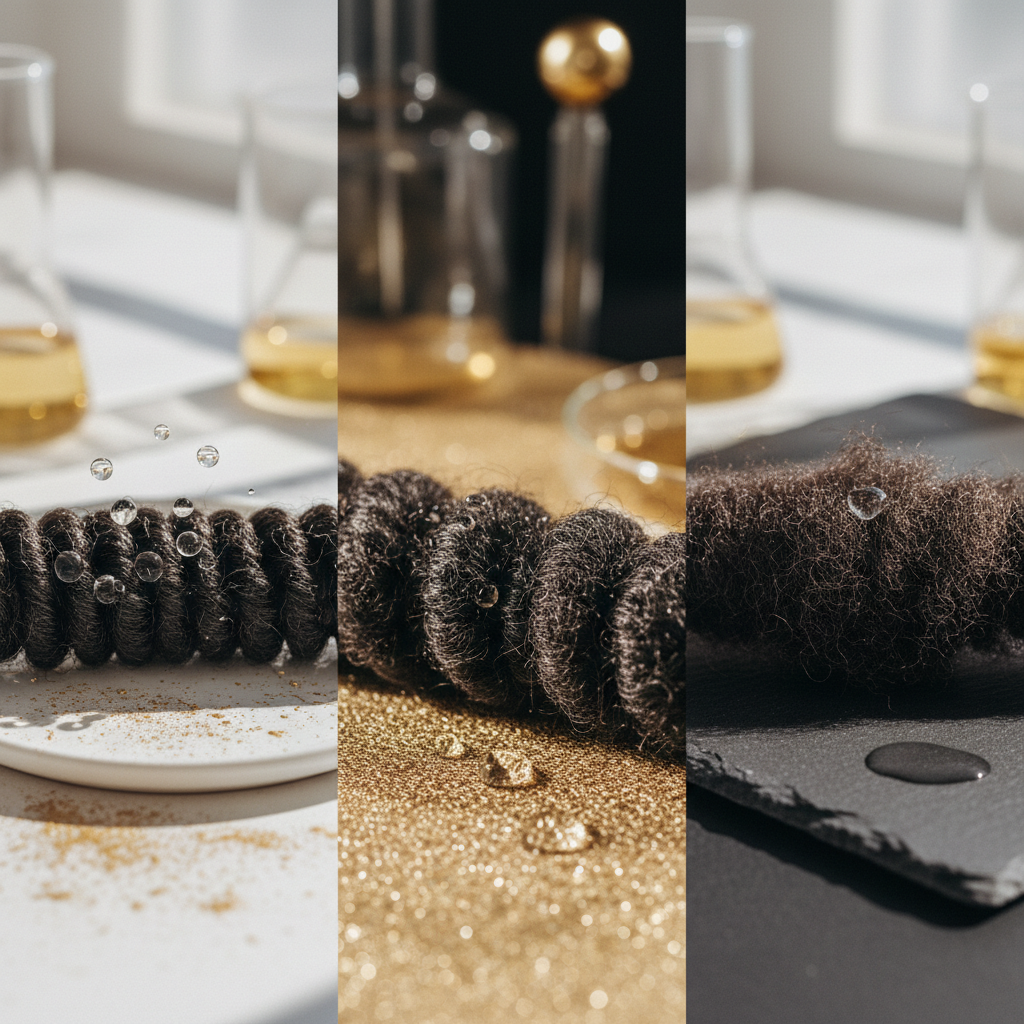
In low-porosity hair, the cuticle shingles lie flat, compact, and tightly overlapping. The hydrophobic 18-MEA lipid layer is largely intact. When you apply water or leave-in lotions, droplets bead on the surface rather than penetrating. It takes significant time for low-porosity afro hair to become thoroughly saturated in the shower, and deep conditioning treatments often sit on top of the hair shaft like a film, leading to rapid product build-up.
Medium (normal) porosity: the balanced barrier
Medium-porosity hair features a flexible, slightly pliable cuticle arrangement. Water enters the cortex without prolonged resistance, and the internal moisture reserves do not evaporate immediately. This structural state requires minimal adjustment and easily tolerates balanced hydration routines.
High porosity: the open gateway
High-porosity hair has lifted, chipped, or perforated cuticle layers. The gaps allow water to rush into the cortex almost instantly, causing rapid swelling (hygral expansion). However, because the protective barrier is compromised, that moisture evaporates just as swiftly when exposed to ambient air. High-porosity afro hair wets within seconds, dries remarkably quickly, tangles easily, and feels rough or brittle when dry.
LOW POROSITY: [======][======][======] (Tight, flat shingles; resists liquid)
MEDIUM POROSITY: [=====\ ][=====\ ][=====\ ] (Slight lift; balanced absorption)
HIGH POROSITY: [/ ][/ ][/ ] (Lifted, broken shingles; rapid loss)
What the evidence does not show
Popular hair forums often promote the "water glass test", where you drop a shed strand into a glass of room-temperature water to see if it sinks or floats. Cosmetic chemists and trichologists widely dismiss this test.
Surface tension across the water's surface easily supports a lightweight strand regardless of its internal porosity. Furthermore, residual styling oils, silicones, and natural sebum make the fibre float, yielding a false "low porosity" reading. Conversely, a clean strand coated in dust or heavy leave-ins might sink irrespective of cuticle structure.
Controlled research also refutes the idea that any cosmetic product can permanently change or "repair" porosity. Once cuticle scales break off or erode from bleach, relaxers, or aggressive heat, no oil, mask, or cream can regrow biological tissue. Products can only patch the gaps temporarily using hydrolysed proteins, cationic polymers, and occlusive lipids.
Comparing hair porosity profiles
| Characteristic | Low Porosity | Medium Porosity | High Porosity |
|---|---|---|---|
| Cuticle Structure | Tightly bound, overlapping flat layers | Slightly open, pliable, uniform alignment | Lifted, frayed, chipped, or missing scales |
| Water Absorption | Very slow; water beads on surface initially | Moderate; saturates evenly in minutes | Immediate; absorbs moisture on contact |
| Drying Time | Prolonged; can take 8 to 24 hours to air dry | Average; dries predictably | Rapid; dries quickly, often feeling parched |
| Product Response | Prone to heavy surface build-up | Absorbs and retains balanced creams | Requires thick butters and film-formers |
| Chemical Susceptibility | Resists processing; needs longer development | Processes evenly | Processes very quickly; high risk of over-processing |
| Primary Risk | Moisture starvation and product buildup | Mechanical wear over time | Severe breakage, hygral fatigue, and tangling |
Reliable signs to look for
Instead of using a glass of water, evaluate your hair during your regular wash routine using touch, drying rates, and product behaviour.
- The shower saturation check: Stand under a steady stream of lukewarm water. If water runs off your afro coils for several minutes before the core feels truly wet, your hair leans toward low porosity. If your hair becomes soaking wet almost the second the water hits it, you are likely managing high porosity.
- The slip-and-slide tactile test: Take a single shed strand from your brush. Hold it taut at the tip with one hand, and with the other hand, run your thumb and forefinger from the tip down toward the root (against the grain). If the shaft feels completely smooth and glassy, the cuticles are tightly sealed (low porosity). If you feel distinct bumps, rough notches, or friction, the cuticles are lifted or weathered (high porosity).
- The air-dry timeline: Note how long your clean, unstyled hair takes to dry after washing. High-porosity hair sheds free water rapidly and can feel coarse and dry within an hour or two. Low-porosity coils remain damp deep inside the core of the afro for many hours, sometimes lasting into the next day.
Practical care strategies for afro-textured hair
Your porosity profile determines how you layer products and apply heat.
Regimes for low-porosity coils
- Incorporate indirect warmth: Apply your deep conditioner and sit under a hooded dryer, heat cap, or steamer for 15 to 20 minutes. Gentle heat raises the water temperature and swells the compact cuticle layers slightly, allowing conditioning agents to enter the cortex.
- Choose light humectants: Favour ingredients like glycerin, aloe vera, and panthenol over heavy solid waxes. Water-based leave-in mists slip past tight cuticles far better than thick pastes.
- Clarify regularly: Because low-porosity cuticles reject heavy products, emollients accumulate on the exterior. Use a gentle, sulphate-free clarifying shampoo once every 2 to 3 weeks to strip away built-up residue.
Regimes for high-porosity coils
- Layer with the LOC or LCO method: High-porosity hair requires structure and sealing. Apply a liquid or leave-in conditioner first, followed by a nourishing cream, and lock it down with a sealing oil or rich butter (such as shea or castor oil) to slow water evaporation.
- Utilise hydrolysed proteins: Small-chain proteins (hydrolysed wheat, silk, or keratin) temporarily dock inside cuticle fissures, restoring tensile strength and reducing hygral fatigue (the weakening of fibres caused by repeated swelling and contracting).
- Respect the pH scale: The natural pH of hair and scalp sebum sits between 4.5 and 5.5. Highly alkaline products raise cuticles, while slightly acidic rinses (around pH 4.0 to 5.0) help flatten the cuticle shingles, preserving internal moisture.
For individuals seeking plant-based care tailored specifically to coils and curls, Frojus offers targeted moisture formulations designed to balance coily strand hydration without synthetic build-up.
When the cause may be something else
If your afro hair feels persistently parched, snapping, or unmanageable, porosity may only be part of the equation.
- Hard water calcification: Mineral deposits (calcium and magnesium carbonate at concentrations above 120 mg/L) bind to negatively charged hair proteins, leaving a stiff, brittle film that mimics high porosity. Chelating shampoos help dissolve this mineral layer.
- Excessive sebum deficiency: Type 4 hair's tight twists hinder the natural travel of scalp sebum down the hair shaft. Dryness is often a simple consequence of sebum starvation rather than cuticular damage.
- Telogen effluvium vs fibre breakage: If you notice hair shedding from the root with a visible white bulb, this is follicular shedding, not a porosity-related issue. If fragments are short, jagged, and snap off without a bulb during styling, your hair is experiencing mechanical breakage driven by dryness or cuticle erosion.
When styling or managing persistent scalp irritation, Watermans provides specialised hair and scalp care solutions formulated to cultivate a clean, balanced environment that supports resilient hair growth.
When to seek professional advice
Consult a registered trichologist or a certified afro-hair specialist if:
- Your hair breaks off across entire sections despite following gentle moisturising routines.
- You experience concurrent scalp symptoms, such as burning, intense itching, persistent flaking, or patchiness.
- Your hair has undergone aggressive chemical processing (such as high-lift bleach followed by a sodium hydroxide relaxer) and exhibits gummy, elastic behaviour when wet, indicating severe cortical disintegration.
Frequently asked questions about Afro Hair Porosity Guide
Can I permanently change my hair porosity?
No, cosmetic products cannot permanently alter your hair's porosity. Porosity is a physical state governed by your cuticle layer. Once cuticles are damaged or removed by heat, chemical relaxers, or environmental weathering, they cannot biologically regenerate. You can, however, use conditioning polymers, hydrolysed proteins, and sealing oils to artificially patch and protect the fibre until new hair emerges.
Why is the water float test inaccurate in this Afro Hair Porosity Guide?
The float test fails because surface tension holds light fibres on top of water regardless of cuticle condition. Additionally, hair coated in natural sebum, oils, or silicone-based serums will float even if the cuticles underneath are severely damaged and porous. Sensory tests, like assessing water absorption speed in the shower, are far more reliable.
Does low-porosity afro hair need protein treatments?
Low-porosity afro hair requires significantly less protein than high-porosity hair. Because the cuticle is already tightly sealed, heavy or frequent protein treatments can overload the shaft, causing the hair to feel stiff, straw-like, and prone to snap. Low-porosity coils generally need protein only once every 6 to 8 weeks, favouring hydrating treatments instead.
Can one head of afro hair have different porosity levels?
Yes, it is common to have mixed porosity. The virgin hair near your roots has experienced minimal friction and usually displays low or medium porosity. The ends, which may have survived years of combing, sun exposure, and styling, frequently exhibit high porosity. Tailor your application by focusing lighter products near the roots and richer sealants on the ends.
Essential takeaways for healthy coils
Navigating your wash-day routine becomes significantly simpler once you understand the biophysical rules covered in this Afro Hair Porosity Guide. Cuticle structure dictates every interaction your hair has with moisture, cleansing agents, and styling products. Rather than fighting your natural coil pattern or relying on flawed kitchen experiments, evaluate how your strands handle water and adjust your techniques accordingly. Balance warmth and gentle hydration for low porosity, and lean on proteins, pH-conscious conditioners, and sealing butters for high porosity to keep your afro hair resilient, flexible, and strong.
Sources and references
- International Journal of Cosmetic Science, "Afro-American hair: physical properties and morphology", 2007.
- Journal of the Society of Cosmetic Chemists, "The effect of chemical treatments on the hair cuticle and moisture sorption", 1993.
- Robbins, C. R., Chemical and Physical Behavior of Human Hair, 5th ed., Springer, 2012.
- British Journal of Dermatology, "Structural and physical properties of human hair in relation to ethnicity", 2005.
Find these ingredients in Watermans products
- Castor Oil: you will find this ingredient in our Camellia & Black Castor Hair & Body Oil.
- Panthenol (Provitamin B5): you will find this ingredient in our Heat Protection Spray.
- Aloe Vera: you will find this ingredient in our Curly Hair Conditioner.