Afro Hair Care Routine: The Complete Evidence-Based Guide
10 min read ·
Discover the science-backed Afro Hair Care Routine to hydrate coils, prevent mechanical breakage, and support long-term scalp health and length retention.

Quick answer: A science-based Afro Hair Care Routine centres on moisture retention, friction reduction, and gentle cleansing to protect naturally coiled hair fibres. Because Afro hair (types 4A to 4C) features an elliptical cross-section and frequent twists along the shaft, natural scalp sebum struggles to travel down the strand, leaving it prone to mechanical breakage rather than follicular hair loss. However, an effective Afro Hair Care Routine cannot change genetic follicle curvature or repair split ends permanently; it maintains hydration, preserves length, and supports scalp health.
Key takeaways
- Afro hair fibres possess an elliptical shape with multiple points of torsion, making them structurally more vulnerable to mechanical breakage than straight or wavy fibres.
- Cleansing frequency should balance scalp hygiene with lipid preservation, typically requiring a sulfate-free wash every 7 to 14 days.
- Water is the primary moisturiser; plant oils and butters act as occlusives that seal water inside the cortex, rather than hydrating the fibre on their own.
- Low-manipulation styling, satin sleep protection, and careful detangling on wet, conditioned hair significantly reduce fibre breakage.
- Scalp conditions such as seborrhoeic dermatitis require targeted antifungal care, not heavy grease, which can worsen inflammation and fungal overgrowth.
Afro Hair Care Routine: what the evidence shows
Research into hair biomechanics reveals that Afro-textured hair requires a specialised approach because of its unique physical architecture. Scanning electron microscopy demonstrates that afro hair fibres have an asymmetrical bulb, an elliptical cross-section, and irregular curvature along the hair shaft. Each twist creates a structural stress point where the cuticle layer is thinner and more vulnerable to lift, crack, or fracture under tension.
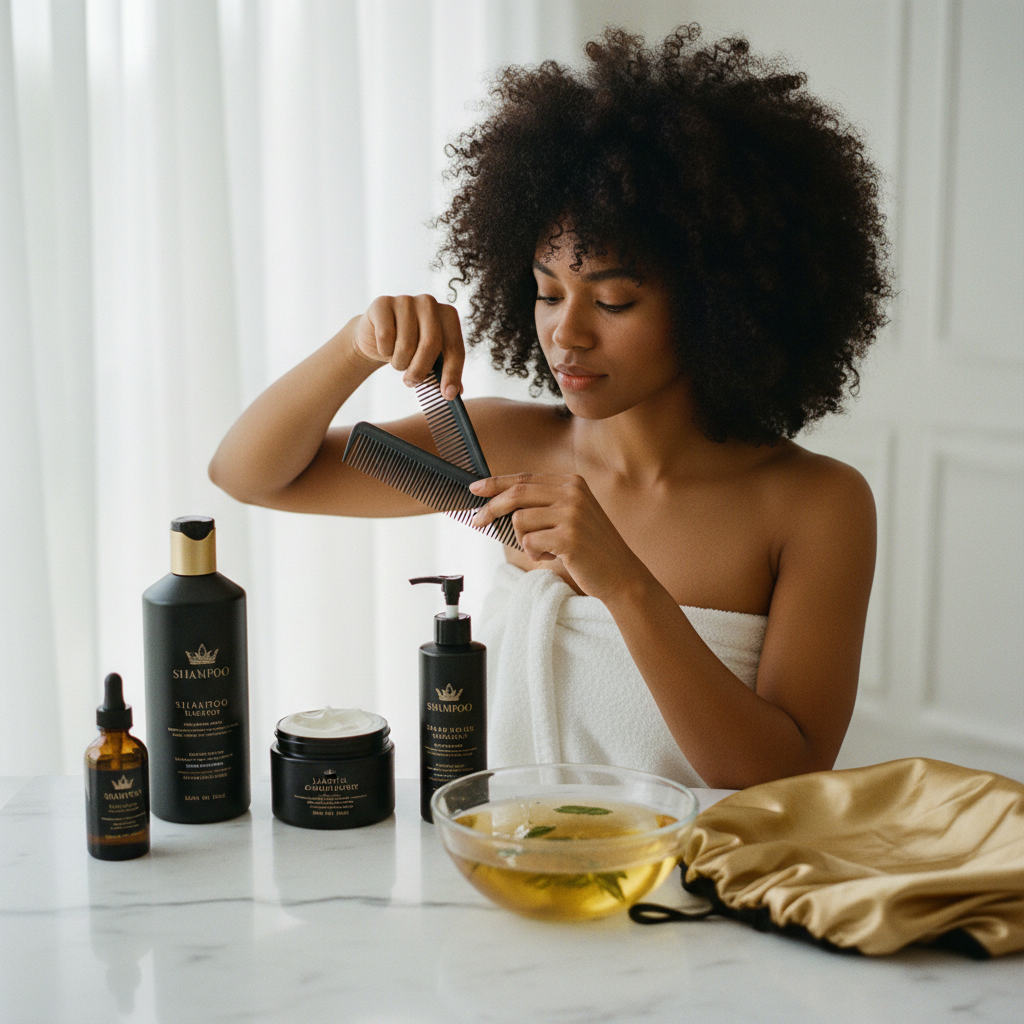
Studies published in the Journal of Investigative Dermatology and the International Journal of Cosmetic Science confirm that Afro hair has a lower tensile strength and moisture content than straight Asian or European hair types. This is not due to an inability of the fibre to absorb moisture (afro hair is actually highly porous and absorbs water rapidly), but rather its inability to retain it. Without an adequate lipid coating, the fibre loses water quickly to the surrounding air, leading to dehydration, stiffness, and snapping.
An evidence-based routine targets three core objectives:
- Hydration and moisture retention: Introducing water into the cortex and trapping it using emollients and occlusive lipids (such as the Liquid-Oil-Cream or L.O.C. Method).
- Minimising mechanical stress: Reducing combing frequency, avoiding dry detangling, and limiting tight tension styles that strain the follicle.
- Preserving the scalp microbiome: Cleansing sebum, sweat, and product build-up at regular intervals without stripping the scalp's natural acid mantle (pH 4.5 to 5.5).
[Hydration (Water)] -> [Emollient (Conditioner/Cream)] -> [Occlusive (Oil/Butter)]
 | | |
 Enters cortex Smooths cuticle Prevents evaporation
The structural mechanism of Afro hair
To understand why traditional haircare techniques fail on afro hair, you have to look at the follicle and the shaft. The hair follicle beneath the scalp is curved like a golf club, which forces the keratinising cells to grow in an asymmetrical spiral.
Because the resulting hair shaft twists tightly, sebum produced by the sebaceous glands cannot travel efficiently along the length of the strand. While someone with straight hair might experience greasy ends within three days of washing, someone with tightly coiled hair often experiences dry ends despite having an oily scalp.
Furthermore, the cuticle layer on afro hair fibres exhibits uneven overlap. At each twist, the cuticle scales flare outward slightly. When dry fibres rub against each other, cotton pillowcases, or rough brushes, these flared scales catch, strip away, and expose the delicate internal cortex. This process causes breakage (the physical snapping of the shaft), which is fundamentally different from shedding (a hair naturally completing its telogen phase and releasing from the root) or alopecia (follicular miniaturisation or loss).
Building an effective Afro Hair Care Routine
A practical routine breaks down into distinct phases: cleansing, conditioning, detangling, moisturising, and protective maintenance.
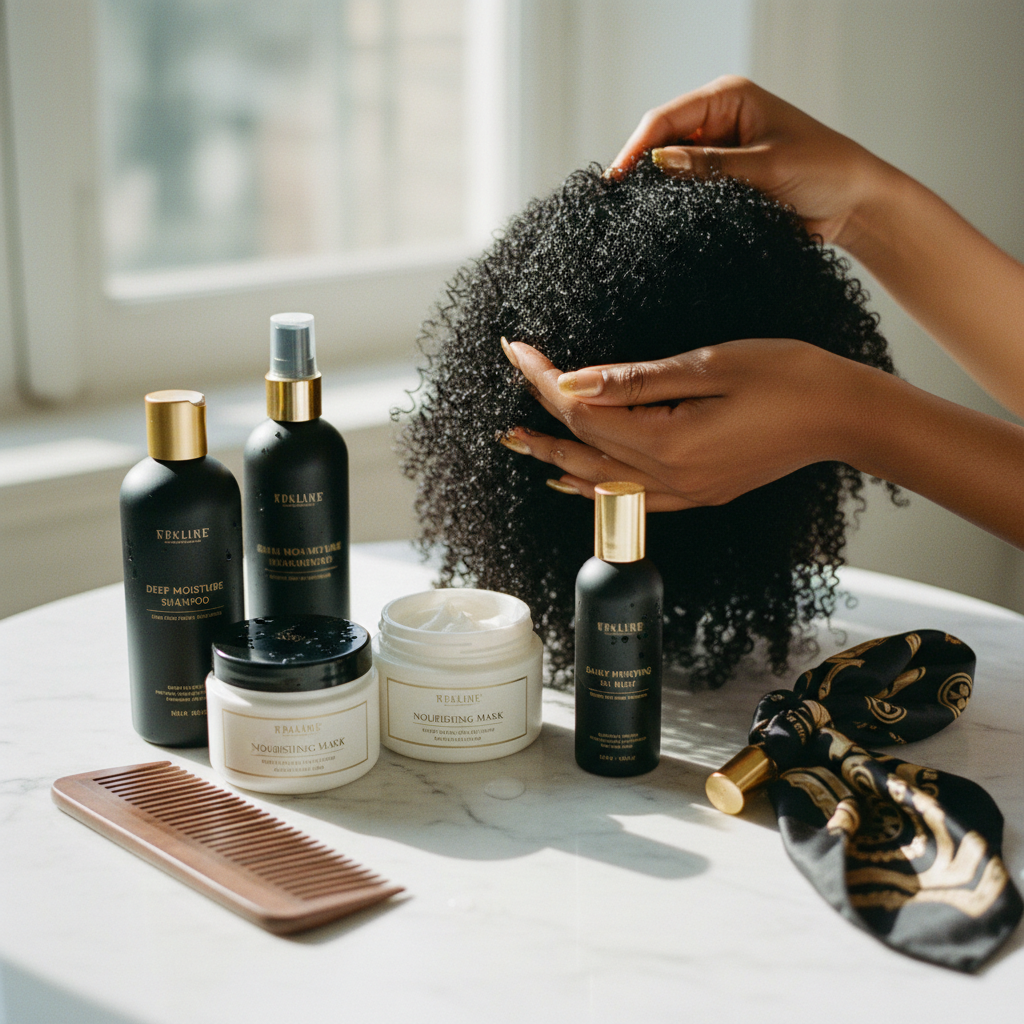
1. Cleansing (Every 7 to 14 days)
Washing afro hair every day strips the scarce lipids it possesses. However, avoiding shampoo entirely leads to product build-up, blocked follicles, and malassezia yeast overgrowth.
Use a gentle, sulfate-free shampoo formulated with amphoteric surfactants (such as cocamidopropyl betaine) that cleanses at an acidic to neutral pH (5.0 to 6.0). If you have product build-up from heavy butters, use a chelating or clarifying shampoo once a month, followed immediately by a rich deep conditioning treatment.
2. Conditioning and detangling
Conditioning restores slip and temporarily patches worn cuticle scales with cationic surfactants (like behentrimonium methosulfate) and fatty alcohols (like cetyl alcohol).
Always detangle hair when it is saturated with water and a slippery conditioner, never dry. Work in four to eight sections, using your fingers or a wide-tooth detangling tool, starting strictly at the ends and moving gradually up to the roots. Deep condition with heat (a warm towel or hooded dryer) for 15 to 30 minutes every wash day to encourage the cuticle to swell slightly and accept conditioning agents.
3. Layering moisture (The L.O.C. Or L.C.O. Method)
Water evaporates from bare hair in minutes. Layering products prolongs moisture retention:
- Liquid (L): Clean water or an aloe-vera-based water spray.
- Oil (O): A penetrating or coating oil (such as jojoba oil, which mimics human sebum, or argan oil) to lubricate the cuticle.
- Cream (C): A rich leave-in conditioner or plant butter (such as shea butter) containing fatty acids to form a semi-occlusive barrier against ambient humidity changes.
Switching the order to Liquid-Cream-Oil (L.C.O.) often yields better results for denser type 4C hair, as the cream penetrates before the oil seals the surface.
4. Low-manipulation and night protection
Afro hair thrives when left alone. Protective styles such as twists, plaits, cornrows, and buns keep the fragile ends tucked away from friction against clothing. However, styles should never pull tightly on the hairline, which can trigger traction alopecia. At night, sleep on a satin or silk pillowcase or wear a satin bonnet; cotton absorbs natural oils and creates high surface friction.
Comparing routine steps and hair requirements
| Routine Element | High-Porosity Afro Hair | Low-Porosity Afro Hair |
|---|---|---|
| Cuticle state | Raised, gaps present, absorbs fast, loses fast | Compact, tightly closed, resists water entry |
| Cleansing focus | Ultra-gentle, protein-balanced shampoo | Clarifying shampoo to remove stubborn surface build-up |
| Conditioning approach | Protein-rich deep conditioners to patch gaps | Heat-assisted conditioning (warm steam) to lift cuticles |
| Moisturising order | L.O.C. (Liquid, Oil, Cream) with heavier occlusives | L.C.O. (Liquid, Cream, Oil) using lightweight oils |
| Ideal ingredients | Hydrolysed wheat protein, shea butter, castor oil | Jojoba oil, sweet almond oil, glycerin, aloe vera |
What the evidence does not show
There are persistent myths surrounding afro hair maintenance that scientific inquiry does not support:
- Greasing the scalp makes hair grow: Petroleum jelly and mineral oil applied directly to the scalp do not stimulate follicles or accelerate cell division. Instead, heavy occlusives trap bacteria, dead skin cells, and sebum, which can trigger scalp folliculitis or seborrhoeic dermatitis.
- Products can mend split ends permanently: No cosmetic formula can rebuild a fractured hair shaft. Protein treatments and polymers can temporarily glue the split closed until the next wash, but physical trimming is the only permanent solution.
- Frequent trimming makes hair grow faster from the root: Hair grows from the follicle inside the dermis, unaffected by shears cutting the dead fibre ends. Trimming simply removes split ends before they travel up the shaft and cause breakage, preserving length retention.
Signs your routine needs adjusting
Your hair and scalp provide clear feedback when your regimen is unbalanced:
- Single-strand knots (trichonodosis): Small knots forming along individual strands indicate excessive dry friction, irregular trimming, or wearing hair out without sufficient lubrication.
- Flaking and persistent itchiness: This often points to build-up from unwashed butters or an inflamed scalp microbiome rather than dryness.
- Snap test failure: If a wet shed hair snaps instantly when pulled gently, it lacks moisture. If it stretches excessively like chewing gum and does not bounce back, it lacks structural protein.
- White bulbs on broken hair: A white bulb at one end means the hair shed naturally from the follicle (normal telogen shedding). If the fallen strand has no bulb, it is a break caused by mechanical, chemical, or thermal damage.
When to seek professional advice
While a daily care regimen manages cosmetic condition, certain symptoms require clinical intervention. If you notice circular, smooth patches of bare scalp, widening parting lines, or thinning around the temples and hairline, consult a consultant dermatologist or qualified trichologist. These are signs of conditions like alopecia areata, traction alopecia, or central centrifugal cicatricial alopecia (CCCA), which require medical diagnosis and prescription treatment rather than cosmetic products.
Supporting hair and scalp vitality with Watermans
A complete regimen starts with a clean, invigorated scalp environment. Watermans Grow Me shampoo provides an advanced, sulfate-free cleanse that purifies the scalp without depleting essential moisture. Formulated with natural ingredients including biotin, rosemary extract, caffeine, and argan oil, it supports scalp vitality and helps reinforce hair fibre resilience.
Pairing Grow Me shampoo with a nutrient-rich, conditioning treatment helps smooth the cuticle layer, significantly cutting down on mechanical friction during detangling. Used consistently as part of your wash-day foundation, it establishes an optimal environment for length retention and stronger-feeling strands.
Frequently asked questions about Afro Hair Care Routine
How often should you wash your hair in an Afro Hair Care Routine?
Most people following an Afro Hair Care Routine should wash their hair every 7 to 14 days. Tightly coiled hair produces natural sebum just like straight hair, but the oils do not travel down the strand. Washing weekly or fortnightly with a sulfate-free cleanser removes sweat, environmental pollutants, and product build-up while preventing the scalp and hair fibres from drying out.
What is the best method to detangle 4C afro hair without breakage?
The safest method is to detangle damp or wet hair saturated with a slippery, water-based conditioner. Never detangle afro hair completely dry. Divide your hair into 4 to 6 manageable sections. Use your fingers first to gently separate larger tangles, then use a wide-tooth comb or flexible detangling brush, working carefully from the tips toward the roots.
Do natural oils moisturise afro hair?
No, natural oils do not moisturise hair on their own. Water is the only true moisturiser. Pure oils contain lipids, not water molecules. When you apply oil to dry hair, you lubricate the surface, but the cortex remains dehydrated. Oils should be applied after water or a water-based leave-in conditioner to seal that hydration inside the hair strand.
Can a protective style damage your afro hair?
Yes, protective styles can cause damage if installed too tightly, left in too long, or neglected. Excessive tension on the follicles can lead to traction alopecia, a form of hair loss common along the hairline. Keep styles in for no longer than 6 to 8 weeks, keep your scalp clean, and ensure braids or twists do not pull the skin taut.
Optimising your Afro Hair Care Routine
Creating a successful Afro Hair Care Routine requires understanding the biological differences of coiled hair fibres. By focusing on consistent hydration, gentle detangling techniques, low-manipulation styling, and regular scalp cleansing, you eliminate the primary causes of mechanical fibre breakage. Pay close attention to how your hair responds, adjust your product weights according to your porosity, and treat the scalp as living skin that requires gentle, ongoing care.
Sources and references
- British Association of Dermatologists. Traction Alopecia Guidelines and Patient Information, 2021.
- International Journal of Cosmetic Science. "Physical and mechanical properties of curly and afro hair fibres", 2017.
- Journal of Investigative Dermatology. "Morphology and mechanical characteristics of ethnic hair types", 2015.
- National Health Service (NHS). Hair loss causes and treatments, 2023.
- Dermatology and Therapy. "Hair cosmetics: An overview of scalp and fibre compatibility", 2019.
Find these ingredients in Watermans products
- Biotin: you will find this ingredient in our Hair Growth Shampoo.
- Castor Oil: you will find this ingredient in our Camellia & Black Castor Hair & Body Oil.
- Wheat Amino Acids: you will find this ingredient in our Heat Protection Spray.
- Aloe Vera: you will find this ingredient in our Curly Hair Conditioner.