Afro Hair Care Guide: The Biomechanics of Healthy Coils
9 min read ·
Master your routine with this evidence-based Afro Hair Care Guide, covering coil biomechanics, moisture retention, low-tension styling, and preventing breakage.
Quick answer: An effective Afro Hair Care Guide centres on protecting structural vulnerability. Afro-textured hair has an elliptical cross-section, tight coil geometry, and uneven cuticle distribution, making it prone to mechanical breakage and moisture loss despite producing normal sebum. A successful regimen combines low-friction cleansing, gentle detangling when wet and conditioned, film-forming emollients to slow water evaporation, and low-tension styling. The main limitation is genetics: cosmetic products cannot alter intrinsic tensile strength or coil diameter, but they dramatically reduce cumulative weathering and breakage.
Key takeaways
- Afro-textured hair fibres have an elliptical shape with periodic twists, producing natural stress points where the fibre diameter thins.
- Natural sebum struggles to travel down tight helical curls, leaving hair lengths physiologically drier than straight hair types.
- Breakage is the primary driver of perceived poor growth; true follicular growth rates for Afro hair average roughly 0.9 cm per month, only slightly lower than other ethnicities.
- Gentle water management, conditioning slip, and minimal thermal or chemical stress preserve the protective cuticle layer.
- Protective styles must be tension-free to prevent traction alopecia along the frontal and temporal margins.
Afro Hair Care Guide: what the evidence shows
Biomechanical studies published in cosmetic science and dermatology literature show that Afro-textured hair (classified as type 4 coiled or kinky hair) is structurally distinct from Asian and Caucasian hair. Scanning electron microscopy reveals an irregular, flattened elliptical cross-section rather than a round or oval geometry. As the fibre curves and twists along its longitudinal axis, the cuticle layers are distributed unevenly. The convex outer edges of these curves often possess fewer cuticle layers, making them vulnerable to mechanical shear.

Research shows that while Afro-textured scalps produce standard levels of sebum, the helical structure acts as a physical barrier. Sebum cannot migrate down the shaft efficiently. As a result, the hair fibre suffers higher friction coefficients and loses water easily, leading to tangling, single-strand knots (trichonodosis), and longitudinal splitting (trichoptilosis).
Controlled studies demonstrate that water absorption causes the hair cortex to swell. In Afro hair, this swelling can create hygral fatigue if repeated excessively without conditioning agents. Applying conditioning lipids, fatty alcohols, and humectants reduces friction, seals the outer layer, and prevents the fibre from snapping under tension.
The biology and mechanics of tightly coiled hair
To care for Afro hair effectively, you must understand three physical mechanisms:
- Elliptical cross-section and nodal points: Where the fibre twists, the cross-sectional area drops. Tensile stress concentrates at these thin nodes. When combed dry, these points snap at significantly lower forces than straight hair fibres.
- Moisture dynamics: Dry hair is brittle, but hair soaked in water without lubricants is weak because hydrogen bonds inside the cortex temporarily break. The ideal state for styling is damp hair coated with a film-forming conditioner that lowers surface friction.
- Disulphide bond alignment: The internal protein chains in Afro hair contain the same keratin building blocks as other hair types, but the curvature means the internal disulphide bonds are arranged asymmetrically. Altering these with chemical relaxers or intense heat breaks structural bonds permanently, lowering tensile strength by up to 50 percent.
Common signs of hair weathering and damage
You can diagnose the state of Afro hair by inspecting how the fibres behave during daily handling:
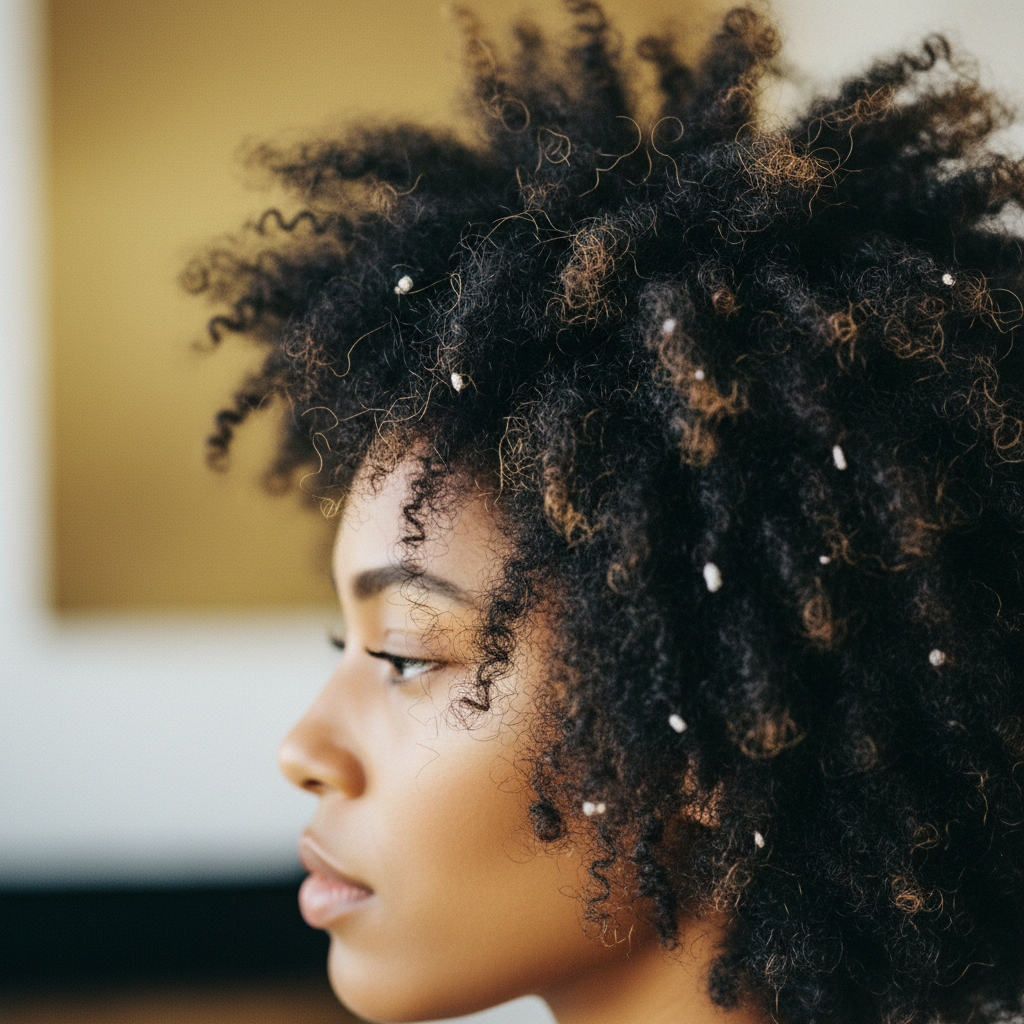
- Mid-shaft snapping: Small, hard fragments of hair falling without a white follicular bulb indicate breakage, not biological shedding.
- Single-strand knots: Tiny beads felt along the hair shaft are knots formed when loose, curly fibres loop around themselves.
- Loss of elasticity: When wet, a healthy hair fibre stretches gently and returns to its resting length. If it snaps immediately when extended, the cortex lacks moisture or internal structural integrity.
- Persistent dullness and rough texture: Raised, chipped cuticles scatter light rather than reflecting it, leading to a matte, straw-like feel.
Cleansing, conditioning, and moisture retention
Effective care relies on a consistent, low-trauma routine. Follow these evidence-backed steps:
1. Low-friction cleansing
Wash the hair every 7 to 10 days using a sulphate-free, low-pH shampoo (pH 4.5 to 5.5). Alkaline shampoos raise the cuticle scales, increasing surface friction and knotting. Focus cleansing on the scalp to remove sebum, sweat, and environmental debris, allowing the lather to run down the lengths without vigorous scrubbing.
2. Deep conditioning and slip
Conditioners containing cationic surfactants (such as behentrimonium methosulfate or cetrimonium chloride) neutralise the negative electrostatic charge of wet hair. This flattens the cuticle, softens the fibre, and provides the lubrication needed to detangle safely. Never detangle Afro hair dry; always use fingers or a wide-tooth comb while saturated with conditioner, working upward from ends to roots.
3. Layering moisture
Water or water-based leave-in conditioners hydrate the internal cortex. Because water evaporates quickly in dry environments, you must lock it in using heavier emollients and plant oils. Layering a liquid leave-in, a light cream, and a sealing oil (often called the LCO or LOC method) slows the rate of trans-epidermal and trans-filament water loss.
Afro hair regimens compared by objective
| Method | Primary mechanism | Best for | Potential risk |
|---|---|---|---|
| Wash-and-go | Regular hydration through frequent washing; minimal manipulation | Short to medium coils, high humidity | High tangling and knotting if not detangled regularly |
| Protective styling (twists, braids) | Tucking ends away to reduce daily friction and environmental wear | Length retention, busy lifestyles | Traction stress on follicles if installed too tightly |
| Low-manipulation wear (buns, clips) | Minimising mechanical contact without adding synthetic hair | Sensitive scalps, fine-density coils | Breakage at the band point if elastic is placed too tight |
| Heat-stretched styles (silk press, blowouts) | Temporarily realigns hydrogen bonds to flatten the coil | Easy detangling, temporary versatility | Heat damage and permanent loss of curl pattern if over 180°C |
Tension, styles, and traction alopecia
A central pillar of any Afro Hair Care Guide is protecting the follicle from mechanical tension. Braids, weaves, and cornrows preserve length by shielding the ends from friction, but they introduce a significant dermatological risk: traction alopecia.
Sustained pulling on the follicular unit triggers inflammation (perifolliculitis), which shows as small bumps, tenderness, or redness around the hairline. If tension continues over months or years, the stem cells in the hair bulge suffer irreversible damage, causing permanent scarring and follicle death.
To prevent traction damage:
- Ensure braids are loose enough that you can raise your eyebrows and sleep comfortably on day one.
- Avoid leaving extensions or weaves in place for longer than 6 to 8 weeks.
- Give the scalp a 2-week break between protective styles.
- Avoid attaching heavy synthetic hair bundles to thin, fragile natural hair sections.
When the cause is biological, not mechanical
Not all thinning is breakage. A full Afro Hair Care Guide must differentiate between fibre breakage and follicular shedding:
- Breakage: The hair fibre snaps along the shaft, leaving short, jagged pieces without a root bulb. This is a cosmetic, structural issue treatable through improved handling and conditioning.
- Telogen effluvium: Widespread, diffuse shedding across the scalp where shed hairs have a white bulb attached. This occurs when physiological stressors (such as illness, hormonal shifts, or severe nutritional deficits) shock follicles into premature resting phase.
- Central Centrifugal Cicatricial Alopecia (CCCA): A scarring alopecia common in women of African descent that starts at the vertex (crown) and spreads outward. It often manifests with burning, itching, or pain, leading to permanent follicular destruction.
If you notice spreading patches of smooth skin, scalp soreness, or loss of follicular openings, see a dermatologist immediately. Cosmetic treatments cannot resolve scarring alopecias.
Supportive care with Watermans and Frojus
When optimising your routine, targeted cosmetic formulations help support your scalp environment and maintain fibre suppleness. Watermans offers nutrient-rich, scalp-focused shampoos and leave-in elixirs packed with caffeine, rosemary, and biotin that invigorate the scalp surface and help fine, thinning edges look fuller. For the distinct structural needs of coils, Frojus delivers intensive plant-derived moisture, rich emollients, and detangling slip that coat delicate Afro-textured strands, reducing the friction that leads to mid-shaft snaps and single-strand knots.
Frequently asked questions about Afro Hair Care Guide
How often should you wash Afro-textured hair?
Wash Afro-textured hair every 7 to 10 days. Washing less frequently allows product buildup and sebum to accumulate on the scalp, which can trigger inflammatory conditions like seborrhoeic dermatitis. Washing daily is equally counterproductive, as excessive water exposure strips natural lipids and causes structural swelling, leaving fragile coils susceptible to mechanical wear and friction damage.
Does Afro hair grow slower than other hair types?
Afro hair grows at approximately 0.9 to 1.0 centimetre per month, compared to roughly 1.2 centimetres per month for Caucasian hair and 1.3 centimetres for Asian hair. However, tight curls shrink visually by up to 75 percent of their true length. Furthermore, frequent breakage along fragile nodal points often offsets follicle production, creating the illusion that growth has stalled.
Can this Afro Hair Care Guide help repair heat-damaged coils?
No guide or product can physically repair heat damage once it has occurred. Temperatures above 180°C permanently denature keratin proteins, melting the cortex and rupturing the outer cuticle. While protein treatments and deep conditioning masks can temporarily patch weak spots and improve slip, the only permanent remedy for thermally altered, straightened coils is trimming away the damaged lengths as new hair emerges.
Why does Afro hair dry out so quickly after moisturising?
Afro hair dries out rapidly because water evaporates quickly through porous, raised cuticles. Applying water alone hydrates the cortex for only a few hours. To maintain moisture, you must follow water-based products with emollient creams and plant oils. These ingredients create a hydrophobic film over the cuticle, substantially slowing evaporation and keeping the interior fibre soft and pliable.
Moving forward with your hair care routine
Adopting an evidence-based Afro Hair Care Guide requires shifting focus from quick cosmetic fixes to long-term structural preservation. By respecting the natural geometry of your coils, managing moisture levels, and removing chronic tension from your styling habits, you preserve the strength of your hair fibres and the health of your scalp. Consistency, patience, and gentle handling form the true foundation of strong, healthy, and resilient Afro hair.
Sources and references
- British Journal of Dermatology: "Morphology and properties of afro-textured hair fibres", 2011.
- International Journal of Cosmetic Science: "The structural and mechanical properties of human hair: an overview of ethnic differences", 2014.
- Journal of the American Academy of Dermatology: "Traction alopecia: the role of styling practices and hair tension", 2017.
- Clinical and Experimental Dermatology: "Central centrifugal cicatricial alopecia: clinical features and pathogenesis", 2019.
- World Health Organization / NHS Health A-Z: "Hair loss and scalp dermatoses overview", 2022.
Find these ingredients in Watermans products
- Biotin: you will find this ingredient in our Hair Growth Shampoo.