Water Softeners vs Shower Filters: What the Science Means for Your Hair
9 min read ·
A detailed comparison of Water Softeners vs Shower Filters, explaining the science of mineral hardness, chlorine removal, and how each device affects hair health.
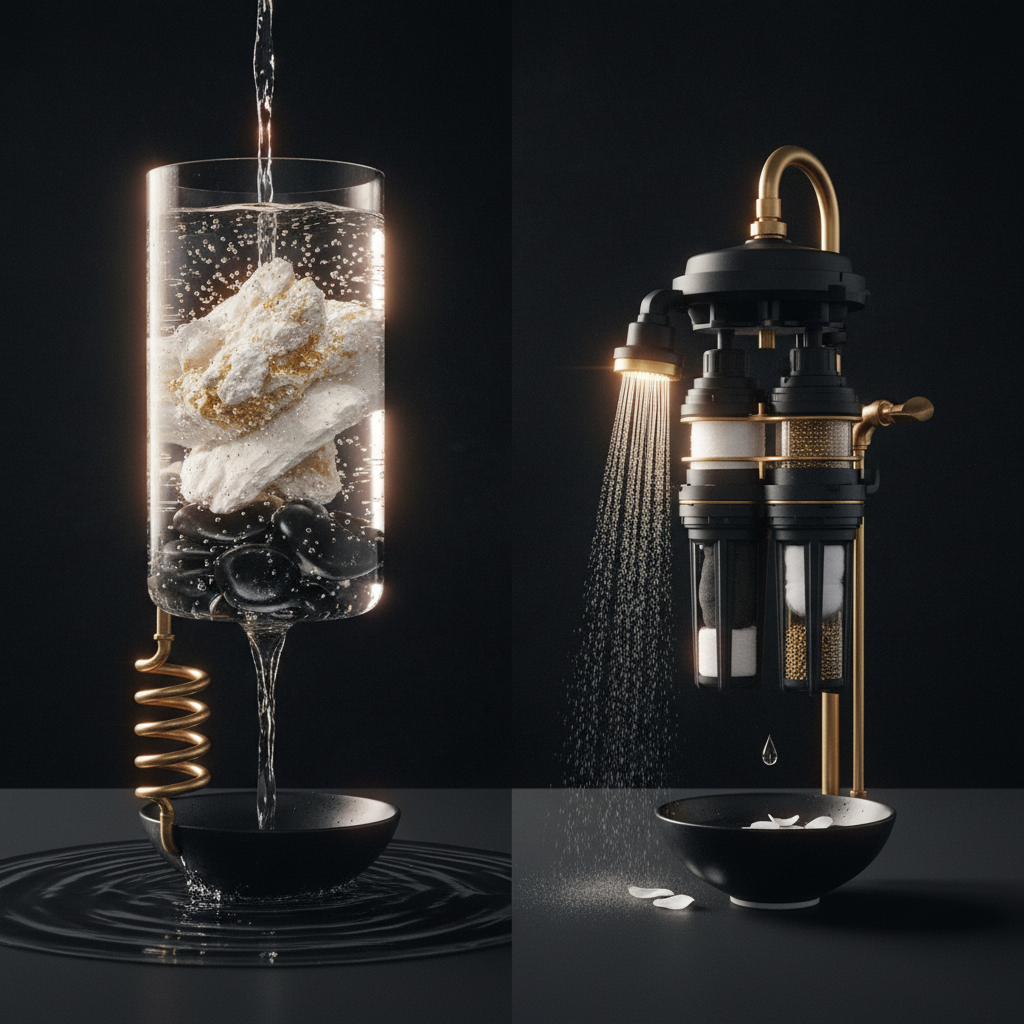
Quick answer: Comparing Water Softeners vs Shower Filters comes down to chemistry: water softeners physically extract dissolved calcium and magnesium minerals through ion-exchange resin, whereas standard shower filters primarily reduce chlorine and synthetic compounds using carbon or KDF media. A shower filter cannot soften hard water or stop mineral deposits on the hair fibre. While both devices help reduce cosmetic dullness and hair breakage, neither system treats medical hair loss conditions like androgenetic alopecia or telogen effluvium.
Key takeaways
- Water softeners use an ion-exchange process to remove calcium and magnesium ions, which are the sole cause of water hardness.
- Most screw-on shower filters use activated carbon or Kinetic Degradation Fluxion (KDF) to neutralise free chlorine, but they leave mineral hardness untouched.
- Hard water deposits calcium salts onto the hair shaft, increasing friction, dulling natural shine, and causing mechanical breakage during brushing.
- Chlorine oxidises the protective lipid layer of the cuticle (18-MEA), causing dryness, frizz, and colour fading.
- Neither device treats follicular hair loss; if you notice diffuse shedding across the scalp, consult a trichologist or GP.
Water Softeners vs Shower Filters: what the evidence shows
The debate over Water Softeners vs Shower Filters is often clouded by misleading product marketing. Many consumers install a compact shower filter expecting it to eliminate limescale, only to find their hair remains dry, stiff, and coated.
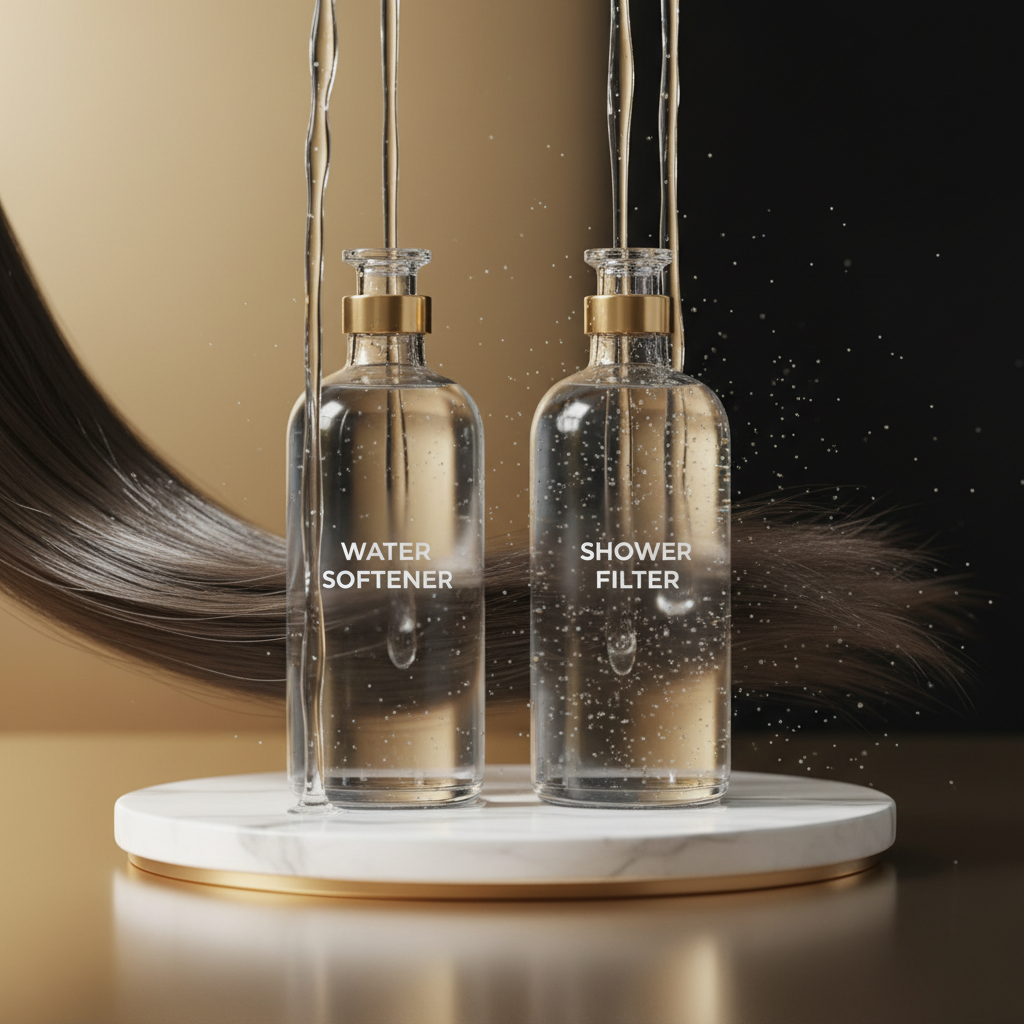
Scientific trials and water chemistry explain why: water hardness is defined strictly by the concentration of dissolved multivalent cations, primarily calcium ($Ca^{2+}$) and magnesium ($Mg^{2+}$). In the UK, water with more than 200 mg/L of calcium carbonate equivalent is classed as hard, and levels above 300 mg/L are considered very hard (Drinking Water Inspectorate).
A true water softener connects to the main plumbing line and runs water through an ion-exchange resin bed. This resin replaces calcium and magnesium ions with benign sodium or potassium ions. Laboratory evaluations published in the International Journal of Trichology and dermatological journals show that washing hair in softened water leaves significantly fewer mineral crystals bound to the cuticle. This reduces inter-fibre friction and cuts down on mechanical breakage.
In contrast, typical showerhead filters rely on granular activated carbon (GAC), calcium sulfite, or KDF-55 (copper-zinc alloy). These media are designed to reduce dissolved chlorine, heavy metals, and chloramines. KDF oxidises soluble chlorine into harmless chloride ions. However, KDF and carbon cannot alter dissolved calcium and magnesium levels at domestic shower flow rates (typically 6 to 12 litres per minute). Therefore, a shower filter does not create soft water.
| Feature | Ion-Exchange Water Softener | Shower Filter (KDF / Carbon) |
|---|---|---|
| Primary target | Calcium ($Ca^{2+}$) and magnesium ($Mg^{2+}$) | Free chlorine, chloramines, sediment |
| Operating mechanism | Polystyrene sulfonate resin ion-exchange | Redox reaction (KDF) / physical adsorption |
| Impact on water hardness | Drops mineral content to near 0 mg/L | No measurable change in mineral hardness |
| Effect on hair surface | Prevents mineral crusting, restores slip | Protects lipid cuticle layer from oxidation |
| Installation scope | Whole house, requires plumbing and salt top-ups | Screws onto existing shower arm in minutes |
| Typical equipment cost | £500 to £1,500+ (plus ongoing salt) | £25 to £80 (cartridges replaced every 3 to 6 months) |
The mechanisms: how water components damage hair fibres
Understanding the difference between these two devices requires looking at how hard water minerals and chlorine interact with the hair shaft.
Hard water and mineral encrustation
Hair fibres carry an overall negative electrical charge (anionic surface), especially at neutral or slightly alkaline water pH (around 6.5 to 8.0). Calcium and magnesium ions carry positive charges (cations). Because opposites attract, these mineral ions bind strongly to the hair surface and can even penetrate into the cortex of porous or chemically treated hair.
As the hair dries, these minerals crystallise. They form a rigid, microscopically rough layer over the cuticle scales. When individual hair strands rub together, this abrasive coating increases friction. The cuticle scales chip and lift, leading to tangles, lack of shine, and mid-shaft snapping. Research shows that while hard water does not reduce the tensile strength of the interior keratin core directly, it drastically lowers elasticity and increases surface roughness.
Free chlorine and lipid degradation
Chlorine is a powerful oxidising agent added to municipal water supplies to eliminate biological pathogens. When free chlorine contacts hair, it oxidises the delicate outermost layer of the hair fibre known as the f-layer (18-methyleicosanoic acid). This hydrophobic lipid coat is what makes healthy hair naturally water-repellent, soft, and shiny.
Repeated exposure to chlorinated hot water strips these protective lipids. This leaves the hair fibre porous, prone to moisture loss, and vulnerable to protein degradation. Furthermore, chlorine reacts with artificial dye molecules, causing salon colour to fade or shift brassy.
What the evidence does not show
There is no credible scientific evidence that either hard water or municipal chlorine causes permanent follicular hair loss (such as alopecia areata, androgenetic alopecia, or scarring alopecia).
Studies comparing populations living in hard water areas against soft water areas have found no direct correlation with male or female pattern baldness. Hard water creates mechanical fragility; it makes hair snap when combed or styled, mimicking the appearance of thinning hair. True hair loss originates below the skin surface in the follicle dermal papilla, which is unaffected by surface mineral deposits.
Similarly, shower filters are often marketed with unsubstantiated claims that they "cure" dandruff or "stop shedding instantly". While reducing chlorine can soothe an irritated, dry scalp barrier, it will not cure fungal conditions like seborrhoeic dermatitis.
Signs your hair is suffering from water quality
Observing how your hair and scalp behave can reveal whether mineral hardness, chlorine, or an entirely different factor is at play:
- Mineral deposits (hard water): Hair feels coated, stiff, or like straw even after deep conditioning. Shampoos fail to lather cleanly, requiring double the normal amount. Blonde or lightened hair turns dull, muddy, or ash-toned.
- Chlorine exposure: Scalp feels tight and itchy immediately after stepping out of the shower. Hair smells faintly of swimming pools when wet. Vibrant colour treatments wash out within two to three weeks.
- Mechanical breakage: You discover short, uneven hair pieces with blunt ends on your shoulders or bathroom counter, lacking the small white bulb that marks a naturally shed root.
Practical steps: what you can do
If you live in a hard water area with chlorinated supplies, a combined strategy delivers the best cosmetic results:
- Assess your local water supply: Check your water utility's annual water quality report to see your local hardness in mg/L or French degrees, alongside free chlorine levels.
- Choose your hardware based on your goal: If you own your home and have high mineral hardness, an ion-exchange water softener is the definitive fix for limescale. If you rent or want an affordable solution for dry scalp and fading colour, a KDF-55 shower filter will neutralise chlorine effectively.
- Incorporate chelating treatments: If installing a water softener is not possible, use a shampoo containing chelating agents like tetrasodium EDTA, disodium EDTA, or citric acid once a week. Chelating agents chemically bond with calcium and magnesium ions, lifting them off the hair fibre.
- Restore the acid mantle: Rinse with a mildly acidic solution (pH 4.5 to 5.5) or an apple cider vinegar rinse (one part vinegar to eight parts water) to encourage lifted cuticle scales to lie flat against the shaft.
When the cause may be something else
If you address your water quality but still notice significant shedding, the problem is likely internal rather than environmental.
Normal physiological shedding involves losing 50 to 100 hairs per day as follicles enter the telogen phase. If you notice hairs falling out from the root in large clumps, patches of bare skin, or widening parting lines, water quality is not the primary cause. Systemic triggers including ferritin (iron) deficiency, thyroid dysfunction, sudden hormonal shifts (postpartum or perimenopause), extreme psychological stress, or nutritional deficits frequently manifest as telogen effluvium.
When to seek professional advice
Schedule an appointment with a registered trichologist or a dermatologist if:
- Shedding exceeds 100 hairs daily for more than six to eight weeks.
- You observe circular, smooth bald patches on the scalp.
- Your scalp displays persistent redness, burning, thick scaling, or pustules.
- Your hair becomes brittle alongside systemic symptoms like unexplained weight change, chronic fatigue, or joint pain.
Supporting hair condition with Watermans
When managing the mechanical stress caused by harsh domestic water, high-performance topical haircare can reinforce fibre resilience. Watermans Grow Me Shampoo and Condition Me Conditioner are formulated without harsh drying sulphates, helping to cleanse the hair gently without stripping vital surface lipids. Enriched with hydrolysed lupin protein, biotin, rosemary extract, caffeine, and argan oil, the range strengthens the hair shaft against the daily breakage and friction that hard water mineral deposits leave behind.
Frequently asked questions about Water Softeners vs Shower Filters
Can a shower filter soften hard water?
No. Standard shower filters cannot soften hard water. True softening requires the physical removal of dissolved calcium and magnesium ions, which requires an ion-exchange resin bed with sufficient contact time. Shower filters use carbon or KDF media to neutralise free chlorine and capture large sediment, but the mineral hardness levels remain identical before and after filtration.
Which is better for colour-treated hair: a water softener or a shower filter?
Both offer distinct advantages, but a shower filter often provides immediate protection against rapid colour fading caused by chlorine oxidation. However, an ion-exchange water softener prevents calcium deposits from dulling light shades and making the hair brittle. For optimal colour longevity, neutralising both chlorine and mineral hardness is ideal.
What is the key difference in Water Softeners vs Shower Filters?
In the comparison of Water Softeners vs Shower Filters, the core difference lies in target compounds and plumbing. Water softeners use ion exchange across the entire property to eradicate calcium and magnesium, halting limescale entirely. Shower filters attach to a single fixture to remove chlorine, synthetic chemicals, and heavy metals, leaving mineral content untouched.
Will installing a water softener stop hair loss?
No. An ion-exchange water softener will not cure or halt follicular hair loss, such as androgenetic alopecia or telogen effluvium. It does, however, stop mineral build-up on the hair shaft, which noticeably reduces mechanical snapping and breakage during styling. This helps your hair maintain its natural thickness and density along the lengths.
A balanced approach to water quality and hair health
Making the right choice between Water Softeners vs Shower Filters begins with understanding the physical properties of your water. If limescale and mineral stiffness are damaging your hair cuticle, only an ion-exchange system or targeted chelating shampoos will solve the problem. If chlorine irritation, dry scalp, and rapid dye fading are your main concerns, an affordable KDF shower filter is a practical, effective choice. Combining smart water management with gentle, protein-rich haircare protects the cuticle layer and keeps your hair feeling resilient and healthy.
Sources and references
- Drinking Water Inspectorate (DWI). "Water Hardness in England and Wales." dwi.gov.uk.
- Evans, T., et al. "The effect of water hardness on the physical properties of human hair." International Journal of Cosmetic Science, 2018.
- Srinivasan, G., et al. "Evaluation of the effect of hard water on hair tensile strength." International Journal of Trichology, 2013.
- National Institute for Health and Care Excellence (NICE). "Alopecia areata: Management." nice.org.uk.
- British Association of Dermatologists. "Telogen Effluvium: Patient Information Leaflet." bad.org.uk.