Understanding Malassezia Yeast: Causes, Symptoms, and Balance
8 min read ·
Understanding Malassezia Yeast reveals the biology behind common scalp flaking, the role of sebum, and how to restore healthy microbiome balance.

Quick answer: Understanding Malassezia Yeast starts with recognising that this microscopic fungus is a normal resident of human skin, not an alien invader. It feeds on natural scalp sebum, breaking it down into free fatty acids. In susceptible individuals, these byproduct fatty acids trigger inflammation, rapid skin cell turnover, flaking, and itching. The main limitation is that you cannot, and should not try to, permanently eradicate Malassezia; effective management focuses on keeping fungal populations balanced and soothing the scalp barrier.
Key takeaways
- Malassezia (formerly known as Pityrosporum) is a lipophilic (fat-loving) fungal genus living naturally on the scalp of over 90 percent of adults.
- It does not cause problems simply by existing; flare-ups occur when sebum overproduction, compromised skin immunity, or barrier breakdown allow specific species (Malassezia restricta and Malassezia globosa) to irritate the tissue.
- The yeast digests triglycerides in sebum and releases oleic acid, which penetrates the stratum corneum and triggers inflammatory flaking in sensitive scalps.
- Conditions linked to Malassezia proliferation include pityriasis capitis (common dandruff) and seborrhoeic dermatitis.
- Over-cleansing or aggressive scrubbing strips the scalp barrier, often triggering compensatory oil production that feeds the yeast further.
Understanding Malassezia Yeast: what the evidence shows
Understanding Malassezia Yeast requires an appreciation of the human cutaneous microbiome. Far from being an infectious agent caught from poor hygiene or shared brushes, Malassezia species colonise human skin shortly after birth. They thrive in areas rich in sebaceous glands, making the scalp, face, upper chest, and back their primary habitats.
Clinical research published in the Journal of Investigative Dermatology and reviews from the British Association of Dermatologists confirm that Malassezia globosa and Malassezia restricta dominate the scalp microflora. Because these organisms lack genes to synthesise their own fatty acids, they rely entirely on external lipids. They produce extracellular enzymes called lipases, which hydrolyse human sebum triglycerides into free fatty acids and glycerol.
Glycerol is consumed by the yeast as food. The residual unsaturated fatty acids, particularly oleic acid, remain on the skin surface. For individuals whose epidermal barrier is permeable or genetically reactive to these metabolites, oleic acid induces irritation, hyperproliferation of keratinocytes, and atypical corneocyte clumping. This manifests visually as visible white or yellowish flakes.
What the evidence does not show
There is no scientific evidence showing that Malassezia can or should be completely sterilised from the skin. Eradication is biologically unfeasible and disrupts the wider microbiome, which protects against pathogenic bacteria like Staphylococcus aureus.
Furthermore, the evidence does not show that Malassezia directly attacks hair follicles to cause permanent hair loss (follicular miniaturisation or scarring alopecia). While severe, neglected seborrhoeic dermatitis can provoke intense itching, vigorous scratching damages hair fibres and leads to mechanical breakage or temporary shedding (telogen effluvium) through localized inflammation. It does not destroy the follicle itself.
Finally, having high populations of Malassezia does not guarantee dandruff. Research demonstrates that individuals with identical fungal loads can display completely clear scalps or severe flaking, proving that host barrier integrity and individual immunological susceptibility are the true determining factors.
The biological mechanism: how flakes form
The cycle of irritation follows a distinct biological sequence:
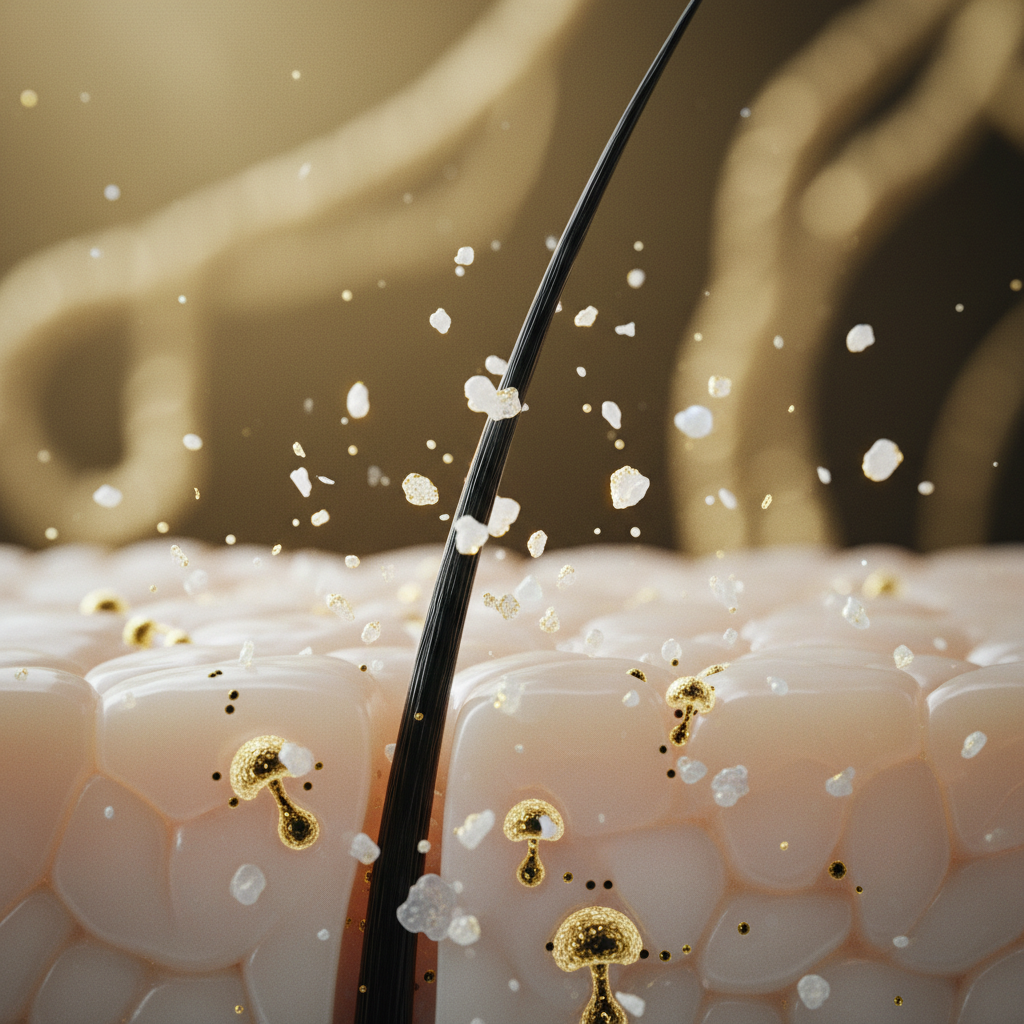
- Lipid secretion: Sebaceous glands produce sebum containing squalene, wax esters, and triglycerides.
- Enzymatic cleavage: Malassezia secretes lipase enzymes to cleave triglycerides for nutritional lipids.
- Oleic acid release: Unsaturated fatty acids are discarded onto the scalp surface.
- Barrier penetration: In susceptible skins, these irritants penetrate the stratum corneum.
- Inflammatory cascade: The immune system responds with mild erythema and accelerating epidermal cell renewal from the typical 28-day cycle down to 7 to 10 days.
- Incomplete keratinisation: Rapidly dividing skin cells fail to mature properly, sticking together with retained nuclei to form visible flakes.
| Feature | Dry Scalp (Dehydration) | Dandruff (Malassezia driven) | Seborrhoeic Dermatitis |
|---|---|---|---|
| Primary Cause | Lack of moisture, harsh weather | Malassezia response to sebum | Inflammatory reaction to Malassezia |
| Flake Appearance | Small, dry, translucent, white | Looser, grey-white or off-white | Thick, yellowish, greasy scales |
| Scalp Redness | Absent to minimal | Very mild, localized | Evident erythema, irritated patches |
| Sebum Levels | Low (under-active glands) | Normal to moderately high | High (oiliness common) |
| Primary Target | Moisture barrier repair | Regulating yeast and sebum | Antifungal agents and anti-inflammatories |
Visible signs of an imbalance
When Malassezia proliferation causes cutaneous distress, several characteristic signs appear on the scalp:
- Persistent itchiness (pruritus): A crawling or irritated sensation, often worsening when sweating.
- Clumping flakes: Flakes that cling to hair shafts or scatter across shoulders, ranging from dry white powder to greasy yellowish scales.
- Scalp erythema: Pink or red patches beneath the hair, particularly along the hairline, crown, and behind the ears.
- Tightness accompanied by oiliness: The scalp feels uncomfortable, yet greasy residue transfers to fingertips shortly after washing.
Practical steps for managing the scalp environment
Managing Malassezia involves modulating oil levels, lowering fungal counts, and strengthening the epidermal barrier.
1. Wash with consistent frequency
Infrequent washing allows sebum to pool, creating an unlimited buffet for yeast. Aim to wash oily or flake-prone scalps daily or every other day using lukewarm water. High temperatures strip moisture and inflame tissue.
2. Rotate targeted wash days
Introduce shampoos containing active ingredients that directly address fungal proliferation or regulate cell shedding:
- Ketoconazole (1% to 2%): Directly inhibits fungal cell membrane synthesis.
- Zinc Pyrithione and Piroctone Olamine: Reduce yeast colonies while calming irritation.
- Salicylic Acid: Softens and lifts adherent scales so active ingredients can reach the scalp.
Leave medicated formulas on the scalp for 3 to 5 minutes before rinsing to give active agents sufficient contact time.
3. Avoid feeding the yeast with heavy oils
Do not apply plant oils rich in triglycerides (such as olive, coconut, or argan oil) directly to a flake-prone scalp. Malassezia feeds directly on these lipids, often transforming mild flaking into severe inflammation. Keep hair-conditioning oils restricted to mid-lengths and ends.
Watermans: supporting a balanced scalp environment
Maintaining a balanced, clean scalp environment is essential when navigating flaking and sensitivity. Watermans approaches scalp care from a cosmetic perspective, creating an optimal foundation for healthy-looking hair.
Using gentle, balancing cleansers helps remove excessive sebum build-up, sweat, and environmental residues without stripping the natural barrier. When the scalp remains fresh, clear, and moisturised, hair fibres experience less traction from scratching, reducing unnecessary breakage and supporting fuller-feeling, stronger-looking growth.
When the cause is something else
Not all flaking stems from yeast. Contact dermatitis (reactions to fragrance, preservatives, or hair dyes) presents with intense redness, burning, and peeling. Scalp psoriasis presents with well-demarcated, silvery-white plaques and minimal fungal involvement. Atopic dermatitis features generalized extreme dryness and an impaired moisture barrier across the entire body. Using antifungal regimens on psoriasis or contact dermatitis can exacerbate irritation.
When to seek professional advice
Consult a GP, dermatologist, or qualified trichologist if:
- Flaking and redness fail to improve after 4 weeks of targeted over-the-counter care.
- The scalp oozes, bleeds, cracks, or forms thick crusts.
- Swelling or signs of secondary bacterial infection appear.
- Scalp irritation is accompanied by widespread, diffuse hair shedding or circular patches of hair loss.
Frequently asked questions about Understanding Malassezia Yeast
Is Malassezia yeast contagious?
No. Malassezia is not contagious. Because it already resides naturally on the skin of virtually all healthy adults, you cannot catch it from sharing hats, towels, combs, or pillows. Problems arise from individual susceptibility and oil production, not exposure.
Can diet affect Malassezia yeast levels?
Direct evidence linking specific foods to Malassezia numbers is limited. However, diets high in refined carbohydrates and saturated fats may influence systemic inflammation and alter sebum composition in some individuals, indirectly creating conditions where yeast flourishes.
Does understanding Malassezia yeast mean stopping all hair oils?
Understanding Malassezia Yeast highlights that this fungus consumes specific fatty acids. Applying heavy plant oils directly to your scalp provides an abundant food supply for the yeast. While oils are fine on hair lengths, keep them away from an active, flake-prone scalp.
Will Malassezia cause permanent baldness?
No. Malassezia does not infect or destroy the hair follicle. Hair loss associated with yeast overgrowth is typically mechanical breakage caused by scratching, or temporary telogen effluvium driven by localized scalp inflammation. Once the inflammation resolves, regular shedding patterns return.
Summary
Understanding Malassezia Yeast allows you to approach stubborn scalp flaking with biological clarity rather than frustration. By shifting the goal from total eradication to microfloral balance, you protect the scalp barrier, regulate excess sebum, and prevent the inflammatory cycle that leads to chronic flaking and irritation.
Sources and references
- British Association of Dermatologists. (2020). Seborrhoeic Dermatitis Patient Information Leaflet. Bad.org.uk.
- Dawson, T. L. (2007). Malassezia globosa and restricta: Breakthrough Understanding of the Etiology and Treatment of Dandruff and Seborrheic Dermatitis through Whole-Genome Analysis. Journal of Investigative Dermatology Symposium Proceedings, 12(2), 15-19.
- Gaitanis, G., et al. (2012). The Malassezia genus in skin and systemic diseases. Clinical Microbiology Reviews, 25(1), 106-141.
- Ro, B. I., & Dawson, T. L. (2005). The role of sebaceous metabolism in the pathogenesis of dandruff and seborrheic dermatitis. Journal of Clinical and Investigative Dermatology, 10(3), 194-197.
- Saunders, C. W., et al. (2012). Malassezia fungi are eukaryotic microbes that inhabit the skin of humans and other animals. PLoS Pathogens, 8(6), e1002701.
Find these ingredients in Watermans products
- Argan Oil: you will find this ingredient in our Hair Growth Shampoo.
- Zinc: you will find this ingredient in our Hair Vitamins.
- Oleic Acid: you will find this ingredient in our Camellia & Black Castor Hair & Body Oil.