Understanding Hair Scalp pH: The Science of Fibre and Skin Balance
9 min read ·
Explore the science behind understanding hair scalp pH, how acidic barriers protect the follicle, and practical steps to reduce friction and breakage.
Quick answer: Understanding hair scalp pH is essential for maintaining both skin barrier health and hair fibre integrity. The human scalp naturally sits at an acidic pH between 4.5 and 5.5, while the hair shaft itself rests around 3.67. This acidity supports the acid mantle, keeps the cuticle flat, and prevents microbial overgrowth. However, while balanced pH optimises condition and reduces friction breakage, topical pH adjustments cannot alter your genetics or cure medical conditions such as androgenetic alopecia.
Key takeaways
- The healthy human scalp maintains an acidic surface pH between 4.5 and 5.5, protected by the acid mantle.
- The hair fibre has an even lower natural isoelectric point, typically around pH 3.67.
- Alkaline products (pH above 7.0) swell the hair shaft, lift cuticles, and increase friction, tangling, and breakage.
- Elevated scalp pH alters the cutaneous microbiome, often encouraging the proliferation of Malassezia yeasts linked to dandruff and seborrhoeic dermatitis.
- Managing pH is a cosmetic and preventative measure. It supports fibre strength and scalp comfort, but does not reverse hormonal hair loss.
Understanding hair scalp pH: what the evidence shows
Understanding hair scalp pH begins with looking at human skin biology. The scalp, like the rest of the skin, is covered by a thin biological film called the acid mantle. This mantle is composed of sebum, sweat, and breakdown products from cellular turnover, creating an environment that naturally sits between pH 4.5 and 5.5.
Peer-reviewed dermatological studies confirm that this mild acidity performs two vital jobs. First, it regulates the scalp microbiome. Beneficial bacteria flourish in slightly acidic conditions, whereas opportunistic pathogens struggle to survive. Second, it maintains enzymatic reactions responsible for lipid synthesis and barrier repair in the stratum corneum.
The hair fibre itself tells a slightly different chemical story. Because hair consists predominantly of keratinised protein without living cells, its surface charge depends directly on the surrounding pH. The isoelectric point of keratin (the pH at which the positive and negative charges balance out) is roughly 3.67. When the surrounding liquid matches or approaches this acidic zone, hair cuticles remain compact, smooth, and resistant to mechanical wear.
What happens when scalp and hair pH shifts?
When the pH of the hair and scalp rises above its physiological baseline, both the skin barrier and the hair structure suffer measurable damage. Most tap water has a neutral to slightly alkaline pH ranging from 6.5 to 8.5, and traditional soaps or poorly formulated shampoos can reach a pH of 8.0 or higher.
Acidic (3.5 - 5.5) Neutral (7.0) Alkaline (8.0 - 12.0)
|-------------------------|-------------------|----------------------|
Healthy scalp & cuticle Tap water baseline Cuticle swelling & lifted
Acid mantle intact Barrier disruption
The mechanical effect on the hair fibre
At a pH higher than 5.5, the negative electrical charge on the surface of the hair shaft increases. This surge in static charge causes cuticles to flare outwards and separate from the cortex. Lifted cuticles produce visible friction:
- Strands snag against each other, leading to severe tangling.
- The porous cortex loses moisture rapidly, causing dry, brittle texture.
- Combing force increases by up to 50 percent, directly accelerating hair breakage along the shaft.
Importantly, this fibre breakage is distinct from follicular hair shedding. A lifted cuticle causes the hair fibre to snap under routine styling tension, but it does not cause the follicle to release the hair root prematurely.
The biological effect on the scalp barrier
On the scalp, an elevated pH disrupts the tight junctions of the stratum corneum. Alkaline exposure strips away essential ceramides and free fatty acids, triggering trans-epidermal water loss (TEWL). As the scalp dries out, the immune system reacts with low-grade inflammation, manifesting as itching, tightness, and redness.
Furthermore, an alkaline shift alters the scalp flora. Malassezia restricta and Malassezia globosa, the lipophilic yeasts associated with dandruff, thrive when the acid mantle is compromised. Research published in the International Journal of Trichology found that over 60 percent of commercial shampoos tested had an alkaline pH greater than 5.5, which can actively aggravate scalp sensitivity and flaking.
Comparing pH levels across hair environments
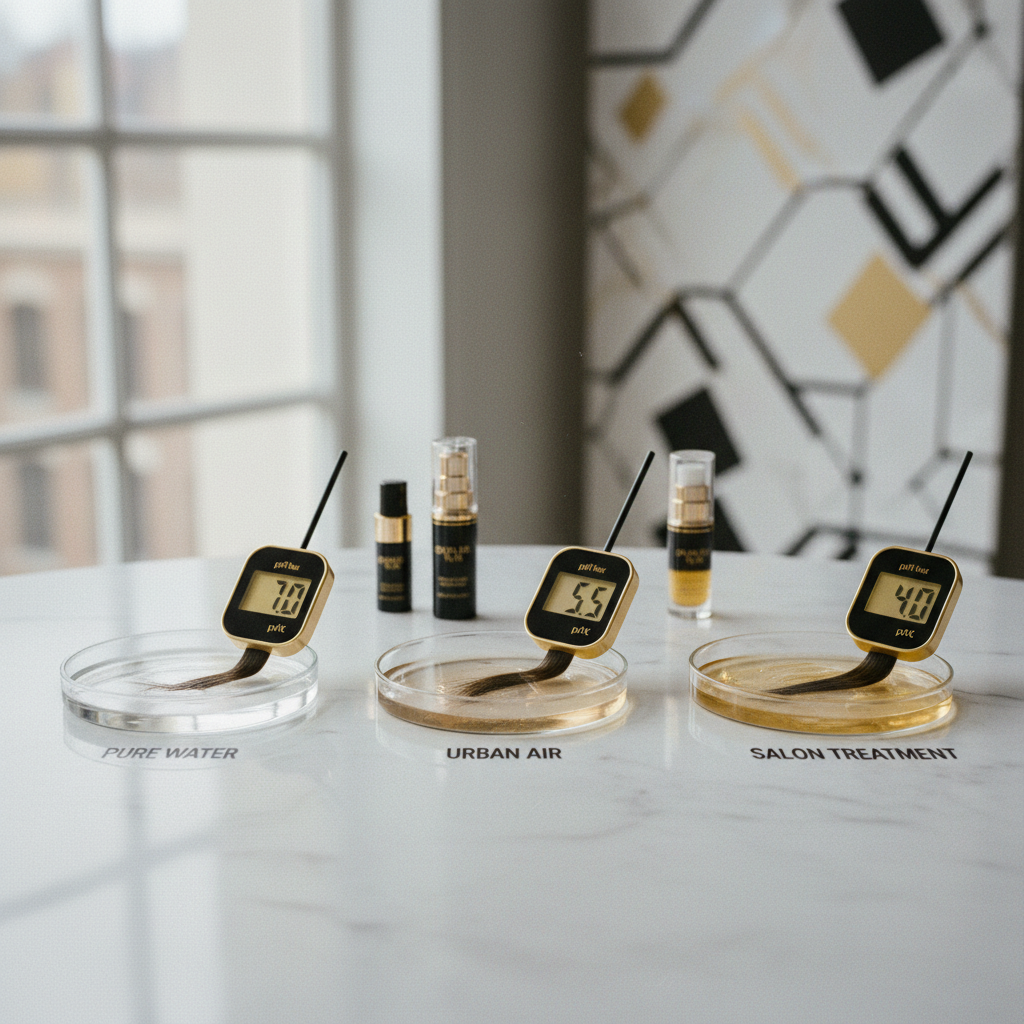
To visualise how common substances affect the hair and scalp, consider their typical pH measurements and biological effects:
| Substance / Environment | Typical pH Range | Impact on Scalp | Impact on Hair Fibre |
|---|---|---|---|
| Scalp acid mantle | 4.5 to 5.5 | Optimum barrier, controlled microbiome | Normal baseline |
| Hair fibre isoelectric zone | 3.5 to 4.0 | Slightly acidic, well-tolerated | Flat cuticles, minimum friction |
| Tap water | 6.5 to 8.5 | Minor temporary neutralisation | Mild cuticle lifting |
| Balancing shampoo | 5.0 to 5.5 | Preserves acid mantle | Smooth, sealed cuticle |
| Traditional bar soap | 9.0 to 10.0 | Strips lipids, increases irritation | Heavy cuticle swelling, dullness |
| Bleach / permanent colour | 9.0 to 11.5 | Potential chemical burns, dryness | Severe cortex swelling, cuticle erosion |
What the evidence does not show
While understanding hair scalp pH is critical for daily hair care, it is equally important to recognise its scientific limits.
Topical pH does not dictate genetic or hormonal hair loss. Conditions such as androgenetic alopecia (pattern baldness) are driven by dihydrotestosterone (DHT) binding to genetically sensitive androgen receptors in the hair follicle. Using an acidic shampoo will not change your androgen receptor genetics, nor will it stop autoimmune conditions like alopecia areata.
Similarly, an acidic product cannot permanently repair a split end. Once the hair fibre suffers structural protein loss or mechanical splitting, it cannot biologically heal. Mildly acidic products can temporarily smooth the cuticle layer and make the hair shaft feel softer, but they do not rebuild broken covalent disulphide bonds on their own.
Signs your scalp and hair pH is unbalanced
You can often identify a disrupted pH balance through distinct sensory and physical symptoms:
- Scalp tightness and persistent itching: Occurs when an elevated pH strips the protective lipid barrier, leading to immediate moisture evaporation.
- Frizz and dull appearance: Raised cuticles scatter light rather than reflecting it, leaving hair looking lacklustre.
- Excessive tangles and breakage: High friction between lifted cuticles leads to stubborn knots and snapping during gentle brushing.
- Sudden flaking or greasiness: The scalp often overproduces sebum in an attempt to compensate for barrier drying caused by alkaline washes, while yeast overgrowth triggers visible flakes.
Practical steps to maintain an optimal pH
Balancing your scalp and hair pH does not require complex chemistry equipment. Simple adjustments to your routine can protect your acid mantle effectively:
- Check product formulations: Choose cleansers and treatments formulated close to the physiological pH of skin, ideally between 4.5 and 5.5.
- Rinse thoroughly: Leaving surfactant residue on the scalp prolongs alkaline stress. Rinse with lukewarm water rather than scalding hot water, which strips natural lipids.
- Condition consistently: Quality conditioners are intentionally formulated at lower pH ranges (often 3.5 to 4.5) to neutralise the slight alkalinity of water, contract the cuticle scales, and restore slip.
- Be cautious with DIY rinses: While diluted apple cider vinegar is a popular home remedy, pure vinegar has an aggressive pH of around 2.0 to 3.0. Applying it undiluted can cause chemical irritation and scalp dermatitis. If used, it must be significantly diluted in water.
Supporting the scalp ecosystem
Understanding hair scalp pH highlights the value of using products that work in harmony with the skin rather than stripping it bare.
Watermans designs haircare products with the natural biological balance of the scalp in mind. Formulated to respect the scalp's delicate barrier while revitalising thinning and lacklustre hair, Watermans Grow Me Shampoo and Condition Me Conditioner deliver targeted botanicals, vitamins, and caffeine in a balanced formula. By maintaining a supportive scalp environment, these formulations ensure hair feels thicker, stronger, and more resilient against daily mechanical breakage.
When the cause may be something else
If you have switched to pH-balanced formulations and your scalp remains irritated, the underlying cause is likely not pH-related.
Conditions such as scalp psoriasis, contact dermatitis (an allergy to a preservative or fragrance), or fungal infections like tinea capitis require distinct dermatological interventions. Furthermore, sudden diffuse hair shedding (telogen effluvium) is typically triggered by systemic factors, such as nutritional deficiencies (ferritin, zinc, vitamin D), severe psychological stress, thyroid imbalances, or postpartum hormonal shifts.
When to seek professional advice
Consult a GP, dermatologist, or registered trichologist if you notice:
- Sudden, patchy, or excessive hair shedding exceeding normal baseline shedding (roughly 50 to 100 hairs daily).
- Severe scalp inflammation, pain, weeping sores, or crusting.
- Flaking that fails to respond to standard clarifying or anti-dandruff care.
- Visible widening of your hair parting or thinning across the crown.
Frequently asked questions about Understanding Hair Scalp pH
What is the ideal pH for shampoo?
The ideal pH for a daily shampoo sits between 5.0 and 5.5. This range matches the natural acid mantle of the scalp. It cleanses excess oil and debris without causing the hair cuticles to swell or compromising the skin barrier.
Can water pH damage my hair?
Yes, water with an alkaline pH (above 8.0) or high mineral content can raise cuticle scales and leave mineral deposits on the hair shaft. This makes strands feel rough, increases styling friction, and can leave hair prone to mechanical breakage over time.
Does understanding hair scalp pH help prevent hair loss?
Understanding hair scalp pH helps prevent hair breakage and chronic scalp inflammation, but it does not prevent follicular hair loss caused by genetics or hormones. Maintaining an acidic pH keeps the fibre strong and the barrier comfortable, creating optimal conditions for healthy-looking hair.
How does hair dye affect the scalp's pH balance?
Permanent hair dyes and lighteners require an alkaline pH (usually between 9.0 and 11.0) to open the cuticle and penetrate the cortex. This temporarily strips the acid mantle and can leave both hair and scalp vulnerable to irritation until an acidic post-colour treatment is applied.
Can I test my haircare products at home?
You can test liquid products at home using calibrated pH test strips or a digital pH meter. Wet the strip with the shampoo or conditioner, wait the designated time, and compare the colour against the reference chart to verify its acidity.
Healthy foundations for hair care
Understanding hair scalp pH gives you the scientific foundation needed to make informed choices about your hair routine. Your hair and scalp function at their best in a mildly acidic environment. Maintaining that balance preserves the skin's natural defences, keeps the hair cuticle smooth, and minimises unnecessary breakage. By matching your daily products to your body's natural chemistry, you protect your hair from the roots outward.
Sources and references
- Gavazzoni Dias, M. F., et al. (2014). 'The Shampoo pH Can Affect the Hair: Myth or Reality?' International Journal of Trichology, 6(3), pp. 95 to 99.
- Ali, S. M., and Yosipovitch, G. (2013). 'Skin pH: From Basic Science to Basic Skin Care.' Acta Dermato-Venereologica, 93(3), pp. 261 to 267.
- Proksch, E. (2018). 'pH in nature, humans and skin.' The Journal of Dermatology, 45(9), pp. 1044 to 1052.
- Robbins, C. R. (2012). Chemical and Physical Behavior of Human Hair. 5th edn. Berlin: Springer-Verlag.
Find these ingredients in Watermans products
- Zinc: you will find this ingredient in our Hair Vitamins.